Japan in the Post–3/11 Era: The Road to Rebirth
Earthquakes and the Economy
Politics Society- English
- 日本語
- 简体字
- 繁體字
- Français
- Español
- العربية
- Русский

The Buddhist temple Murōji in the mountains of Nara Prefecture, known for its beautiful five-storied pagoda. The structure was damaged in 1998 by a typhoon, but repaired in 2000.
Let me begin this article by introducing a wonderful place in Japan. Adherents of the esoteric Buddhism (mikkyō) that arose in Japan some 1,200 years ago, during the Heian period (794–1185), went to the mountains in their quest for the divine. The temples they built are to be found deep in the hills, far removed from human habitation. So visiting these temples means heading to the hills, just as is the case with the Romanesque churches of Europe.
The most beautiful of the esoteric Buddhist temples is Murōji, located in the Uda Mountains at a considerable distance to the south of Nara. After walking for about two hours from the nearest train station through the forested hills, suddenly the prospect opens up, and the temple comes into view, its grounds covering an entire mountain. The sight is so splendid that it makes one think the temple was built here deep in the mountains in order to impress visitors with its appearance. The temple houses a statue of the Buddha that was designated as a National Treasure in 1951. Statues of the Buddha made during the Nara period (710–94) were put together using multiple layers of lacquer, but this one was carved from a single piece of wood. It is a first-rate work of art in terms of elegance, size, and majesty; the carving clearly reveals the grain of the wood, and the statue as a whole, with its low center of gravity, evokes a feeling of substance and dignity.
The Great Jōgan Tsunami
As I started to write about the March 11 Great East Japan Earthquake, my thoughts turned to the statue of the Buddha at Murōji. I happened to remember that the period when it was made was the Jōgan era (859–77). After the March 11 earthquake, which struck off the eastern coast of northern Honshū, the newspapers contained many references to this era, because it was when a quake of similar scale, at least 8.3 in magnitude, struck the same area of the Pacific Ocean and similarly caused a huge tsunami. This fact came to light in 1990. The Asahi Shimbun carried an interesting story on the background to this discovery and its subsequent impact in its evening edition on June 22:
The Onagawa Nuclear Power Station just escaped being directly hit by the March 11 tsunami by 80 centimeters.“The fields and roads all turned into a blue sea... a thousand people drowned.” So it is written in the Nihon sandai jitsuroku [Veritable Record of Three Generations of Emperors of Japan] concerning the Jōgan tsunami of 869, which has come into the limelight in connection with the recent tsunami. The physical traces of this earlier disaster were first confirmed in a geological survey in 1990, which revealed that the Sendai Plain was inundated to a distance of three to four kilometers inland, confirming that the record in the above document seems to be basically factual. The findings were published in a paper by a team at the construction office of the Onagawa Nuclear Power Station operated by Tōhoku Electric Power Co. in Onagawa, Miyagi Prefecture. According to one member of the team, Chigama Akira, deputy head of the planning department, this was part of the surveying conducted to apply for a permit to install a second unit at the Onagawa plant.
On the basis of a survey of historical documents conducted in 1970, when Tōhoku Electric applied for permission to put up the first unit, it was assumed that the [maximum] height of a tsunami would be 3 meters. After that, according to Chigama, because there were advances in the techniques for surveying old earthquakes, they conducted [further] surveys and research, including excavation to search for traces of the Jōgan tsunami. As a result, the tsunami height assumption was increased to 9.1 meters. From the time of the construction of the first unit, though the assumed height was 3 meters, the plant was put at an elevation of 14.8 meters on the basis of a “comprehensive judgment,” which proved its worth this year. The land on which the Onagawa plant stands subsided by 1 meter as a result of the March 11 earthquake, and the tsunami that struck there was 13 meters high. The plant avoided being directly hit by a margin of 80 centimeters.

The series of accidents that occurred at the Fukushima Daiichi Nuclear Power Plant operated by Tokyo Electric Power Co. (TEPCO) following the great tsunami has developed into a disaster on a level comparable to the Chernobyl accident, the worst nuclear plant disaster in history. The above article indicates what was missing from TEPCO’s safety planning. It might have been possible to avoid this disaster if, like Tōhoku Electric, TEPCO had taken the trouble to conduct careful archeological studies, assumed a worst-case scenario for earthquakes and tsunamis, and prepared for such a scenario.
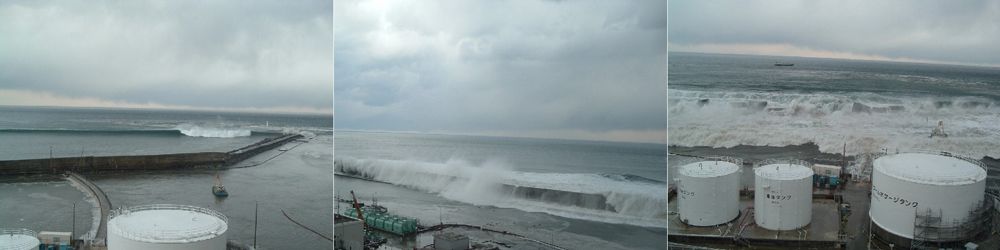
Shots of the higher than expected tsunami sweeping over the wall protecting the Fukushima Daiichi Nuclear Power Station on March 11. (Photo: TEPCO)
Problematic Assumptions
In the wake of the March 11 disaster, the term sōtei-gai, meaning “unforeseen” or “beyond what was assumed possible,” has come into frequent use. People in positions of responsibility have repeatedly used it in order to avoid blame for what happened. But the real problem lies in the nature of the assumptions used. According to a 2007 government report, Japan, which covers a mere 0.25% of the world’s total area, experienced 21% of the earthquakes of magnitude 6 or above during the previous 10 years. Everybody knows that earthquakes may happen. The problem is their scale. To forecast how big an earthquake might strike, it was necessary to look back in time by examining the historical evidence, as the people at Tōhoku Electric did.
How far back should one go? Let us consider an example. Some 640,000 years ago, a volcano located in what is now Yellowstone National Park in the United States erupted, spewing a volume of smoke said to be 1,000 times greater than that from the 1980 eruption of Mount St. Helens, the largest volcanic eruption of recent years. Geologists believe that a similar eruption could occur even now, spewing debris and ash to a height of 1 meter across half of North America. In the case of economic forecasts, data from 100 years ago is not much use, because the structure of the economy changes rapidly with time. But when forecasting natural phenomena, data not just from 100 years ago but even from 1 million years ago can be of great value.
The Jōgan era was a time of numerous calamities in Japan. In addition to the earthquake and tsunami, plague struck, and Mount Fuji erupted. It was during this era that the culture of esoteric Buddhism flowered and the sublimely beautiful statue of the Buddha at Murōji was created. The Japanese are an interesting people.
The Terrible Toll of the Tokyo Earthquake
“The catastrophe occurred a few seconds after noon. It was impossible to mistake the time because, during those first few horrific seconds of shaking, while we were still unsure when the ever-growing convulsion would cease, the shot of the midday cannon added its official burst of sound to the tumult, no more deterred by the unruly elements than it would have been by the trumpet of the Last Judgment.” (*1)

Scene of the Ginza shopping district after the Great Kantō Earthquake. The damage from the magnitude 7.9 quake was centered on Kanagawa Prefecture and spanned from Ibaraki to Shizuoka Prefectures, resulting the worst natural disaster in Japanese history, with a total of 105,000 dead or missing. (Photo: Jiji Press)
Thus wrote Paul Claudel, the great French dramatist and diplomat, about the earthquake that struck Tokyo on September 1, 1923, while he was serving as France’s ambassador to Japan. Over 100,000 people died in this Great Kantō Earthquake, some 90% of them from the fires that it caused. This is five times the death toll of around 20,000 from this year’s Great East Japan Earthquake; the large number of deaths is attributable to the fact that the quake struck the heavily populated Tokyo-Yokohama area and that the residential neighborhoods of the time were made up of densely packed wooden houses, magnifying the toll from fires. The foreign quarter that was located in Yokohama at the time suffered especially severe fire damage. Claudel headed there to provide assistance, and he wrote this account of what he saw that night:
“We spent that night on a railroad embankment among some refugees, with this doomsday panorama [of Yokohama] on one side and the huge red cloud of smoke from the fire in Tokyo on the other. Between the two, a moon of indescribable purity and serenity rose from the sea. The earth below us would not stop trembling, and almost every hour we would hear the nearby racket of train cars shaking and trying to jump their rails.” (*2)
In addition to the terrible human toll that it took, the Great Kantō Earthquake caused another major problem. The major banks had branches and head offices in Tokyo, and Yokohama was the location of the bank that at the time was in charge of all foreign exchange transactions, the Yokohama Specie Bank. These banks suffered serious damage, with cash, stock certificates, and loan records going up in smoke. Promissory notes that were almost due became unredeemable, and it became impossible to settle debts.

Taishō and early Showa era financier and politician Inoue Junnosuke (1869–1932). Became the governor of the Bank of Japan in 1919 and the minister of finance under Prime Minister Yamamoto Gonnohyōe in 1923. The following year he was nominated to the House of Peers. In 1927 he once again headed the Bank of Japan, this time under Finance Minister Takahashi Korekiyo. He became finance minister himself in 1929 under the cabinet of Prime Minister Hamaguchi Osachi, and during his tenure put Japan back on the gold standard. Retired from politics in 1931 and was assassinated in the so-called League of Blood Incident the following year. (Photo: National Diet Library)
Inoue Junnosuke, who was minister of finance at the time, was an expert at crisis management. He immediately declared a moratorium on debt payments, and he subsequently had the Bank of Japan discount promissory notes, even if they were of dubious creditworthiness, thereby averting a financial crisis with a lavish supply of liquidity. Inoue’s “liquidity management policy,” as it was called, has been blamed by some for setting the stage for the financial crisis of 1927 by having the Bank of Japan lend imprudently and allowing enterprises that should have gone under to remain in existence.
Another point concerning finance after the earthquake bears noting. In the wake of the disaster, donations poured in from around the world, just as they have this time. These funds helped, but when the time came to undertake full-scale reconstruction, the donations alone were insufficient, and it became necessary to raise additional funds by borrowing on international markets like New York and London. Japan’s external debt grew, and foreign capitalists like the House of Morgan indicated their reluctance to lend any more unless the country returned to the gold standard. This was how it came to pass that in 1930, when serving as finance minister in the cabinet of Hamaguchi Osachi, Inoue pushed through the reckless step of putting Japan back on the gold standard in the middle of the Great Depression.
Claudel made an interesting observation about the foreign assistance immediately after the 1923 quake: “According to the papers, the amount of money collected in the United States [for earthquake relief] has already topped $40 million. In addition, American warships were the first to arrive on the scene and to unload relief supplies—in some cases even before anything from the Japanese government. American destroyers and launches dotted the waters of Tokyo, and ambulances and trucks marked ‘U.S.A.’ crowded the streets of the capital. The Imperial Hotel was full of cheerful rescue workers in shirtsleeves. I felt as if I had been transported back to the postwar Paris of 1918–19.” (*3)

The Great Hanshin-Awaji Earthquake that struck the Kobe area in 1995 resulted in 6,434 fatalities, nearly 80% of which were instant deaths from collapsing houses or falling furniture. Japan’s disaster prevention measures were significantly beefed up after the disaster, including the introduction of stricter quake-resistance requirements for buildings. (Photo: Studio right/PIXTA)
It is truly ironic that the same scene was to repeat itself in Tokyo in the summer of 1945, just 22 years later. This time the Americans came not as rescuers but as occupiers. (And after this year’s earthquake, the Americans again made a major contribution to the relief effort through the US military forces’ Operation Tomodachi [Friends].)
The Quick Recovery from the 1995 Kobe Quake
In 1995 Japan experienced another major earthquake, the Great Hanshin-Awaji Earthquake that struck the Kobe area. It came at a time when the country’s financial system was again under serious strain, following the collapse of the real estate bubble in 1992. George Horwich of Purdue University has written an overview of the impact in a paper titled “Economic Lessons of the Kobe Earthquake.” (*4)
Horwich starts by noting that immediately after the quake, observers in other countries expected it to take a very long time for Kobe to recover from the damage. For example, the World Disasters Report 1996 published by Oxford University Press included a forecast that reconstruction would take 10 years, given the tremendous damage that Kobe suffered. Collapsed residences accounted for half of the total amount of damage in monetary terms, but industry was also dealt a heavy blow. The damage was especially severe in the case of the port-related operations accounting for about 40% of the city’s gross industrial output, because the port facilities were “a shambles.” This and other damage to the capital stock came to a tremendous amount: Horwich uses an estimate of $114 billion based on the commercial exchange rate at the time, equivalent to about ¥9 trillion.

Highway overpasses collapsed in several places in Kobe. The heavily damaged Hanshin Expressway was up and running again 21 months later. (Photo: Kawaguchi Tsutomu/PIXTA)
The actual reconstruction was surprisingly quick, however, taking much less than 10 years to complete. As of a year after the quake, even though the restoration of the port facilities was only half done, the amount of imports recorded by the Kobe customs office was back to the pre-quake level, and exports had recovered to 85% of their previous trend. By March 1996 (15 months after the quake), manufacturing had recovered to 98% of its pre-quake level. By July that year (18 months after the quake), 100% of the city’s department stores and 79% of its retail shops were back in operation. In October (21 months after the quake), the Hanshin Expressway was reopened for traffic. And as of January 1997 (two years after the quake), the clearing away of debris from the quake was completed.
Horwich explains the speed of the recovery with reference to economic principles. The earthquake destroyed considerable amounts of capital stock (plant and equipment), but this is not something so essential that production activity is impossible without it. Other factors of production also exist, notably human capital. In other words, production is possible as long as there are people who have both a strong will to work and a high level of skill.

The area around the port of Kobe was significantly remodeled after the 1995 earthquake, including the construction of this promenade.
Regardless of the damage to capital stock from a disaster, if an area still has human capital, production activity will eventually resume. Workers will repair the damaged plant and equipment. While the machinery is being repaired, they will work more hours in an effort to catch up with the lag in production. As noted above, a year after the Kobe earthquake the port facilities were only half restored, but even so the amounts of imports and exports being handled at the port were almost back to prequake levels. This was possible because the caps on the maximum number of hours port laborers could work were relaxed; by working longer hours, they made up for the handicap of damaged facilities.
Horwich notes the role of substitution as a key point in this connection, writing, “The first principle of economics is that output can be produced by variable combinations of resources.” (*5) In the case of production activity, if one method becomes impossible to use, it often can be replaced with another. If capital stock has been destroyed, for example, capital-intensive production can be replaced with labor-intensive production. He cites this as the reason for Kobe’s ability to recover to 98% of its prequake industrial production level in value terms in a mere 15 months.
Let me note one additional point. The destruction resulting from a major disaster like this earthquake involves a country’s capital stock and other physical assets; it is not a direct measure of the impact on the flows of production and income that make up the country’s gross domestic product. Consider this example: Say a farmer has 100 hectares of land under cultivation, but 5 hectares become unusable because of pollution or other causes. Let us assume the farmer derives his income from growing grain. Will his income necessarily decline as a result of the pollution that has made part of his farmland unusable? The answer is no. The farmer can still increase his income by increasing the productivity of his remaining 95 hectares, such as by using more fertilizer, for example, or by spending more hours working in his fields.
In other words, even if one factor of production, namely, land, is decreased, it is still possible to achieve an increase in income (production) by substituting increased inputs of other factors of production, such as fertilizer and labor. Of course, if the farmer were to sell his land, the proceeds would decrease in proportion to the 5% of it that had become unusable. In other words, the farmer would have become poorer in terms of his stock of assets. But in terms of his annual income flow, he could become even better off than before.
In the case of Kobe’s recovery, this sort of substitution came into play in various respects. For example, when companies replaced equipment lost in the earthquake, they did not simply install the same machines as before but put in the newest available equipment. In that sense the earthquake had the positive effect of promoting an advance in production technology. Also, manufacturers whose supply chains were interrupted by the damage to Kobe were able to repair them quickly by switching to production in other areas. Some production activities left Kobe as a result of the quake. For example, even though the amounts of exports and imports were restored virtually to the prequake levels, the significance of port operations for Kobe itself and the position of Kobe among the ports of Asia both subsequently declined.
Contribution to the Economic Recovery

A view of the apartment buildings that line the new residential area that sprang up around Kobe’s port after the 1995 earthquake.
What sort of impact did the Kobe earthquake have on the Japanese economy as a whole? The Great Hanshin-Awaji Earthquake occurred on January 17, 1995, and in the January–March quarter of that year the growth rate of Japan’s real GDP, while remaining positive, fell to a low figure of 0.2% (annualized), presumably reflecting the impact of the quake. But in the following two quarters, April–June and July–September, the economy grew at a rate of 1.3%, and in the final quarter, October–December, the rate climbed to 2.3%. This brought the growth rate for the entire year to 1.4%. This was a substantial increase over the previous year’s growth rate of 0.6%; not only that, but it was the highest rate since 1990, when Japan’s stock market bubble burst. The yen was extremely strong in 1995, trading at a rate of ¥79 to the dollar, which made conditions difficult for exporters, and so the strength of the economy’s growth this year is all the more remarkable.
To judge from these figures, the Kobe earthquake seems not to have acted as a drag on the Japanese economy in 1995; on the contrary, there is a strong chance that the resulting reconstruction demand helped power the economic recovery. We can hypothesize a number of reasons for the fact that the earthquake did not weigh the economy down.
First we should note that as of January 1995 the Japanese economy was in a period of stagnation following the collapse of the bubbles that formed in the late 1980s. The stock market peaked in the second half of 1989, and the real estate market in the second half of 1991, but even after the stock and real estate bubbles burst in 1990 and 1992, respectively, many commentators in the Japanese media maintained that the consumption boom would continue. In fact, however, the collapse in the value of real estate—which at one point was so high that it was said the grounds of the Imperial Palace in Tokyo could be assessed at a price worth twice the value of all the land in California—resulted in the failure of many investments that were predicated on ongoing increases in land prices. The companies that made these investments were stuck with huge liabilities, and the banks that lent money for the investments found themselves with huge piles of nonperforming loans. This widespread debt burden was something that Japan had never experienced before in the post–World War II period.
“The economy will pick up this year.” That was the refrain each year through 1994. Given the combination of falling asset prices, ballooning debt, and a business downturn, the monetary policy authorities naturally had to move toward a looser stance. I used to accept the conventional evaluation that the Bank of Japan hesitated to lower interest rates lest the bubbles reemerge. This perception ties in with the famous remark made in 1992 by Kanemaru Shin, the powerful politician then serving as vice-president of the ruling Liberal Democratic Party, who declared that the discount rate should be cut, even if it meant firing the governor of the BOJ.
It is true that the central bank was slow to lower its discount rate, but it actually moved quite rapidly to lower what is now referred to as its policy interest rate, namely, the overnight call rate. As I now see it, the reason this loosening was not very effective either in helping financial institutions’ performance or in giving a boost to the economy as a whole is that the bank had been attempting to rein in the speculative frenzy by pushing the overnight rate up to an excessively high level until just before the bursting of the bubbles. Since this short-term interest rate was so high, even the rapid moves to lower it were not sufficient to bring it down to a level low enough to stimulate investment.
Putting Idle Equipment into Operation
Before the Kobe earthquake the Japanese economy was in the doldrums, and so there was idle equipment at enterprises around the country. This is an important point to note when considering what happened to the economy after the quake.
Even if it is possible to use increased inputs of labor as a substitute for other factors of production, if an economy is in good shape, with plant and equipment operating steadily, then the loss of productive capital stock due to a major disaster will lead to a decline in production, thereby acting as a drag on GDP. As of the beginning of 1995, however, there was a considerable amount of idle equipment in Japan as a whole. It was quite possible to make up for the production capacity lost in Kobe by bringing this idle equipment back into operation. And that is not all. The reactivation of this equipment had a further positive effect on the Japanese economy, which was caught in a postbubble slowdown.
The existence of idle capital equipment itself is a source of economic stagnation. An economy cannot grow without vigorous investment, but the presence of idle equipment makes businesses reluctant to invest in new equipment, which would aggravate the excess in production capacity. On top of that, firms with excess equipment are liable to produce goods just for the sake of keeping the equipment in operation and sell the resulting products for any price they can get. This fosters a deflationary trend in prices, which in turn makes it difficult to recoup the cost of new equipment through sales of the products made with this equipment. So businesses become even more reluctant to invest. At the beginning of 1995, the Japanese economy had fallen into this sort of persistent slump in investment sentiment.
The situation changed dramatically with the January 17 earthquake, which destroyed capital equipment in Kobe and led to higher rates of capacity utilization in other parts of the country. Businesses became bullish about investing in new equipment. One element of this was the appetite for investment in equipment to replace what had been lost in the quake. As I noted above, firms did not simply replace the old machinery but installed the latest models. So in some cases they ended up with higher production capacity than before. The second element was the nationwide increase in capacity utilization, which caused businesses to think positively about investing in additional equipment. The earthquake helped alleviate the excess in production capacity that up to then had been acting as the biggest impediment to investment.
It is easy to see how the above two elements pushing up investment may have been the cause of the 1995 growth rate, which was higher than in any previous year since the bursting of the bubbles. Horwich suggests that the effects of the BOJ’s monetary policy relaxation from 1992 on made themselves felt in a time-lagged manner at this point. When the BOJ seeks to lower short-term interest rates, it buys securities on the open market and thereby ensures that there is ample money in circulation. But no matter how ample the supply of funds may be, if businesses are not interested in using this money to expand their investments, the easing will have little effect in stimulating the economy.
The situation up to the beginning of 1995 was precisely of this nature. Businesses had large amounts of excess equipment and felt little inclination to take advantage of the available funds. But when firms’ desire to invest surged following the earthquake, the ample supply of money made it easy for them to borrow the funds needed for their investments. So they were able to follow through on their bullish plans to add new equipment.
Fast Forward to 2011
Above we have seen that even a major earthquake can leave the economy unhurt overall and actually provide positive stimulus in the form of increased investment for reconstruction. Can we expect a similar outcome in the case of this year’s Great East Japan Earthquake? Unfortunately we cannot be that optimistic. This is because the natural disaster of the earthquake and tsunami has been compounded by the human-caused disaster of the nuclear plant accident and resulting shortage of electricity. At one point TEPCO was predicting a 25% shortfall in the supply of power to its service area at this summer’s demand peak, though the company has now revised the outlook, saying it expects the figure to be “only” 15%. Data from the past indicates that electricity consumption goes up by 1% for every 2% of economic growth; based on this, the summer shortfall will work to push down production in eastern Japan by 30%. Meanwhile, the accident at TEPCO’s Fukushima Daiichi plant has made local residents in other parts of Japan leery of nuclear power. This can be expected to lead to the halt of operations at nuclear plants around the country, causing power shortages in areas served by other power companies as well.
This means that steps to increase the supply of power are an urgent priority for the sake of promoting reconstruction-generated investment. The situation is similar in a way to that in the period after Japan’s defeat in World War II, when expanding the supply of coal was the first item on the agenda. The second item on the agenda is also similar to that of the postwar period, namely, for the government and private sector to do everything in their power to build up the country’s export capacity. We must accept it as an objective fact that the Fukushima Daiichi accident will bring a halt to the earlier plans for increased use of nuclear power. And it will be hard to come up with sufficient “clean” energy to make up for the resulting shortfall. So our dependence on fossil fuels will increase, and the democratic uprisings in the Middle East, combined with the fallout from the Fukushima accident, can be expected to cause the price of these fuels to rise further.
For many years the ruling families and dictators who have monopolized control over the production of oil in Middle Eastern countries have used the money earned from oil exports to buy shares in companies in advanced countries so as to continue to enjoy affluence even after their oil reserves are depleted. This has created a cozy symbiosis between the advanced countries and the oil exporters. But the democratic revolutions that have been breaking out in the region are bound to change this situation at least temporarily. Even Saudi Arabia, the world’s top oil-producing country, will probably seek to avoid radical political change by hiking the price of crude oil and using the income to provide largesse to the general public. Meanwhile, the Fukushima disaster has heightened aversion to nuclear power in the advanced countries. This can be seen most clearly in Germany, which moved quickly to suspend the operation of seven nuclear reactors, but the United States also seems likely to reconsider its plans to build new nuclear plants. The result will be higher global dependence on fossil fuels.
Even if energy prices rise, as long as Japan can keep up its export capacity, it will be able to import the resources it needs to support economic growth. But if it cannot do so, it will find itself short of the funds needed to pay for imported resources, and the limits on the supply of electricity are likely to become permanent. The Japanese government currently has its hands full dealing with the emergency situation and coming up with a consensus in the face of the split in public opinion about the future of nuclear power. But an issue that has now become even more important from a long-term perspective is the drive to conclude free trade agreements with other countries.
(Originally written in Japanese.)
Great East Japan Earthquake Great Kantō Earthquake Great Hanshin-Awaji Earthquake Bank of Japan