
Japan in the Post–3/11 Era: The Road to Rebirth
“Emergent Destruction” and Japan’s Revival
Politics Society- English
- 日本語
- 简体字
- 繁體字
- Français
- Español
- العربية
- Русский
Japan suffered unprecedented damage in the Tōhoku and Kantō regions of Honshū from the earthquake, tsunami, and nuclear meltdown. Today, more than 100 days after the March 11 calamity, the possibility has arisen that it will go down in history not as a natural disaster but, to a large extent, as a human-made catastrophe. It is becoming clear that the government and Tokyo Electric Power Co. (TEPCO), the operator of the damaged Fukushima nuclear power station, badly bungled their response and that in the drive to develop nuclear power, unrealistic planning and pork-barrel politics were hidden behind the scenes. At the same time, politicians are conducting themselves disgracefully, making us want to cover our eyes. People with no clear sense of the direction Japan should be headed are trotting out plans for reconstruction. Furthermore, lacking any vision, some politicians and bureaucrats are calling for tax hikes. The disaster has placed further strain on our heavily indebted country, which is groaning under government liabilities approaching the scale of ¥1 quadrillion. I would like to believe, however, that misfortune can be turned to good account, and that the time is ripe for forging an entirely new nation. We have been provided with a fine opportunity for considering, from a fresh perspective, what kind of country we want Japan to be.
Japan’s Postwar Paradigm Shift
Let me begin with a review of Japan’s paradigm shift from the period before World War II to the postwar period. Before the war, it was generally assumed that three physical constraints were obstructing Japan’s economic growth: (1) Japan’s lack of rich natural resources, notably oil, (2) its relatively small size and the fact it is surrounded by the ocean, and (3) its excessively large population of 75 million people (compared with Germany’s 60 million and France’s 40 million at the time).
These supposedly unfavorable conditions provided an excuse for the national policy of territorial expansion into Manchuria, China, and Southeast Asia. As a result of its imperialistic ambitions, Japan ended up suffering a miserable defeat in the war and had to make a fresh start from scratch. However, contrary to expectations, the nation subsequently achieved miraculous growth, becoming the world’s second largest economic power.
The point I want to emphasize is that a paradigm shift occurred in postwar Japan. In a reversal of the prewar thinking, the following consensus emerged after the war: (1) Japan could simply import any natural resources it was lacking, (2) its geographic location as an island country was actually an advantage, and (3) its large population, which soon grew to 100 million, created a good domestic market and provided a supply of excellent workers. The country was soon busily importing raw materials from all over the world and engaging in production and sales on a mass scale. What had seemed to be an excessively large population in fact created a large domestic market in which new products could be tested, and after manufacturers had fine-tuned the production processes and provided products with added value, exports to the world market got underway. This was, in short, a remarkably successful paradigm shift that is historically worthy of note.
Leading the Way to a Nuclear-Power-Free, Low-Carbon Society
Viewed from a broader perspective, what is likely to be the shape of things to come in the wake of the disaster? If we close our eyes and think about this objectively, we should have no trouble envisioning a future in which Japan is the envy of the world. This is a vision of Japan leading the world in the drive to create a nuclear-power-free, low-carbon society and becoming a nation of decentralized “city-states.” Energy consumption would be cut by more than half, but Japanese people would continue to enjoy an affluent lifestyle and convert knowledge into wealth by sharing their know-how with the rest of the world.
The disaster opened people’s eyes to the extreme dangers of nuclear power and the fragility of an economic setup dependent on it. As many have already pointed out, nuclear power is a technology that still lacks an answer regarding how to ultimately dispose of used nuclear fuel. It is said that a period 10 times longer than plutonium’s half-life of 24,000 years will have to elapse before it becomes a harmless substance. Because methods for recycling plutonium have not been developed, the only options are to bury it underground in remote locations or dump it into the sea. How can we expect to come up with a method to safely store a substance that will remain lethal for a period far longer than the roughly 25,000-year history of human beings? Abandoning nuclear technology is really the only viable course. In Japan we have already created a ¥1 quadrillion debt for future generations to pay off, and it would be highly irresponsible to add polluted land to the legacy we bequeath to our children and grandchildren. This is why Japan must step forward as a world leader in the quest to move beyond nuclear power.
The rebuttals that invariably arise to counter this sort of assertion are always based on a supply-side logic. Opponents ask: Can the electricity supply that has sustained Japan’s economic power up to now keep flowing without nuclear power? This is the logic, however, of people incapable of making a paradigm change. What is needed in Japan now is dramatic innovation on the demand side. Before fanning the flames of unease about the supply of electricity, we should get to work immediately on reducing demand for electricity.
Innovations to Reduce Demand for Power
Among the specific innovations on the demand side are smart buildings and houses with smart meters installed. They would draw electricity from a smart power grid and be located in smart cities. The development and diffusion of such innovations should be carried out at an accelerated pace.
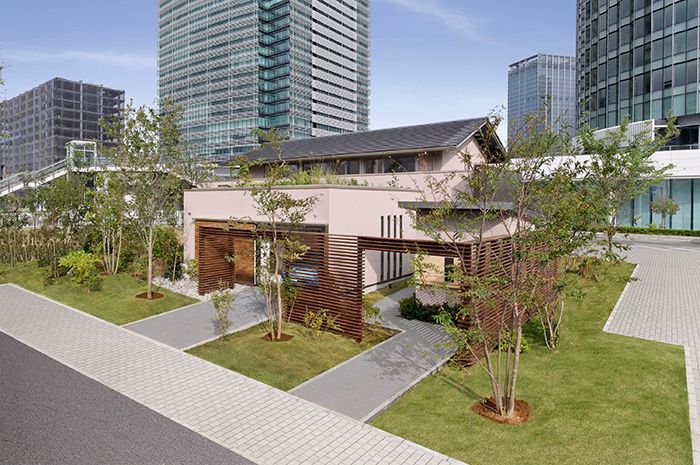
A prototype “smart house” located in the Yokohama Minato Mirai 21 district. (Photo: Sekisui House, Ltd.)
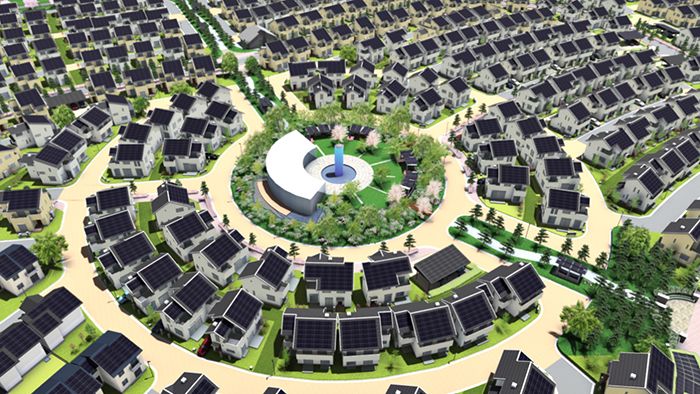
Panasonic has teamed up with the city of Fujisawa in Kanagawa Prefecture and eight other companies for the Fujisawa SST project to build a “smart town” on a 19-hectare plot of land that was once the site of the company’s factory. (Photo: Panasonic Corp.)
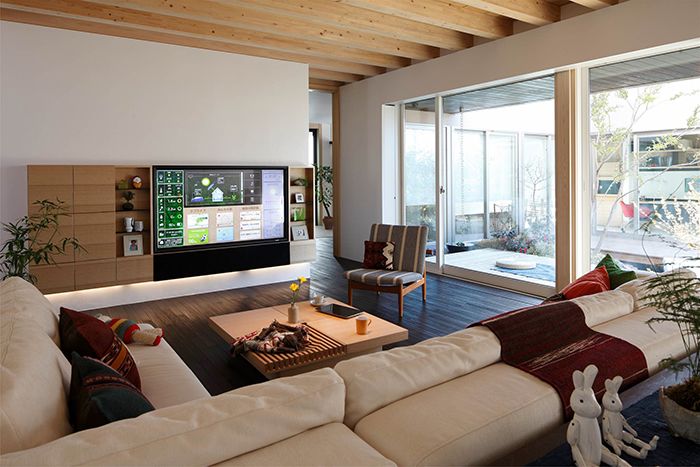
Interior of a type of house that prioritizes concern for the environment while integrating network technologies. The aim is to explore new styles of amenable living in houses constructed for long-term use. (Photo: Sekisui House, Ltd.)
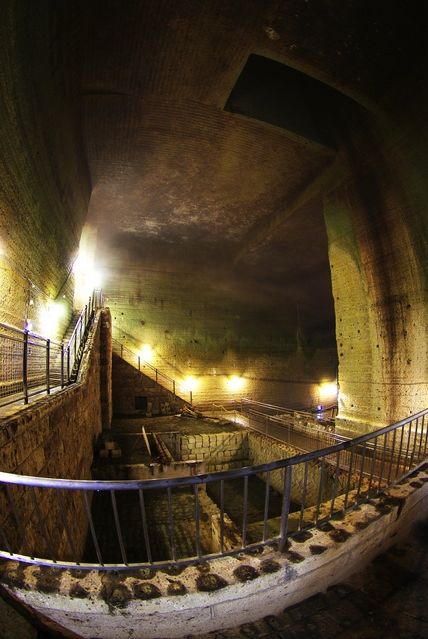
The Ōya Stone Museum built of an abandoned underground mine in Utsunomiya, Tochigi Prefecture. Other areas of Japan are considering the possibilities for taking advantage of the natural cooling of such underground areas, which makes them ideal locations for data centers and servers.
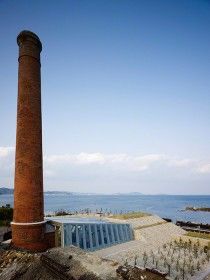
The Inujima Art Project Seirensho; a museum that preserves and revives the remains of a copper refinery on the island. The building makes use of the refinery’s smokestacks and its “karami” bricks created as a byproduct of the refining process, while also utilizing natural sources of energy such as solar and geothermal power. (Photo: Naoshima Fukutake Art Museum Foundation)
Artwork: Yanagi Yukinori
Architectural design: Sambuichi Hiroshi
Administration: Naoshima Fukutake Art Museum Foundation
Photography: Ano Daici
There is much room for improvement in the efficiency of heating, cooling, and lighting in Japanese offices and homes. Just attaching sensors equipped with intelligent functions would be extremely helpful. By piling up small innovations, including the rearrangement of office layouts and installation of light reflectors, an unrivaled level of energy saving can be achieved. The cooling of computer servers, which are now expanding exponentially, is an area where much can still be done by making the most of the technologies accumulated up to now, including sophisticated sensors and local-cooling devices. The tasks of refining sensor technologies, building local heating and cooling equipment, and developing new materials are in fact made to order for Japanese manufacturing.
From the viewpoint of dispersing risks, it will be best not to concentrate in just a few locations the data centers that house huge numbers of servers. Some of them might be moved to subterranean caverns on the islands of Hokkaidō and Kyūshū and in the Chūgoku region of western Honshū. Maximum use should also be made of energy-saving technologies for constructing buildings. An example of what is possible can be seen on the island of Inujima in the Seto Inland Sea, where structures have been built that make use of the natural power of light and wind. Japan’s famed expertise at making things is likely to demonstrate its potency in this area too. Indeed, coming up with demand-side innovations is something at which Japan excels. And the technologies devised in Japan can be exported directly to emerging countries and other parts of the world.
Nonetheless, even after being informed of such possibilities, people who think according to the old paradigm may still find it hard to appreciate the need to abandon nuclear power. Japan will not have much of a future, however, unless it can put major and minor innovations to use to end its reliance on nuclear power, which currently supplies on average about 30% of Japan’s electricity. Matsushita Kōnosuke, the founder of Panasonic Corp., once remarked that while cutting costs by 3% is difficult, cutting them by 30% is not that hard. And his company apparently accomplished that feat. What he meant is that breakthrough innovations will not be realized if engineers set their sights on a 3% target, which can be attained merely by taking existing technologies one step forward; but when the target is a 30% improvement, engineers are motivated to pursue completely new lines of thinking. Seen in this light, 30% is not an impossible goal to pursue.
Solar Power Generation for Schools
One more demand-side innovation to be considered is the application of solar power to generate electricity for educational institutions, especially elementary and junior high schools. Now that Google is making books available in digital form and various other sources of information can be accessed over the Internet, each school no longer needs to maintain a large library. If students are provided outstanding online facilities and English instruction, they will be able to access information from anywhere in the world. Moreover, most elementary and junior high schools are used only in the daytime. Thus, when repairing the schools damaged in the March 11 disaster, a policy of aggressively introducing solar power should be introduced. It would have at least three ripple effects. First, the prices of solar panels would significantly fall because of the large-scale orders. Second, regional economic recovery would be boosted by the reactivation of public works. And third, Japan could become a valuable model for countries now engaged in economic development because they are eager to build an educational infrastructure, particularly Internet facilities.
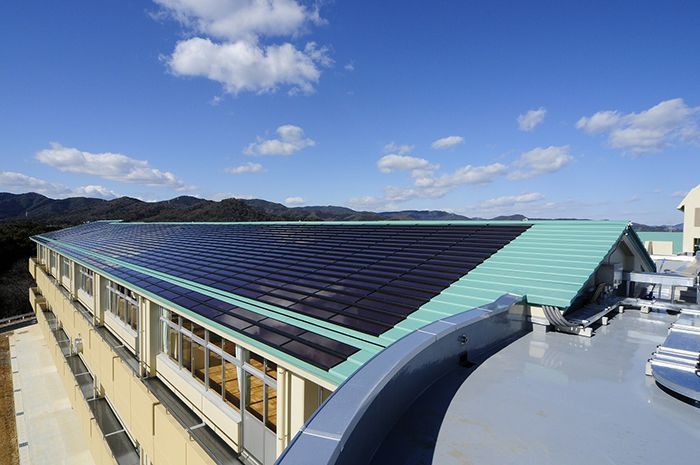
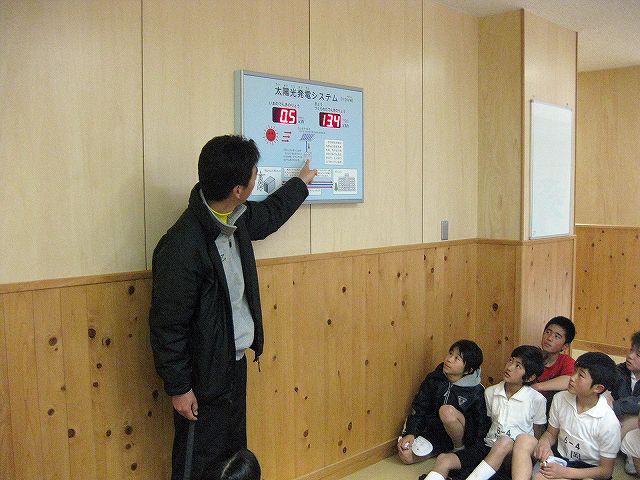
The addition of solar panels to elementary and junior high schools is one part of a government-led effort to promote “eco schools” equipped with environmentally friendly facilities. In addition to reducing the burden on the environment, this initiative involves incorporating educational materials for teaching about environmental issues. (Photo: Ministry of Education, Culture, Sports, Science, and Technology)
Eco Cities and Affirmative Action
Promoting urban planning should be seen as one of the most important elements in energy development for the nuclear-free, low-carbon society I have been discussing. For the purpose of reconstruction, I recommend that the government designate at least 10 municipalities for transformation into eco towns and smart cities. This does not need to be limited to municipalities in the badly battered areas of the Tōhoku region. If cleaning up the damage from the nuclear power accident is going to take a prolonged period of time, municipalities in other parts of Japan that have taken in Tōhoku evacuees could also be selected. As I will discuss later, highly self-reliant local governments should draw up plans and the central government should provide them with reconstruction funds to begin as soon as possible the construction of cutting-edge cities that bring together the world’s most advanced energy-saving technologies.
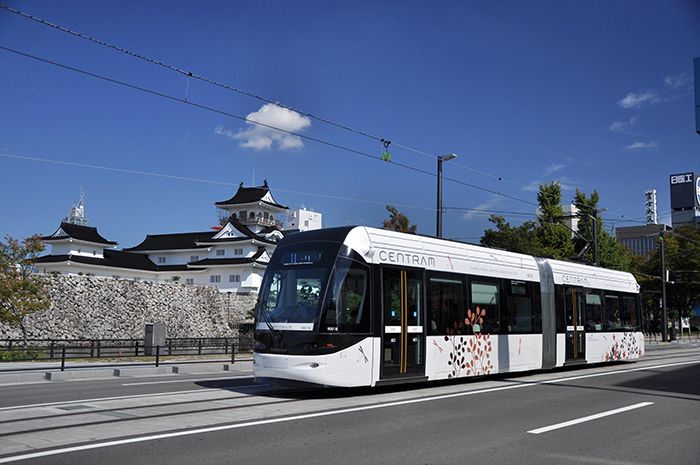
The Centram light rail system was introduced in the city of Toyama, starting in December 2009, to help create a public transportation network that is both people-friendly and environmentally considerate. (Photo: City of Toyama)
In any event, the construction of eco towns and smart cities is sure to begin before long now that a variety of tentative plans have been formulated. Here I would like to point out how a policy of “affirmative action” would be highly desirable in pursuing this construction. What I have in mind is a rule that 30% of the procurement orders made by the central and local governments should go to newly established companies, local businesses, and foreign firms. Japan has experienced revolutionary change twice in the past—first when it embarked on modernization at the time of the Meiji Restoration of 1868 and next when it engaged in reconstruction after World War II. In both cases new social strata served as the driving force and the stimulus from other countries in an open-door environment energized the transition. When the central and local governments start building eco towns and smart cities, accordingly, they should channel 10% of the funding to up-and-coming companies established within the past three years, 10% to middle-ranking small and medium-sized local businesses, and 10% to foreign firms. Such affirmative action would apply to designing and procurement, including the acquisition of construction materials, equipment and tools, and hardware and software for communication technologies.
Effects of Procurement Quotas
The procurement quota for newly launched firms can be expected to energize innovative companies by accelerating the birth of start-ups and the creation of spinoffs from major corporations. Early in the Meiji era (1868–1912), new space for economic activities was created through the rise of lower-ranking samurai, and in the postwar period the dissolution of the zaibatsu conglomerates and the purge of business leaders had a similar effect. In the wake of the recent disaster, there is a need for opening up new economic space once again to facilitate the reconstruction process. If this is not done, existing companies will continue to employ conventional methods, obstructing the emergence of innovation. By the same token, the procurement quota for smaller local companies would have the objective of not just creating jobs but also drawing in the necessary human resources. I have heard that many young people are now heading off to Tōhoku or returning there in order to take part in the reconstruction; places where they can be put to work need to be readied.
The quota for foreign corporations is also important. As the architect Andō Tadao has emphasized, foreign companies will not show much interest in the construction of new cities and towns if they do not have a state-of-the-art design. They need to be attractive projects that whet the appetite of investors. In light of this, a quota would be sure to draw the attention of overseas companies. It would also have other benefits. In the public works sector, the participation of foreign companies in construction projects would likely put an end to exclusionary business practices, and the price tags of winning construction bids could be expected to fall considerably. Innovative methods underpinned by a variety of conceptions could also be expected. As a result of the catastrophe, Japan has become the world’s largest recipient of assistance, and we need to make the benefits we have received openly available to the world in order to repay this kindness. This would be Japan’s third period of opening itself to the world—following the Meiji and postwar openings.
The Need for Decentralization
As the nation begins work on the construction of decentralized eco towns and smart cities, we must recognize that an important part of the paradigm shift involves ending the lopsided concentration of functions in Tokyo and establishing a decentralized society with more regionally autonomy. The building of these new municipalities represents a departure from the paradigm in which every effort was made to achieve balanced development in all parts of Japan. Under a series of Comprehensive National Development Plans, essentially identical cities were built nationwide, regardless of differences in climate and natural features. What is now needed, however, is a development plan that makes the most of the distinctive character of each region. Urban development based on the fourth of the Comprehensive National Development Plans resulted in areas around train stations and airports throughout Japan looking the same and in sprawling urban areas. Community building for eco towns and smart cities needs to take a different approach. For one thing, it must be premised on local electricity generation utilizing solar, wind, and geothermal power, as well as biomass and timber pallets. In addition, the twentieth-century city model in which residents commute from suburban homes to urban jobs is no longer appropriate because it is premised on excessive energy consumption. The design of urban space now needs to be compact and agreeable, bringing homes, workplaces, educational institutions, and entertainment facilities closer together.
Having a highly concentrated central government impose standardized designs from the top down is not the way to realize highly energy-efficient cities and towns. Regional governments holding discretionary powers will play an important role. Decentralization is also desirable from the viewpoint of the state’s risk management. The recent disaster made clear to everyone just how dangerous it is to amass state functions in a single region. If a major earthquake directly hit the Kantō region, the state would become completely paralyzed because Japan’s administrative, business, and information functions are so highly concentrated in the Tokyo metropolitan area. The road to recovery from such a disaster would likely be extremely chaotic.
Creating Larger Regional Administrative Units
Here I want to draw attention to the merits of introducing a system of large, highly autonomous regional administrative units. I envision a federation of about 10 subnational jurisdictions, each with nearly as much autonomy as an independent nation. It is worth pointing out that the size of Japan (approx. 370,000km2) is smaller than that of California (420,000 km2). Whereas a single governor is in charge of California’s administration, however, Japan has a separate governor for each of its 47 prefectures. Granted, Japan is about four times larger than California in terms of economic scale and population, but surely it does not need as many as 47 governors.
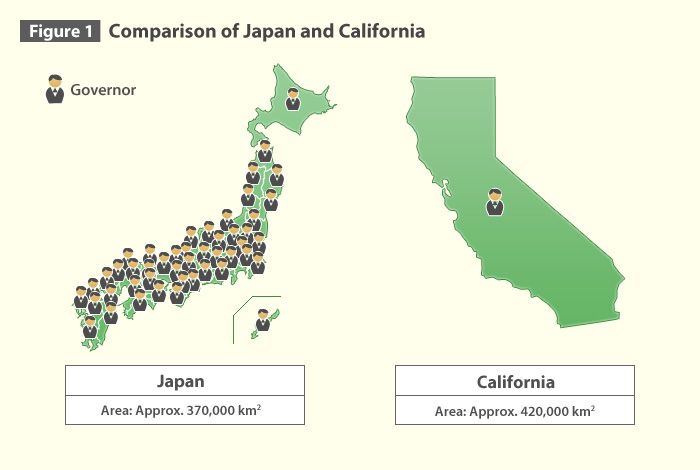
Japan is divided into a large number of prefectures simply because when the modern administrative apparatus was put into place, the prefectural system was modeled on the traditional feudal domains. There had been almost 300 domains, but the Meiji government decided that that was too many. Back then people traveled between Tokyo and Osaka by foot, and it took even express messengers 14 days to cover the distance. In what was a bold reform at the time, the government cut the number of subnational jurisdictions to some 70 prefectures in 1871, and then to 47 prefectures not long thereafter. However, information tools have greatly advanced since that time, and now it takes less than three hours to travel from Tokyo to Osaka by the Shinkansen bullet train. Continued use of an administrative setup created more than a century ago has become incongruous.
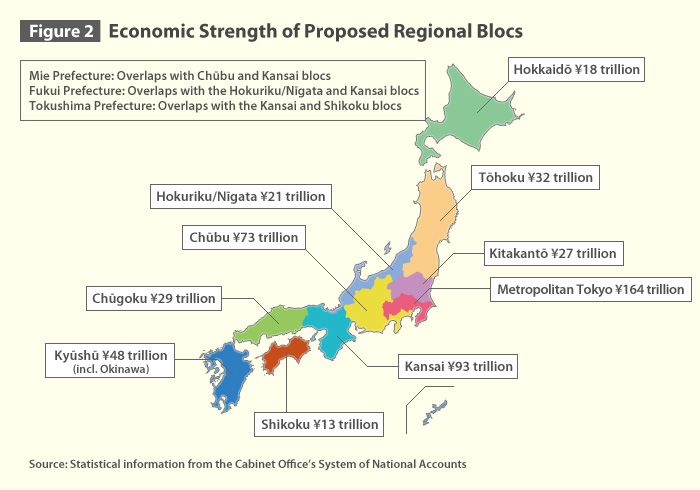
As is clear from Figure 2, each of the proposed regional blocs would have ample economic strength to allow for regional autonomy. For example, the economic strength of the Kansai bloc would be roughly on par with the ¥90 trillion output of South Korea, that of the Chūgoku bloc would be comparable to the ¥72 trillion level of the Netherlands, and the economy of the Kyūshū bloc would be larger than the ¥29 trillion economy of Denmark (all figures are taken from the OECD Annual National Accounts Database and converted into yen based on an exchange rate of $1 = ¥113.26).
Model Cities for a Graying Society
The decreasing birthrate and graying of the Japanese population has already resulted in serious problems in some parts of Japan. This trend is particularly severe in the Tōhoku region, which meant that many elderly people were among the victims of the earthquake and tsunami. This demographic shift is by no means limited to Japan, however. The total fertility rate, which indicates the average number of children born to a woman during her lifetime, was below 2.0 in many member countries of the Organization for Economic Cooperation and Development during the 2005–10 period. South Korea had the lowest rate (1.22), followed by Japan and Poland (1.27 each), Germany (1.32), Italy (1.38), Canada (1.57), the Netherlands (1.74), Britain (1.84), and France (1.89). Any country in which women on average do not bear more than two children will see its population decline. Only in a few OECD countries did the rate exceed 2.0, such as New Zealand (2.02), the United States (2.09), and Mexico (2.21).
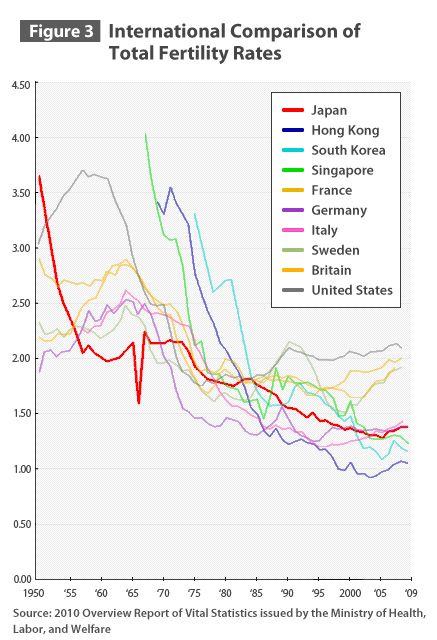
Japan’s neighbor China also has a declining population. Its total fertility rate is 1.77, but in cities where the nation’s one-child policy has been most strictly applied since its introduction in 1979, a rate of around 1.0 has indeed been maintained. As a result, China’s population is graying even faster than that of Japan. We can see, then, that the critical problems associated with a decreasing birthrate and graying population are common to developed countries and are also emerging in highly populous China. Japan is merely at the front of the pack that is moving down this road.
Given the severity of the demographic shift in the Tōhoku region, the construction of eco towns and smart cities should include the creation of advanced systems of medical care and welfare, making them responsive to the needs of the elderly. If that is done, the community-building efforts could become a model not just for Japan but for the whole world. And if smart cities are designed to be highly amenable, with homes, workplaces, educational institutions, and entertainment facilities located close to each other, the cities will attract not just senior citizens but young people as well, probably boosting the birthrate as a result.
Emergent Destruction
Doubts will certainly arise at this point as to whether Japan really has leaders capable of steering the country in this new direction. My response is that there is no longer any need for highly charismatic leaders. As research on complexity has shown, complex ant colonies function properly without queen ants issuing any orders. Indeed, the queen ants devote themselves exclusively to laying eggs, while worker ants carry out such tasks as transporting food and other ants specialize in keeping the anthill clean. Highly complex and functional ant colonies are created when all ants undertake their designated work within the overall design.
In the study of complex systems, the term “emergence” is used to indicate how the sum of relatively simple actions can result in a power that exceeds the imagination. This is the sort of power seen in the Jasmine Revolutions of Tunisia and Egypt, where change occurred in the absence of revolutionary leaders or organizations. Aspiring for freedom and democracy, people individually took small steps whose power was amplified when communicated via Twitter or Facebook, resulting in the collapse of regimes once thought to be indestructible. In these revolutions, information, especially video footage, evoked favorable responses among countless young people. What is needed in Japan today is a quiet jasmine revolution of this type.
I call such power “emergent destruction.” Joseph Schumpeter used the related term “creative destruction,” saying it was indispensable for innovation. Without doubt, one cannot expect a new cycle to begin within the context of an old order. But when one sees the mechanism of change in terms of creative destruction, one immediately supposes that powerful entrepreneurs or leaders must be the key agents. But this is not the case when we speak of emergent destruction. I would add, however, that revolutions to come will not actually be that destructive; instead, they will be emergent affairs born from the large waves of change set in motion by the small declarations and innovations of assorted individuals.
Japan’s natural disaster has provided an opportunity that is bound to initiate a fundamental remaking of the nation. To be sure, those clinging to the old paradigm or those with vested interests are bound to regard this as a pipe dream. In the ashes of Tokyo and Hiroshima in 1945, however, how many people could have imagined that Japan would grow into the world’s number-two economic power? In Japan at the time, there were no charismatic leaders. The future business leaders were people like Kawasaki’s Nishiyama Yatarō, who during the purge was promoted from non-managing director to president and was regarded as a third-class executive spouting nonsense; or those with no more than an elementary school education, like Panasonic’s Matsushita and Honda’s Honda Sōichirō. These entrepreneurs had sensed the needs of the nation and were just taking their first steps.
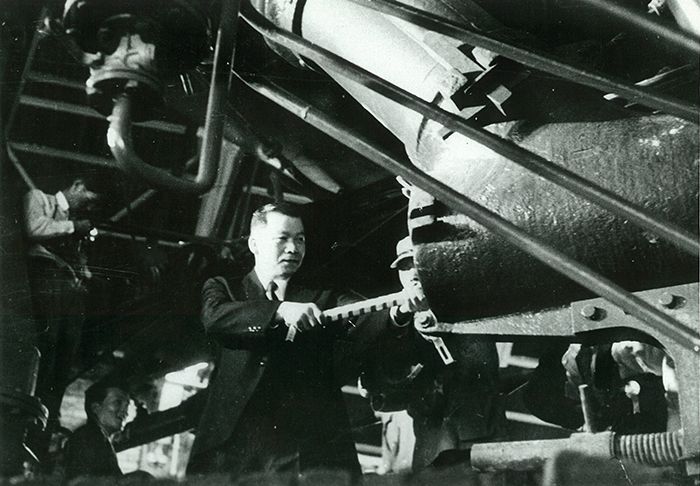
Nishiyama Yatarō, the first president of Kawasaki Steel Corporation. Nishiyama played a leading role in Japan’s postwar recovery. His idea of creating a cutting-edge, integrated steel mill a few years after the end of World War II was greeted with opposition for being “unrealistic,” but he was convinced that steel was crucial to Japan’s recovery and went ahead with the construction of a steel mill in Chiba Prefecture for Kawasaki Steel. (Photo: JFE Steel Corp.)
The Power of Young People
I am pinning my hopes on the power of young people. On May 25, 1961, shortly after the Soviet Union had beaten the United States in the race to space by sending its first cosmonaut into orbit in April, US President John F. Kennedy issued a challenge in a special address to Congress: “I believe that this nation should commit itself to achieving the goal, before this decade is out, of landing a man on the moon and returning him safely to the earth.” As the United States up to that time had accomplished nothing more than sending one astronaut by rocket on a suborbital flight, there were no solid technological grounds for believing that the moon mission was feasible. One wonders how many people believed that it could be accomplished so quickly. Speaking at Rice University in September 1962, Kennedy urged on his fellow Americans with these words: “We choose to go to the moon in this decade and do the other things, not because they are easy, but because they are hard.” It was young people in large numbers who most eagerly rose to the occasion. Outstanding students from all over the United States were soon rushing to the National Aeronautics and Space Administration in the hope of taking part in the project, and in July 1969 the Apollo 11 mission successfully reached the moon. It has been reported that the average age in the project team assembled for the moon shot was around 26 or 28, which shows how students were at the forefront of those responding to Kennedy’s challenge.
Today we have no need to wait for a charismatic leader to emerge. Recognizing that Japan must transform itself into a leader in the drive to create the nuclear-free, low-carbon society that the times demand, we can place our trust in the emergent power that will result from actions undertaken by numerous individuals who display professionalism in their respective fields. On Facebook pages you can see how there is a growing chorus of calls across Japan for emergent destruction and emergent creation.
(Originally written in Japanese.)
Great East Japan Earthquake paradigm change nuclear/carbon-free society smart house smart city energy efficiency Inujima solar panels regional blocs declining birth rate aging population