

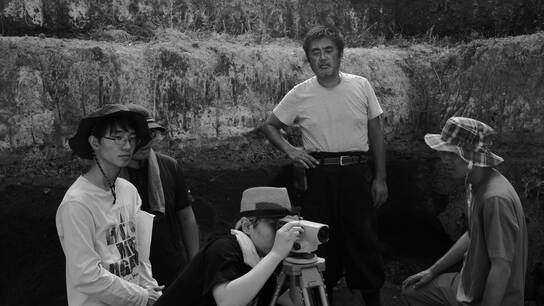
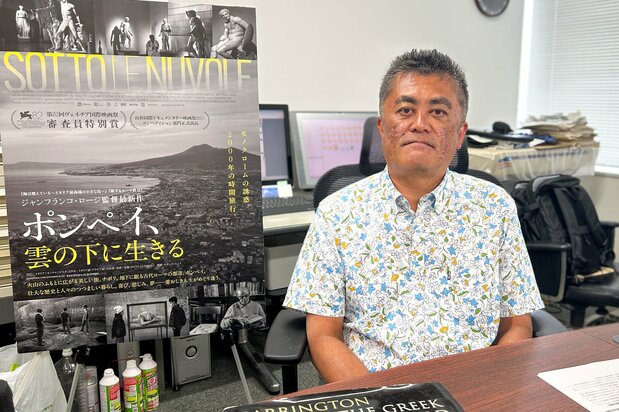
Pompei: Below the Clouds is a prizewinning film focusing on Japanese archaeological activities at the foot of Mount Vesuvius. We talk to a University of Tokyo researcher involved in the work about what the team is unearthing in the shadow of the volcano.
Japanese Excavation Team Enters Ancient Roman Ruins
Mount Vesuvius is a volcano overlooking the Gulf of Naples with a history of major eruptions that goes back tens of thousands of years. The most notorious of these was the eruption of 79 CE, which completely buried two ancient Roman cities, Pompeii and Herculaneum (known today as Pompei and Ercolano), in volcanic ash.
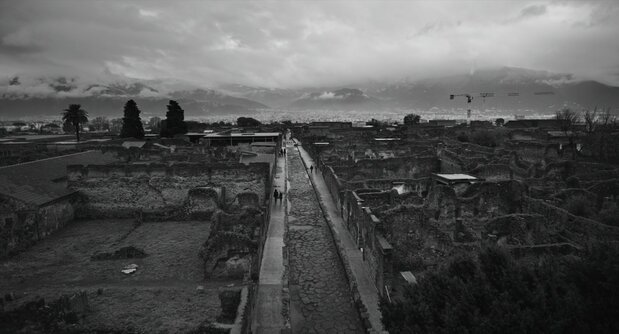
 From the film Pompei: Below the Clouds. The ruins of Pompeii, buried in 79 CE by the eruption of Mount Vesuvius. (© 21Uno Film Srl/Stemal Entertainment Srl 2025)
A team from the University of Tokyo’s Graduate School of Arts and Sciences has been involved in an excavation of the Somma Vesuviana ruins since 2002. This project was founded by Aoyagi Masanori, a professor emeritus at the University of Tokyo and the leading figure in research on ancient Rome in Japan. He also served as Japan’s commissioner for cultural affairs from 2013 to 2016 and is currently chairman of the board of directors at Tama Art University.
Aoyagi first traveled to Italy in 1969 during his graduate studies at the University of Tokyo. He studied for three years at the University of Rome (now the Sapienza University of Rome) and became an assistant at the University of Tokyo upon his return. Before long, however, he requested and was granted permission by the Italian government to continue his research through excavations at Pompeii. It was a small dig, he recalls, with barely enough funding to hire a single photography assistant to join him on the team.
People from outside Italy had excavated ancient Roman ruins before. Unlike investigators from elsewhere in Europe and the Americas, however, Aoyagi was arriving from an Asian country with very little connection to ancient Rome. He recalls facing many obstacles, but, with the help of friends made during his years at the University of Rome, he overcame them all. Building on his success at Pompeii, he went on to conduct digs in Sicily and Tarquinia, and the acclaim they received opened the door to the Somma project.
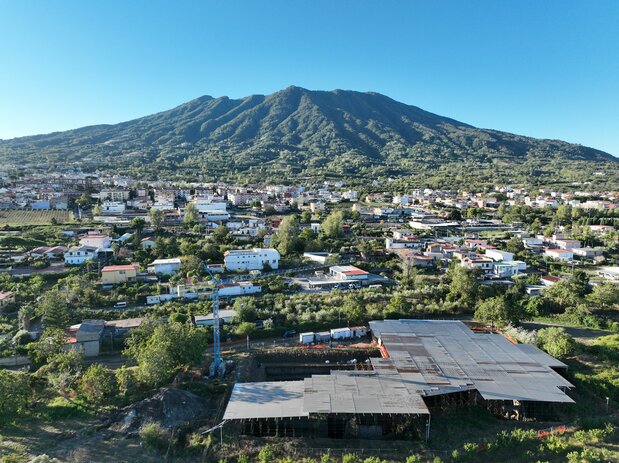 The site of the Somma Vesuviana ruins, just north of Mount Vesuvius. (© UTPSV)
Possible Links to the First Roman Emperor
The primary thing the Somma dig set out to find was a villa owned by Augustus (63 BCE–14 CE), first emperor of Rome. Geographically speaking, the area matches the descriptions of “the place where Emperor Augustus met his end.” In the 1920s, a local farmer happened to uncover a hard, buried structure there, and exploratory excavations by archaeologists uncovered architectural columns, sculpture, and more. But in the 1930s, Benito Mussolini ordered resources diverted to the excavation of Pompeii, and the suspected “Villa Augustea” was reburied.
Some 70 years later, Aoyagi’s team from the University of Tokyo restarted the dig at Somma. Almost immediately after they began, however, they realized that the buildings, murals, and artifacts they were uncovering were more stylistically characteristic of the second century, long after Augustus’s death. The team concluded that the villa was among those buried by an eruption of Vesuvius in AD 472, rejecting the hypothesized connection to Augustus.
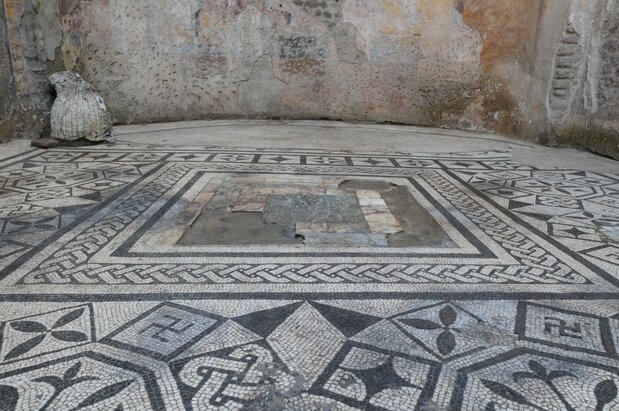 A mosaic floor discovered in 2007 (© UTPSV)
In 2019, however, a separate structure was found one level deeper.
“We had given up [on the Augustus connection] and were excavating with a different subject in mind,” recalls researcher Iwaki. “So it was a surprise some twenty years later to find part of a building that seemed to be the one we had originally expected to find. I was suspicious at first, but new ruins continued to emerge from the following year onward, expanding the scale of the site. The facts piled up gradually, and by around 2024 I was increasingly convinced.”
One factor adding to his confidence was the discovery that damage to the newly excavated structure was caused by pyroclastic flow from the 79 CE eruption. Also discovered was a system of multiple furnaces—seven have been uncovered so far—suggesting expansive bathing facilities, which in turn made it more likely that the villa belonged to a highly powerful figure.
Ancient records offered further evidence in the form of claims that a shrine had been built on the former site of the Villa Augustea. The extensive structure uncovered on the upper layer matched those records precisely. If further investigations prove beyond doubt that this is the site where Emperor Augustus met his end, it would be a discovery of global historical importance.
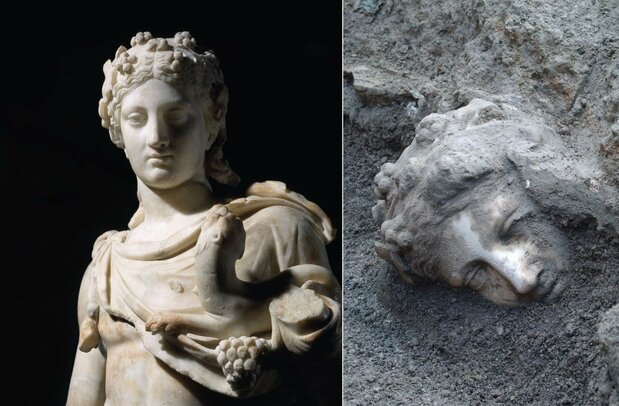 Left: A large marble statue of Bacchus (Dionysus) exhumed at Somma in 2004. Right: The statue during the excavation process. (© UTPSV)
A Priceless Site for Disaster Archaeology
These discoveries connecting the site to Augustus are more than enough to attract global attention and promote the project’s achievements. But the Somma excavation has great meaning for other areas of study as well.
The project’s excavations have shed new light on volcanic activity. In the past, Somma was thought to have escaped serious damage from the eruption that buried Pompeii and Herculaneum because it was on the north side of Vesuvius. The shape of the landscape and direction of the wind all tend to make the lava, volcanic mud, and ash flow toward the southwest. But a dig launched in 2024 found an extremely thick layer of volcanic ash, surprising even experts in volcanology.
“Pompeii and Herculaneum were buried by an eruption and that was the end of it,” says Iwaki. “Somma, meanwhile, was devastated again and again. Studying this repeated cycle of destruction and recovery could provide useful data.”
 Seven furnaces that may have been used to heat water for baths. (© UTPSV)
In short, Somma is a valuable research site for the field of disaster archaeology, which elucidates the relationships between past natural disasters and human society.
“Particularly noteworthy is the near-immediate recovery from the disaster. In ancient Roman ruins, towns devastated by volcanic eruption are frequently rebuilt elsewhere, their original sites abandoned. It’s now clear that, in Somma, the old buildings were used as the foundation for new buildings instead.”
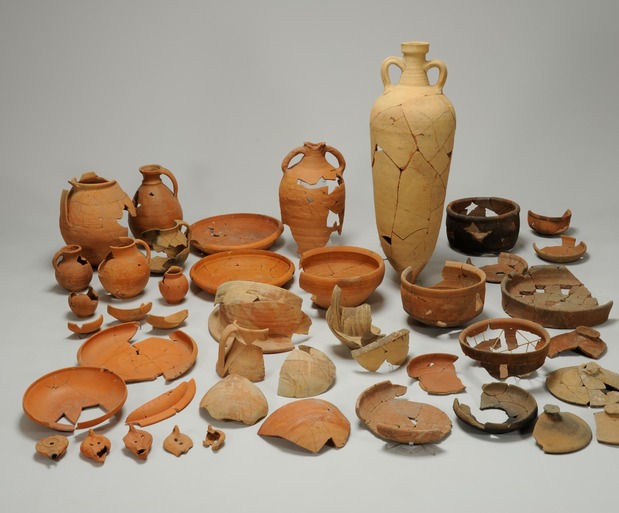 A wide range of earthenware was also unearthed. (© UTPSV)
If this was indeed a site connected to Augustus, it would provide still another convincing reason why the Somma ruins were not abandoned following the eruptions.
“The area around Mount Vesuvius has been densely populated from ancient times to the present day. There’s no knowing when the volcano might erupt, so the government restricts the inflow of new residents and offers large grants for people to move away—but very few do. That’s how appealing the area is. Presumably this is why people kept returning and rebuilding no matter how many times it erupted.”
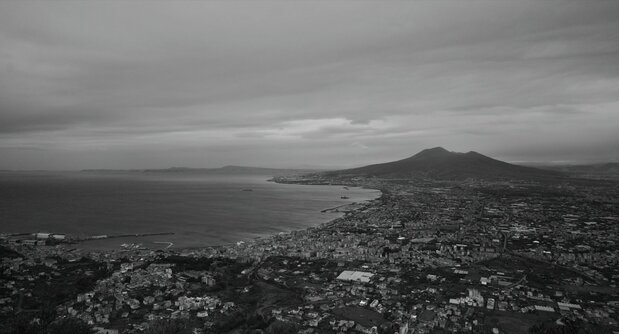 Mount Vesuvius is a 1,281-meter volcano that looms above the Gulf of Naples (from the film Pompei: Below the Clouds). (© 21Uno Film Srl/Stemal Entertainment Srl 2025)
Seeing Through the Eyes of a Master Documentarian
The 2025 film Pompei: Below the Clouds is an evocative glimpse at this human activity with the volcano as a backdrop. This documentary, winner of the Special Jury Prize at the eighty-second Venice International Film Festival, is the latest work from director Gianfranco Rosi, who has received awards at both the Venice and Berlin International Film Festivals—two of the “big three” of the cinematic world.
The cameras that entered the Somma dig captured a sunburned Iwaki dressed in nikkapokka trousers and jikatabi soled socks, silently digging in the earth. In the next scene, a figure stands before a group of young students on hand to learn about the excavation’s research, explaining to them that “research requires work.” This speaker is project founder Aoyagi. Juxtapositions like this reveal Rosi’s own perspective, making this more than a simple filmed record of events.
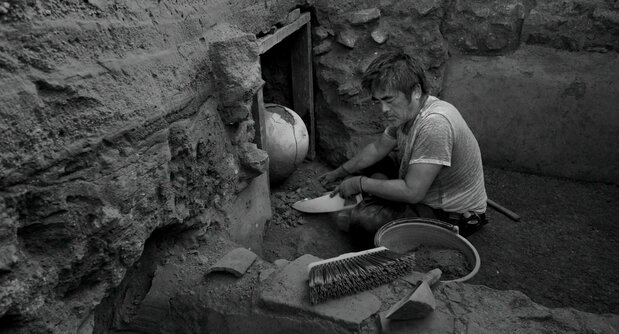 Iwaki hard at work (from the film Pompei: Below the Clouds). (© 21Uno Film Srl/Stemal Entertainment Srl 2025)
The first dig Iwaki participated in as a student was the one led by Aoyagi in Tarquinia. Over the more than three decades since, he has continued to get his hands dirty uncovering layers from 2,000 years ago.
“In those words,” says Iwaki, “we can see Professor Aoyagi’s conviction that research ‘begins with fieldwork to obtain your own materials.’”
Work, in short, means not just digging, but recording finds, taking them home to the laboratory, and analyzing them. Rosi’s camera also captures Iwaki’s colleague, Research Associate Sugiyama Kōhei, making detailed notes on excavated artifacts. Long days of careful, painstaking work are what allow the value of the culture created by the ancients to be handed down to later generations.
“I kind of doubt there are many people my age who still dig this hard,” says Iwaki, who was born in 1970. “Our site only has students who are visiting for short-term observation, so we have to do the digging ourselves. I started archaeology because I loved being out in the field, though, and I’m grateful that I can still dig.”
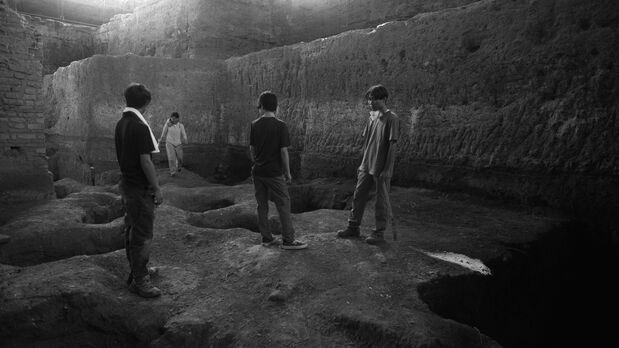 Students from the University of Tokyo enter ruins under excavation for the first time as part of their study curriculum (from the film Pompei: Below the Clouds). (© 21Uno Film Srl/Stemal Entertainment Srl 2025)
(Originally published in Japanese. Banner photo: The University of Tokyo Somma Vesuviana Excavation Project dig site. Research Associate Iwaki Katsuhiro watches over students participating in the research. © 21Uno Film Srl/Stemal Entertainment Srl 2025.)