

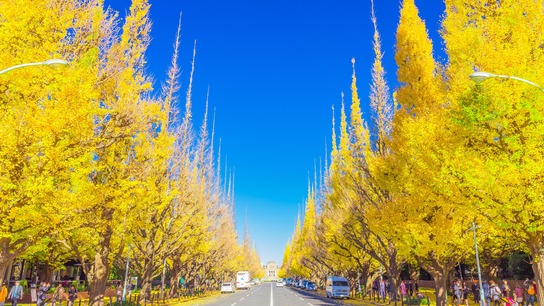
Famous for its autumn ginkgo trees and historic sports venues, Tokyo’s Meiji Jingū Gaien marks its centennial in 2026 as a major redevelopment prepares to reshape the landmark district.
A Lane Framed in Gold
Among Tokyo’s most popular autumn sights is the ginkgo-lined avenue at Meiji Jingū Gaien (commonly shortened to Jingū Gaien, or simply the Gaien), the outer garden of the Shintō shrine Meiji Jingū. Stretching from Aoyama-dōri toward the Meiji Memorial Picture Gallery, four rows of ginkgo trees line the broad boulevard, two on each side. In late autumn, a golden canopy forms overhead, while fallen leaves carpet the ground, drawing a steady stream of visitors from Japan and abroad.
The celebrated vista is no accident. The trees nearest Aoyama-dōri were planted taller, while progressively shorter trees were placed closer to the Picture Gallery. The roughly 300-meter lane also slopes gently downward, with a difference in elevation of about one meter between its ends. Together, the varying heights of the trees and the subtle incline create a striking sense of depth. The designers effectively applied the principles of pictorial perspective to an outdoor landscape.
Including the two rows that branch off toward Chichibunomiya Rugby Stadium, the avenue contains 146 ginkgo trees. Their story can be traced back to seeds collected in Shinjuku Gyoen, then an imperial garden, in 1908. From around 1,600 saplings raised on what is now the grounds of Meiji Jingū’s inner garden, a select group was chosen and planted here in 1923. Since the Gaien was formally inaugurated in October 1926, the trees actually predate the complex by three years.
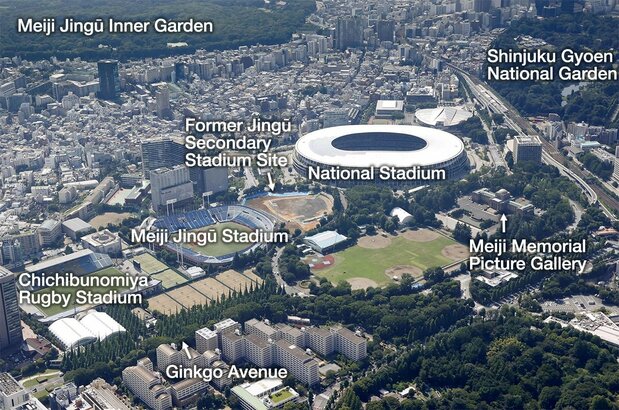
 The Meiji Jingū Gaien area. (© Kyōdō)
From Military Site to Public Park
Meiji Jingū is a shrine established in 1920 dedicated to Emperor Meiji and Empress Shōken. While the forested inner garden in Yoyogi serves as a place of worship, the Gaien was conceived as a space that would preserve the memory of the imperial couple for future generations. Although part of the shrine complex, the Gaien was designed as a Western- style public park, centered on the Picture Gallery and surrounded by spaces where people could relax and enjoy sports.
The site was originally occupied by the Imperial Japanese Army’s Aoyama Parade Ground. After Emperor Meiji passed away in 1912, it served as the venue for his funeral ceremony. To fund construction of the Gaien, prominent private citizens led by Shibusawa Eiichi launched an association to raise funds; money and trees were donated from across the country, while youth groups contributed labor. Construction was temporarily suspended after the Great Kantō Earthquake of 1923, and the grounds were opened to disaster victims.
On October 22, 1926, the completed outer garden was formally presented to Meiji Jingū, marking its official foundation. Inside the Picture Gallery, 80 large murals depict key episodes from the lives of Emperor Meiji and Empress Shōken.
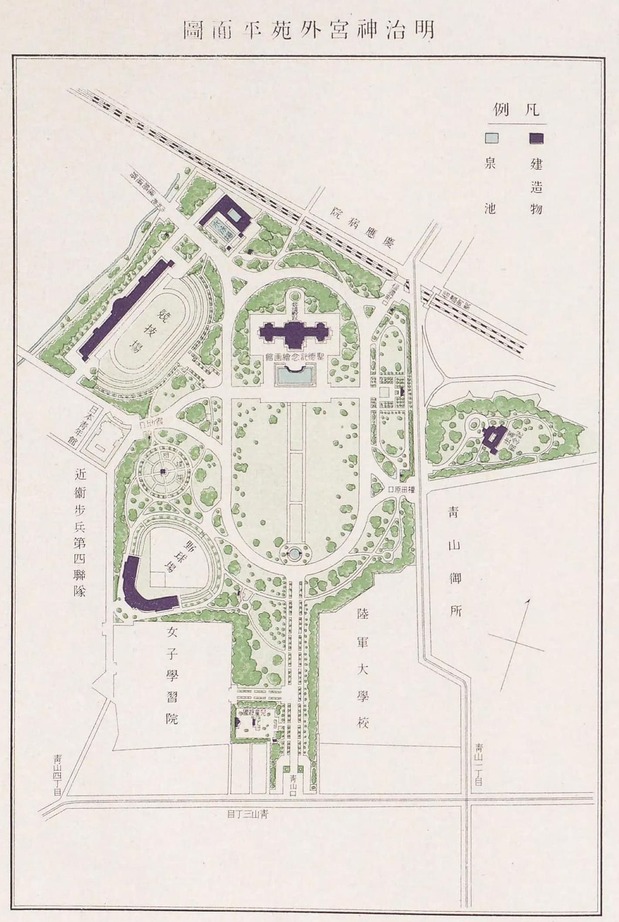 Plan of Meiji Jingū Outer Garden at the time of its dedication (from the October 1926 Summary Report on the Dedication of Meiji Jingū Outer Garden). (Courtesy Meiji Jingū Gaien)
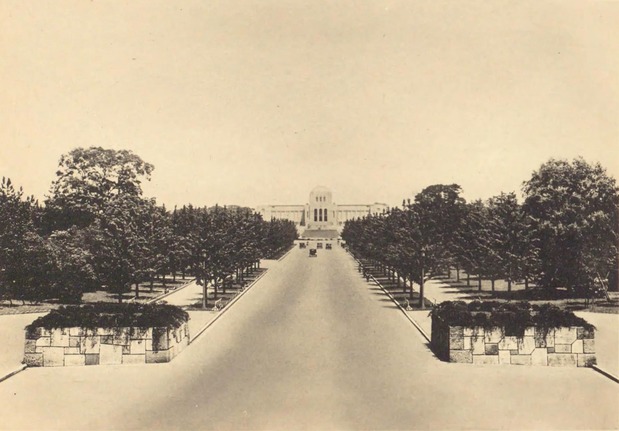 For some time, the ginkgo trees were shorter than the surrounding trees. The Meiji Memorial Picture Gallery is visible in the center background (from Meiji Jingū Gaienshi [History of Meiji Jingū Outer Garden], August 1937). (Courtesy Meiji Jingū Gaien)
Wartime Silence
On October 21, 1943, the Meiji Jingū Gaien Stadium, standing on the site of today’s Japan National Stadium, hosted a send-off ceremony for students mobilized for military service. With Japan facing mounting setbacks in World War II, exemptions from military conscription for university students—mainly those in the humanities and social sciences—were revoked. Students from 77 universities and colleges in and around Tokyo marched through the rain before being sent to war.
Baseball games also disappeared. Tokyo’s Big 6 university baseball league, which had been playing at Meiji Jingū Stadium since the district opened in 1926, was ordered to disband in the spring of 1943. The ballpark was converted into a storage facility for fuel and construction materials. During an air raid in May 1945, incendiary bombs struck the stadium, which burned for several days.
The Gaien was requisitioned by the Allied occupation forces following Japan’s surrender, and Jingū Stadium became an occupation-only facility called Stateside Park.
Yet just three months after the war, baseball returned in November 1945 with a special game between students and alumni of Waseda University and Keiō University. According to stadium records, some 45,000 spectators attended, evidence of the enduring popularity of the famed Waseda-Keiō rivalry, which had become a national phenomenon through prewar radio broadcasts.
The stadium was not returned to Japanese hands until 1952, however. During the occupation years, directives promoting the separation of religion and state, together with new legislation, transformed Meiji Jingū from a state-administered shrine into a private religious body.
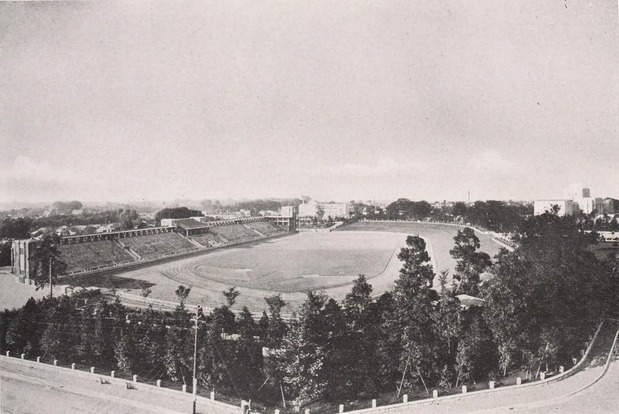 Meiji Jingū Gaien Stadium (from the October 1926 Summary Report on the Dedication of Meiji Jingū Outer Garden). (Courtesy Meiji Jingū Gaien)
A Home for Every Sports Fan
One of Meiji Jingū Gaien’s great attractions is that premier venues for several sports lie within easy walking distance of one another: the National Stadium for soccer and track and field, Jingū Stadium for baseball, and Chichibunomiya Stadium for rugby.
The original Meiji Jingū Gaien Stadium was completed in 1924, before the formal opening of the Gaien district itself. After the war, the facility was sold to the national government, which replaced it with the National Stadium for the 1958 Asian Games. The venue served as the centerpiece of the 1964 Tokyo Olympic Games and became one of the most iconic stages in Japanese athletics and soccer. In 2019, it was rebuilt on the same site, serving as the main venue for the pandemic-postponed 2020 Olympic and Paralympic Games more than half a century after the initial games.
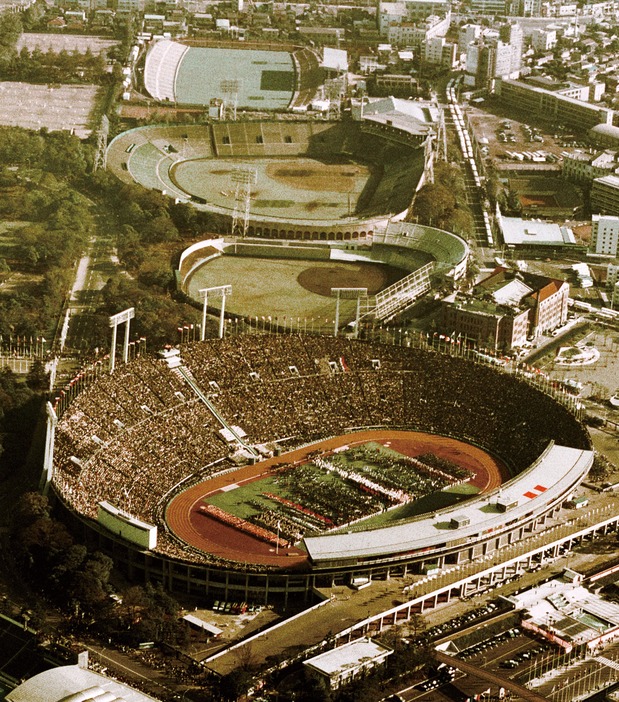 The former National Stadium (foreground) on October 10, 1964, the day of the opening ceremony of the Tokyo Summer Olympics. Visible in the background are the former Jingū Second Stadium, Jingū Stadium, and Chichibunomiya Rugby Stadium. (© Kyōdō)
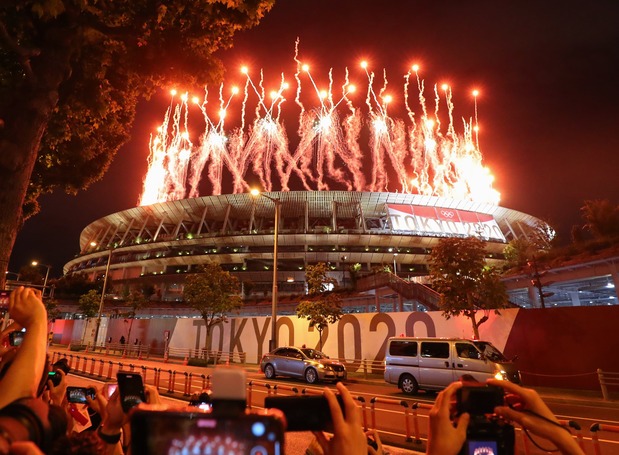 The opening ceremony of the Tokyo 2020 Summer Olympics, held at the current National Stadium on July 23, 2021. (© Jiji)
Jingū Stadium opened in 1926. It was not part of the original Gaien plans but was added in response to the surging popularity of university baseball. Just two days after the district’s dedication ceremony, the stadium hosted its first official Tokyo Big 6 League game between Meiji University and Hōsei University.
League play continues to this day, with Waseda, Keiō, Meiji, Hōsei, Rikkyō, and the University of Tokyo competing each spring and autumn. The rival schools’ organized cheering in the stands is nearly as famous as the games themselves. Because the stadium also hosts national university and high school tournaments, it has become—along with Hanshin Kōshien Stadium, home of the famed national high school baseball championships—one of the most important venues for amateur baseball in Japan.
In 1964, the professional Kokutetsu Swallows, then funded by affiliates of Japanese National Railways, made the stadium its home field. Now called the Tokyo Yakult Swallows, the team continues to play at the stadium. By day, the stands are filled with those cheering on student athletes; by night, professional baseball fans take over. The stadium is also available for recreational use, making it a place where people can enjoy baseball not only as spectators but also as players.
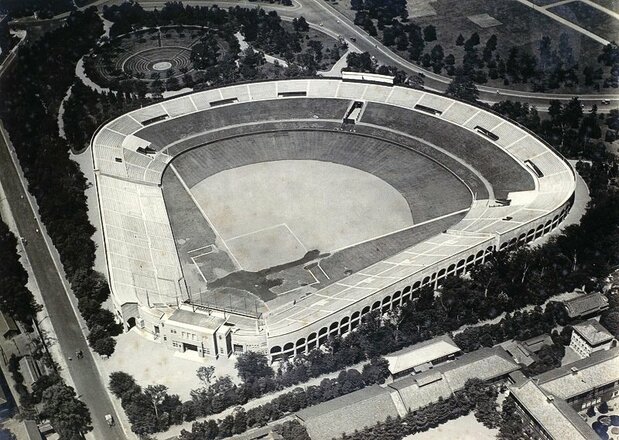 Jingū Stadium after its 1931 expansion. Because the Tokyo Big 6 Baseball League helped fund the stadium’s construction and expansion, university teams have retained scheduling priority over professional teams even since it began hosting pro games. (Courtesy Jingū Stadium)
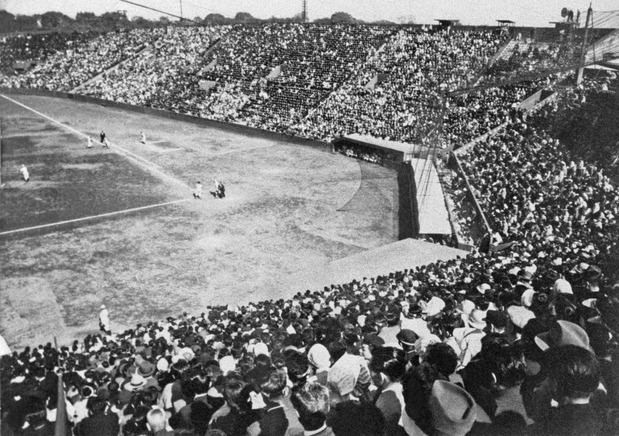 For some years after World War II, Tokyo Big 6 Baseball remained popular enough to pack the stands of Jingū Stadium to capacity, as seen here on April 29, 1956. (© Kyōdō)
Chichibunomiya Rugby Stadium was built following the war. When the original athletic stadium was requisitioned by occupation forces, rugby supporters launched a campaign to build their own venue. Alumni of university teams donated funds, and players themselves helped with construction. Tokyo Rugby Stadium opened in 1947 on the former grounds of the war-destroyed Gakushūin Girls’ School and adopted its current name in 1953. Since then, it has hosted countless matches, from university competitions to international tests. Winter rugby matches and the passionate crowds they attract have long been a cherished part of the Gaien’s identity.
The neighborhood once also featured a pool for both recreational and competitive use. An ice-skating rink was added in 1963 and has been operating year-round since 1994. A sumō arena stood here as well during the district’s early years; following the war, its site became Jingū Secondary Stadium.
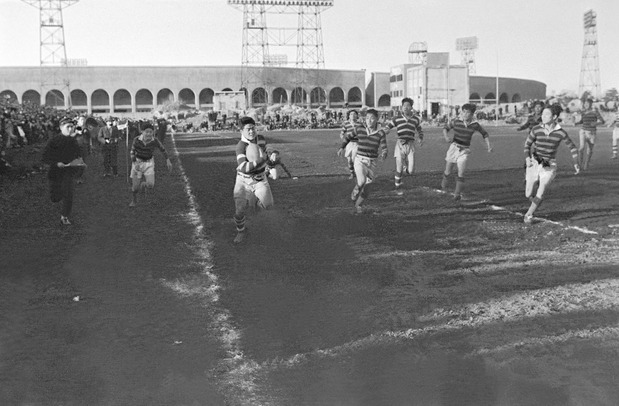 A match between Kwansei Gakuin University and Meiji University on January 2, 1948, the year after Tokyo Rugby Stadium opened, with Jingū Stadium in the background. (© Kyōdō)
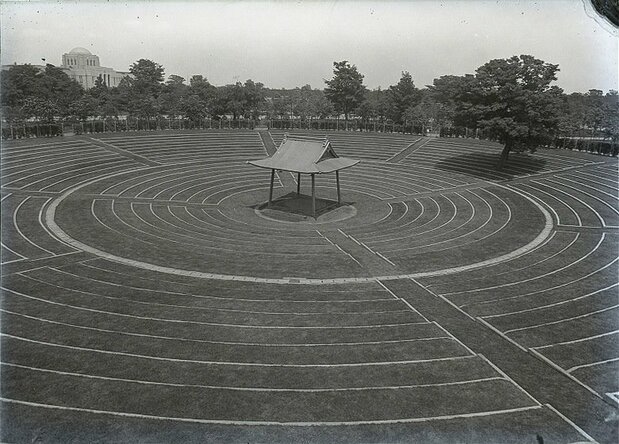 When the outer garden was established in 1926, a sumō ring stood adjacent to Jingū Stadium. (Courtesy Jingū Stadium)
Renewal for the Next Century
The Secondary Stadium has now also been demolished, and construction of a new Chichibunomiya Stadium began on the site in February 2026, scheduled to open in 2030. The site of the current rugby stadium will be used for a new baseball park to be built as part of a broader redevelopment project led by Meiji Jingū, Mitsui Fudōsan, Itōchū, and the Japan Sport Council, which owns the National Stadium and rugby stadium. To minimize disruptions to sporting events, the rugby and baseball stadiums will be rebuilt in phases. The new baseball complex, which will include a hotel, is due for completion in 2033.
Redevelopment of the entire district is scheduled for completion in 2038, but the project has prompted concerns over its environmental impact. Shortly before his death in 2023, musician Sakamoto Ryūichi sent a letter to Tokyo Governor Koike Yuriko and others urging stronger protections for the area’s trees and landscape. In response, project planners have announced enhanced measures to safeguard the iconic ginkgo boulevard and reduce the number of trees slated for removal.
Opponents remain unconvinced. From the outset, the redevelopment plan has included a plaza in front of the Picture Gallery and more green and open space than exists today, but critics argue that construction of high-rise buildings and the loss of mature trees would mar the landscape.
Meiji Jingū faces financial realities as well. The upkeep of the forest surrounding its inner Shintō sanctuary is funded mainly by revenue from facilities in the Gaien. Jingū Stadium, meanwhile, often hosts multiple baseball games each day between March and November, making it difficult to undertake major renovations while remaining at its current location.
As a Swallows fan, the author has been attending games at the existing stadium for nearly half a century. There is much to love about the venue, but its stairs vary in height, making them easy to trip on, and the concourse can become so crowded that here is no room for even a wheelchair to pass. For all that, the author eagerly awaits a new ballpark where everyone can take their seats safely and watch the game in comfort.
A century ago, people across Japan contributed money, labor, and trees to build Meiji Jingū Gaien. Preserving its cherished landscape while adapting it to contemporary needs remains one of the district’s central challenges today. Looking to the next hundred years, one hopes that it will remain one of Tokyo’s most beloved neighborhoods not only for its many sports venues but also for the beauty, each autumn, of its golden ginkgo-framed lane.
(Originally published in Japanese.)