


An international relations scholar’s trip to the movie theater for a children’s film provides fodder for deeper consideration of diplomatic issues and global power dynamics.
Perception and Misperception on Mermaid Island
In early August 2026, overwhelmed by a seemingly endless pile of work despite the summer holidays, I decided to take my child to the cinema. Russia’s war against Ukraine, which I have followed closely for years, showed no sign of coming to an end. I was physically and emotionally exhausted. All I wanted was a brief escape from international politics, preferably in the company of some small, adorable creatures.
But by the time the credits rolled, I found myself drawn even deeper into the world I had hoped to escape. I had gone to see Chiikawa: The Secret of Mermaid Island to forget about international politics, if only for a couple of hours. Instead, I found myself captivated by a film that seemed to offer a miniature—and remarkably brutal—portrait of international politics itself. (The following text contains spoilers for the film.)
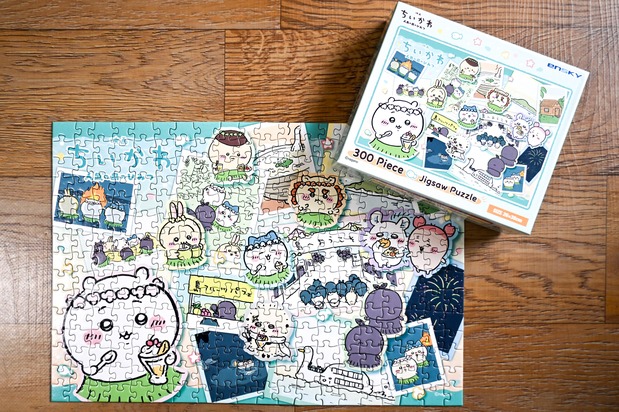
 Chiikawa and friends appear in a jigsaw puzzle based on the movie. (© Nippon.com)
Let us begin with a geopolitical briefing on the conflict depicted in the film.
Lured to a remote island by an advertisement promising generous financial rewards—an offer subsequently revealed to be based on false information—Chiikawa and his companions discover that their hosts have rather different expectations. The islanders want them to eliminate Siren, a fearsome creature responsible for repeated killings among the local population.
With only fragmentary intelligence about the situation on the ground and virtually no understanding of the conflict’s origins, Chiikawa and his friends find themselves operating as an expeditionary armed force, effectively intervening on behalf of the islanders against Siren.
Yet the islanders’ account of the conflict contains a critical omission. The violence began when certain islanders killed a mermaid who had been Siren’s companion. Seeking to identify the perpetrators, Siren launched attacks against the island’s inhabitants as a whole. These attacks bore the hallmarks of collective punishment: an entire population was made to suffer for the actions of particular individuals.
Meanwhile, the intervention itself proceeds with difficulties. The hastily assembled coalition struggles to coordinate its operations, as differences in the preferences and behavior of its members undermine cohesion. The conflict enters a stalemate. Eventually, however, the arrival of a new intervenor, Shimajirō, together with the repurposing of civilian goods for combat, shifts the balance on the battlefield.
Of course, Chiikawa is not a straightforward allegory of real-world international politics. I am often asked to explain the wars in Ukraine or Palestine through Chiikawa, but there are obvious limits to assigning fictional characters the roles of particular states or political leaders.
What makes the film illuminating is something more fundamental: the ways in which conflict defies simple moral categories, allies pursue divergent interests, and individually understandable choices produce collectively disastrous outcomes. In a world where security is never guaranteed and vulnerable creatures must survive with limited information and resources, many of the central problems of international relations become strikingly visible.
 Momonga, at left, and Usagi in their islander garb. (© Nippon.com)
The Tragedy of Small Creature Politics
In The Tragedy of Great Power Politics, the international relations scholar John J. Mearsheimer examines how states seeking to ensure their own survival and security become trapped in struggles for power with other states.
Chiikawa and his companions are, of course, not great powers. Nor are they states bent on maximizing their relative power, as Mearsheimer’s theory of offensive realism would suggest. Yet the film exposes a tragedy that also lies at the heart of international politics: Actions taken to protect one’s own interests—or those of loved ones—can generate devastating consequences for others.
Consider the islander Hitoha, whose desperate attempt to save the life of her beloved Futaba results in the death of a mermaid. From Hitoha’s perspective, the motivation is understandable. For the mermaid, the consequences are fatal.
Siren’s subsequent retaliation, too, can be understood in terms of grief, anger, and the desire for retribution. But understanding these motives does not justify attacks against islanders who bear no responsibility for the original killing.
This distinction is crucial. To explain an actor’s behavior is not to excuse it. We may understand why Hitoha acted as she did, or why Siren sought revenge, without absolving either of responsibility for the harm their actions caused.
From an international relations perspective, the central problem is the divergence between decisions that make sense to individual actors and the destructive outcomes generated by their interaction. No one needs to have intended a large-scale conflict for one to emerge. What begins with an attempt to save a loved one escalates into cycles of retaliation and countermeasures, drawing ever more actors into the confrontation.
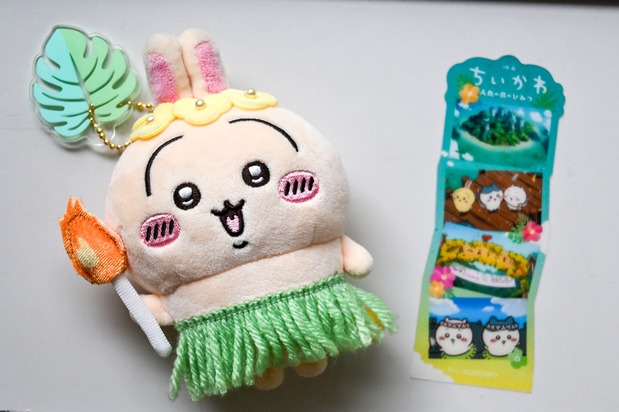 Chiikawa goods associated with the film have proved popular with fans. (© Nippon.com)
Coalition of the Unwitting
The expression “Coalition of the Willing” became widely associated with the US-led intervention in Iraq in 2003. But what should we call a coalition whose participants do not fully understand what they have signed up for?
Chiikawa and his companions might more appropriately be described as a Coalition of the Unwitting.
They join the islanders’ fight without knowing the underlying causes of the conflict or the full circumstances of Siren’s actions. Their intervention thus takes place under conditions of profound information asymmetry. Moreover, the security interests of the islanders and the risks borne by the intervening outsiders are not necessarily aligned.
Nor is this improvised coalition a unified actor.
Momonga, in particular, provides an extraordinary case study in the difficulties of alliance politics. Self-indulgent and frequently uncooperative, Momonga insists on getting something nice and sweet to eat at a critical moment in the fighting. Such behavior illustrates a familiar problem: membership in the same coalition does not imply identical preferences, compatible priorities, or a shared willingness to bear the costs of collective action.
Yet Momonga is far from being a mere liability.
Later in the story, Momonga actively participates in a diversionary operation involving Usagi’s rap performance. In the final stages of the confrontation, Momonga’s exceptionally fluffy tail becomes instrumental in amplifying the effectiveness of an unexpected battlefield asset: an extraordinarily spicy curry.
What looks like a marginal capability turns out to have considerable operational value.
This is more than a charming comic twist. It points to a fundamental problem in alliance management: Divergent preferences and complementary capabilities can coexist within the same coalition. An ally who obstructs cooperation in one situation may provide an indispensable contribution in another.
Coalition effectiveness cannot be assessed simply by measuring how agreeable, disciplined, or cooperative each member appears to be. It also depends on how different capabilities interact under changing circumstances.
There are no entirely reliable allies, just as there are no allies who contribute absolutely nothing.
 Characters from The Secret of Mermaid Island appear in collectible sticker form. (© Nippon.com)
Peace Without Siren?
The brutal realities of conflict termination come into sharp focus in the film’s closing sequence.
Siren lies defeated, suffering and apparently no longer capable of mounting an attack. Yet the surrounding islanders, overcome with excitement, demand that the punishment continue.
Watching the scene unfold, Chiikawa and his companions begin to question what they have accomplished: Was this really the right thing to do?
It is a striking illustration of the distinction between military victory and political conflict resolution. Neutralizing an adversary’s ability to inflict harm is not the same as determining when retaliation should end—or establishing a political settlement that can prevent further violence.
In January 1917, while the First World War was still raging, US President Woodrow Wilson called for “Peace Without Victory.” His argument was that a peace imposed by victors upon a humiliated and resentful defeated side would struggle to endure.
But what about Peace Without Siren?
Siren ultimately leaves Mermaid Island, and the islanders are freed from the immediate threat. This is unquestionably a meaningful achievement for a population that has suffered repeated attacks.
Yet the underlying causes of the conflict remain unresolved. The killing of the mermaid has not been reckoned with, and Siren’s desire for revenge has not disappeared.
Hitoha and Futaba secretly flee to another island without revealing to the other islanders the truth about the killing that triggered the conflict. Siren and the others continue their pursuit.
In other words, while one phase of the fighting has ended, the antagonism between the parties persists. The film’s final moments even suggest the possibility of the conflict spreading geographically, as the pursuit moves beyond the original island.
International relations scholarship distinguishes among the cessation of fighting, the termination of hostilities, the political settlement of a dispute, and the establishment of a durable peace. These are related but fundamentally different outcomes.
The film’s ending captures this distinction with unsettling clarity. Removing an immediate threat does not necessarily eliminate the grievances, incentives, and unresolved disputes that generated the conflict in the first place.
An apparent victory may mark the end of a battle without marking the end of the conflict.
 Chiikawa: More than just adorable? (© Nippon.com)
How I Learned to Keep Worrying and Love Chiikawa
Conflicts do not always begin because every participant seeks a large-scale confrontation. Decisions that appear understandable from the perspective of individual actors can interact in unexpected ways, generating spirals of violence that none of them initially intended.
And once a conflict has begun, resolving it may prove far more difficult than achieving victory on the battlefield.
Chiikawa presents these paradoxes of international politics with extraordinary force, precisely because they emerge from the struggles of such small and seemingly innocent creatures.
Thinking about international politics through Chiikawa is not an exercise in identifying which character represents which country. Rather, it allows us to ask more searching questions about the world beyond the screen.
Whom are we trying to protect? Who bears the costs of providing security? Why is cooperation so difficult even among those who stand on the same side? And once a threat has been removed, what more must be done to build a lasting peace?
I entered the cinema hoping that Chiikawa and his friends would help me forget international politics for a little while.
Instead, they left me with even more reasons to keep thinking about it.
(Originally written in English. Banner photo: Chiikawa characters go global, appearing at a pop-up shop in Sichuan, China, in May 2024. © Yuan Kejia/VCG.)