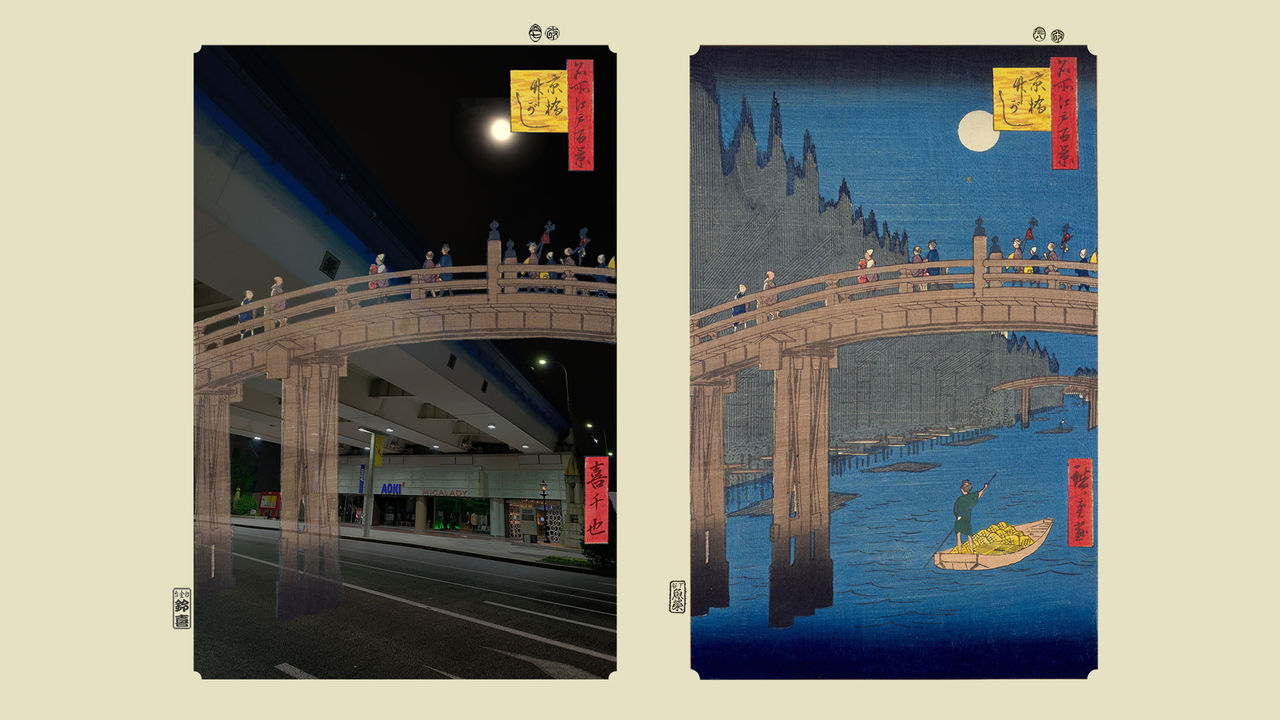
“Bamboo Yards, Kyōbashi Bridge”: Expressway Echoes of an Elegant Span
Guideto Japan
- English
- 日本語
- 简体字
- 繁體字
- Français
- Español
- العربية
- Русский
Echoes of Long-Lost Bamboo in an Expressway Guardrail
The Kyōbashi bridge is said to be named for Kyoto as it was the first span travelers crossed as they set off down the Tōkaidō highway from Nihonbashi to the old capital. Hiroshige’s print shows tall bundles of bamboo for sale along on the adjacent riverbank. The artist lived in nearby Tokiwa, so this moonlit tableau must have been a familiar sight to him. The bamboo yards crowding the bank of the river are drawn in beautiful perspective, while the bridge dominates the foreground.
Because the print is considered an autumn scene (from July to September by the old calendar), I always assumed that it was the mid-August full moon. But the men crossing the bridge are carrying bonten back from their pilgrimage to Mount Ōyama (made between June 27 and July 17), leading some to argue that it must be the mid-July moon instead. This would put the scene around the middle of Obon when Japanese people welcome their ancestors’ spirits to their homes, so perhaps the men were hurrying home so as not to be late for the festival.
I took my photo standing under the Tokyo Expressway on the east side of Ginza-dōri-guchi intersection. The river has long since been filled in, and the bridge is no more. At first I was disappointed, but then I noticed the colors of the expressway guardrails. By forcing the perspective with a wide-angled lens, I was able to take a photograph where the expressway itself took the place of the bamboo yards, towering above the viewer and fading to indigo at the top.
About the Location
Kyōbashi Bridge
Built by the shogunate during the Edo period (1603–1868), Kyōbashi bridge had central pillars topped with giboshi ornaments in the shape of sacred gems. Outside of the Edo castle moat, Kyōbashi, Nihonbashi, and Shinbashi were the only bridges adorned in this way, indicating their importance.
In 1875, Kyōbashi’s original wooden structure was replaced with a stone arch bridge. This was rebuilt in 1905, and again in 1922, but in 1959 the river itself was filled in and paved over. Now two pillars of the 1875 bridge and one from the 1922 bridge are all that remain.
The area itself was officially named Kyōbashi in 1931. Today, it is a business district full of corporate offices. However, it is not without a certain air of culture since it is also home to the Bridgestone Museum of Art and many galleries and antique stores. The scene Hiroshige created is long gone, replaced by a road east of Chūō-dōri and the north of the expressway. But in 2012 that road was renamed Kyōbashi Takegashi-dōri, in honor of the old bridge and bamboo yards.
One Hundred Famous Views of Edo by Kichiya, the Ukiyo Photographer: Today’s Tokyo Through Hiroshige’s Eyes
Meisho Edo hyakkei, known in the West as One Hundred Famous Views of Edo, was one of ukiyo-e artist Utagawa Hiroshige’s most celebrated works, influencing even Western artists like Van Gogh and Monet. Drawn in Hiroshige’s final years and published from 1856 to 1861, the series depicted the sights of Edo (as Tokyo was then known) through the changing seasons. Audiences around the world admired Hiroshige’s inventive use of bold compositions, bird’s-eye-view perspectives, and vivid colors. A century and a half later, “ukiyo photographer” Kichiya has set himself the task of recreating each of these views with a photograph taken in the same place, at the same time of year, from the same angle. Join us in this new series at Nippon.com on a tour of these “famous views” in Edo and modern-day Tokyo, guided by Kichiya’s artistry and his knowledge of old maps and life in Edo.
tourism Tokyo ukiyo-e One Hundred Famous Views of Edo by Kichiya Kantō