
Few Cards Left to Play: Japan’s Weak Hand in Tariff Negotiations
Economy Politics World- English
- 日本語
- 简体字
- 繁體字
- Français
- Español
- العربية
- Русский
Final Deadline?
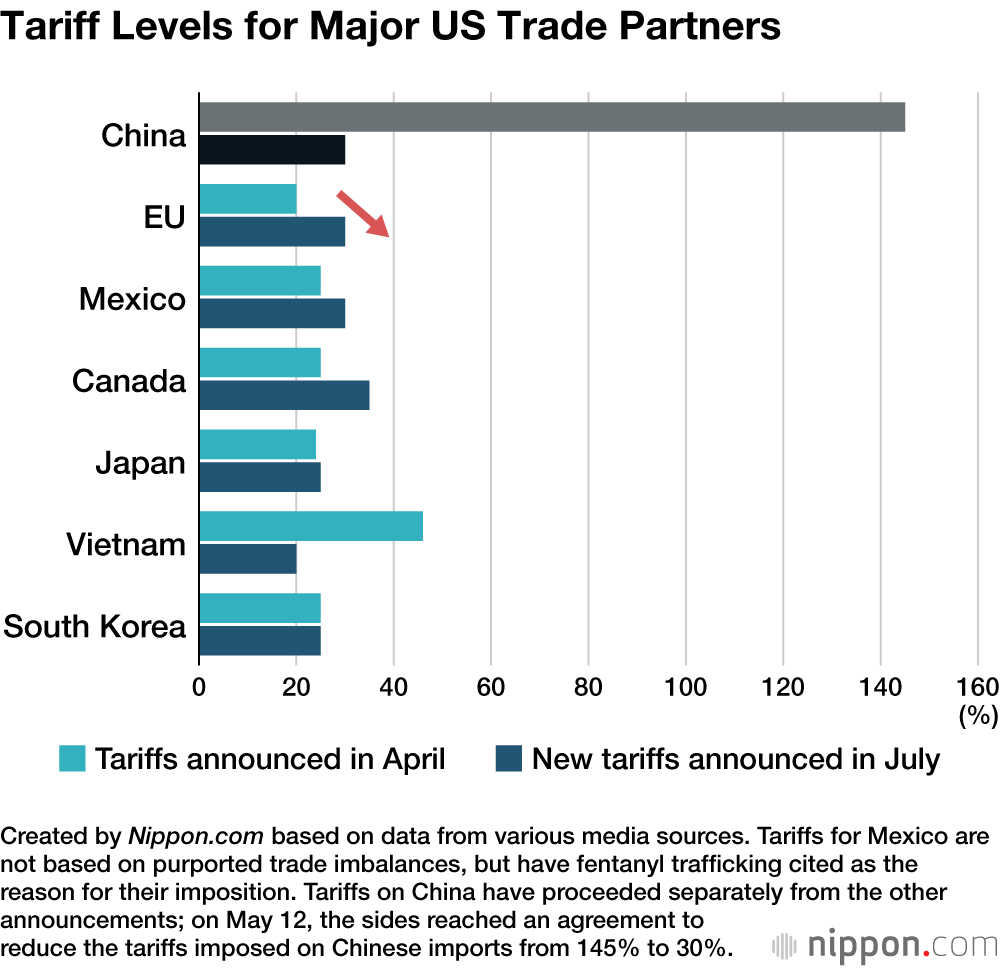
On July 7, 2025, US President Donald Trump sent letters to a number of major trading partners informing them of new tariff rates to kick in on exports to the United States from August 1. Japan was no exception, receiving a letter (also shared by the president on social media) notifying it of a 25% rate to be applied across the board in the absence of further agreements to be reached by the end of the month.
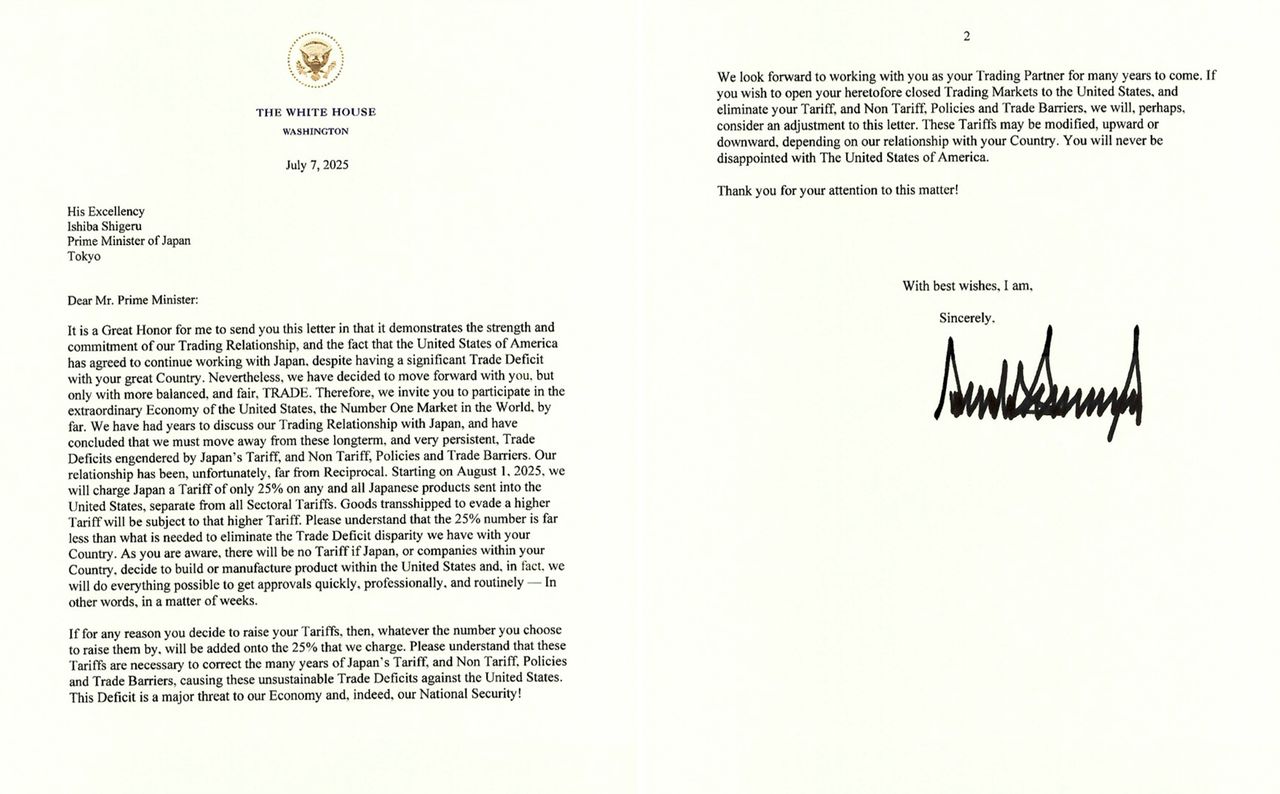
US President Donald Trump announced information on social media about new 25% tariffs on Japan. (© Jiji)
Tariff negotiations between the United States and Japan will continue until at least the end of July. However, Japan has few cards left to play. It is unlikely to be able to produce additional materials that prove decisive, even with more time for discussions. What is needed to bring down tariffs, as China succeeded in doing, is a powerful advantage on the level of controlling exports of rare earths. Japan has nothing like this.
When US Treasury Secretary Scott Bessent visits Japan ahead of the July 20 House of Councillors election, he will presumably hold talks of some kind with Prime Minister Ishiba Shigeru and other key figures in the Japanese government. As any serious discussion will take place after the election, however, it will be a short-term showdown. The opposition parties have not made any inopportune statements to hinder progress, so even if the ruling coalition of the Liberal Democratic Party and Kōmeitō fails to secure a majority, leading to the establishment of a new coalition government, I do not think it will affect negotiations.
US President Donald Trump has stressed that he has no plans to shift the deadline from the end of July, but financial markets assume that he will postpone it again. I think that while Trump is probably telling himself that “this time it really is final,” if no agreement is reached, he will extend it again.
US-EU Talks Break Down
With negotiations at an impasse, the one bright note had been the progress of tariff negotiations between the United States and European Union. Japan, lacking an ace up its sleeve that could sway Trump, saw the EU as a last hope, in that from preliminary observations, it seemed to be putting up a good fight, despite being in a similar position to Japan in having a large trade surplus with the United States.
Some commentators said that the EU might secure “reciprocal” tariffs as low as 10% with no additional punitive levies, and reach some kind of agreement to decrease automobile tariffs. If this was the case, it would be a benchmark for Japan in its own negotiations, and I thought it would mean some realistic possibility of tariff reductions.
However, on July 12 Trump announced that tariffs on the EU from August 1 would be 30% (up from the previous figure of 20%). While negotiations are still ongoing, this was an unexpectedly harsh turn of events. If there had been a US-EU agreement to reduce tariffs, it would have left room for compromise in Japan’s case.
The United States has not decreased its 25% automobile tariff on EU vehicles. Japan previously proposed a plan to reduce its trade deficit by reimporting vehicles manufactured in the United States as a way of getting a reduction in tariffs, but this failed to bear fruit. Apparently, the EU put forward a similar plan, and if this had been accepted with a positive effect on tariffs, Japan could have pressed the United States again. Instead, the reduction of automobile tariffs has become an even more difficult task for both the EU and Japan.
Three Inconsistent Demands
Trump has made three demands of Japan: to cut the trade deficit, eliminate “nontariff barriers” to imports of American automobiles, and increase rice imports. There is no logical connection between the three. Even if Japan removed nontariff barriers on automobiles and hiked its imports of rice, it would barely affect the trade deficit. Trump’s demands are inconsistent, but no doubt he would only bluster in response to anyone pointing this out.
No matter how many times Japan might say that US cars do not sell because nobody wants to buy them, if the US side consistently responds that the nontariff barriers are the problem, the discussion just goes round in circles. One option would be for Japan to relax its safety standards that are presented as one of these barriers, so that sales thereafter would depend only on the US automakers’ efforts.
Besides the limited effect on the trade imbalance of any increase in rice imports, there are doubts about the US capability to supply grain for export. It is also unclear how much could be sent to tackle Japan’s current rice shortages while they last. Even so, Japan should make efforts to increase rice imports, if that is what Trump wants, and then explain how this does not result in a reduced deficit.
An Economic Blow
If Trump’s across-the-board and automobile tariffs do end up fixed at 25%, Japan’s government would need to provide support to sectors that are directly affected. Some think tanks (not including my own Marubeni Institute) have suggested that tariffs at this level would lead to a reduction in Japan’s GDP of around 0.8% to 1.0%, which might mean dropping into negative growth.
While Japan’s auto industry cannot absorb 25% tariffs, the fact is that it already produces more cars in the United States than it exports there. Other industries are not particularly export-oriented either. One argument goes that building factories in the United States to avoid steep tariffs will lead to a hollowing out of domestic manufacturing, but labor shortages actually mean that production in Japan is not operating at full capacity. With the use of local production, and presuming that policy support is there, I think there is the possibility of getting through the crisis, even if there is confusion in some industries.
(Originally published in Japanese on July 16, 2025, based on an interview by Mochida Jōji of Nippon.com. Banner photo: US President Donald Trump announces “reciprocal” tariffs on many countries on April 2, 2025. © Reuters.)