Is the US-Japan Tariff Agreement Really “Good Enough”?
Economy Politics World- English
- 日本語
- 简体字
- 繁體字
- Français
- Español
- العربية
- Русский
Reduced Tariff Rate Still a Heavy Burden
On July 23, an uncertain period came to an end with the announcement of a tariff, trade, and investment agreement between Japan and the United States. A significant factor in the sudden development in bilateral tariff discussions was likely US President Donald Trump’s domestic political calculations. Specifically, Trump wanted to promote his achievements in negotiations while also diverting public attention from his own scandals.
The subsequently announced tariff agreement between Tokyo and Washington imposes a 15% rate on Japanese imports into the United States. As this was an improvement on the 25% rate initially levied on Japanese exporters, Tokyo stock prices enjoyed a sharp rise. However, we should not lose sight of the fact that 15% is still a significant increase for many industries—Japanese automobile exporters will now face a tariff of 15% rather than the 2.5% rate in place prior to the second Trump administration.
As of July 31, a Yale University–affiliated research institution estimated overall effective tariff rates into the United States at 18.3%. This represents the highest rate since 1934. The Budget Lab at Yale further estimated that the additional per household burden on American consumers will reach $2,400. To the degree that companies decide to pass on the burden of tariffs to consumers, this is bad news for the global economy—including for Japan. Given the Trump administration’s unpredictability, companies are also facing difficulties making medium- to long-term plans, which in turn will make them cautious about growth-focused capital investment.
In relative terms, Japanese competitiveness with other nations exporting to the American market will not decline as the negotiated tariff rate is the same as that imposed on the European Union and South Korea. As the current exchange rate is around ¥140 to the dollar—a historically low level of yen appreciation comparable to the 1970s— Japanese companies should therefore be able to absorb the impact of this 15% tariff to some extent.
Furthermore, Japanese companies in the past have tended to embrace the spirit of perseverance during difficult economic times and avoided passing on tariff costs to American consumers. However, the risk is that Japanese domestic subcontractors will eventually bear brunt of these tariff impositions rather than American consumers.
European and US companies selling directly to the American market have so far also been cautious about raising prices, but they are beginning to do so gradually in consideration of shareholders and profitability. Certainly, it is not advisable for Japanese companies to raise prices sharply and alienate customers.
However, while it would be problematic to raise prices suddenly and lose consumers, I think Japanese companies need to closely monitor the market situation relative to their competitors and consider gradually passing on the costs to the consumer so that Americans also come to understand and feel the impact of these policies.
Outline of the US-Japan Strategic Trade and Investment Agreement
- Baseline tariff rate on Japanese imports now 15% (down from 25%)
- Japan will invest $550 billion (¥80 trillion) into the United States
- 90% of investment profits will remain in the United States
- Japan will immediately increase imports of American rice by 75%
- American automotive standards will be applied in Japan
- Both countries will explore a new offtake agreement for Alaskan liquefied natural gas
- Japan agrees to additional purchases of US defense equipment (billions of dollars annually)
Source: White House fact sheets (July 23, 2025)
Ambiguity Remains
As can be seen above, the Strategic Trade and Investment Agreement is still a broad outline rather than a comprehensive agreement. The final details need to be worked out, so Japanese authorities will still need to remain resolute and willing to engage in tough negotiations.
Differences in perception between the United States and Japan have already surfaced. For example, Treasury Secretary Scott Bessent announced that the agreement with Japan will be reviewed every quarter, warning that if Trump is not satisfied with progress, the President may reinstate a tariff of 25 percent on cars and other goods. This was apparently the first time Japanese authorities had heard of this.
There are also ample uncertainties surrounding Japan’s promise of $550 billion of investment into the American economy. While the American government expects Japanese companies to invest their own capital immediately, Japanese authorities insist that this commitment represents a “line of credit” provided by government-affiliated financial institutions.
Ultimately, President Trump wants to look good domestically and is focused on giving the impression that he is skillfully handling foreign relations. Japan needs to exploit this and approach the administration in a way that favors its interests. For example, Japanese companies and the government will need to work hard to show the Trump administration their commitment to the new framework, especially by including in the $550 billion figure investments that Japanese companies would have likely made voluntarily in the first place. Furthermore, it is important to realize that it is unlikely that the Trump administration will move to further raise tariffs ahead of the 2026 midterm elections in November next year due to the likely inflationary domestic effects of such a move.
Nevertheless, caution is needed as President Trump is very fickle. He has three and a half years left in his term and Tokyo needs to be prepared for the fact that he will not make considered decisions on policy and will continue to run his administration based on coercion. During his first term, he was surrounded by advisors who were considered reasonable and who put the brakes on his excessive policies. This time around, Trump has surrounded himself with people who are loyal to him and are more likely to enable extreme policies. There are very few people who are willing or able to check his impulses.
Threats to the Independence of the Federal Reserve
Trump’s reckless trade policies may not ultimately cause the US dollar to lose its place as the world’s reserve currency. However, its relative strength is likely to weaken as the gap with the euro, the second-ranked currency, gradually narrows. After the 2008 global financial crisis, the American economy recovered by increasing productivity, mainly in the digital industry. The greenback’s position strengthened further in response. However, this time the Trump administration’s efforts to protect heavy and capital-intensive industries through its foreign economic policy are undermining the strengths of the American economy, which will accelerate the relative decline of the dollar.
Compounding this is volatility in the market for US Treasury bonds and a possible long-term increase in the cost of debt. Indeed, in April, concerns over Trump’s tariffs led to a big sell off of US Treasury bonds. President Trump is also once again threatening the independence of the US Federal Reserve Board by putting pressure on the Federal Reserve to lower policy interest rates, ostensibly to stimulate the economy.
However, the long-term consequences of such a move could be disastrous. If the Federal Reserve yields to the administration’s demands for interest rate cuts beyond what is required by the economic situation, confidence in the dollar will collapse and inflation will rise even more quickly than it is now. Treasury bonds will be sold off, long-term interest rates will rise, and the economy will fall into a vicious cycle of stagnation.
There is, in turn, a risk that upward pressure on interest rates will spread to the Japanese government bond market. Federal Reserve Chair Jerome Powell’s term ends in May 2026, and all eyes will be on the appointment of his successor.
The Pendulum May Not Swing Back Any Time Soon
Despite the political and economic turmoil unleashed by President Trump, the Democratic Party’s popularity has not risen in response. It is entirely possible that a Republican president will be elected again in 2028. While his policies will likely be more reasonable than Trump’s, they will probably stick to an “America First” stance that rejects free trade.
One American international relations scholar notes that it took a whole generation (about 30 years) after World War I for the United States to truly shake off its “America First” tendencies. Only then could the American government fully engage in the building of the post–World War II order, including taking an active role in the Cold War. It may well take a similar amount of time for people to realize that “America First” is a mistake this time around as well.
Therefore, other countries cannot simply ignore tariff challenges or just wait for a change in the political atmosphere. The recent compromises with the United States are only for the time being. If Washington does not significantly reverse course in the near future, the rest of the world will conclude that we have reached a “new normal” and start making other plans.
In Japan’s case, Tokyo will continue to recognize the economic and security importance of the Untied States. However, it will work harder than ever to avoid excessive dependence. Japan will cooperate more closely with countries with which it has built a relationship of trust, such as Europe and other Asian countries. It will pursue a two-track strategy that separates relations with the United States from those with trusted partners.
At the same time, no matter how President Trump’s attitude unfolds, it is extremely important for Japan to continue to assert the importance of the free trade system as a matter of principle. This can serve as the fundamental basis for diplomacy and enhancing the building of cooperative relationships with countries other than the United States.
The popularity of the antiglobalization sentiment central to the appeal of the Trump administration is rooted in widening economic disparities within the United States. Japan currently does not face the same degree of disparity, but it is nonetheless growing. Unlike the United States, Japan lacks natural resources, has low food self-sufficiency, and is experiencing rapid population decline. We therefore cannot even begin to think about adopting an antiglobalization or “Japan First” policy. Instead, the distorted political situation in the United States should be a lesson for others to learn from.
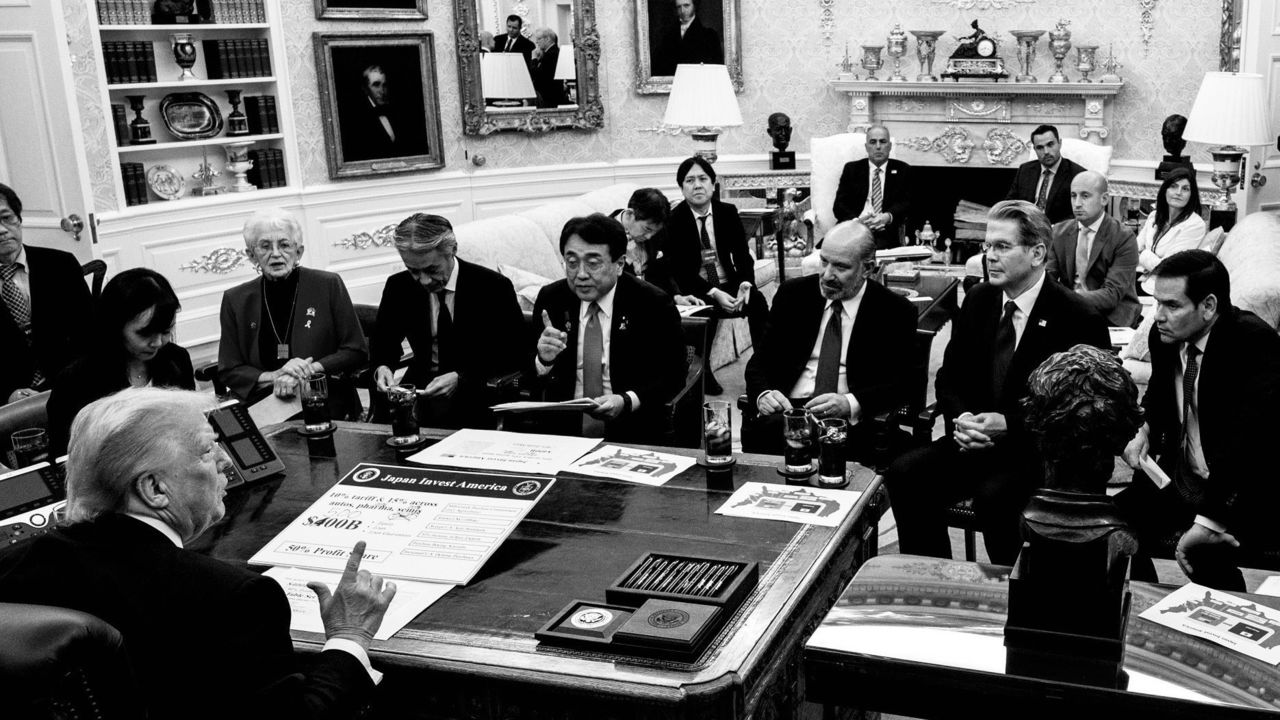
(Originally published in Japanese on August 8, 2025, based on an interview by Mochida Jōji of Nippon.com. Banner photo: A scene from Japan-US trade negotiations from the X account of presidential aide Dan Scavino, July 23, 2025. © Jiji.)