
President Lee’s “Pragmatic Diplomacy”: Can He Balance Foreign Ties and Security?
Politics- English
- 日本語
- 简体字
- 繁體字
- Français
- Español
- العربية
- Русский
Consistency Builds Trust Between Nations
Issues of historical awareness have long complicated Japan–South Korea relations. Following his election on June 3, South Korea’s new president Lee Jae-myung hinted at a more flexible approach to history issues, saying that “Taking a consistent approach is extremely important in diplomacy” and that it is “unrealistic” for new leaders to unilaterally change diplomatic tack based on their personal views. As such, President Lee seems likely to emphasize the importance of “pragmatic diplomacy centered on national interests” over historical consciousness in relations with Japan.
Also notable is that, when President Lee made his introductory phone calls to world leaders on June 9, Japanese Prime Minister Ishiba Shigeru was second after US President Donald Trump. When fellow progressive Moon Jae-in took office in 2017, he spoke to both the United States and China before speaking to the Japanese leader. President Moon also advocated “balanced diplomacy” between the United States and China. By contrast, Prime Minister Ishiba and President Lee agreed that “amid a worsening strategic environment” in East Asia, maintaining close bilateral ties between Japan and South Korea, as well as trilateral cooperation with the United States, is essential to diplomatic stability.
On June 17, Lee and Ishiba conducted an in-person meeting on the sidelines of the G7 Summit in Canada. There, the South Korean president emphasized the importance of “looking past minor differences” to keep building a “cooperative relationship” in a “future-oriented manner.” Welcoming this, Prime Minister Ishiba expressed hope that, amid the current challenging international situation, cooperation between the two nations would contribute to both regional security and global stability. With both sides embracing “pragmatic diplomacy,” it appears that the next chapter of Japan–South Korea relations is off to a smooth start.
The so-called “minor differences” President Lee has in mind relate to events over the last decade that soured diplomatic relations between the neighbors. In 2015, the conservative administration of Park Geun-hye concluded an agreement with the Abe Shinzō administration regarding the comfort women issue. However, the progressive Moon Jae-in administration effectively abandoned it in 2018, in the process damaging mutual trust between the two countries. There were concerns that something similar would happen this time with the wartime colonial laborer issue. While this issue was effectively “resolved” in Korea during the Yoon Suk Yeol administration, there are concerns in Japan that a progressive administration will revive it.
During the three years of the Yoon administration, Japan–South Korea relations quickly normalized, and trilateral security cooperation among Japan, the United States, and South Korea similarly strengthened. Will this momentum be maintained going forward?
This year, 2025, marks the eightieth anniversary of the end of World War II and the Korean Peninsula’s liberation from colonial rule. It is also the sixtieth anniversary of the normalization of diplomatic relations between Japan and South Korea. During this period, the countries concluded various agreements, including the 1965 Treaty on Basic Relations and the Agreement on the Settlement of Problems concerning Property and Claims and on Economic Cooperation. They also entered into security agreements such as the 2016 General Security of Military Information Agreement to protect classified military information. Japan has also addressed war responsibility through official statements by Prime Minister Murayama Tomiichi in 1995, by Prime Minister Kan Naoto in 2010, and by Prime Minister Abe in 2015. With the inauguration of South Korea’s new president coinciding with the sixtieth anniversary of his country’s diplomatic relations with Japan, it is the perfect opportunity for both sides to reaffirm the core international legal principle of pacta sunt servanda (“agreements must be kept”) that underpins mutual international trust.
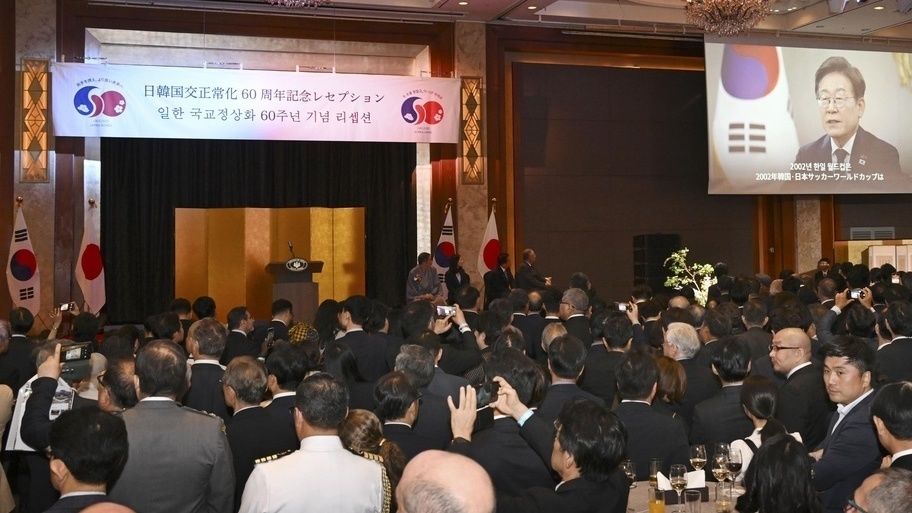
An event held in Seoul on June 16, 2025, to commemorate the sixtieth anniversary of the normalization of diplomatic relations between Japan and South Korea. President Lee can be seen delivering a video message (back right). (© Kyōdō)
President Lee Jae-myung declared that the “real” Republic of Korea has resumed with his election, ending the period of social unrest that began with the declaration of martial law by his predecessor that many progressives saw as a coup d’état. His challenge is to reset domestic affairs while emphasizing the importance of consistency in foreign policy and national security. President Lee has stated that he intends to stabilize relations with North Korea, thereby reducing “Korea risk,” but a much greater risk that he must contend with is one where South Korea is perceived as a “swing state” where a new government regularly results in drastic foreign and security policy changes.
Trilateral Cooperation but No Mention of the “Indo-Pacific”
Polarization between conservatives and progressives in South Korea remains severe. Reaching consensus in the National Assembly has been extremely difficult, and divisions among citizens are intensifying and becoming more emotional. These dynamics are particularly evident in foreign affairs and national security, especially when Japan and North Korea are involved.
According to a January public opinion survey conducted by the East Asia Institute, a South Korean think tank, when asked about the most important issue the South Korean government should prioritize in diplomacy toward Japan, conservative respondents cited “resolving historical issues” (24.0%) less frequently than “advancing future-oriented cooperation” (55.5%). Progressive respondents, however, were the mirror opposite: 56.2% wanted to prioritize resolving historical issues versus 26.8% preferring to emphasize cooperation. If President Lee Jae-myung wants to maintain his support base, a resurgence of historical issues should be expected at some point during his administration.
There are similar divisions when it comes to South Korea’s policy toward North Korea and the United States. Among conservative respondents, 41.5% wish to strengthen security measures while only 17.0% of progressives chose this as a priority. On the other hand, only 15.7% of conservatives valued “expanding inter-Korean exchanges,” while 44.6% of progressive respondents chose this option. Regarding South Korea’s general approach to relations with the United States, 50.4% of conservatives selected strengthening the US-ROK alliance as the top priority, compared with only 26.6% of progressive respondents. Progressives on the other hand were more likely to select “establishing an equal partnership with the United States” as the top priority (32.6%)—only 9.8% of conservative respondents chose this option. Despite these divisions, majorities of both progressive (55.1%) and conservative (84.6%) respondents did favor strengthening trilateral military security cooperation among Japan, the United States, and South Korea.
In a situation of extreme polarization where citizens unreservedly support or oppose the policies of an administration based on their ideology, it can be very difficult for new governments to carry forward initiatives of their predecessors if they are not from the same party. The resolution of the wartime labor issue is a characteristic example of this, and indeed President Lee is on record as criticizing Yoon’s pragmatic diplomacy toward Japan on this issue as “humiliating” and something that “undermined national self-respect.”
Another prominent policy pursued by former President Yoon that could come under scrutiny is South Korea’s Indo-Pacific Strategy. The normalization of Japan–South Korea relations during the Yoon administration, and South Korea’s seeming rhetorical commitment to an Indo-Pacific Strategy, shaped the redefinition of the US-ROK relationship as a global comprehensive strategic alliance (April 2023), which in turn underpinned the Camp David Principles (August 2023) that marked the beginning of a new era of US-ROK-Japan trilateral security cooperation.
However, President Lee Jae-myung did not once mention the term “Indo-Pacific” during his presidential election campaign. What one does not say can often speak louder than what one does say. When considering future diplomatic policy, it is important to pay close attention to South Korea’s approach toward the Indo-Pacific strategy under the new administration.
A Stark Temperature Difference on Taiwan
The Free and Open Indo-Pacific concept was originally formulated by Japan as a global strategy, and some variation of this vision has subsequently been adopted by the United States, South Korea, Australia, Canada, the European Union, and the North Atlantic Treaty Organization. It has become an indispensable framework contextualizing the common international challenges of our time.
Particularly notable is that since 2022, the leaders of Japan and South Korea, as members of the IP4 (Indo-Pacific Partners) grouping with Australia and New Zealand, have participated in NATO summit meetings. This symbolizes the increasing interdependence of security between the Indo-Pacific and North Atlantic regions, as well as between the east and west of the Eurasian landmass.
At one time in the past Japan and South Korea were considered “quasi-allies” due to both nations sharing intimate military alliances with the United States. However, this designation is currently much more likely to be applied to Australia and the United Kingdom in Japan’s case. In order to reinvigorate the Japan–South Korea “quasi-alliance,” there needs to be a cold hard look at what Japan, South Korea, and the United States should do, what they can do, and importantly, what they cannot do together. It is important to neither get overly ambitious nor give up too soon when trying to forge trilateral cooperation.
One area of potential divergence relates to Taiwan. The 2023 Camp David Principles reaffirmed the importance of “peace and stability across the Taiwan Strait”; this was part of a broader clarification that the US-ROK alliance was a global comprehensive strategic alliance not necessarily limited to contingencies on the Korean Peninsula. The United States’ Indo-Pacific strategy is predicated on the region comprising one theater, with American forces in both South Korea and Japan effectively positioned on the frontlines of this single theater. In the event of a crisis not only on the Korean Peninsula but also in the Taiwan Strait or the South China Sea, the United States requires flexible and organic coordination between the US-ROK alliance and the US-Japan alliance.
In Tokyo, this notion is increasingly acceptable. Successive prime ministers have, after all, adopted the stance that “today’s Ukraine could be tomorrow’s East Asia” and that “a Taiwan contingency is a Japan contingency” requiring the US-Japan alliance to act. As such, political leaders and officials have doubled down on efforts to enhance deterrence and response capabilities and will continue to do so for the foreseeable future.
Mutual trust is of extreme importance between allies. In South Korea, though, there is a different sense of urgency. Taiwan is perceived to be far away, and the likelihood of a crisis is considered low. Somewhat astonishingly, President Lee has openly stated during past political campaigns that all South Korea needs to do is say xiexie (thank you) to both China and Taiwan should a conflict break out, and that Korea does not need to overly concern itself with Taiwan Strait events. President Lee does not appear to fear the possibility that President Trump might consider drawing down American forces from allies who are unwilling to commit to supporting American forces during a regional US-China conflict—wherever it takes place. This is despite the removal of American troops being likely to drastically alter the balance of power with North Korea and impact South Korea’s own security.
President Lee is on record repeatedly saying that fighting and winning is a poor strategy, and that it is more important to avoid fighting in the first place through diplomacy. While diplomatic efforts to avoid conflict are of course important, preparing for the worst is a fundamental principle of deterrence and national security approaches that aim to avoid fighting in the first place. The true effectiveness of President Lee’s “pragmatic diplomacy centered on national interests” will ultimately be determined by how the new South Korean president strikes the balance between diplomacy and national security.
(Originally published in Japanese. Banner photo: Japanese Prime Minister Ishiba Shigeru, at left, shakes hands with South Korean President Lee Jae-myung ahead of their summit meeting on June 17, 2025. © Jiji.)