Relations on the Rocks? Survey Finds 70% of Japanese See Ties with USA Fraying
Politics Economy- English
- 日本語
- 简体字
- 繁體字
- Français
- Español
- العربية
- Русский
Major Opinion Shift with Arrival of “Trump 2.0”?
The summer of 2025 marks the eightieth anniversary of the end of World War II, but today’s international landscape holds complexities and threats that can seem to rival the days leading up to that traumatic phase of history. From July 22 through 24, Nippon.com worked with JX Press on an online survey to gauge the Japanese people’s views of the reality now.
One key question asked whether Japan-US relations had improved or deteriorated since the January 2025 inauguration of Donald Trump for his second term in office. Responses were negative across the board, with a total of just 2.3% of respondents answering that ties had “improved considerably” or “improved somewhat.”
Meanwhile, fully 69.5% of respondents saw a worsening of bilateral ties, with 47.1% selecting “deteriorated somewhat” and 22.4% “deteriorated considerably.” In the middle stood 28.3% of respondents who had seen no meaningful change in Japan-US ties.
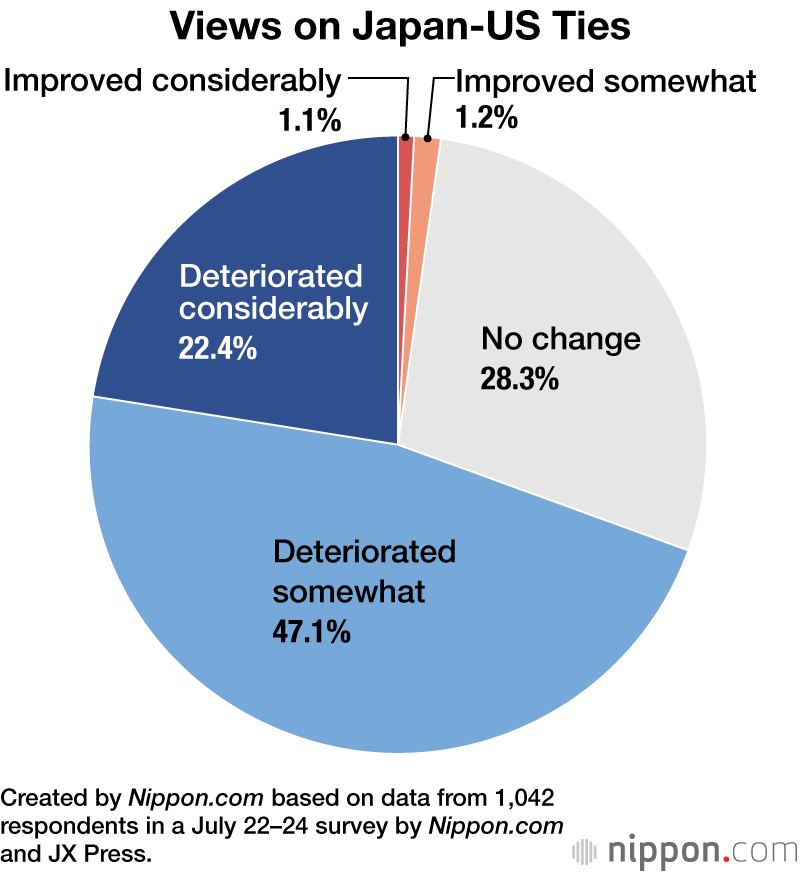
Negative views were particularly pronounced among older respondents, with more than 70% of those in their sixties and more than 80% of those in their seventies describing the relationship as having deteriorated. In the younger cohorts, a majority of those in their twenties and thirties opted for “No change” or “Deteriorated somewhat,” marking a generational gap in perceptions of bilateral ties—one that can perhaps be explained by the long years of warmer ties experienced by older Japanese.
A gender gap was also evident, with 28.5% of male respondents selecting “Deteriorated considerably,” compared to just 16.3% for female respondents.
The survey was carried out soon after the July 20 House of Councillors election, right around the July 23 announcement by US President Donald Trump of the agreement on setting tariffs on Japanese imports to the United States at 15% starting in August. Despite this representing a drop from the previously indicated 25% tariff level, this slight relaxation of Trump’s hard-line stance did little to stave off the majority view that Japan’s relationship with the United States was headed in the wrong direction—particularly given the uncertainties at the time surrounding the possibility of further negotiations swaying the outcome.
All in all, our results stand in stark contrast to those from a Cabinet Secretariat poll carried out in October and November 2024. That survey, focusing on public views of Japan’s foreign policy, asked respondents how they thought Japan-US relations were going and received an overwhelming 85.5% “going well” appraisal, compared to just 11.4% who felt they were “going poorly.”
These are different surveys carried out with different methods—the government poll was performed via postal mail, rather than online, and had 1,734 valid responses—but their wildly divergent results do point to a significant shift in Japanese views of the bilateral relationship in just over half a year.
Counting on Alliance Now a Minority View
The changes in Japanese views of their American allies are making themselves felt in their takes on Japan’s security issues as well.
One question in the survey asked: “What should Japan do in the future to ensure its peace and security?” The top response, chosen by 41.7% of respondents, was “Japan should work harder to defend itself,” outstripping both “Japan should forge ties with countries other than the United States” (33.7%) and “Japan should further enhance its ties with the United States” (24.7%).
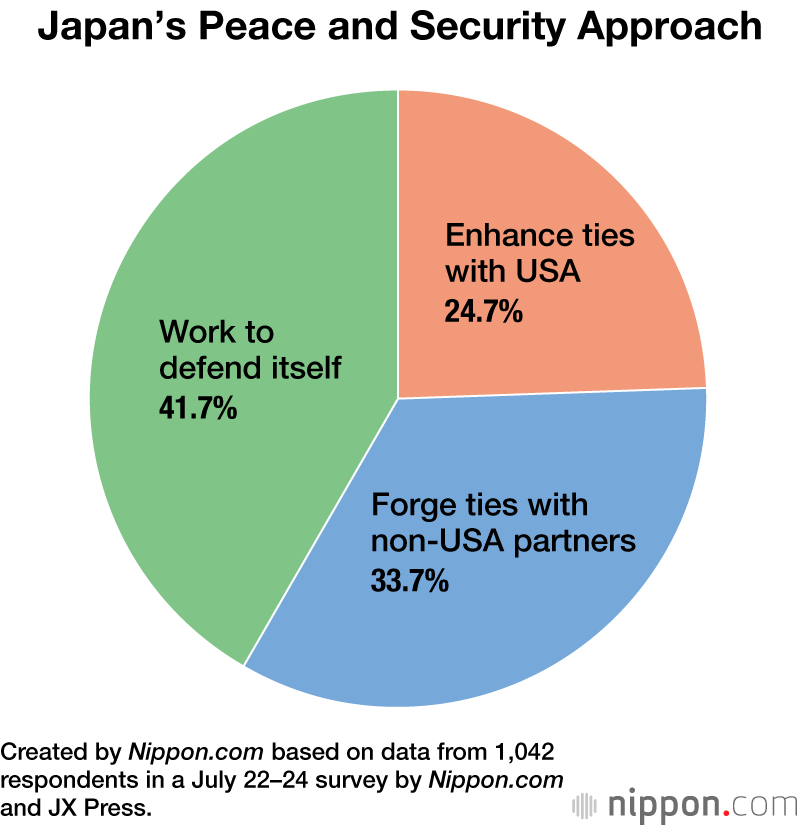
The Japan-US Security Treaty is at the core of the nation’s defense posture. Respondents stating Japan should further enhance its ties with its US alliance partner are basically arguing for a continuation of this as the nation’s main policy, while those suggesting it should forge ties with countries other than the United States likely have in mind a more multilateral security framework involving partners like Australia, South Korea, and the Philippines. The most popular reply, meanwhile, came from those hoping to see Japan take a more self-defense-oriented tack in the security sphere.
Breaking down the respondents by age shows that this self-defense choice was selected by more than 40% of people from their thirties through their sixties. Those aged 70 and up, meanwhile, had “ties with non-US partners” as their top choice, with more than 40%, well ahead of the self-defense option. There was relatively little difference by gender, with 36.2% of male respondents across all ages choosing “non-US partners” versus 31.1% of female respondents, and 40.6% of males choosing “self-defense” versus 42.8% of females.
For Japan, surrounded on several sides by nuclear-armed adversaries (Russia, North Korea, and China), any decision to develop its own defense capabilities to replace the US nuclear deterrent it now relies on will involve a massive increase in defense spending and fundamental revisions to its Constitution and other laws. It may be wiser to take the high percentage of respondents urging Japan to defend itself as less of an indication that the people are ready to take on these tasks and more of an expression of unease at a future where the United States is no longer seen as a reliable partner and ally.
One former senior administrative defense official, when asked about the self-defense option’s top position in the polling, notes: “To an extent I think this has been triggered by Donald Trump’s personality. There’s no doubt that we’ve seen a rise in the number of people with more negative views of America over the past half-year, but there’s still a need to think calmly about the security environment facing Japan today. It’s a tremendous leap from there to a nation that is fully self-sufficient in terms of its defense.”
Dwindling American Soft Power
The survey also asked respondents to choose from six options the one area where the United States maintained the strongest influence. Far and away in the lead was “Economic activities,” chosen by 59.7% of respondents, followed by “National defense” with 22.0%. The remaining choices were far less popular, as seen below.
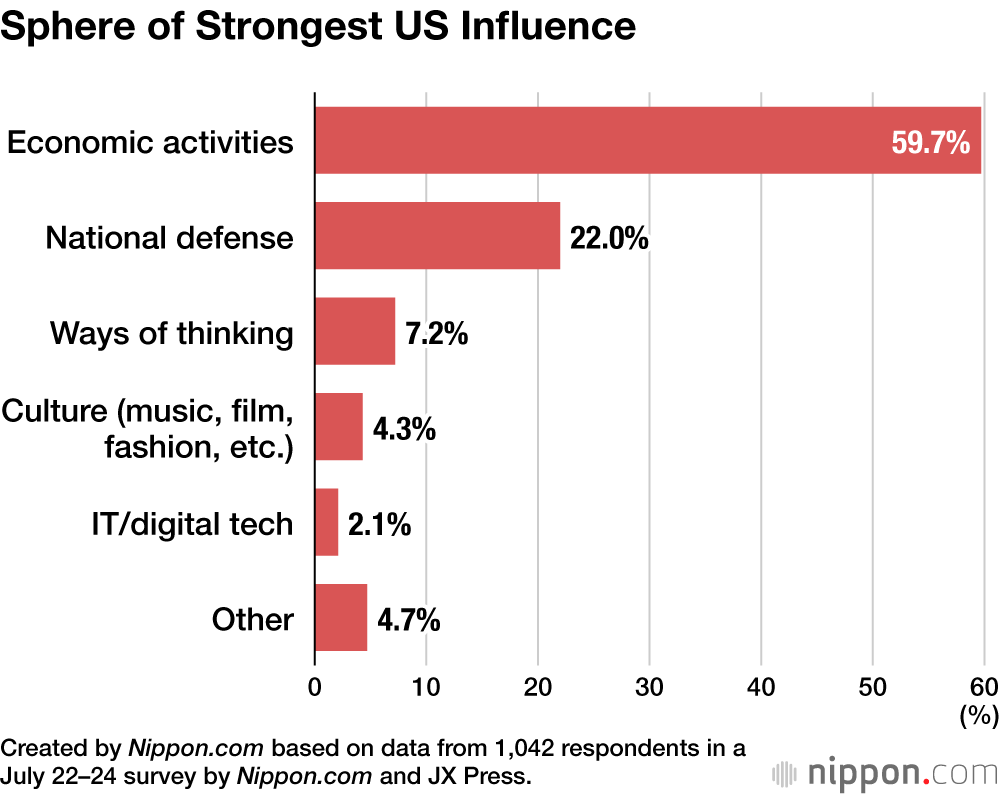
The economy may have come out on top in part due to the prevalence of news coverage of Japan-US tariff negotiations at the time of the survey. Respondents in all generations, from their twenties through their seventies, chose this option at a rate in the 50% to 60% range. Fully 5.6% of respondents in their twenties opted for “IT/digital tech,” considerably higher than the overall average. Women, meanwhile, were more likely to choose “Ways of thinking” (8.6%) and “Culture” (5.2%) than their male counterparts.
For Japan, the postwar era began with the United States wielding tremendous influence over almost every aspect of its existence. American soft power infused everything from Japanese people’s lifestyles and the forms of entertainment they pursued to their very culture. The survey results, however, hint that this trend may be far less pronounced today.
The Nippon.com/JX Press survey was administered to a random selection of monitors preregistered on JX Press’s website, with questions delivered and replies received online. There were a total of 1,042 valid responses.
(Originally written in Japanese. Banner photo © Pixta.)