Sony Group Takes On the World with Global “Demon Slayer” Hit Parade
Culture Entertainment Economy- English
- 日本語
- 简体字
- 繁體字
- Français
- Español
- العربية
- Русский
Screened by Over 70% of Cinemas on Opening Day
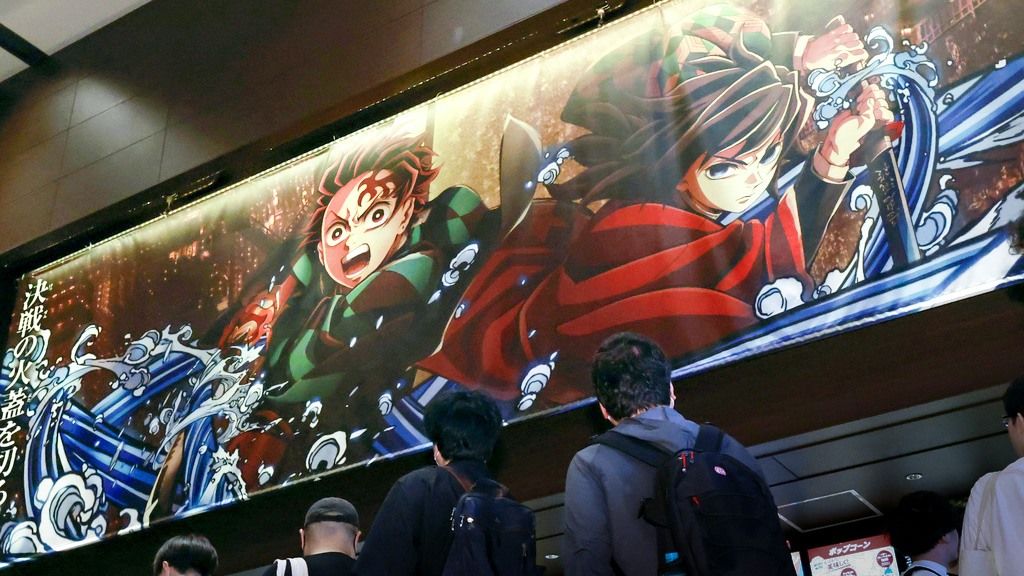
Demon Slayer: Kimetsu no Yaiba Infinity Castle opened in Japanese theaters on July 18. Subtitled Part 1: Akaza Returns, promising to be the first in three new cinematic outings for the series, it is the first Demon Slayer feature film in five years. Infinity Castle is the sequel to Demon Slayer: Kimetsu no Yaiba Mugen Train, which was released in October 2020 and went on to be Japan’s highest grossing movie ever. Around 75% of the country’s 590 cinemas screened Infinity Castle on its opening day. In fact, Universal Pictures is said to have delayed the Japan release of Jurassic World Rebirth to avoid clashing with the animated blockbuster.
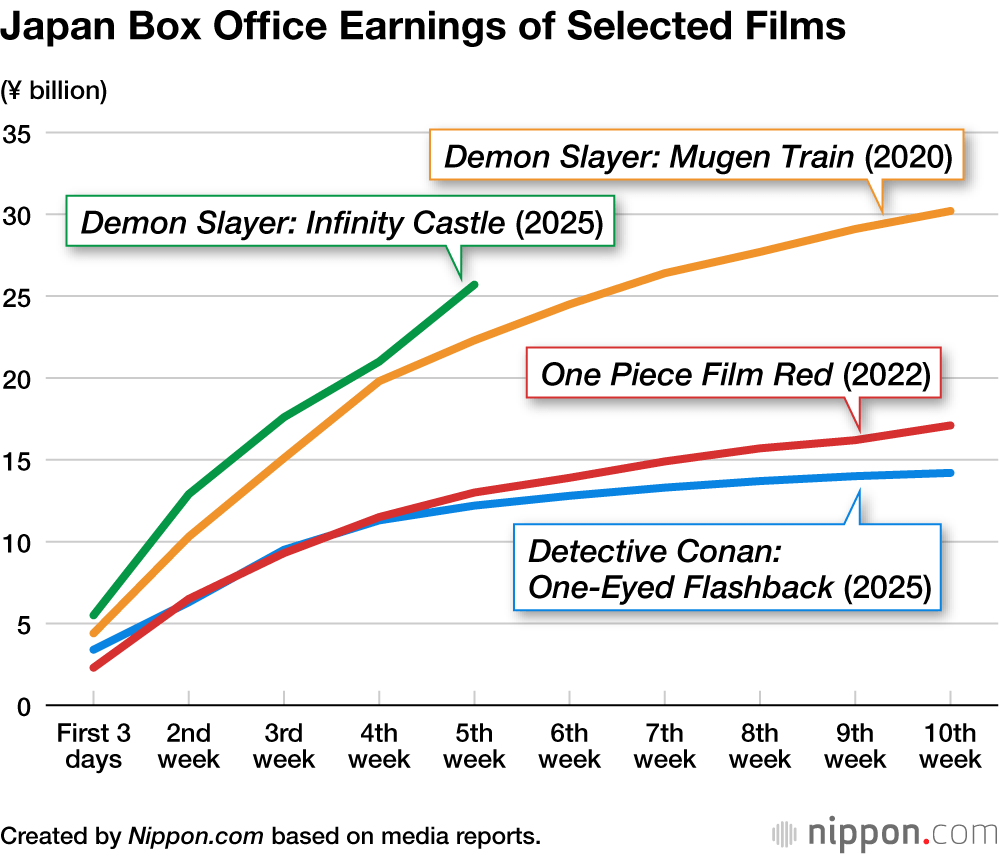
In its first five weeks, Infinity Castle earned ¥26 billion and was seen by an audience of 20 million. The film is set to overtake the total earnings of Mugen Train, over ¥40 billion, by mid-October.
Giving Ghibli a Run for its Money
In fact, Kimetsu no Yaiba is breaking many records as a Japanese film. Let us first consider whether it will be able to carve out a place as one of the country’s classic animations. The current record for box office earnings of a Japanese animated film series is held by Detective Conan, whose 28 films have grossed ¥140 billion. However the label “household name” really belongs to the works of Studio Ghibli, whose 24 films have entertained audiences for over 40 years. The studio’s films have grossed a total of ¥169 billion and been seen by a cumulative domestic audience of 120 million, both figures that help to define what we mean by “household name.”
According to the White Paper on Leisure (published by the Japan Productivity Center), 31 million Japanese residents said they went to the movies in 2024. The Mugen Train cumulative audience of 29 million is over 90% of this number, and the terrestrial TV adaptation is believed to have achieved an audience twice that size, suggesting that there is ample room for the Kimetsu no Yaiba series to surpass Ghibli.
The Japanese film industry experienced a long slump from the 1970s until the 1990s, and it was Ghibli who revived the industry with its prowess in the animated film genre. Princess Mononoke (1997) is credited with making a significant contribution to turning around audience numbers, which had been declining from a peak of more than 1.1 billion in 1958. The box-office juggernaut that was the Ghibli series, together with Japan’s multiplex boom, not only brought punters back to the cinema, but also turned family moviegoing in Golden Week, school summer holidays, and other extended holiday periods into an institution. This cultural paradigm shift was achieved singlehandedly by Ghibli, but now, Kimetsu no Yaiba is attempting to surpass it.
Set in a castle that stretches to the ends of the earth (and on into infinity), and portrayed with a unique 3D style of animation, the first Infinity Castle installment features fight scenes delivered with a sense of overwhelming speed. Infinity Castle thoughtfully incorporates visual effects in a manner not seen in previous animated works. So enthralling that you don’t even think about its two-hour-35-minute length, Infinity Castle takes the viewer on a rollercoaster ride of emotions that will leave even young children teary-eyed.
Akaza Returns is the first installment in the Infinity Castle trilogy, and the subsequent installments are expected to achieve collective box office revenues of up to ¥80 billion and a cumulative audience of 60 million. It is not hard to see how another Kimetsu no Yaiba boom will likely take place when the second and third films come out. The Demon Slayer films are sure to rewrite the history of Japanese animation that has been built up by Ghibli.
Slaying the Competition
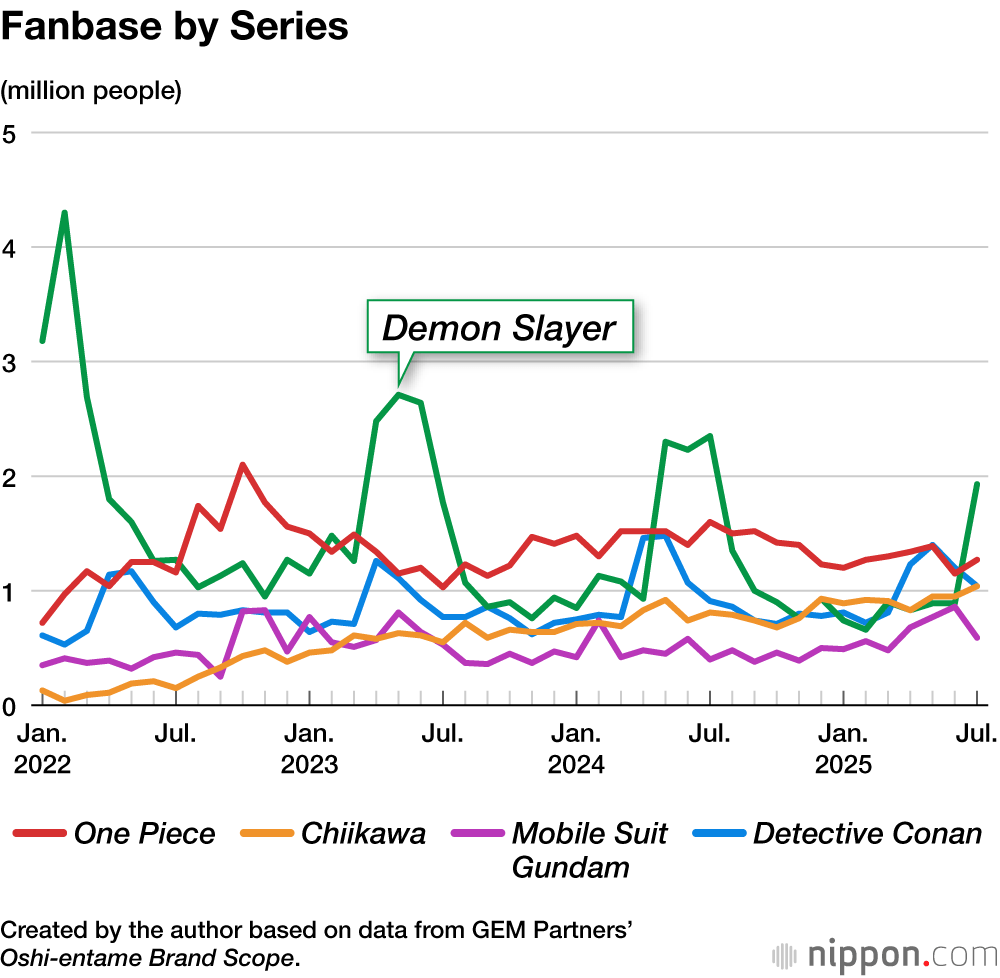
One recent study by the market research agency GEM Partners measured numbers of new fans of animations, computer games, mascot characters, music, film, and other creative content. When one compares the findings regarding the most popular content in Japan, one sees that Kimetsu no Yaiba was by far and away number one in terms of popularity in 2020–22. While it is believed that even this popularity was exceeded by the first film in the series, Mugen Train, at the time of its release in late 2020, the Kimetsu no Yaiba fanbase, which numbered 4.3 million at the beginning of 2022, recorded significant peaks of 2 million in spring 2023 with the broadcast of the Katana kaji no sato TV series and spring 2024 with the broadcast of the Hashira-geiko TV series. It is expected that the latest film, Infinity Castle, has created a similar phenomenon in July and August 2025.
What is different this time is the level of competition. Detective Conan, Chiikawa, and other properties known for steadily growing their fanbases also have increasing numbers of core fans.
Breaking ¥100 Billion Barrier in China is Key
While Kimetsu no Yaiba has cemented its spot as one of Japan’s most popular series, the extent to which it is able to increases popularity overseas will be a touchstone to its future growth. Infinity Castle was rolled out in Indonesia, Hong Kong, Malaysia, Thailand, and Vietnam beginning in mid-August, grossing over $3 million in each country. The film is now being shown in more than 80 markets, including the Americas and Oceania. The previous film, Mugen Train, earned some $120 million internationally, and the latest offering is seen sure to surpass this.
In China, viewers are unable to see Kimetsu no Yaiba as the Director intended due to concern over depictions of battle. However, at events such as Bilibili World, an animation event hosted by Chinese streaming site Bilibili, Kimetsu no Yaiba is enjoying considerable popularity, testament to its popularity.
China is a significant market for Japanese animated film, as exemplified by the fact that Suzume (directed by Shinkai Makoto and released in China in 2023) made 800 million yuan while Miyazaki Hayao’s The Boy and the Heron (released in China in 2024) made 790 million yuan. If Infinity Castle were shown in China as the director intended, it would likely outperform both these films. In fact, global box office takings could well exceed ¥100 billion.
Centerpiece of a Global Empire
Kimetsu no Yaiba is produced by Sony Music Entertainment subsidiary Aniplex, which handles the distribution and international release of Sony’s animated films. As Sony has developed its international strategy, so Aniplex has grown.
It all began with the Sony Pictures Entertainment animation division, which was established by then Sony Chair Ōga Norio after he was inspired by Disney animation. (Ōga was also the architect of Sony’s takeover of CBS Records, now part of SME, and Columbia Pictures, now part of SPE, as well as the development of gaming hardware in the form of the PlayStation console.) The animation start-up lost money until the success of Fullmetal Alchemist in 2003, after which it went on to produce hit series like Fate and Puella Magi Madoka Magica, finally achieving the status of a leading player in Japan’s animation industry with Kimetsu no Yaiba.
Incidentally, the Walt Disney Company also saw its revenues from animation and live-action film slump in the mid-1990s. However, thanks to its acquisition of Pixar in 2006, Marvel in 2009, and Lucasfilm in 2012, it came roaring back in the 2010s to churn out blockbuster after blockbuster. In particular, Pixar, which was no more than a tiny animation company, albeit a pioneer in computer generated animation, succeeded in dramatically growing its revenue from the Toy Story series to hit $400 million in 1995, $500 million in 1999, $1 billion in 2010, and $1 billion again in 2019, through its alliance with Disney. Pixar is now a central part of the Disney empire. There are therefore many parallels with Aniplex, which is to the Sony Group what Pixar is to Disney.
The Sony group, whose intellectual property business spans the entire globe, has made Kimetsu no Yaiba the cornerstone of its global strategy, and now aims to take on Disney itself. If the box office juggernaut that is the Demon Slayer series continues its successful run, that possibility is no fantasy.
(Originally published in Japanese. Banner photo: Fans on the latest Kimetsu no Yaiba movie’s opening day on July 18, 2025, Tōhō Cinemas Hibiya, Tokyo. © Kyōdō.)