Japan-Europe Security Ties in the “America First” Era
Politics- English
- 日本語
- 简体字
- 繁體字
- Français
- Español
- العربية
- Русский
Bolstering Ties with Europe
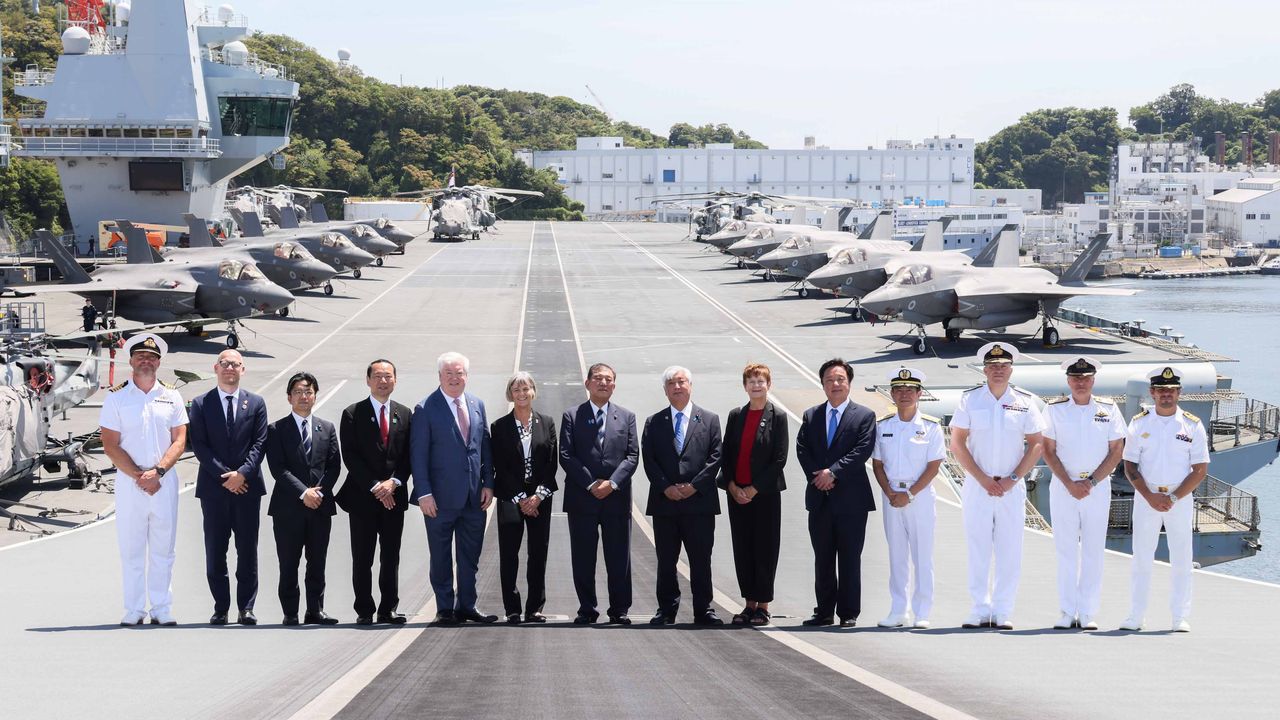
Cooperation between Japan and Europe has been much in the news. The Japan–European Union summit held in Tokyo in July 2025 received front-page coverage in major Japanese newspapers. The arrival of the British aircraft carrier HMS Prince of Wales at the port of Tokyo in late August generated headlines and drew crowds of onlookers.
What is driving this surge in Japan-Europe collaboration? What are the two sides seeking— and what are they not seeking at this point? Without undertaking an in-depth analysis of the political and security relationship, I would like to explore the significance of Japan-Europe cooperation, both as an aspect of Europe’s growing engagement in the Indo-Pacific and as a response to the challenges facing Japan and Europe as allies of the United States.
As I explain below, it was Russia’s full-scale invasion of Ukraine in February 2022, together with the support Moscow subsequently received from China and North Korea, that clearly revealed the necessity for interregional cooperation. But the America First policies of US President Donald Trump, who took office for a second time in January 2025, have provided further impetus for building closer cooperative ties between Japan and Europe. As things stand now, such linkages are no substitute for the manifold benefits of alliance with the United States, on which both Japan and Europe still depend heavily. Yet for that very reason, the future of security relations with the United States must enter into any longer-term consideration of Japan-Europe cooperation.
Impact of the War in Ukraine
At the core of the current surge in Japan-Europe defense cooperation is the awareness that the security of the Euro-Atlantic region has become closely intertwined with that of the Indo-Pacific, and that the linkages are growing ever stronger. What happens in Europe impacts Asia, and vice versa. Increasingly, the two regions are obliged to engage with one another in order to safeguard their own interests. The war in Ukraine has underscored this interdependence.
In a speech at the June 2022 IISS Shangri-La Dialogue, then Prime Minister Kishida Fumio expressed his deep concern that “Ukraine today could be East Asia tomorrow.” That sense of crisis stemmed from a fear of the wider repercussions if Russia was permitted to alter the status quo in violation of international law.
More recently, Prime Minister Ishiba Shigeru echoed this sentiment in a written message for the March 15, 2025, online summit meeting on Ukraine. He cautioned against allowing the “wrong lesson” to be drawn from the situation, noting that the outcome of the conflict could impact the security of the Indo-Pacific as well as that of Europe and the rest of the world. The immediate focus of Ishiba’s concern, of course, was China, and by “wrong lesson” he meant the conclusion that the international community would ultimately accept the use of force to alter the status quo.
Meanwhile, China’s energy imports have helped prop up Russia’s wartime economy, and its exports of dual-use components and technology have contributed to Russia’s manufacture of arms and ammunition. North Korea has provided not only weapons but also combat troops to help fight the Ukrainian army on the ground. In return, North Korea gains actual combat experience and (reportedly) Russian military technology—which can only heighten the threat posed by North Korea in Northeast Asia.
As key supporters of Russia’s war, China and North Korea could reasonably expect Moscow’s support were they to engage in similar actions in East Asia following the conflict in Ukraine. Granted, Russia is not one to sacrifice its own interests for the sake of either neighbor. But just as Beijing has supported Moscow in the belief that a Russian defeat was not in China’s best interests, Moscow may well conclude that it is to Russia’s long-term advantage to help China prevail in a conflict involving the United States. Japan and Europe stand face to face with China and Russia.
From the standpoint of deterrence, the most important challenge is to avoid simultaneous armed conflicts in Europe and the Indo-Pacific. Such cross-regional deterrence will require a new level of cooperation among Japan, the United States, and Europe.
Too Soon to Give Up on America
The second major factor driving the recent surge in Japan-Europe cooperation is the Trump administration. Trump’s disregard for the rules of international society is a source of growing concern for Japan and the European Union, which have long championed the rules-based world order. The Trump tariffs, which appear more targeted toward friends and allies than hostile powers, have undermined other countries’ trust in the United States. In this context, it has been suggested that Japan and Europe should join forces to resist American coercion, not just in the economic sphere but also in the areas of foreign policy and security. This may seem like the logical next step.
But the danger of such a course cannot be overstated. It is easy enough to identify areas where current American values and interests diverge from those of Japan and Europe. But the fact is Japan and Europe still have more in common with the United States than they do with China, Russia, and most of the rising Global South. In an increasingly polarized world, frameworks like the Group of Seven that bring together Japan, Europe, and the United States, still have meaning for the protection of shared interests and values. And when it comes to tackling international problems, it is unlikely that a Group of Six excluding the United States would prove more effective than the G7.
Put simply, it is too soon to give up on partnership with the United States.
In East Asia, the Japan-US alliance remains vital to dealing with the threats from China and North Korea, and its importance is unlikely to diminish in the foreseeable future. Even taking into account increases in our defense budget, Japan has no hope of deterring China single-handedly, and cooperation from Europe is no substitute for US power in the region.
Europe, too, remains deeply dependent on the United States as evidenced by the European leaders’ deference toward Trump at the June 2025 NATO summit, their tendency to bend to Washington’s will on the subject of Ukraine, and their panicked response to the Trump tariffs.
Keeping America Engaged
The reality is that both Japan and Europe rely far too heavily on the United States for their security and economic well-being to stand up to Washington. For now, their common challenge is not to replace the United States but to keep it actively involved in international affairs, especially the security of Europe and the Indo-Pacific. And that means finding ways to lighten the burden on the United States.
To this end, it is essential that America’s allies, particularly Japan and NATO’s European members, assume a larger share of the costs. Those who advocate America First have a tendency to portray all US allies as a burden and nothing more. That makes it all the more important that we demonstrate how vital the network of alliances is to America’s own interests. Japan and Europe are currently operating on the shared assumption that, by alleviating the burden on America, we make it easier for the United States to maintain its commitment to the security of Europe and the Indo-Pacific.
From a balance-of-power standpoint, Japan and Europe have no realistic choice but to work with the United States—notwithstanding its rule-flouting behavior—to counter the challenge from Russia and China. This is the fundamental premise of Japan-Europe cooperation today.
Toward Strategic Autonomy
While persuading the United States to stay engaged is in Japan and Europe’s immediate interests, appeasing Donald Trump is no long-term solution. Beyond today’s expedient “plan A,” there is still a need for “plan B”—which is to say, the development of strategic autonomy (as the EU frames it) in preparation for a post-American, post-NATO era.
Strategic autonomy, however, should be regarded as a means, not an end. The point is not to make decisions that diverge from Washington’s but to achieve the ability to make our own judgments grounded in the national interest. This may or may not mean bolstering ties with the United States, depending on the situation. After all, the alliance is not an end in itself but a means of safeguarding our national security and prosperity.
It is in the long-term interests of both Japan and Europe to build strategic autonomy in this sense of the term. Fortunately, the first steps toward achieving this goal differ little from the basic requirements for keeping the United States engaged. They entail boosting our defense capabilit y, which means increasing defense spending. They also entail strengthening our defense industry’s capacity to manufacture weapons and ammunition.
With these aims in mind, Japan has joined with Britain and Italy to develop a next-generation stealth fighter under the Global Combat Air Programme. Japan’s Self-Defense Forces and Europe’s armed forces are also stepping up joint military exercises. Viewed in the context of our alliances with the United States, these initiatives can be seen as part of the campaign to assume a larger share of the burden in order to keep America engaged in Europe and the Indo-Pacific. From a medium- or long-term perspective, however, they can also be viewed as preparation for “plan B.”
This dual focus must persist for some time to come. From a long-range strategic standpoint, we will eventually need to shift the emphasis from one goal to the other. But at this stage in the evolution of Japan-Europe cooperative ties, the only realistic option is to maintain a delicate balance.
(Originally published in Japanese. Banner photo: Prime Minister Ishiba Shigeru poses with other Japanese officials and the British and American ambassadors to Japan on the flight deck of HMS Prince of Wales during the British aircraft carrier’s port call at the US naval base in Yokosuka, August 23, 2025. © Jiji.)