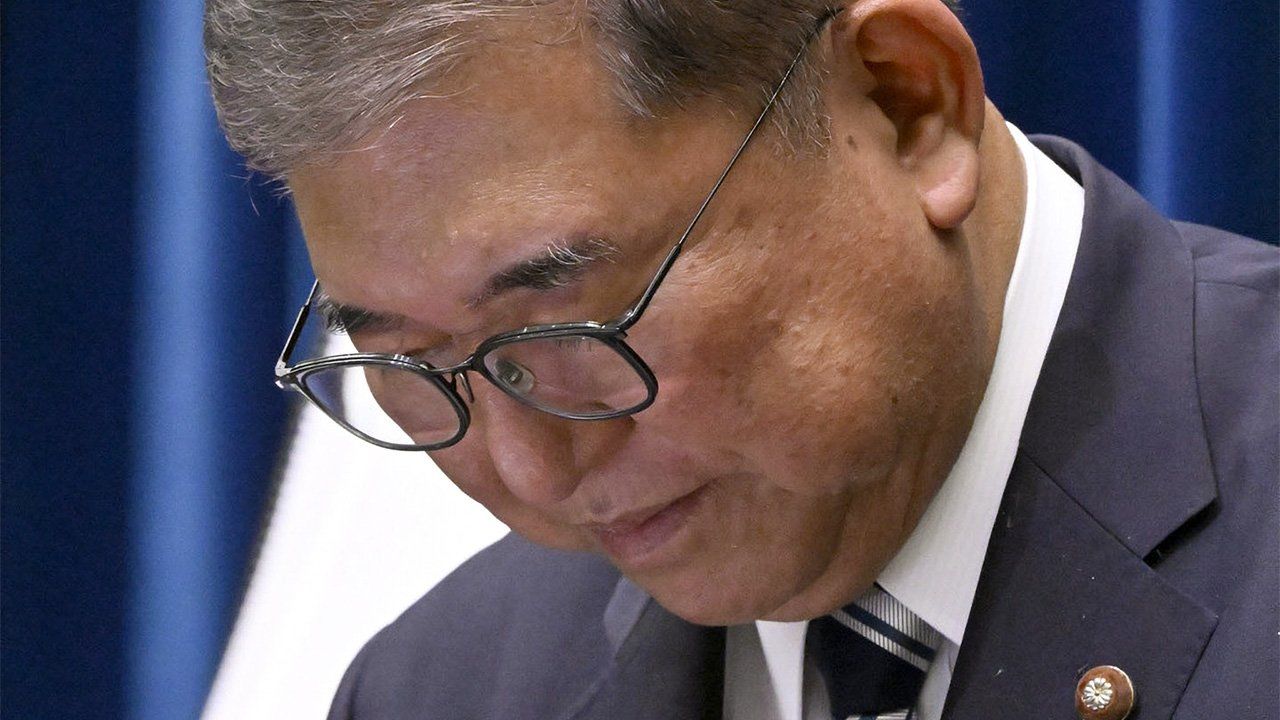
Prime Minister Ishiba Bows to Party Pressure, Agrees to Step Down over Election Defeats
Politics- English
- 日本語
- 简体字
- 繁體字
- Français
- Español
- العربية
- Русский
Reluctant to Resign
On September 7, Prime Minister Ishiba Shigeru announced his resignation, just ahead of the results of deliberations by members of his ruling Liberal Democratic Party on whether to hold an early leadership election. With a majority of LDP lawmakers and prefectural chapters apparently set to back the early election, he could see that he had to step down or be pushed aside. By hanging on after defeat in the House of Councillors election in July, following the similar poor performance in the House of Representatives election in October 2024, Ishiba was running counter to the “common sense” mainstream of LDP thought, laying bare the stresses that had arisen in the party under the leadership of a man who had spent much of his career on its margins, as a force of internal opposition.
This year marks the seventieth anniversary of the formation of the LDP on November 15, 1955. Its first president was Hatoyama Ichirō, while Ishiba is considered the twenty-eighth, counting Abe Shinzō twice for separate periods of leadership.
It is rare for LDP leaders to step down willingly at the end of their terms, as was the case for Nakasone Yasuhiro and Koizumi Jun’ichirō. Most leave their post reluctantly under a variety of circumstances, such as for health reasons like Abe, amid scandal like Tanaka Kakuei, or through withdrawal from an upcoming scheduled leadership contest like Kishida Fumio. Ishiba is one of these reluctant quitters.
Election Defeat Equals Time to Go?
There were 49 days between the loss of the LDP-Kōmeitō majority in the upper house election on July 20 and Ishiba’s eventual resignation on September 7. The coalition had previously lost its majority in the lower house in October, shortly after he became president. Despite these successive setbacks, Ishiba showed an unusual perseverance, by LDP standards, in remaining in his post.
In the history of the party, there has never been a leader who did not resign after national election defeats involving major losses of seats. Miki Takeo stepped down in 1976 after the LDP lost its House of Representatives majority for the first time, and Miyazawa Kiichi quit in 1993 after a defeat that laid the path for an eight-party coalition led by Hosokawa Morihiro to remove the LDP from power for the first time in 38 years. Asō Tarō also resigned following a historic lower house defeat in 2009 that resulted in the Democratic Party of Japan forming a government.
Even with a House of Representatives majority, crushing House of Councillors defeats have had the same effect. Uno Sōsuke headed for the exit when the Japan Socialist Party made major gains in 1989, while Hashimoto Ryūtarō fell on his sword after a disappointing result in 1998. Although Abe Shinzō did his best to hang on after losing control of the upper house in 2007, he ultimately threw in the towel a month and a half later.
Within the LDP, it has been an unwritten rule—almost party culture—that leaders should voluntarily step down to take responsibility for electoral defeats.
The opening of the LDP governance code, formulated in May 2022, states that governance within political parties is fundamentally based on the judgement of citizens via elections. It goes without saying that this can be read as a statement that leaders have no choice but to resign if a harsh judgement at the polls means that they lose their authority.
The LDP is dominated by the idea that leaders achieve legitimacy through their election results. It is plain that a president who suffers a poor verdict from voters will struggle to govern, and this is why—apart from Abe—many choose themselves to quit immediately, although often with persuasion from advisers.
One former prime minister I spoke with stated: “Even if it is not one’s fault, taking full responsibility through resignation revitalizes the party. That’s what pride and love of the LDP means for the party president.”
Buoyed by Public Support
However, Ishiba did not follow this way of thinking, and the chaos continued until his hand was forced by the movement for an early leadership election.
At a press conference on July 21, the day after the House of Councillors vote, he announced his intention to remain as prime minister, stating that the largest party had to fulfill its responsibility toward the nation and the people to avoid political stagnation.
Given that it was the first time for the LDP to be governing while holding a minority in both houses, there was surprise within the party that Ishiba had made no mention of resignation. The head of one former faction wondered if he was waiting for the right timing, amid tariff negotiations with the United States and a busy diplomatic schedule, but even at a meeting with three former prime ministers on July 23 there was still no talk of stepping down.
A movement to oust Ishiba arose. But the fact it was led by members of the former Abe and Motegi factions, which had both been blasted for the party’s kickbacks scandal, must have roused Ishiba’s fighting spirit. He saw the Abe faction as most to blame for the election defeats and refused to bow to their pressure.
Demonstrations calling on him not to step down and other supportive messages gave him encouragement, while rising backing for his cabinet in opinion polls as the days went by—indicating that people who wanted him to continue outnumbered those who did not—strengthened his resolve. Ishiba was previously regularly ranked highly in public polls over who the next prime minister should be, and he used this support from citizens to compensate for his weak base within the political establishment. This was a factor that spurred him on as he clung to power.
He also took pride in having passed the budget and additional legislation in the regular Diet session, despite leading a minority government. It was noted among the party’s top four executives that the uncertain state of a post-Ishiba LDP, and the absence of a new governing framework, were likely encouraging the prime minister to stay his course.
In September, however, LDP Secretary General Moriyama Hiroshi—a pillar of the administration—and the other three leading party executives submitted their resignations following an in-party assessment of the July election. The decision on whether they would go was left to Ishiba, and while he hesitated, the party’s executive functions ground to a halt.
In late August, as many LDP members pushed for a swifter selection of the party’s next leader, heavy-handed pronouncements from Ishiba and his supporters that this would be put to a written contest, with all votes made public, invited a harsh backlash. This was only compounded when news broke that Ishiba intended to dissolve the House of Representatives to seek a public mandate if an early election was decided. In the end, the premier’s attempt to stop the movement by force backfired, spelling the end of his term.
Seeking Motivations
It was never feasible that Ishiba would be able to continue in office. What, then, was the background to the remarkable situation that split party members over whether to bring their president down?
It has been suggested that Ishiba, who left the LDP for a period in the 1990s, is not a dedicated lover of his party, and that he is basically indecisive. Setting that aside, the long years he spent in the political wilderness even after returning to the party, while Abe dominated the government, may have been a motivating factor.
There is no politician so intent on keeping power as one who has been at a distance from it. Looking back on LDP history, there are parallels to the present situation in how Miki Takeo acted when facing calls to step down in 1976, having originally risen to the premiership from a minor faction during the power vacuum that followed the fall of Tanaka Kakuei, due to the Lockheed scandal. Miki’s focus on investigating the scandal won him considerable public support, and he persisted in the effort despite efforts from other LDP factions to topple his government.
There are also similarities in how, when pushed to the brink, Miki convened an extraordinary Diet session in September 1976 and threatened dissolution of the lower house. This did not happen due to opposition from 15 cabinet members—and in the end, the party lost its House of Representatives majority in the general election toward the end of that year—but like Ishiba, Miki was a politician who had spent a long time on the sidelines and well understood the meaning of power and ways to wield it.
The Race for Succession
With Ishiba’s offered resignation, the LDP is now moving toward its next leadership contest. Koizumi Shinjirō, who finished third in last year’s party presidential contest and is currently minister for agriculture, appears to be well placed for succession. On the evening of September 6, he visited Prime Minister Ishiba at the Kantei along with LDP Vice President Suga Yoshihide, where they urged Ishiba to announce his resignation before the September 8 early leadership election deadline to avoid a split in the party. In addition to his popularity, Koizumi’s strength lies in being able to put together a younger team, and he might be able to make common cause with Nippon Ishin no Kai in pursuit of the LDP’s legislative goals.
Takaichi Sanae, who won the first round in the LDP presidential contest last year before losing the second to Ishiba, has also expressed an interest in running. However, many of the 20 Diet members who previously nominated her, a requirement for all candidates, lost their seats in the elections in both houses since. Her first task will be to secure 20 backers.
Chief Cabinet Secretary Hayashi Yoshimasa (fourth in 2024) would provide political stability, but is lacking in fresh appeal. Former faction leader Motegi Toshimitsu also plans to run again, while Kobayashi Takayuki is expected to throw his hat in the ring, with the backing of younger lawmakers.
It is essential for the LDP to pick a new leader as soon as possible, to bring stability to politics, firmly establishing a new framework for advancing the policies the nation needs. Without this, Japan can only expect a further decline in its fortunes.
(Originally published in Japanese on September 8, 2025. Banner photo: Prime Minister Ishiba Shigeru at the press conference where he announced his resignation in Tokyo on September 7, 2025. © Kyōdō.)