Xi Jinping’s Changing Historical Narrative: An Eightieth-Anniversary View from Japan
Politics- English
- 日本語
- 简体字
- 繁體字
- Français
- Español
- العربية
- Русский
The Meaning of September 3
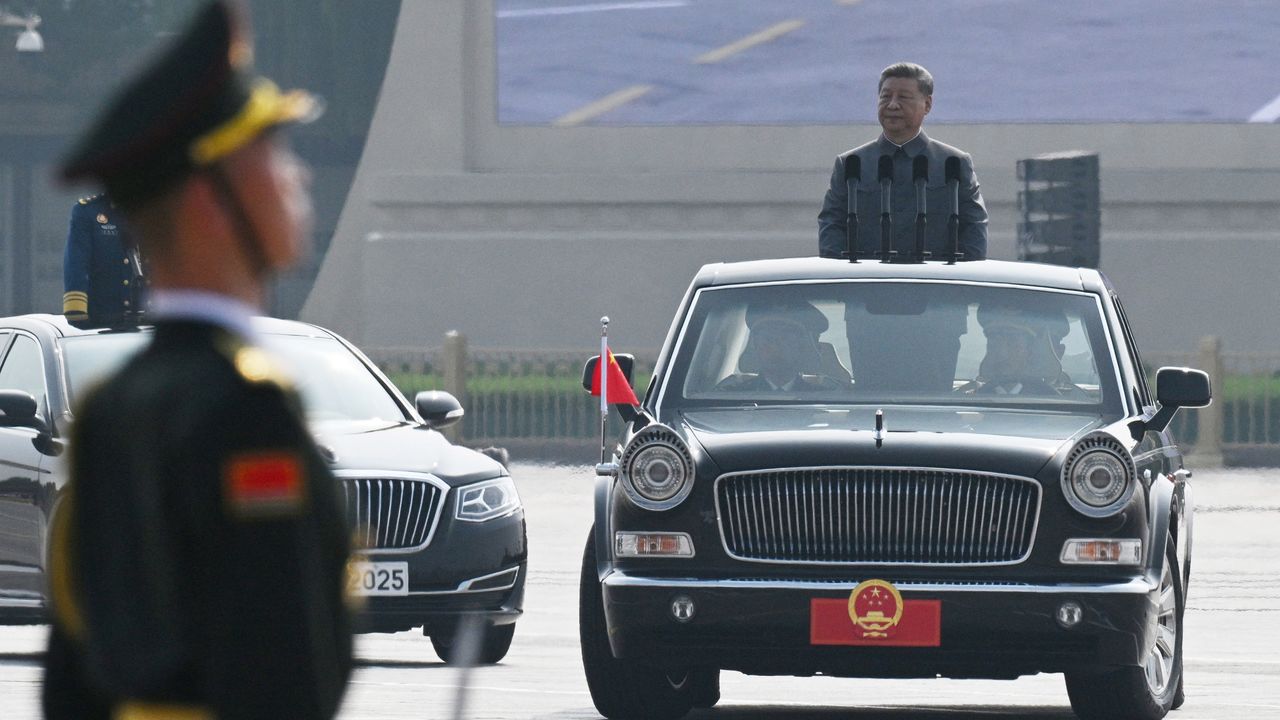
On September 3, 2025, the eyes of Japan’s China watchers were trained on Beijing’s Tiananmen Square as the government celebrated the eightieth anniversary of China’s victory in World War II. September 3 has a dual significance in China, commemorating not only Japan’s surrender but also the Chinese Communist Party’s role in defeating global fascism.
Technically, that victory belonged to the Republic of China, controlled by the Kuomintang (Nationalist Party), which was locked in a bitter civil war with the Chinese Communist Party. A representative of the ROC, General Xu Yongchang, signed the Japanese Instrument of Surrender in Tokyo Bay on September 2, 1945. The ROC held a victory ceremony in Chongqing the following day, and September 3 was subsequently designated Victory over Japan Day.
In fact, September 3 is still celebrated in Taiwan (whence the Kuomintang, routed by Mao Zedong’s Communist forces, fled in 1949) under the name of Armed Forces Day. On September 3, 2025, President Lai Ching-te marked the eightieth anniversary of the end of World War II with a ceremony at the Martyrs’ Shrine in Taipei. In his remarks on that occasion, Lai called for a renewed national commitment to the defense of Taiwan and to the protection of democracy, liberty, and human rights.
Victory Day in the People’s Republic of China has its own lineage, however. When the Communists founded the PRC in 1949, they initially settled on August 15 (the day the emperor announced Japan’s surrender) as victory day. Later, the day was switched to September 3 (a day after America’s Victory over Japan Day) in solidarity with China’s socialist neighbors, the Soviet Union and Mongolia. In the decades that followed, China vacillated between August 15 and September 3, but in February 2014, the government of President Xi Jinping officially declared September 3 Victory Day of the Chinese People’s War of Resistance Against Japanese Aggression. (At the same time, it established a new holiday on December 13, National Memorial Day for the Victims of the Nanjing Massacre.)
A Politically Driven Narrative
In mainland China, these holidays and their observance are part of a larger campaign by President Xi Jinping to promote “a correct understanding of history” at home and around the world. In Chinese schools, the Xi regime has introduced a new curriculum revolving around the history of the Communist Party. The aim is to nurture not just patriotism but also devotion to the CCP. In keeping with this slant, the new narrative downplays the Second United Front, under which the Communists and Nationalists agreed to suspend their civil war in order to resist the Japanese invasion. The start of the Second Sino-Japanese War is moved back from 1937 all the way to 1931 (the year of the Mukden Incident), and the Communists are portrayed as the clear protagonists in this 14-year conflict.
The new curriculum provides historical support for the Xi regime’s foreign and domestic policies. With the outbreak of the Second Sino-Japanese war moved back to 1931, the Nationalist-Communist United Front against Japan, forged from the Xi’an Incident of December 1936, becomes a mere footnote to Chinese history. This reflects Beijing’s policy shift regarding reunification with Taiwan. After the May 2016 election of Taiwanese President Tsai Ing-wen, Beijing essentially abandoned its strategy of pursuing unification via a “third united front” with Taiwan’s Kuomintang and instead embraced a policy of building support for unification within Taiwanese society.
More generally, Xi Jinping’s take on history reflects his emphasis on bolstering domestic security, in large part by strengthening the concentrated power of the CCP (as opposed to the state) and tightening the party’s control over every facet of Chinese life. In conjunction with this goal, the regime has propagated a concept of “state security” that encompasses virtually all domains, including the economy and the environment. The Xi regime sees a need to guard steadfastly against all potential threats to state security (its top priority), particularly infiltration by agents of the United States and Japan (among others), who seek to incite and support subversive elements within China in hopes of overthrowing the Communist regime. The amended Counter-Espionage Law is aimed squarely at this threat of infiltration, targeting both foreigners and Chinese citizens who associate with them. (The United States, Japan, and others who support Taiwan’s de facto independence are viewed as hostile powers, since they oppose the national goal of reunification.)
China’s new history textbooks are intended to justify this vigilance. They highlight the large number of Japanese spies who infiltrated Chinese society before World War II with the help of native collaborators. They also stress the devastating impact Japan’s military incursion had on China’s nation-building efforts, as well as the vast number of Chinese citizens who lost their homes, families, and lives as a result. At the same time, government propaganda regarding the resurgence of Japanese militarism today works to link Japan’s regrettable past with its present. Such messaging has laid the basis for viral rumors that Japanese spies are even now infiltrating China with the aim of instigating a “color revolution.” The results of a 2024 public opinion survey by The Genron NPO suggest that the impression of Japan among the Chinese people took a sharp turn for the worse from the previous year.
China’s revisionist historians are also working to delegitimize the peace process by which a defeated Japan rejoined the international community. In recent years, Chinese scholars have begun denying the legality of the 1951 Treaty of San Francisco (which re-established peaceful relations between Japan and the Allied Powers), thus calling into question not only Japan’s position in the postwar order but also the legal status of Okinawa, not to mention Taiwan. This is historical revisionism as a tool of foreign policy, adduced to support the national goals of surpassing the United States, unifying Taiwan with the mainland, and rebuilding the East Asian international order to China’s advantage.
Of course, this use of history to buttress domestic and foreign policy has been going on for some time, as has the Xi regime’s crusade to propagate a uniform “correct understanding of history.” What has changed since the seventieth anniversary of the war’s end a decade ago is the international and domestic situation. The Xi Jinping regime has adjusted its policies and pronouncements on history in response to these changes.
Playing Up the North-South Dichotomy
What, then, did the eightieth anniversary celebration present that was not evident a decade ago? One conspicuous addition to this year’s ceremony was the ultra-high-tech weaponry on display in the September 3 military parade. Another was the lineup of global leaders who joined Xi Jinping atop the Gate of Heavenly Peace in Tiananmen Square.
In 2015, the seventieth anniversary ceremony was attended by an ideologically diverse group that included even South Korean President Park Geun-hye. In 2025, the invitees were overwhelmingly leaders of developing and emerging countries, with Russia and North Korea receiving top billing. Back in 2015, Xi Jinping was advancing the notion of China as one of the founders of the postwar world order, along with Western powers like the United States and Britain. But the emphasis shifted as relations between China and the United States deteriorated. In 2017, at the Nineteenth National Congress of the Chinese Communist Party, Xi Jinping clearly announced a policy of building a new world order as one of China’s national goals. From that time on, Beijing began playing up the conflict between the developed and developing world while criticizing the former as dinosaurs. The lineup of global leaders flanking Xi Jinping at the 2025 celebration reflects this change in emphasis.
In 2015, when coordination with Taiwan’s Kuomintang was still regarded as central to Beijing’s reunification strategy, retired officers of the ROC armed forces joined the September 3 military parade. While a few ROC veterans and Kuomintang elders participated in the 2025 festivities, they did not take part in the military parade.
Xi Jinping’s address at the 2025 ceremony did not diverge sharply from the remarks he delivered a decade earlier, but the speech was shorter overall, and it omitted some significant elements. In 2015, for example, after stressing the need to “foster a keen sense of a global community of shared future,” Xi had gone on to assert that “all countries should jointly uphold the international order and system underpinned by the purposes and principles of the UN Charter [and] build a new type of international relations featuring win-win cooperation”—thus pivoting from the existing international order to the new Chinese order envisioned by Xi and the CCP. Although the 2025 speech also pledged that China will “join hands with all peoples around the world in building a community with a shared future for humanity,” it omitted the aforesaid references to the international order, opting instead to highlight the importance of “building China into a great country on all fronts and realizing great national rejuvenation through Chinese modernization.” This focus is consistent with recent messaging from the top stressing the importance of achieving the national goal of “socialist modernization in all respects” by the year 2035.
Another noteworthy difference between the two speeches is that in 2015, Xi Jinping used the occasion of Victory over Japan Day to announce that China was cutting 300,000 troops from its armed forces. Not surprisingly, the notion of defense cutbacks was absent from Xi’s 2025 speech, which called on those serving in the armed forces to “speed up the building of a world-class military.”
Wang Yi Leading the Charge
What, then, of Japan’s place in Xi’s version of history?
While the theme of Japanese culpability is integral to the September 3 holiday, Xi Jinping’s 2025 speech did not elaborate much on the topic. That task was dispatched earlier by Foreign Minister Wang Yi, in a statement delivered on August 15.
Wang blamed Japanese militarists for the war of aggression and included the Japanese people among the victims of that war, echoing the longstanding CCP position distinguishing the Japanese people from the military apparatus of Imperial Japan. At the same time, Wang used the statement to intensify Beijing’s anti-Japanese rhetoric. After noting that “the Cairo Declaration and the Potsdam Proclamation . . . required that Japan return all the territories it had stolen from China, including Taiwan,” he lamented that “certain forces in Japan are still trying to whitewash or deny the aggression, distort or falsify history, and even honor the war criminals and justify their crimes.” He went on to assert that “such despicable and disgraceful actions bring shame upon themselves and challenge the United Nations Charter, the postwar international order, human conscience, and all the people of the victorious countries.” Of course, it is important to note that Wang explicitly limited his criticism to “certain forces.” Nonetheless, without altering the CCP’s fundamental interpretation of history, the statement represents a significant escalation of Beijing’s rhetorical attacks on Japan.
As the foregoing suggests, the Chinese government’s interpretation of history—including its perspective on Japan’s past and present role therein—is firmly rooted in certain basic premises yet flexible enough to adjust to shifts in the government’s domestic and foreign policies. In today’s volatile international environment, the subtle and unsubtle changes in Beijing’s historical rhetoric bear especially close watching.
(Originally Published in Japanese. Banner photo: President Xi Jinping of China reviews the troops at the military parade held celebrating the eightieth anniversary of the Victory of the Chinese People’s War of Resistance Against Japanese Aggression and the World Anti-Fascist War in Beijing’s Tiananmen Square, September 3, 2025. © AFP/Jiji.)