China’s Choice: Toward the Formation of an Anti-Western Axis
Politics- English
- 日本語
- 简体字
- 繁體字
- Français
- Español
- العربية
- Русский
Display of Power and Defiance
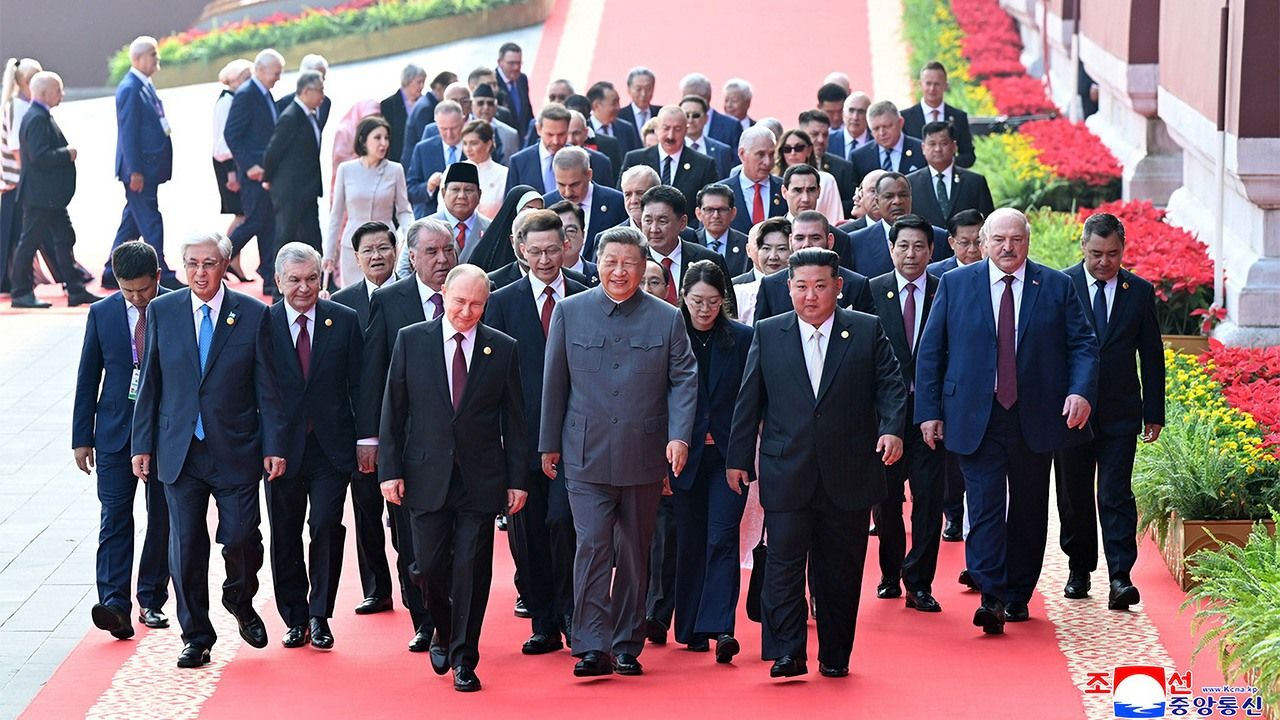
On September 3, President Xi Jinping, flanked by Russian President Vladimir Putin and North Korean Supreme Leader Kim Jong-un, commemorated “the victory of the Chinese people’s war of resistance against Japanese aggression and the world anti-fascist war” with a massive military parade in Beijing, just days after hosting a summit of the Shanghai Cooperation Organization (August 31–September 1).
The September 3 military parade, showcasing some of the most advanced weaponry in the arsenal of the People’s Liberation Army, left little doubt that China had taken its place among the world’s most advanced powers—not just economically but militarily as well. Among the heads of state in attendance, Russian President Vladimir Putin and North Korean Supreme Leader Kim Jong-un took center stage alongside President Xi. Around them stood the leaders of 26 other countries, including the 10 members of the SCO. The images of the ceremony seemed to testify to the rise of a new axis of power centered on China.
As expected, the leaders of Western Europe, North America, and Japan declined to take part. The absence of South Korean President Lee Jae-myung was significant, especially given the participation of then President Park Geun-hye 10 years earlier, at China’s seventieth-anniversary celebration. President Lee had just returned home from visits to Japan and the United States to confer with Prime Minister Ishiba Shigeru (August 23) and President Donald Trump (August 25), respectively.
Two Major Implications
For China watchers, the eightieth-anniversary celebration offered valuable glimpses into the country’s growing military capability, but my focus here is on the ceremony’s role in Beijing’s diplomatic strategy. From this standpoint, the key implications of the event were twofold.
First, through this public display, the Xi Jinping regime clearly communicated its intent to challenge the current world order. By choosing as its guests of honor two countries severely sanctioned by the West and its allies—Russia for its invasion of Ukraine and North Korea for its nuclear missile program—China announced its departure from the existing international order. (Xi’s message was not lost on President Trump, who responded bitterly with the Truth Social post, “Please give my warmest regards to Vladimir Putin, and Kim Jong Un, as you conspire against The United States of America.”) Underlying Xi’s defiance is a worldview that blames most of humanity’s problems on the major Western powers, led by the United States.
The second key message from Beijing was that China, as one of the victors in World War II and a major military power today, has a legitimate role to play in adjusting the postwar international order. This was certainly implied in Xi Jinping’s speech, in which he called on the People’s Liberation Army to ”provide strategic support for the great rejuvenation of the Chinese nation and make greater contributions to the peace and development of the world.”
The SCO and Xi’s Global Governance Vision
The thrust of China’s foreign policy was more clearly delineated at the Shanghai Cooperation Organization Heads of State Council Meeting held in Tianjin immediately before the eightieth-anniversary ceremony.
Speaking at the summit on September 1, Russian President Vladimir Putin characterized the SCO as a force for “genuine multilateralism” that “helps lay the . . . foundations for . . . a system that would replace outdated Eurocentric and Euro-Atlantic models.“ President Xi, in a jab at the Trump administration, urged the organization to oppose the “Cold War mentality, bloc confrontation, and bullying practices“ of the Western powers. He then called for the prompt establishment of an ”SCO development bank“ and pledged grants worth 2 billion yuan to the SCO’s 10 member states by the end of 2025. In this way, Beijing hopes to establish its own legitimate claim to international leadership while using economic leverage to strengthen ties with Russia, India, and other SCO member states.
For Beijing, the highlight of the summit (according to a September 2 statement by Chinese Foreign Ministry spokesperson Guo Jiakun) was the unveiling of Xi’s Global Governance Initiative at the September 1 “SCO Plus” meeting, which included leaders from 10 observer countries. The GGI touts the principles of sovereign equality, international rule of law, multilateralism, a people-centered approach, and a focus on concrete action. It also stresses the value of the UN Charter and such multilateral mechanisms as the United Nations, though its aim is clearly to place China at the center of global governance.
From the perspective of international politics, the merits and significance of the GGI’s content (however enthusiastically touted by the Chinese) are less significant than the very fact that Beijing has put forth its own vision for global governance.
The GGI is the fourth sweeping global initiative proposed by Xi Jinping. The Global Development Initiative, announced in 2021, was followed by the Global Security Initiative (2022) and the Global Civilization Initiative (2023). Year by year, an imposing theoretical framework was built, integrating these initiatives into a vision for a global community “with a shared future for humanity,” united under China’s economic, military, and civilizational (values-based) leadership. The GGI adds a fourth element, governance, to this strategic vision.
According to reports, some in China’s governing elite objected to the idea of using the eightieth-anniversary ceremony to solidify the China–Russia–North Korea axis. But the Xi regime has clearly made its choice to issue a forthright challenge to the United States. Looking back, the world may recall September 2025 as the first clear sign heralding the emergence of a new East Asian power structure.
Dissecting Chinese “Discourse Power”
Still, one might well ask whether the challenge and conflict implicit in the September 3 parade will alter the world order at a structural level. It might be argued that China’s relationship with Russia and North Korea is purely opportunistic, quite unlike the long-term partnership of Western powers bound by shared values. In considering this question, it is instructive to examine the workings and effects of government propaganda in China.
Propaganda is a firmly entrenched tool of governance in modern China, as attested by the existence of the century-old Publicity Department (also known as the Central Propaganda Department), a dedicated unit reporting directly to the Central Committee of the Chinese Communist Party. China’s regime controls public discourse and opinion with a combination of negative and positive reinforcement. On the one hand, it makes use of a sophisticated surveillance system and various penalties to identify and punish dissidents. On the other hand, it uses propaganda to shape public opinion and rewards actors who uphold the party line. This basic approach is by no means unique to China. As a means of securing popular support for rulers unable to claim legitimacy via the democratic process, it is a common feature of communist regimes.
However, the Xi regime has gradually extended the scope of its thought-control campaign to include Chinese citizens living overseas, international organizations, and even other states. This is in line with China’s recent emphasis on “discourse power” (huayuquan) as a component of its international strategy. Xi raised the topic back in May 2021, at a collective study session of the CCP Politburo, where he expounded the need for China to acquire “discourse power commensurate with its overall national strength and international status.” In the same speech, he called for concerted efforts “to explain Chinese practice with Chinese theory; to perfect Chinese theory with Chinese practice; to develop new concepts, new categories, and new expressions that unite China with other countries; and to present the Chinese story and the ideological and spiritual power behind it more fully and distinctly.”
In light of this official policy, the eightieth-anniversary ceremony and the SCO summit should be viewed not just as political theater tailored to the moment but as integral parts of Xi’s long-term international strategy. To adhere to Xi’s directives, China’s leadership will continue to emphasize the country’s importance as a defender of the postwar international order and champion of world peace (bolstered by military power) and will work to suppress any discourse that deviates from that narrative. This propaganda campaign has already spread overseas and has had some effect.
The negative portrayal of China’s rivals and critics is integral to this campaign, and the natural targets of such criticism are (1) the Western powers, centered on the United States, and (2) Japan, the antagonist in China’s “war against Japanese aggression.” In the context of the eightieth anniversary, we have seen renewed efforts to paint Japan as the archvillain in movies and other public events. Japan needs to take care lest deeply anti-Japanese attitudes spread among the overseas Chinese community.
As we have seen, Xi Jinping’s diplomatic strategy centers on criticizing the existing order and its leaders while touting China’s own virtues and legitimizing its claim to leadership. Unfortunately, the more such Chinese propaganda spreads and takes root, the more insular and xenophobic Chinese society will become. Ultimately, this dynamic cannot work to China’s advantage. Nonetheless, we must be prepared to live with such a China for some time to come.
(Originally published in Japanese. Banner photo: Chinese President Xi Jinping (center) walks with Russian President Vladimir Putin (center left), North Korean Supreme Leader Kim Jong-un (center right), and other foreign leaders to the Tiananmen rostrum in Beijing ahead of a military parade to commemorate the eightieth anniversary of Japan’s surrender in World War II on September 3, 2025. Korea News Service/Kyōdō.)