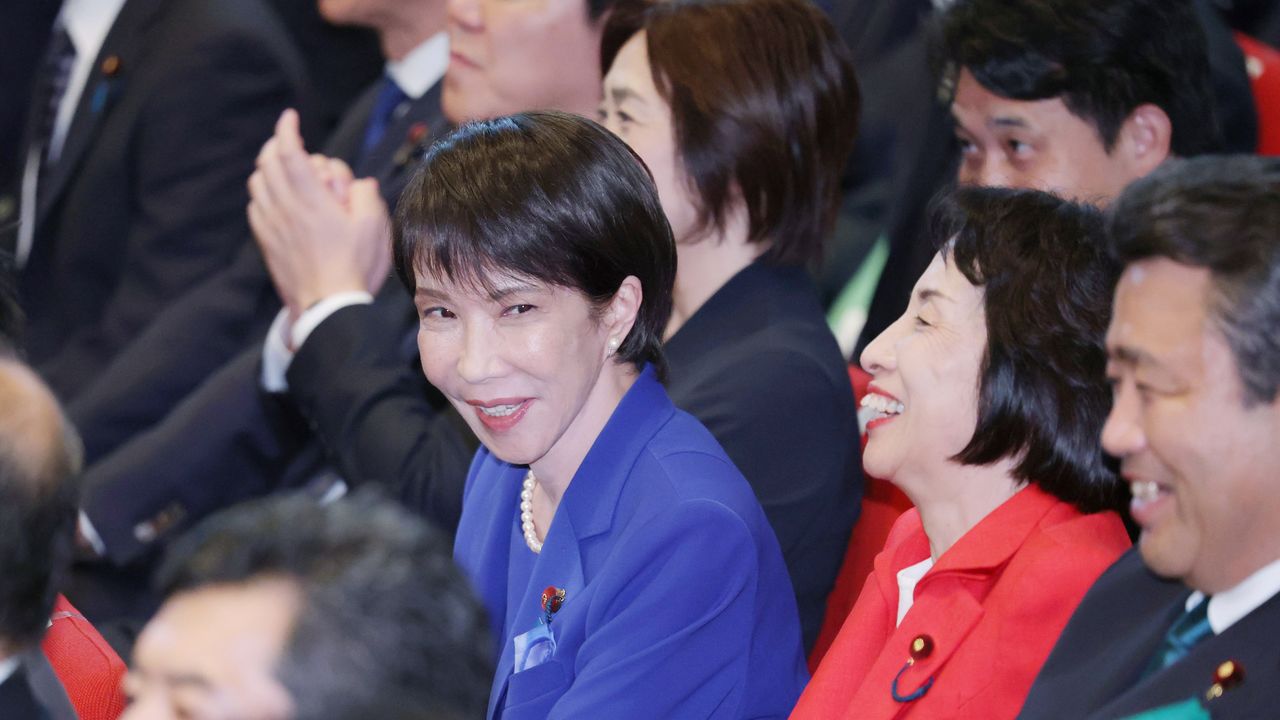
Takaichi Sanae: A Look at the First-Ever Woman to Lead the LDP
Politics- English
- 日本語
- 简体字
- 繁體字
- Français
- Español
- العربية
- Русский
An Unusual Career Path for the LDP’s Newest Leader
On October 4, 2025, the ruling Liberal Democratic Party held its contest to pick the next president of the party, following Prime Minister Ishiba Shigeru’s September 7 announcement that he would step down. In the first round of voting, none of the five candidates won an outright majority of the 590 votes available (295 LDP members of the National Diet and an equal number of ballots representing the national membership of the party).
This meant a runoff between the top two vote-getters. In this second round Takaichi Sanae (64) came out on top with 185 (149 Diet members and 36 of the prefectural chapter votes), besting Koizumi Shinjirō with 156 (145 from the Diet and 11 from the prefectures). Koizumi had been tapped by many as likely to win this contest, but it appears that concerns about his lack of experience—at age 44, he was the youngest of the five candidates to put their hats in the ring—torpedoed his chances.
Takaichi Sanae hails from the history-rich prefecture of Nara, which she played up in her speeches during the presidential campaign: “I’m a woman of Nara. I grew up in the ancient land of Yamato.” While many powerful members of the LDP are second- and third-generation politicians carrying on the “family business” of being in office, she grew up in a household with two working parents. Her unusual resume also includes a stint as a heavy metal drummer during her days at Kobe University.

Takaichi at her set. (Courtesy of Takaichi Sanae’s official website)
After graduating from university she entered the Matsushita Institute of Government and Management in 1984. While there she took part in a dispatch program that sent her to Washington DC, where she worked on the staff of a Democratic Party member of the House of Representatives. Even this did not prompt her immediate entry into the world of politics; starting in 1989 she worked as a newscaster for TV Asahi, building a name for herself with her political analysis.
Taking Her Place in the Political World
In 1992 she took part in her first election, running for a seat in the House of Councillors as an independent candidate in the Nara district. The drubbing she took then did not dissuade her from trying again; in the following year she took a stab at the House of Representatives and topped the vote count in the Nara district, winning her first seat in the Diet. (Also taking his first seat in this election was the future prime minister Abe Shinzō, with whom Takaichi would work closely.)
In 1994 Takaichi joined the Shinshintō, or New Frontier Party, under whose banner she won reelection in the 1996 lower house contest, representing the Nara 1 district. Her time with this party did not last, though—soon after taking her seat she jumped ship and went to the LDP.
As a Liberal Democrat, she aligned herself with the policy group called the Seiwakai (later the Mori faction and then the Abe faction.) Former Prime Minister Mori Yoshirō in particular took her under his wing, and she was tapped in 2006 for her first cabinet position, as minister of state for Okinawa and Northern Territories affairs during the first administration of Prime Minister Abe. In 2012, when the LDP regained control of the government from the Democratic Party of Japan, she was named the party’s first female head of the powerful Policy Research Council, and in 2014 she became the first female minister of internal affairs and communications.
It was in February 2016, during her time in this post, that she touched off a free-speech furor with comments that the government could take broadcasters off the air if they broadcast politically biased content. She was also involved in a struggle with Suga Yoshihide—another future prime minister who wielded considerable influence in the Internal Affairs Ministry—over political appointments there.
During the 2021–24 administration of Kishida Fumio, Takaichi was once again tapped as the LDP’s Policy Research Council chief, as well as minister of state for economic security issues. She did not keep herself from vocally opposing Prime Minister Kishida’s policy stances, though, which dragged her position down somewhat within the party.
With Margaret Thatcher as a Model
In political terms, Takaichi identifies as a hardline conservative, naming British Prime Minister Margaret Thatcher as a figure she reveres. She argues forcefully for maintaining the traditional system of imperial succession, with only male children of male members of the imperial family eligible for the throne. On the economic front, she appears ready to carry forward the Abenomics program—next to be called Sanaenomics?—of bold monetary easing and robust government spending.
In an apparent effort to court support from LDP members sympathetic to Abe Shinzō’s conservative stances, she announced during the 2024 LDP presidential contest (which she lost to Ishiba Shigeru) that she would continue paying her respects at Yasukuni Shrine even if she became prime minister. (It is worth noting that she was considerably vaguer on this position during this year’s election period.)

Takaichi Sanae joins a suprapartisan group of lawmakers visiting Tokyo’s controversial Yasukuni Shrine on August 15, 2014, to pay their respects to Japan’s war dead. (© Jiji)
Her conservative bona fides may cause trouble for the LDP’s coalition with junior partner Kōmeitō, though. Saitō Tetsuo, who heads Kōmeitō, was quoted before the LDP presidential election as saying “Without a leader in the LDP who adheres to the ideals of conservative centrism, it will be difficult for us to remain in a coalition with the party.” If Takaichi is voted in as Japan’s next prime minister later this month, this move to distance Kōmeitō from her LDP may cause problems for her new administration, particularly as it tries to approach other parties like Nippon Ishin no Kai and the Democratic Party for the People, neither of which she has cultivated strong ties with to date.
In her personal life, Takaichi is married to Yamamoto Taku. They wed in 2004, when he was an LDP member of the House of Representatives, and divorced in 2017, but remarried in 2021. (Perhaps in line with her belief that married couples should not be allowed to bear separate surnames, her husband is Takaichi Taku on official documentation.) She is known for being open in her social media presence, going so far as to post late in 2024 about some nasal surgery she had undergone, and is also famed as a die-hard fan of the Hanshin Tigers baseball team.
It remains to be seen how the LDP’s president will move out in her new position, but in her remarks after securing victory, she told the assembled members that they had “carved out a new era for the Liberal Democratic Party.” She also noted, “I am abandoning the phrase ‘work-life balance’ as of today”—a statement about the hard work she hopes to tackle.
(Originally written in Japanese by Nippon.com. Banner photo: Takaichi Sanae, in blue, smiles at LDP headquarters in central Tokyo after securing election as the party’s new president on October 4, 2025. © Jiji.)