When Will Japan Recognize Palestine?: Timing and Trump Keep Tokyo on Sidelines
Politics- English
- 日本語
- 简体字
- 繁體字
- Français
- Español
- العربية
- Русский
Amid increasingly dire humanitarian conditions in Gaza, including starvation and disease, this fall’s annual session of the United Nations General Assembly crackled with excitement as Israel came under concerted pressure to end its protracted war with Hamas.
On September 12, the General Assembly overwhelmingly approved the New York Declaration on the Peaceful Settlement of the Question of Palestine and the Implementation of the Two-State Solution, with 142 out of 193 member states voting yes. On September 22, France and Saudi Arabia co-chaired the High-Level International Conference for the Peaceful Settlement of the Question of Palestine and the Implementation of the Two-State Solution. Meanwhile, Group of Seven countries France, Britain, and Canada announced their official recognition of Palestine as a sovereign state. The Japanese government, which supports a two-state solution, did not join them. In the following, I explain the short-term and long-term factors behind this decision.
Choosing to Defer Recognition
Japan was among the 142 UN member states voting in favor of the September 12 New York Declaration. However, at a press conference a week later, then Foreign Minister Iwaya Takeshi announced that Tokyo was deferring formal recognition of Palestine (thus aligning itself with three other G7 members, Germany, Italy, and the United States). Although Iwaya attended the aforementioned high-level conference held on September 22, then Prime Minister Ishiba Shigeru did not.
At a time when the international climate of opinion is leaning heavily toward recognition of Palestinian statehood, why did Japan demur?
According to Foreign Minister Iwaya, the decision to forgo recognition was based on “a comprehensive assessment” of what course of action would actually contribute to a solution. Specifically, he voiced concerns that recognizing Palestine at that time would only serve to harden Israel’s stance. He also stressed the need for the Palestinians “to build a robust governance system,” pointing out that the Palestinian Authority was as yet ill-equipped to carry out the functions of a state government. In short, he explained, while Tokyo favors a two-state solution, it did not feel the time was right for formal recognition of a Palestinian state.
Europe’s Unachieved Goal
Given the circumstances, it was not an unreasonable argument.
The fact is that Britain and France had spearheaded the drive for broader recognition primarily as a means of pressuring Israel into a ceasefire. Casualties had soared (topping 65,000) in the Gaza Strip after the Israel Defense Forces had resumed their offensive in March, and hundreds more Palestinians were facing malnutrition and starvation as a result of Israel’s total blockade. In July, Britain and France had announced that they would recognize Palestine as a state at the coming General Assembly unless Israel agreed to a ceasefire and took “substantive steps to end the appalling situation in Gaza.” The two European powers doubtless believed that a two-month warning would give the Israelis adequate time to respond.
In the event, these threats proved completely ineffectual. Three days after the September 12 New York Declaration, Israel launched a ground assault on Gaza City. To be sure, it announced its intentions in advance, but the timing of the invasion can be taken as an open rebuke to critics and a clear message that Jerusalem would not bow to pressure from Western Europe. Israeli Prime Minister Netanyahu publicly boasted of America’s unflagging support and declared that he would not submit to efforts by European powers to box Israel in. International isolation was only making Jerusalem more defiant, and there was no reason to think that ratcheting up the pressure further would improve the situation for Palestinians in Gaza or elsewhere. In short, Britain and France had gained nothing by playing the “recognition card,” and once that was clear, it was not unreasonable for Japan to distance itself from their gambit.
Recognition of statehood is a diplomatic card that can only be played once, and the Japanese government could be saving that card for a time when it will have the greatest impact. Nor is Japan the only country to make this calculation. Belgium and Singapore, for example, gave similar reasons for postponing recognition, even though they had earlier signaled their support for the campaign.
Deferring to the United States
A more enduring factor shaping Japan’s stance on the conflict is the relationship with the United States, Japan’s powerful ally. In the decades since World War II, the bilateral alliance established by the Japan-US Security Treaty has been the foundation on which Tokyo has built its diplomacy and security policy, making it difficult to diverge with Washington on key foreign-policy matters. And the United States had clearly expressed its opposition to recognizing Palestinian statehood at this time.
US President Donald Trump has staked out a staunchly pro-Israeli position since the start of his first presidency, when he put his Jewish son-in-law, Jared Kushner, in charge of Middle East diplomacy. During last September’s UN General Debate, Trump was sharply critical of the aforementioned moves to recognize Palestinian statehood, saying it was tantamount to rewarding Hamas for the attacks of October 7, 2023. In light of the situation, it is likely that Tokyo concluded that it was not in the best interests of Japanese security or foreign policy to defy Washington and align itself with European forces that have been critical of Israel.
Prioritization of relations with the US is an ongoing imperative. After the General Assembly meeting, leadership of Japan’s ruling party changed hands, and Takaichi Sanae was installed as Japan’s first woman prime minister. Meeting with Trump in Japan the week after she took office, Takaichi confirmed the stance of her predecessors. For the prime minister, the main objectives of the summit were strengthening the Japan-US alliance and building ties of personal trust with President Trump. Because no joint statement was issued, it is difficult to determine the specific content of their discussion on such topics as the Middle East, but barring a major change in the situation, it is unlikely that Japan will diverge from US policy on the question of Palestinian statehood anytime soon.
Toward a Two-State Solution
That said, ever since Israel and the Palestine Liberation Organization signed the Oslo Accords in the mid-1990s, Japan has officially espoused a two-state solution to the Israel-Palestine conflict. Prime Minister Ishiba explicitly reaffirmed this stance in his September 23 address to the General Assembly, stating that the question was not whether but when to recognize Palestinian statehood. At the same time, the prime minister confirmed his government’s resolve to continue providing aid aimed at strengthening Palestine’s economic autonomy and governance capacity.
The Japanese government has come under considerable criticism domestically for deferring recognition of the Palestinian State despite its explicit support for a two-state solution. A petition on Change.org posted last August, before the General Assembly meeting, called on Japan to join the 147 other UN member states (more than 76% of the total) that had already recognized Palestine, arguing that “the establishment of a Palestinian state—where international law, including human rights and humanitarian law, will be applied—can ensure Palestinians the right to self-determination and could be a path towards a liberated life.” The petition has garnered nearly 40,000 signatures.
Japan’s Middle East Diplomacy
Historically, Tokyo has at times pursued different Middle East policies to those of the West, notwithstanding a strong tendency to align itself with Washington. In 1973, during the oil crisis that followed the Yom Kippur War, Chief Cabinet Secretary Nikaidō Susumu issued a statement in support of the Palestinians’ right to self-determination. Given Japan’s heavy dependence on imports of oil from the Arab Middle East, critics took a cynical view of this stance; as some saw it, Tokyo’s position was not so much pro-Palestinian as pro-petroleum. But whatever the motive behind the statement, it did reveal the potential for some degree of political independence in matters of Middle East diplomacy.
Two weeks after Hamas’s October 7 attack, all of the G7 countries except Japan issued a joint statement expressing “support for Israel and its right to defend itself against terrorism” while calling for “adherence to international humanitarian law.” At a press conference on the morning of October 23, Chief Cabinet Secretary Matsuno Hirokazu explained that Japan differed from the other six countries in that none of its citizens had been harmed in the conflict. But surely the decision to abstain from the statement reflected the Japanese government’s desire to maintain a certain degree of neutrality and distance at that early stage in the conflict.
At some point, Japan will have to recognize Palestinian statehood if it intends to uphold its own stance of support for a two-state solution. But at this time of intense and rising hostility between the parties to an armed conflict, the prospects for agreement on a long-term resolution are all too remote. Both sides will be in a better position to negotiate a lasting solution when the war is over and progress has been made toward rebuilding Gaza and restoring order to the region. Only at that stage can we expect Tokyo’s recognition of Palestinian statehood to make a positive contribution to the Middle East peace process.
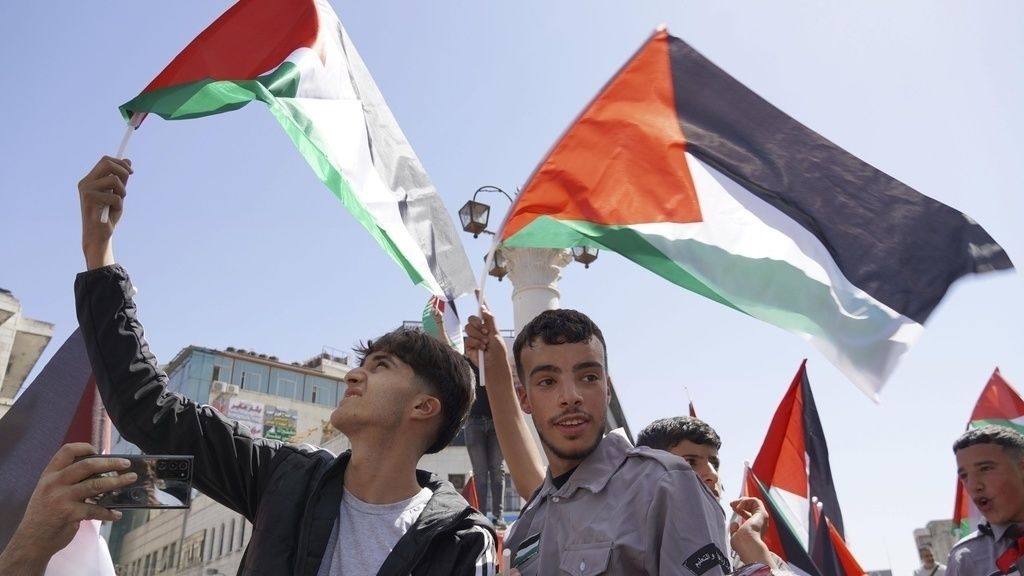
(Originally Published in Japanese. Banner photo: Young Palestinians in Ramallah, in the West Bank, celebrate the recognition of Palestine as a sovereign state by Britain, France, and others, September 23, 2025. © Kyōdō.)