Beware of the “G2” Trap: Understanding China’s Diplomacy and Its Pressure on Japan
Politics- English
- 日本語
- 简体字
- 繁體字
- Français
- Español
- العربية
- Русский
China’s Insistent Demands
The diplomatic maelstrom was touched off by Japanese Prime Minister Takaichi Sanae’s answer to a question during House of Representatives Budget Committee proceedings on November 7. Asked about Japan’s potential response to a hypothetical use of force by China to impose a naval blockade around Taiwan, the Japanese premier responded that such an act could constitute a “survival-threatening situation” to Japan. In the Japanese security lexicon, a “survival-threatening situation” could enable the invocation of Japan’s right to collective self-defense and the mobilization of the Self-Defense Forces to support military action by the country’s ally, the United States.
The very next day, Xue Jian, China’s consul general in Osaka, posted an inflammatory message on social media in response to these parliamentary proceedings: “An intruding, filthy head must be cut off without a moment’s hesitation.” Implying the decapitation of the current Japanese leader, the remarks were later deleted. Despite this, Beijing dismissed Japan’s subsequent protestations and adopted a confrontational stance. A Chinese Foreign Ministry spokesperson instead expressed “strong dissatisfaction” and “firm opposition” to the remarks by Prime Minister Takaichi.
Beijing was not finished expressing its displeasure. China insisted that the Japanese side officially withdraw Takaichi’s statement at the United Nations, claiming “Japan has not reflected on its past invasion of China”. China subsequently employed coercive tactics, such as encouraging Chinese tourists and students to refrain from visiting Japan, halting imports of Japanese seafood, and cancelling screenings of Japanese films and performances by Japanese artists in China.
Real Damage Done to Japanese Industry
These tactics primarily target Japan’s economy and cultural sectors. Experts have characterized this approach as “informal economic coercion”, meaning that the actions are not based on the application of laws by officials or government institutions. Previously, measures like the notorious rare earth export restrictions were based on official policy. However, such approaches became a focal point in the recent US-China negotiations, and theChinese government promised to refrain from further such actions.
It seems China is still willing to employ informal measures, however, such as urging citizens to refrain from visiting Japan due to “deteriorating public safety” or announcing the need to re-inspect seafood products citing “food safety concerns.” It is also difficult for the Japanese side to implement countermeasures against these tactics. Chinese tourists account for over 20% of all inbound visitors to Japan, and with cancellations reportedly reaching 500,000 airline tickets, there is already tangible damage being done to the Japanese economy.
There may be many at Japan’s most crowded tourist destinations who will feel some measure of temporary relief, out of the belief that fewer Chinese tourists will mean less disruptive behavior. However, the tourism industry and others potentially affected by this and future “informal economic coercion” have been slow to implement alternative measures in preparation for what will likely be a sustained period of pressure.
Trump’s Conciliatory Stance Toward China
Some American experts believe that the Xi Jinping administration is putting pressure on Japan to weaken the political foundations of the new Takaichi government. After all, the new ruling coalition formed between the Liberal Democratic Party and Nippon Ishin no Kai, the Japan Innovation Party, is in its infancy and already on shaky foundations. There are also some in the governing LDP who have sympathies for China. China is therefore likely using diplomatic pressure and economic coercion to demonstrate the damage it can do to the new administration and to influence Takaichi’s foreign policy stance toward China and Taiwan.
The timing is also concerning due to US President Donald Trump’s conciliatory stance toward China. This is despite Trump’s pledge to strengthen the US-Japan alliance during his recent visit to Japan. With midterm elections less than a year away, Trump is relentlessly working away at striking a deal ahead of his planned April 2026 visit to China. The president is aiming to extract maximum economic benefits from China in trade negotiations and may be less likely to upset China for the time being.
On November 24, China’s Foreign Ministry unilaterally announced that the American side had purportedly expressed its “understanding of the importance of the Taiwan issue” during a phone call between the American and Chinese leaders. A few days later the People’s Daily newspaper, the official media arm of the Chinese Communist Party, even called on the United States to form a “United Front” as the two countries“shared responsibility” to work together to “resolutely prevent actions that undermine world peace and stability.”
President Trump himself reportedly told Prime Minister Takaichi during their November 25 phone call to “avoid provoking China.” China’s immediate objective is likely to induce a conciliatory stance toward Chinaand on the Taiwan issue from Trump, given the president’s desire for a smooth resolution of US-China trade negotiations. Beyond that, Beijing’s strategy is to draw the United States into a “G2” system, where China and the United States jointly lead and shape the international order.
This “G2” concept was previously promoted early in the first Barack Obama administration. However, due to China’s authoritarian nature and the incompatibility between of the American and Chinese worldviews at the time, it soon became a meaningless diplomatic expression.
Yet, President Trump has suddenly started using the term again. Just before his late-October summit with President Xi Jinping in South Korea, Trump posted on social media that “THE G2 WILL BE CONVENING SHORTLY!” Following the meeting, President Trump announced that “My G2 meeting with President Xi of China was a great one for both of our countries,” indicating his clear acceptance of the concept. If the Trump administration were to truly embrace the G2 notion of the United States and China collaborating to dictate international affairs—even temporarily—it would not only jeopardize Taiwan’s future and that of the US-Japan alliance but could upset peace and stability throughout the Indo-Pacific region.
Weaponizing Economic Influence: The Need for Cooperation
American media coverage of Takaichi’s Taiwan statement pointed to it “breaking” with previous Japanese policy, where even the late Prime Minister Abe Shinzō avoided mentioning Taiwan in relation to Japanese security contingencies. Given the current security environment, the idea that “a Taiwan contingency is a Japan contingency” should be self-evident. However, we should reflect upon why we believed it was not necessary to say this beforehand.
The real issue lies in how to respond to Beijing’s escalating pressure. China’s economic coercion has previously caused genuine harm through product boycotts leveraged against South Korea (2016), suspensions of Australian meat and wine imports (2020), and import bans on Lithuanian goods (2021). The Japanese government must collaborate with these nations and others to widely publicize to the international community the damage caused by unfair, coercive tactics.
Furthermore, China relies on imports from Japan, the United States, and South Korea for nearly 100% of the silver powder needed for solar panels and depends on Western imports for numerous other goods. Leveraging this dependency could provide countermeasures against such pressure tactics if the international community were willing to adopt them.
Most importantly, however, Japan must ensure that Trump does not fall prey to the allure of a “G2” notion and remains committed to strengthening the US-Japan alliance.
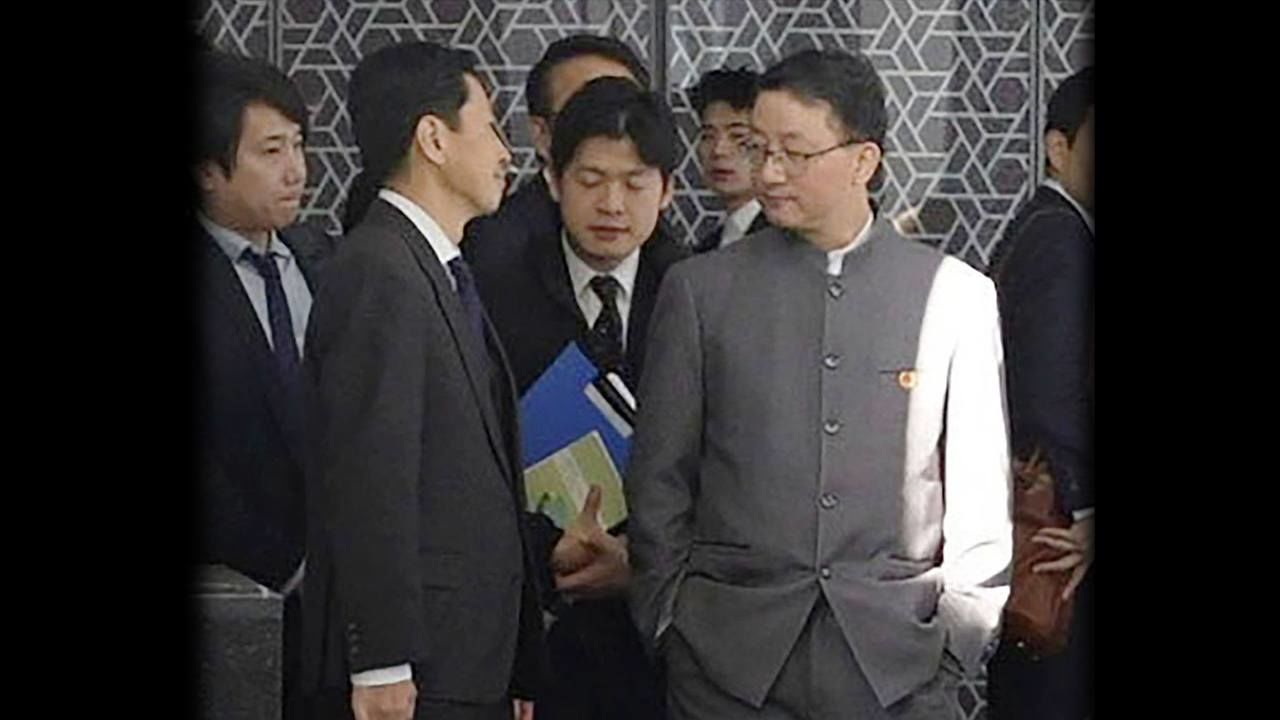
(Originally published in Japanese. Banner photo: Kanai Masaaki [facing sideways at left], director-general for Asian and Oceanian affairs at the Japanese Ministry of Foreign Affairs, and Liu Jinsong [in gray suit], China’s director-general for Asian Affairs, following their meeting at the Ministry of Foreign Affairs, Beijing, November 18, 2025. © Kyōdō.)