The Taiwan Strait and Postwar Japanese Diplomacy
Politics History- English
- 日本語
- 简体字
- 繁體字
- Français
- Español
- العربية
- Русский
Controversial Remarks
On November 7, in response to questions during a session of the House of Representatives Budget Committee, Prime Minister Takaichi Sanae pointed to a blockade of sea lanes, the use of military force, or disinformation and cyber propaganda as possible actions China might take to bring Taiwan fully under Beijing’s control. She then stated that if such actions involved warships and the use of military force, they could easily constitute a situation threatening Japan’s survival.
Why would the use of force in Taiwan or the Taiwan Strait become an existential threat to Japan—defined in Japan’s legal framework as endangering the “right to life, liberty, and pursuit of happiness” of the Japanese people? For at least half a century, Taiwan and the Taiwan Strait have been central to Japan’s security. The following discussion situates Japan’s position on this issue within the broader context of its postwar diplomatic history.
Taiwan’s Importance for Japan
Under the September 1951 San Francisco Peace Treaty, Japan renounced sovereignty over Taiwan and the Penghu Islands. Concluded at the same time, the 1951 Japan-US Security Treaty granted the United States the right to use its forces to maintain “international peace and security in the Far East.” And in April 1952, Japan signed the Treaty of Peace with the Republic of China, recognizing the ROC government in Taiwan as the government of China and again renouncing claims to Taiwan and the Penghu Islands.
The Chinese Civil War between the Kuomintang-led ROC government and the forces of the Chinese Communist Party continued into the 1950s along China’s southeastern coast, culminating in two Taiwan Strait crises. The second crisis in 1958—when the People’s Republic of China shelled Kinmen Island, held by Taiwan—shocked a Japanese public focused on economic growth under the postwar Constitution.
During negotiations to revise the Japan-US Security Treaty under Prime Minister Kishi Nobusuke, public debate centered on the meaning of “Far East.” If another Taiwan Strait crisis erupted, a military clash between US and Chinese forces was conceivable. In such a scenario, Beijing might attack US bases or other targets in Japan, raising concerns that Japan could be drawn into war.
The revised security treaty was signed in January 1960. The following month, the Japanese government issued an interpretation defining the “Far East” to include territories under the control of the Republic of China—namely Taiwan, the Penghu Islands, Kinmen, and Matsu. In other words, the Taiwan Strait was explicitly recognized as part of the treaty’s geographic scope.
The joint statement following November 1969 meeting in Washington between Prime Minister Satō Eisaku and President Richard Nixon noted that, in response to the president’s reference to the treaty obligations of his country to the Republic of China which the United States would uphold, Satō stated that the maintenance of peace and security in the Taiwan area was also a most important factor for the security of Japan.
This reaffirmed that the Taiwan region fell within the practical scope of the Japan-US alliance, especially in the context of Okinawa’s reversion to Japan. The idea that peace and stability in the Taiwan Strait are vital to Japan’s own security is therefore not a new development but one rooted in decades of diplomatic history.
Japan-China Normalization and the One-China Question
On September 29, 1972, Japan and the People’s Republic of China normalized diplomatic relations and issued a joint communiqué stating that the PRC “reiterates that Taiwan is an inalienable part of the territory of the People’s Republic of China” and that Japan “fully understands and respects this stand” and “firmly maintains its stand under Article 8 of the Potsdam Declaration.”
The phrase “fully understands and respects” indicates that Japan is not explicitly endorsing the PRC’s claim. Meanwhile, the reference to Article 8 of the Potsdam Declaration is especially important for China, as it stipulates the implementation of the Cairo Declaration, which called for the restoration of territories taken by Japan—including Taiwan and Penghu—to the Republic of China. For Beijing, Japan’s normalization with the PRC and severance of ties with the ROC in 1972 allow the declaration to be reinterpreted as calling for the return of Tawain to the PRC.
Japan had already renounced its claims to Taiwan under the San Francisco Treaty. In other words, Japan no longer had the authority to determine to whom Taiwan should be returned. By affirming its adherence to Article 8 of the Potsdam Declaration in the 1972 communiqué, Japan implicitly acknowledged that Taiwan should be returned to China—now defined as the PRC. The question then becomes: Did Japan merely forfeit its claims, or did it signal that Taiwan belonged to the PRC?
Japan’s position can be summarized as follows: Japan has renounced Taiwan, and Taiwan “should” be returned to the PRC, although this has not yet occurred. Thus, Japan “fully understands and respects” China’s position.
Why, then, did Tokyo and Beijing include a reference to Article 8—implying that Taiwan should be returned to the PRC—in their joint communiqué? In essence, it signaled Japan’s deference to the PRC position by rejecting the notion of “two Chinas” or “one China, one Taiwan.”
Foreign Minister Ōhira’s 1972 Clarification
After Japan normalized ties with the PRC, questions arose about the communiqué’s references to Taiwan. In response, Foreign Minister Ōhira Masayoshi, speaking in the House of Representatives Budget Committee on November 8, 1972, clarified the government’s position as follows (translation by Nippon.com):
Japan’s position is that it fully understands and respects the view of the government of the People’s Republic of China that Taiwan is an inalienable part of the territory of the People’s Republic of China. Accordingly, we consider the confrontation between the government of the People’s Republic of China and Taiwan to be, basically, a domestic matter of China. Japan hopes that this issue will be resolved peacefully between the parties concerned, and we believe there is no realistic possibility that it will develop into an armed conflict.
It is important to note Ōhira’s use of the qualifier “basically.” Why did he choose that wording? The answer lies in the latter part of his statement, where he expressed Japan’s hope for a peaceful resolution and his belief that armed conflict was unlikely. In other words, Japan regarded the Taiwan issue as a “domestic matter of China” on the assumption that it would be settled peacefully. Put differently, if the issue were not resolved peacefully, Japan might no longer view it as a purely domestic matter.
This aligns with the 1969 Japan-US joint statement following the Satō-Nixon summit, which affirmed that the maintenance of peace and security in the Taiwan area was also a most important factor for the security of Japan. Ōhira’s explanation has generally been upheld by subsequent Japanese administrations. But was this interpretation something Japan arrived at alone, or was it shared with China?
A clue lies in the September 1972 summit, as documented in the 2003 Iwanami Shoten volume on normalization talks, edited by Ishii Akira and others. Premier Zhou Enlai reportedly told the Japanese delegation on September 26 that, in regard to the Japan-US Security Treaty, he did not believe that the PRC would liberate Taiwan by force. He also stated that Japan bore no responsibility for the 1969 Satō-Nixon joint statement linking Taiwan to Japan’s security, adding that Washington has also indicated it would not raise this matter.
Neither Prime Minister Tanaka nor Foreign Minister Ōhira is recorded as directly responding to Zhou’s remarks. However, it is clear that they regarded Zhou’s assurance that China would not use force against Taiwan as closely linked to the 1969 joint statement emphasizing Taiwan’s importance to Japan’s security. Japan’s decision to treat the Taiwan issue as a domestic matter—on the assumption of a peaceful resolution—was likely premised on Zhou’s statement.
Japan’s Legal Framework for a Taiwan Contingency
References to the Taiwan Strait have continued to appear in the years that followed, including during the 2005 Japan-US 2+2 meeting of foreign and defense ministers. To this day, both Japan and the United States—and at times even Japan and China—regularly invoke the phrase “peace and stability in the Taiwan Strait.” More recently, the expression has become established in G7 statements and in Japan-US-ROK summit meetings.
Meanwhile, within Japan, institutional preparations have been advanced for the possibility that the Taiwan issue might not be resolved peacefully—that is, if China were to attempt to settle the matter by force. A major step in this direction was the package of security legislation enacted during the second Abe Shinzō administration.
The immediate trigger for the current diplomatic rift with China—Prime Minister Takaichi’s response to questions from opposition lawmaker Okada Katsuya about what would constitute a situation threatening Japan’s survival—also touches directly on this issue. When pressed on the kinds of measures Beijing might use to bring Taiwan fully under its control, the prime minister stated that actions involving warships and the use of military force could, by any reasonable interpretation, constitute a survival‑threatening situation.
It should be noted, however, that Takaichi prefaced this with remarks that any judgment must be based on the specific circumstances of an actual situation and must take all available information into account. She added that the definition of a “survival‑threatening situation” is already set out in Article 2, Paragraph 4 of the Armed Attack Situation Response Act. This provision defines such a situation as one in which “an armed attack against a foreign country that has a close relationship with Japan occurs, and as a result, threatens Japan’s survival and poses a clear danger of fundamentally overturning people’s right to life, liberty, and pursuit of happiness.”
This raises the question of which countries fall under the category of a “foreign country that has a close relationship with Japan.” The Japanese government has addressed this point repeatedly. For example, at a plenary session of the House of Representatives on March 14, 2017, Prime Minister Abe stated that, realistically, the likelihood of any country other than the United States falling into this category was quite limited, although he noted that any determination would ultimately depend on the specific circumstances of the situation.
In other words, the United States is the primary “foreign country in a close relationship with Japan,” though this does not rule out other possibilities. In practice, it is with the United States that Japan regularly conducts exercises in anticipation of coordinated operations.
This leads to the next question: Which other foreign countries, if any, could fall under this category? On this point, the government stated, in a written response dated July 21, 2015, to questions submitted by House of Councillor member Mizuno Ken’ichi, that a “foreign country in a close relationship with Japan” generally refers to countries that share an interest in responding to an external armed attack—viewing it as a common threat—and that express a willingness to respond jointly with Japan. This may include countries with which Japan does not have diplomatic relations.
From the government’s perspective, then, the United States unquestionably falls within this category, and the basic premise is the exercise of collective self‑defense with Japan’s sole treaty ally. However, the statute also allows for case‑by‑case judgments based on the specific circumstances of a situation, and it acknowledges that the category may include countries with which Japan lacks diplomatic relations, such as Taiwan.
At first glance, this interpretation might seem to go beyond earlier discussions that framed the Taiwan Strait issue within of the context of the Japan-US Security Treaty. In practice, however, the Self‑Defense Forces conduct exercises for joint‑operations primarily with US forces, not with Taiwan’s military.
In that sense, the exercise of collective self‑defense in a survival‑threatening situation would, in practical terms, occur between Japan and the United States. While Taiwan could theoretically fall under the category of “a foreign country in a close relationship with Japan,” the law is written broadly enough that any country, including those without diplomatic ties to Japan, could fall under that definition. For this reason, one cannot definitively conclude that the written response was specifically intended with Taiwan in mind.
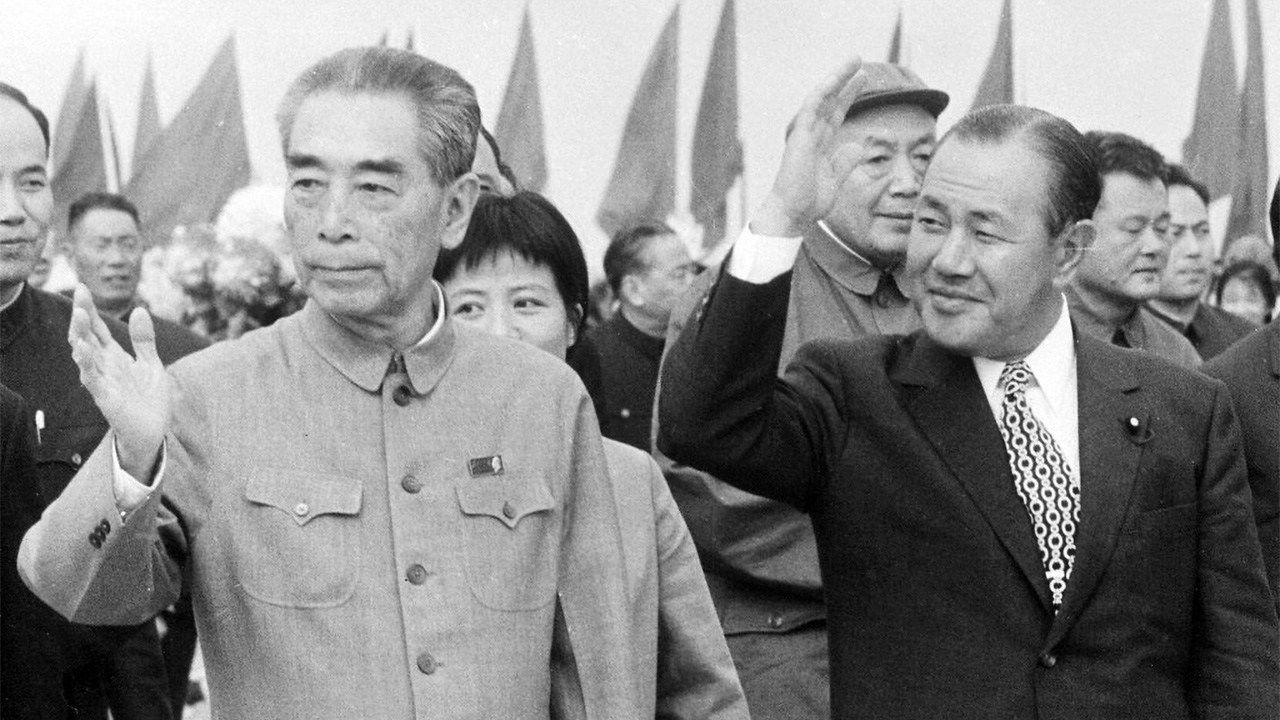
(Originally published in Japanese on December 25, 2025. Banner photo: Chinese Premier Zhou Enlai, left, and Japanese Prime Minister Tanaka Kakuei, wave to crowds at Shanghai’s airport as Tanaka departs from China in September 1972. © Kyōdō.)