Behind the Latest Japan-China Blowup (Part 2): Strategic Ambiguity in Need of an Upgrade
Politics- English
- 日本語
- 简体字
- 繁體字
- Français
- Español
- العربية
- Русский
Dissecting the Disconnect
Prime Minister Takaichi Sanae elicited a sharp condemnation from Beijing last November when she indicated during Diet questioning that the Japanese government might view a crisis in the Taiwan Strait as a situation threatening Japan’s own survival. A Chinese Foreign Ministry official called the prime minister’s remark “egregious” interference in a domestic issue situated “at the very core of China’s core interests.”
Some may be tempted to dismiss the backlash as a passing tantrum or bit of political theater intended for domestic consumption. At bottom, however, the controversy reflects a deep cognitive disconnect between Japan’s perception of its own security environment and Beijing’s perception of Japan-China relations—a gap that has widened to the point where it can no longer be obscured by diplomatic doublespeak.
As Tokyo sees it, the concept of a “survival-threatening situation,” built into Japan’s security laws, provides a set of general criteria for internal decision making vis-a-vis the operations of the Japan-US alliance. For those involved in such operations at a practical level, it has long been evident, in view of the geopolitical and military picture, that a crisis in the Taiwan Strait could compromise the operations of the US forces in Japan and the safety of Japan’s territorial waters and airspace. From this vantage point, it is hard to understand why a statement equating a hypothetical Taiwan crisis to a survival-threatening situation should, in itself, be interpreted as a major deviation from Japan’s established China policy or a repudiation of past diplomatic agreements.
Beijing’s perception of the issue, of course, is fundamentally different. As Beijing sees it, the Taiwan question is inextricably tied to China’s “core interests” of sovereignty, territory, and unity. Consequently, the mere hint of foreign involvement or intervention has political, ideological, and strategic implications that go far beyond any practical consequences.
It makes little difference that the comment was made for the purpose of explaining an established Japanese legal concept. The moment that concept was mentioned in conjunction with Taiwan, it had the potential to be taken as a redefinition of Japan’s stance toward China, a denial of the basic framework of Japan-China relations as defined by political documents going back decades. The issue here is not how Takaichi’s statement meshes with Japanese law but how it clashes with the all-important narrative of Chinese sovereignty.
Anatomy of Cognitive Gap
The perceptual asymmetry between Japan and China has been exacerbated by the content and style of the political documents that have defined Japan-China relations over the past half century or so. Ever since the 1972 Joint Communiqué issued by the governments of Japan and the People’s Republic of China, the bilateral relationship has rested on language that deliberately sidesteps any finalization of Taiwan’s political status. The joint statements and memoranda issued by the two governments over the years have facilitated political coexistence not by deepening mutual understanding but by using language that glosses over differences by conveying one thing to one side and something different to the other. In other words, the stability of the bilateral relationship has been maintained not by explaining one another’s positions but by avoiding such explanations.
During this time, Japan has boosted its defense capability within the framework of the Japan-US alliance, operating on the premises of various real-world scenarios—including a contingency in the Taiwan Strait. Yet the language it uses to explain itself to others still relies on the vocabulary of diplomatic documents drawn up in the 1970s. While the internal situation has evolved, the external facade has remained virtually unchanged, and as a result, the unexplained portions of Japanese security policy have expanded year by year. On Beijing’s side, meanwhile, the political rhetoric surrounding Taiwan has steadily intensified. Today, with the Taiwan issue defined as a matter “at the very core of China’s core interests,” any hint of involvement by another country is seen as an infringement of Chinese sovereignty. As a result of these two trends, the cognitive disconnect has approached criticality.
The Ghost of Wars Past
Another means by which the perception gap is amplified is historical discourse, which Beijing is increasingly inclined to marshal for political purposes. China rarely confines its criticism of Japan to the substance of individual policies. Instead, it frames its grievances in terms of larger, historical issues, such as militarization. Any mention of Taiwan immediately invokes rhetoric about China’s “core interests,” and discussions of the workings of the Japan-US alliance are folded into a larger narrative concerning the origins of the postwar world order and Japan’s deficient “understanding of history.” So it is that a statement that the Japanese view as elucidating a technical point is taken as a political provocation.
This disconnect suddenly burst into full view thanks to a single off-script remark never intended for external consumption. From the Chinese standpoint, Japan had suddenly, with no explanation or advance notice, stepped over a line that it had tacitly respected for decades. From Japan’s standpoint, it was difficult to understand how a comment that merely articulated well-established realities and systems could elicit such a response. This discrepancy is the very picture of a cognitive gap.
This is by no means the first time the gap has emerged, nor is the disconnect confined to Taiwan. For years now, Japan and China have maintained and developed the bilateral relationship by glossing over conflicting assumptions on a wide range of security issues. This balancing act functioned as long as things were on an even keel, but its precariousness became evident whenever security tensions spiked for one reason or another.
Some have blamed Takaichi for letting slip such an impolitic remark. But the crux of the matter is that we have reached the stage where it is almost impossible to proceed without articulating these sensitive issues. Changes in Taiwan’s security environment have eroded the tacit understanding on which Japan-China relations have long relied and exposed its limits.
Clarifying Strategic Ambiguity
Some have concluded that the ambiguity of Japan’s stance on Taiwan is the root cause of the latest falling-out, but this is not quite accurate. The problem lies not in ambiguity per se but in our failure to clearly delineate the strategy’s operational assumptions, including the underlying design principles and the sharing of policy information in accordance with those principles.
Strategic ambiguity is not the passive avoidance of clear commitments. It is a governance technique involving the deliberate allocation of information and uncertainty. For whom should things be left uncertain, and with whom should our assumptions be shared? Only when these lines are clearly drawn can ambiguity function effectively as a deterrent. Ambiguity itself is not the problem. The source of instability is a lack of shared understanding regarding the scope and significance of the ambiguity.
These principles of strategic ambiguity informed the legal concept of the “survival-threatening situation” as it was originally formulated. Without committing to intervention in specific situations, the concept opened the door to military action as deemed necessary by the country’s political decision makers. It was a device that allowed Japan to maintain such decision-making flexibility in relation to alliance operations and domestic policy alike. In that sense, it represents a Japanese version of strategic ambiguity.
However, while this design concept was shared within the Japan-US alliance, it was not sufficiently articulated to others. This is what permitted a practical posture that Tokyo views as a given to be taken by Beijing as egregious interference in China’s core interests. What precipitated the crisis was not a shift in policy but interpretive asymmetry.
The Need for Ongoing Dialogue
With all this in mind, we should avoid reducing the source of the current dispute to a single instance of careless speech or poor message management. Rather, we should understand it as the outcome of a situation in which a delicate balance, just barely preserved by skirting the subject, has reached its limit and can no longer be sustained. Our failure to update the language of diplomacy to reflect changes in the security environment has made such a clash inevitable.
Japan’s task now is neither to state clearly its intent to intervene in a Taiwan contingency nor to place formal limits on what might constitute a survival-threatening situation. What we need now is a clearer domestic understanding of the types of situations that can be considered survival-threatening, together with new language to communicate to other countries the existence and meaning of this concept. This does not mean automating the decision-making process. It means clarifying the conditions for such a political decision and the locus of responsibility.
At the same time, for ambiguity to function as deterrence, it is vital that we keep open the lines of dialogue with China. The risk of misunderstanding is greatest when ambiguity is divorced from dialogue. Without a basic shared understanding regarding Japan’s good intentions and the circumstances that could give rise to a serious response, ambiguity could become a hotbed of miscalculation instead of a tool of deterrence. What we are talking about here is not compromise but risk management.
The current controversy is not a failure of Japanese diplomacy. It is an incident that has illuminated the rift between security realities taken for granted by the Japan-US alliance and the diplomatic understandings enshrouding those realities. The important thing now is to heed that warning and seize the opportunity to refine Japan’s version of strategic ambiguity into a technique of governance, not dismiss the crisis as a passing storm.
Amid the rising uncertainty surrounding Taiwan, the Japanese government should not be rushing to commit itself to a specific course of action. Instead, it should be doing its best to minimize misunderstanding and build trust, while leaving room for flexible decision making. The concept of survival-threatening situations should remain in place as a valuable tool for this purpose. The question now is how best to refine its design and application.
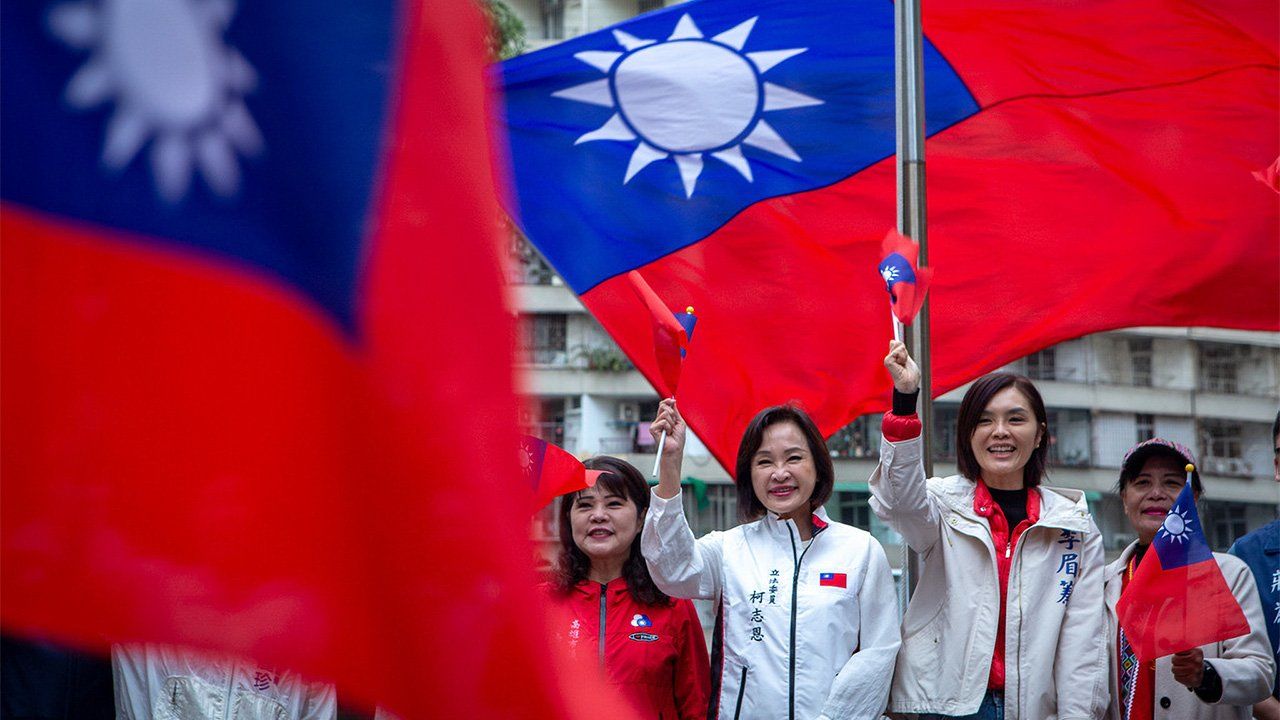
(Originally Published in Japanese. Banner Photo: Residents of Kaohsiung, Taiwan, welcome the New Year with a traditional flag-raising ceremony at dawn on January 1, 2026. © Cheng-Chia Huang/Zuma Press /Kyōdō.)