
Japan’s Digital Deficit Raises Sovereignty Concerns: A Call for Strategic Policy Making
Economy Technology- English
- 日本語
- 简体字
- 繁體字
- Français
- Español
- العربية
- Русский
Digital Disquiet
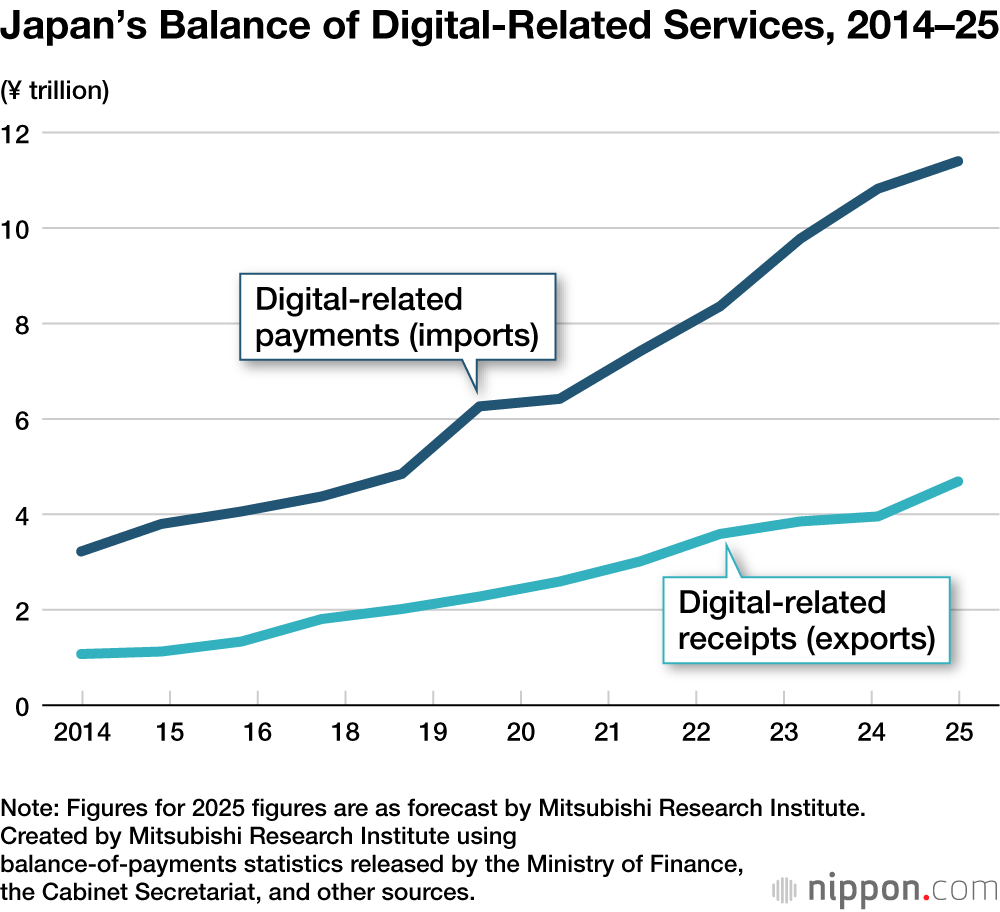
Japan’s negative balance of payments for digital services is alarmingly high. The Ministry of Finance and the Bank of Japan have forecast that the country’s “digital deficit” for 2025 will again top ¥6 trillion. Japan’s digital exports, which include royalties and license fees for anime and other digital content, rose to more than ¥4 trillion in 2025. But its payments to foreign-based digital providers now exceed ¥10 trillion (see graph below).
Digital-related services comprise three categories. The first is royalties and license fees. This covers not only payments for the use of digital content, such as music and anime, but also license fees for the operating systems like Windows and iOS installed in computers and smartphones. The second category is telecommunication, computer, and information services. This category includes payments for the use of such cloud computing services as Amazon’s AWS and Microsoft’s Azure, as well as the new generative-AI systems, such as ChatGPT and Gemini. The third category is specialized and management consulting services. The main component here is fees for online advertising, including the internet ads linked to Google searches and those posted on social networks like Facebook and Instagram.
DX and Competitive Weakness Drive the Deficit
There are two basic forces behind this trend.
The first is increased use of digital services by Japanese companies and individuals. This should not necessarily be seen as a negative. The highly convenient online services offered by foreign-based tech giants can make people’s lives easier and contribute to the health of the economy by boosting the efficiency of business operations and creating added value. In this sense, the deficit generated by digitalization can be viewed as a necessary investment.
More problematic is the second factor, namely, the declining competitiveness of Japan’s IT sector. If the domestic IT industry were more competitive, Japan would not be so dependent on foreign-based digital services. Back when the market was in its first youth, home-grown Japanese cloud services and social media sites were able to secure a significant share. But competitiveness in this sector hinges largely on the “network effect,” whereby success yields further success. In other words, the more users a platform has, the more attractive it becomes to new users. Consequently, smaller-scale domestic services have fallen farther and farther behind the big-tech companies’ global operations. This digital deficit, the result of declining competitiveness, should be viewed as a strategic issue, as it poses a threat to the future of Japan’s IT sector and ultimately to the nation’s economic autonomy and security.
Unfortunately, there is every likelihood that the digital deficit will remain high or even grow over the coming years. Much will depend on the development and spread of generative artificial intelligence. If foreign-based AI services enrolled just 30 million new Japanese subscribers—less than half of the labor force—at a rate of ¥3,000 per month, those payments would add more than ¥1 trillion to Japan’s annual outflows. Moreover, as the technology continues to develop, the focus will shift from systems that generate text and images to “AI agents” that carry out tasks autonomously to achieve complex goals. As companies adopt AI agents and AI robots to do the work currently carried out by employees, total outlays for such services can be expected to skyrocket. And if overseas firms continue to account for the majority of these services, the digital deficit is sure to grow as a result.
That said, digital services are a hypercompetitive market. In situations where prices are inflated by anti-competitive practices—such as the commission Apple has charged developers on sales of smartphone apps sold through its app store—courts and legislatures have been inclined to intervene, leading to price reductions. If the yen strengthens against the dollar, that will also help limit growth of the digital deficit.
Getting Ahead of the Game
There is no quick fix for the digital deficit. The digital services provided by foreign-based tech giants already have a strong foothold in Japan, and American and Chinese tech giants have pulled far ahead of Japanese companies in terms of financial and human resources. With such constraints in mind, Japan needs to strive toward two distinct goals.
First, the nation’s businesses and consumers should make the most of the advanced digital services available to them, including generative AI. It is true that one of the key factors contributing to the digital deficit is digital transformation. But this is an area in which Japan has fallen behind and must work hard to catch up. According to the report DX dōkō 2025 (Digital Transformation Trends 2025), published by Japan’s Information-Technology Promotion Agency, fewer than 50% of Japanese businesses are working actively to integrate generative AI into their operations, a substantially lower ratio than that seen in the United States and Germany. Such delays in the adoption of advanced digital technologies are eroding Japan’s competitiveness. Even if it means adding to the digital deficit over the short term, it is vital for Japanese companies, including those outside the IT industry, to rethink their operating models with AI in mind (“AI first”), so as to take productivity to a new level and augment the added value of their products and services.
Second, Japan must engage in strategic investment to boost the competitiveness of the domestic IT industry over the medium-to-long term. By making our IT businesses more competitive, we can ultimately lessen our dependence on foreign-based tech giants and reduce the digital deficit. But Japan lacks the financial and human resources to compete with big tech across a broad spectrum of services. It will need to concentrate on a few key domains. In selecting targets for investment, the focus should be on economic security—that is, on technologies and services that are essential to Japan’s digital sovereignty.
The public and private sectors are already putting their heads together on ways to secure Japan’s digital sovereignty from both a hardware and a software perspective.
An example in the hardware realm is “watt-bit collaboration.” The use of generative AI has increased demand for electricity to power large data centers. The watt-bit integration initiative proposed by Mitsubishi Research Institute would simultaneously advance DX (digital transformation) and GX (green transformation) through the construction of regionally distributed data centers powered by renewable energy and other low-carbon power sources. Thus far, Japan’s big data centers, concentrated in the Tokyo area, have been funded largely by foreign investment. But firms like Softbank, KDDI, and Sakura Internet are stepping up investment in data centers elsewhere in Japan. If sustained, this trend could contribute significantly to the reduction of digital-related outflows.
In the software realm as well, we are seeing a push toward the development and use of “sovereign AI”—marshaling home-grown technology, infrastructure, data, and personnel—to lessen reliance on foreign resources. Japan’s first Artificial Intelligence Basic Plan, approved by the cabinet in December 2025, outlines measures to promote the development of trustworthy foundation models and AI systems that play to Japan’s strengths. AI development is being carried out primarily by startups with financing from such IT giants as NTT, Softbank, and NEC and support from the Ministry of Economy, Trade, and Industry. The AI Basic Plan also includes measures to promote the domestic collection and organization of high-quality Japanese-language and industrial data so as to enhance the accuracy of Japanese AI. The hope is that these initiatives will help strengthen the competitiveness of the Japanese IT industry while securing Japan’s digital sovereignty.
Keeping the Deficit in Perspective
A great deal of attention has been focused on the size of the digital deficit from a monetary standpoint. But we need to appreciate the causes of the deficit in order to craft savvy policies in response. The key is to make optimum practical use of digital services provided by foreign-based companies while strategically prioritizing the capabilities that Japan most needs to protect. This is the crux of the digital-deficit challenge.
On the one hand, industry must adopt and integrate advanced digital services as needed to maintain and boost competitiveness—which means transitioning to “AI first”—unconstrained by short-term concerns about the digital deficit. At the same time, Japan must invest in the construction of its own data centers and the development of sovereign AI in order to boost the domestically supplied share of our digital economy and create an environment conducive to the safe and reliable use of generative AI.
Powering the data centers, which consume large amounts of electricity, is one key to digital sovereignty, a challenge that countries in Europe, Southeast Asia, and elsewhere are also grappling with. In the future, Japan may be in a position to export technological know-how relating to watt-bit collaboration and the development of domestic AI models. By investing in such technology, we should be able to lessen our dependence on foreign software and services, expand our options, and ensure our continued autonomy.
(Originally published in Japanese. Banner Photo: © Pixta.)