Prime Minister Takaichi’s Foreign Policy Challenge: Balancing Vision and Pragmatism in the Trump 2.0 Era
Politics- English
- 日本語
- 简体字
- 繁體字
- Français
- Español
- العربية
- Русский
New Mandate for Japan’s First Female Prime Minister
Prime Minister Takaichi Sanae’s Liberal Democratic Party and its junior coalition partner, Nippon Ishin no Kai, scored a landslide victory in the February 2026 general election, winning 352 of the 465 seats in the House of Representatives. The LDP alone boosted its lower house strength by 120 seats in a contest that Takaichi had characterized as an “election to choose a prime minister,” allowing her to claim a strong mandate.
The combined opposition still controls over half of the seats in the House of Councillors (upper house), but that has become immaterial; in the lower house, the LDP-Ishin coalition has the two-thirds majority needed to override the upper house on legislation. Armed with this supermajority, Takaichi has attracted the global spotlight. Indeed, the British magazine The Economist has dubbed her “the world’s most powerful woman.”
What will Prime Minister Takaichi do with that power?
Security is one area in which major policy changes are anticipated. There have already been reports that the Takaichi administration wants to ease restrictions on the export of defense equipment. In addition, it plans to update the nation’s three key strategic documents ahead of schedule, amend the economic security legislation enacted in 2022, and further beef up the defense budget. Expert panels have been launched to deliberate stricter controls over the activities of foreign nationals, including land acquisitions, and they are expected to begin submitting their conclusions within the next few months. It is shaping up to be a watershed year for Japanese security policy.
Staying in Trump’s Favor
When US President Donald Trump welcomes Prime Minister Takaichi to the White House on March 19, he will doubtless express his admiration for the way Japan’s “iron lady” has solidified her leadership at home. By contrast, the Trump juggernaut appears to have stalled ahead of November’s midterm congressional elections. With domestic dissatisfaction deepening over the administration’s handling of immigration and inflation, Trump is doubtless hoping to burnish his image on the diplomatic stage. But his ability to leverage tariffs—one of his favorite diplomatic tools—has been severely compromised by the Supreme Court’s ruling that the president lacks the legal authority to impose such taxes by fiat under the International Emergency Economic Powers Act.
How should Japan deal with Trump under these new circumstances?
In many countries, Japan included, there is growing support for the kind of defiant rhetoric employed by Canadian Prime Minister Mark Carney in his speech at Davos this past January, when he implicitly castigated the United States for undermining the international order. Let us ask ourselves first whether Japan stands to benefit from such a confrontational stance.
Alarm is spreading among Trump administration officials and other conservatives over signs that European countries are moving closer to China as they ramp up their criticism of America’s foreign policy. Carney’s Davos speech came shortly after his January visit to Beijing, during which he is said to have reset ties with America’s number one rival. Amid growing tensions with Europe and Canada, Japan has risen in Washington’s esteem. Tokyo was relatively quick to reach an agreement with the Trump administration on trade and has already announced the first batch of investments that were part of the tariff agreement. In addition, Takaichi has shown herself willing and able to stand up to China. By maintaining consistency in its dealings with the US and its stance toward China, Tokyo has secured a favorable status in the eyes of the Trump administration, and it is in Japan’s best interests to maintain that position.
In order to keep the bilateral relationship on an even keel over the short term, the March 19 summit needs to make substantive progress in the key areas of trade, investment, and security. Of course, we must be careful not to let these commitments impose an excessive burden on the Japanese government. But the fact is that investment in the United States promises to benefit Japanese industry by widening its access to the US market. Some here have called on the government to renegotiate the $550 billion strategic investment deal it concluded with the United States last year, but it is too soon to broach such a potentially explosive topic.
Keeping Cool with Beijing
Where Japan-China relations are concerned, the prospects are dim for any substantial improvement in the near future. In late February, Beijing announced new restrictions on the export of dual-use goods to Japanese companies and other entities. Given China’s antipathy toward Takaichi’s ideological orientation, including her views on history, Beijing will doubtless maintain a guarded attitude at least until the November APEC (Asia Pacific Economic Cooperation) summit, to be held in Shenzhen. But in the long run, the Takaichi government’s strong domestic backing, combined with its firm ties with the United States, should strengthen Japan’s negotiating position and pave the way for positive change in the Japan-China relationship.
From a medium-term perspective, Tokyo needs to avoid actions or words that might solidify the current impasse and prevent an eventual thaw in Japan-China relations. To keep the door open to détente, the Japanese government should reaffirm its commitment to the four basic diplomatic documents underpinning the bilateral relationship and let it be known that Japan remains open to dialogue at all times. Beyond that, any proactive moves to mend fences with China would be inadvisable at this time—nor are they likely under the Takaichi administration.
Partnering with South Korea
Takaichi and President Lee Jae-myung of the Republic of Korea got off to a good start with Lee’s visit to Japan last January. Takaichi is expected to return the visit as early as March, and ongoing “shuttle diplomacy” (frequent mutual visits) should further the trust-building process. For too long now, historical and territorial disputes have impeded a much-needed partnership between Japan and South Korea. The only way to move forward is to adopt a two-track approach, clearly separating such intractable, long-term disagreements from areas in which cooperation is possible and desirable.
It is time for both sides to adopt a future-oriented approach and begin working together on real-world issues. We need to start thinking outside the box of Japan-US-ROK security cooperation and step up bilateral collaboration in the economic and technological spheres. Just like other governments seeking to strengthen bilateral ties, Tokyo and Seoul should draw up a list of joint projects in the fields of economic security and technology and publicly commit to their implementation.
The Takaichi administration also has a broader responsibility to deepen ties of cooperation with other like-minded countries in the Indo-Pacific region. Many of these countries have shown themselves increasingly receptive to China’s overtures of late. What can Japan do to advance its vision of a Free and Open Indo-Pacific? How should Takaichi go about building the “strong and affluent Indo-Pacific” she promised in her February policy speech to the Diet?
ASEAN and the Indo-Pacific
The first step is to follow the lead of the late Prime Minister Abe Shinzō and strengthen diplomatic ties with the Association of Southeast Asian Nations. This will involve substantive efforts to step up cooperation in such areas as high tech, economic security, and defense. Tokyo also needs to ramp up diplomacy with Australia, India, Taiwan, and the Pacific Island Countries.
From a global perspective, the erosion of the rules and norms governing international society has given rise to widespread anxiety about the fate of the world order. Japan needs to demonstrate its determination to contribute to a rules-based international order through the mechanism of the 12-member Comprehensive and Progressive Agreement for Trans-Pacific Partnership and similar frameworks.
All of that said, management of the Japan-US relationship remains the top diplomatic challenge facing the Takaichi administration. President Trump’s behavior—unpredictable at the best of times—could wax even more erratic as he strives to claw back popular support ahead of November’s congressional elections. It is entirely possible that Trump will take further actions that flout international norms and run counter to the interests of America’s European allies. To navigate diplomatic relations with such a government, the Takaichi cabinet must be prepared to make sound judgments grounded not just in moral principles but, more importantly, in the nation’s best interests.
Stepping Up to the Plate
In her February policy speech, Prime Minister Takaichi pledged to make Japan a “shining beacon” in the Indo-Pacific region. This is a key aspect of Takaichi’s vision for the future. At the same time, Japan must continue to strengthen its ties with the United States, not only with the goal of managing the bilateral relationship in the Trump era but also with the aim of encouraging the United States to resume constructive engagement with the international community.
With the March 19 Japan-US summit in the offing, I would like to propose that Prime Minister Takaichi take the opportunity to deliver a major speech in Washington, DC. In that address, she should convey the sense of crisis and anxiety gripping the world today and communicate in forceful and concrete terms Japan’s determination to assume greater responsibility in partnership with the United States.
The United States needs to understand that the Japanese government will make the independent decision to keep ramping up its efforts in the area of defense. Japan must demonstrate its willingness to contribute to our joint security not just through investment but also by working with the United States to break free of our overdependence on China for strategic materials, a major vulnerability. Japan must portray itself not as a dependent unilaterally seeking handouts from the United States but as an equal partner, coordinating with the United States on the global stage without sacrificing its own vision.
The ruling party’s supermajority gives Takaichi considerable latitude to pursue her own vision. But with freedom comes responsibility. Japan’s foreign policy must remain centered on realistic management of relations with the United States, while at the same time keeping a lid on tensions with China, deepening cooperation with like-minded countries like South Korea and Australia, and helping to build a free and open order in the Indo-Pacific and around the globe. In our current age of uncertainty, with the international order hanging in the balance, it is all the more vital that we pursue a clear-eyed, realistic foreign policy measured not by ideals but by results—namely, the achievement of lasting peace and prosperity.
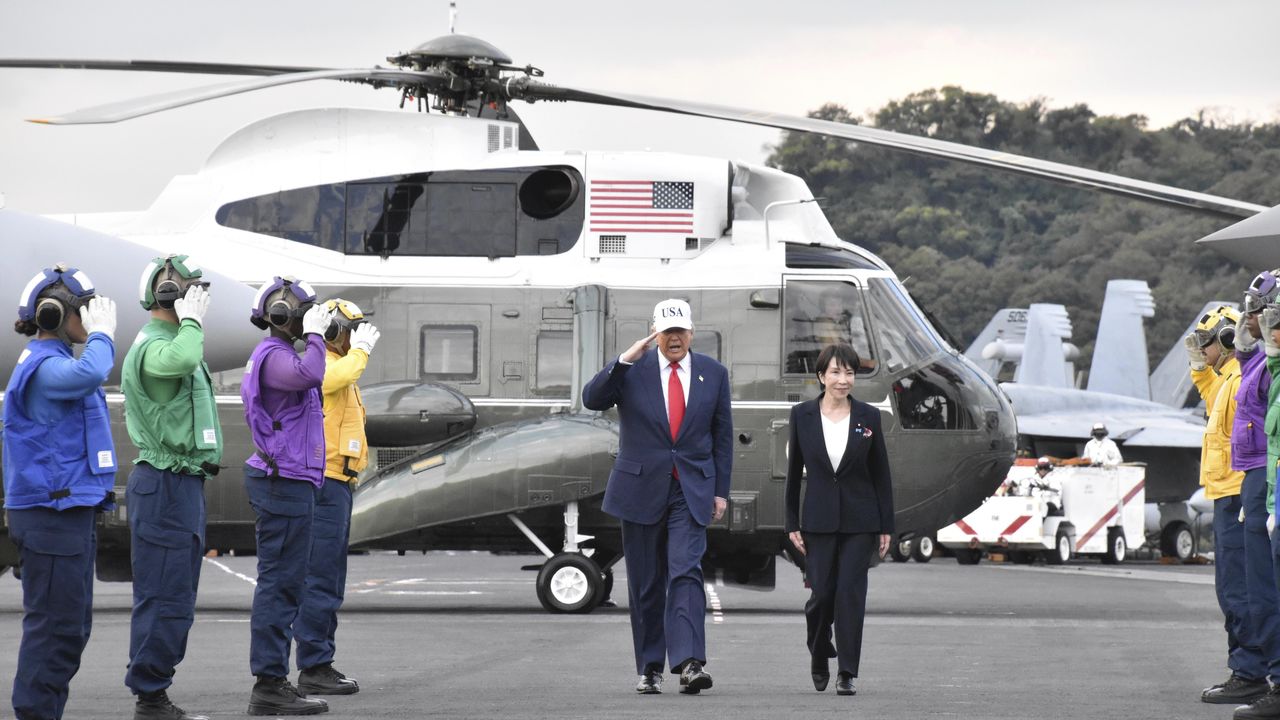
(Originally published in Japanese. Banner photo: Alighting from the presidential helicopter Marine One, US President Donald Trump and Prime Minister Takaichi Sanae greet troops aboard the aircraft carrier USS George Washington, stationed at the US naval facility in Yokosuka, Kanagawa Prefecture, on October 28, 2025. © Jiji.)