Takaichi’s Summit Success: March Meeting with Trump Ends “Without Incident”
Politics- English
- 日本語
- 简体字
- 繁體字
- Français
- Español
- العربية
- Русский
A Summit Made Murky by the Fog of War
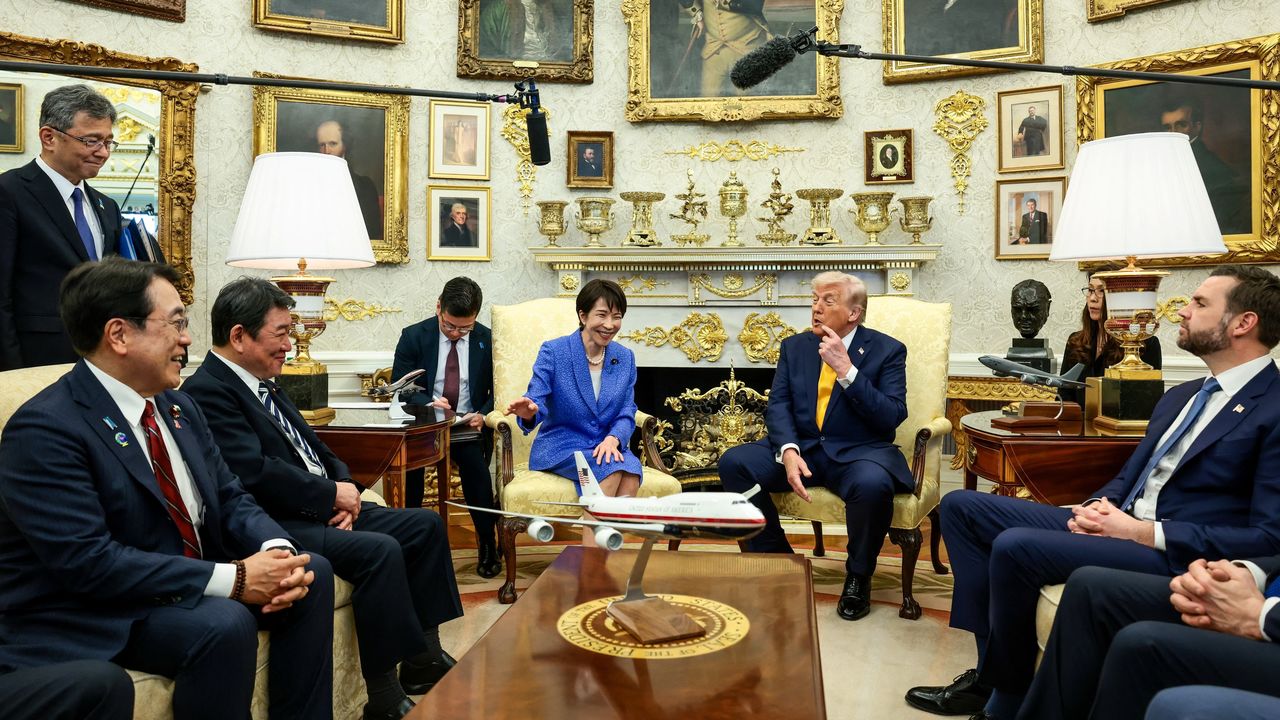
On March 19, 2026, Japanese Prime Minister Takaichi Sanae went to Washington DC and held her second summit with US President Donald Trump, following the first in October of the previous year in Japan. The meeting began with a warm embrace as the two leaders met once again and continued in a harmonious atmosphere right up to its end.
At the outset of the summit, President Trump welcomed Takaichi to the White House with praise for her Liberal Democratic Party’s overwhelming victory in the February 8 House of Representatives contest, a “tremendous election in a record-setting fashion” that he described as giving her “something in common” with himself. Hailing her as “a very popular, powerful woman,” he then watched as she began by offering thanks in English and then switching to Japanese. Here Trump recognized her “very good interpreter,” Takao Sunao of the Ministry of Foreign Affairs. Takao, the director of the ministry’s Status of US Forces Agreement Division, also handled interpreting duties for Prime Minister Abe Shinzō and is a familiar face to the president, who has in the past called him “the little prime minister.” The Japanese side’s selection of him for this year’s summit speaks to the care with which personnel choices and other preparations were made.
Takaichi’s trip to the United States was originally envisioned with a different goal in mind. With President Trump slated to visit China at the end of March, the aim was to head off a situation where the United States bypassed Japan and achieved a conciliatory thaw in Sino-American ties that could impact Japan negatively. Preparations for Takaichi’s Washington visit began in earnest in early January.
This was also around the time that the prime minister announced her intention to dissolve the lower house and call a general election. The Japanese side was thus concerned about whether it was really a good idea to move ahead with summit preparations at a time when nobody knew what the election results might be; the American side, however, eagerly proposed a schedule for Takaichi’s visit, seemingly confident that she would win handily and arrive in Washington in a stronger position.
While remaining well aware that there is no predicting what Donald Trump might do, Japanese government officials nevertheless, even at that early stage, began to harbor higher expectations for the summit—an optimism fueled by Trump’s evident fondness for Takaichi.
In the end, though, that unpredictability rose to the fore. When the United States and Israel attacked Iran on February 28 and President Trump postponed his visit to China, the ground assumptions for Takaichi’s trip to Washington crumbled. Now the question was how Japan, as an ally to the United States, would respond to this military action, and what sort of contributions to the effort Trump would demand of the Japanese. In March Iran effectively closed the Strait of Hormuz, sending oil prices skyward. The upcoming bilateral summit between Japan and the United States, ordinarily not something that would attract much attention in the international political scene, was suddenly something of considerably more significance.
The Disjointed Trump Response to Japan’s Joint Statement
Ever since his second administration kicked off in January 2025, President Trump has frequently bashed key European nations, even appearing to view other North Atlantic Treaty Organization members as foes to oppose at times. In this challenging situation, the Japanese government has stepped up to lay the groundwork for supporting the United States alongside European states.
The day before Takaichi’s summit with Trump, Japan joined with five other nations—fellow Group of Seven members Britain, France, Germany, and Italy, along with the Netherlands—to release a joint statement on the Strait of Hormuz situation. The six signatories condemned “in the strongest terms” Iran’s attacks on civilian infrastructure and “de facto closure” of the passage, declaring: “We express our readiness to contribute to appropriate efforts to ensure safe passage through the Strait.” This document did not, however, include any consideration of the legality of the US attack on Iran.
In his summit-opening statements the following day, President Trump praised Japan’s role in this statement. “We’ve had tremendous support and relationship with Japan on everything. And I believe that, based on statements that were given to us yesterday . . . they are really stepping up to the plate.” Bewilderingly, despite the NATO members releasing the statement alongside Japan, he added: “Unlike NATO.” Observers were split on how to take this quip—was Trump’s dislike of the organization too strong to be overcome by a mere joint statement, or was he signaling that he hoped to see Japan take a still deeper role in the Iran situation moving forward?
Trump has often commented on Japan’s dependence on the Middle East for more than 90% of its imported oil, noting the need for a stronger Japanese contribution in resolving the Iranian crisis. Japanese Minister for Foreign Affairs Motegi Toshimitsu, though, has sought to build this reliance into a source of strength, speaking by telephone twice with his Iranian counterpart Abbas Araghchi. This underscores Japan’s “special relationship” with Iran, something that is not in place in any other G7 member.
Indeed, in a telephone interview with Kyōdō News just after the Takaichi-Trump summit, Foreign Minister Araghchi indicated Iran’s willingness to ensure safe passage through Hormuz for Japan-related vessels. This combined a message of goodwill toward the Japanese and an effort to prevent Japan from aligning overly closely with the United States, providing a glimpse of the complex Tehran take on its relations with Tokyo.
Takaichi Opts for Flattery
In her own statements at the outset of the summit, Prime Minister Takaichi blatantly massaged her host’s ego, telling him: “I firmly believe that it is only you, Donald, who can achieve peace across the world.” This was almost certainly a phrase chosen through nerve-racking deliberation on how best to win Trump’s favor. But even if it was delivered in the spirit of pleasing the president and prompting him toward an early conclusion of hostilities, the risk remains that the global community will view it as a Japanese recognition of the US attacks on Iran as legal.
Most nations today are viewing these attacks not as preemptive strikes against an imminent threat, but rather as “preventive strikes” aimed at engineering desired outcomes for the United States. The former would be legal in terms of international law, but the latter are not. Washington, though, has not traditionally paid much heed to the legality of its actions under international law, as seen in the crafting of a security strategy under President George W. Bush that includes preventive strikes among America’s options.
Since the beginning of hostilities, the debate over the legality of attacking Iran and humanitarian concerns about attacks impacting civilian populations have faded into the background as attention focuses instead on the more pragmatic question of reopening the Strait of Hormuz, whose closure is dealing a severe blow to the global economy. Japan, and many others in the Western camp, are expressing only vague assessments of the legality of US and Israeli military actions—perhaps the wise choice, if the goal is to avoid angering a president who is so emotionally involved in his Iran campaign that he has chosen the bombastic “Operation Epic Fury” as its label.
A Surprising Comment on the Need for Surprise
The Japanese side carefully planned out various scenarios for this summit, but when the time came, there was one development that briefly shocked everyone into silence.
When a Japanese journalist asked President Trump why the United States had not shared information with Japan and its other allies ahead of the attack on Iran, he replied: “We went in very hard and we didn’t tell anybody about it because we wanted surprise. Who knows better about surprise than Japan, OK? Why didn’t you tell me about Pearl Harbor? Right? . . . You believe in surprise, I think, much more so than us.” The Japanese government officials and media representatives in the room froze at this statement. Prime Minister Takaichi, too, said nothing, her expression frozen on her face.
We might argue over the pluses and minuses of Takaichi’s dedication to the task of keeping Donald Trump in high spirits, no matter what. But at the very least, this summit came across as one that counted as a success for Japan. The Japanese team came back home with some positive news to tell: There were no strongly worded demands for an active Self-Defense Force presence in the Middle East. While Trump’s meeting with the Chinese leadership has been put on hold, Japan did manage to get out ahead of it and deliver a message on the strength of its alliance with America. And Takaichi coaxed a statement out of the president on the continued US involvement in maintaining the free and open Indo-Pacific.
Underpinning this success at the deepest level is the “Trump strategy” that has been deployed in concert by the Foreign Ministry, including the embassy in Washington, the Ministry of Economy, Trade, and Industry, and other actors on the Japanese side. The goal of this strategy has been to keep the Trump administration convinced that Japan retains high strategic value for America.
Economy, Trade, and Industry Minister Akazawa Ryōsei—who has made his way to Washington countless times for tariff talks since the administration of Takaichi’s predecessor, Ishiba Shigeru—accompanied her on this month’s trip, pleasing the Trump White House by driving home the Japanese contribution on the economic front. During this visit, as the second tranche of the $550 billion in Japanese investment pledged during Ishiba’s time in office, he signed an agreement on projects totaling some $73 billion: two small modular reactors built in Tennessee and Alabama as part of the next generation of nuclear power plants, and natural gas generation facilities in Pennsylvania and Texas. This doubtlessly buoyed President Trump’s spirits during Takaichi’s visit.
Big Burdens to Carry Back Home
Takaichi Sanae was not known for particularly deep diplomatic experience before becoming prime minister. But she has overcome this, along with her previously recognized tendency to pay little heed to advice from others, in tackling summit diplomacy with what one high-ranking Japanese official has called “performances that go well beyond what the script calls on her to do on the global stage.” Her accomplishments here are significant in terms of avoiding the worst-case scenario of an unraveling of the US-Japan relationship.
At the same time, though, over the longer term, she may have saddled Japan with some weightier, more difficult challenges to face.
If Japan comes to be seen as throwing in with Trump’s reckless “peace through strength” approach to global affairs, it will be harder for the nation to take on a leading role in the international community of the future, assuming a timely return to a focus on morality and the rule of law. Having witnessed the overwhelming military might the United States has deployed in Venezuela at the beginning of the year and now in Iran, Japan will now find it harder to build momentum toward a “plan B” to supplement the bilateral alliance. And if it continues its excessive reliance on the United States in the security realm, it will find its options increasingly limited in the area of foreign affairs. Trump says something different almost every day; there is no guarantee that he will not change his stance on ties with Japan at some point.
On March 22, soon after the summit’s conclusion, German Minister of Defense Boris Pistorius came through Japan as part of a tour of Asia. While here he accompanied Japanese Minister of Defense Koizumi Shinjirō on an inspection of the US Navy base at Yokosuka, Kanagawa, and the nearby Maritime Self-Defense Force Yokosuka Naval Base, holding a joint press conference with an MSDF destroyer as a backdrop. As Koizumi stressed the importance of Japan-Europe coordination in an increasingly chaotic global situation, Pistorius made certain to reiterate the following:
“What both of our countries recognize is the importance of not rule by force, but the rule of law.”
(Originally published in Japanese on March 25, 2026. Banner photo: Japanese Prime Minister Takaichi Sanae and US President Donald Trump share a laugh at the White House ahead of their summit discussions on March 19, 2026. © Reuters.)