Japan’s Task: Safeguarding Maritime Security in the Indo-Pacific
Politics- English
- 日本語
- 简体字
- 繁體字
- Français
- Español
- العربية
- Русский
Japan’s Post–World War II Engagement with Southeast Asia: A Primarily Economic Approach
After accepting the Potsdam Declaration in August 1945, Japan renounced all overseas territories, including those in Southeast Asia and the South China Sea. This renunciation was legally confirmed in the 1952 San Francisco Peace Treaty. Against this historical backdrop, Japan refrained for several decades from involvement in Southeast Asian political and security affairs, instead rebuilding its relations with the region primarily through economic engagement.
Japan achieved a rapid recovery from wartime devastation and experienced remarkable economic growth from the mid-1950s through the early 1970s. During this period, Japan also contributed significantly to the industrialization and economic development of the “Four Asian Tigers”—South Korea, Taiwan, Singapore, and Hong Kong—as well as other Southeast Asian countries and China, the last of which enjoyed impressive economic expansion after launching its reform and opening-up policies in the late 1970s.
However, economic development across emerging Asian economies also helped drive nationalism and military buildups. Nowhere has this trend been more visible than in the South China Sea, which has become an arena for competition over national interests among coastal states. Disputes over sovereign rights to numerous islands and maritime features scattered across one of the world’s most strategically vital sea lanes are one manifestation of this competition, and these disputes remain unresolved.
The Expanded Scope of Japan’s Security Policy
Against the backdrop of these changes in the regional security environment, the scope of Japan’s security policy was reassessed in the 1990s and geographically expanded to encompass the broader Asia-Pacific region. A major turning point occurred at the Japan-US summit meeting between Prime Minister Hashimoto Ryūtarō and President Bill Clinton in April 1996. The Joint Declaration on Security issued by the two leaders reaffirmed that the Japan-US alliance plays a pivotal role in maintaining peace, stability, and prosperity in the Asia-Pacific region, and that the future security and prosperity of both nations are closely linked to the region’s stability. Japan’s security policy has since then become increasingly intertwined with the security dynamics of Southeast Asia.
The Free and Open Indo-Pacific vision, initially articulated by Prime Minister Abe Shinzō in 2016, emphasizes the rule of law, freedom of navigation, the promotion of free trade, economic prosperity, and commitment to peace and stability. Accordingly, FOIP incorporates a security dimension that includes capacity-building assistance aimed at strengthening governance, maritime security, and navigational safety.
Even prior to the articulation of FOIP, Japan’s security and defense policies had been gradually adapting to the international environment emerging from the end of the Cold War, as well as to the changing regional security landscape. Nevertheless, FOIP represented a major step forward in Japan’s strategic engagement in the Indo-Pacific region, particularly in Southeast Asia. For example, the Japan Maritime Self-Defense Force has conducted Indo-Pacific Deployment long-range training missions, mainly in the South China Sea, since 2017. These deployments deliberately incorporate port visits and joint exercises with regional navies, reflecting broader strategic considerations.
The Japan Ground Self-Defense Force and Air Self-Defense Force have also expanded defense exchanges with countries located along major sea lines of communication across the Indo-Pacific under the FOIP framework, in line with the Ministry of Defense’s approach.
Japan has further strengthened defense cooperation with the Philippines by concluding both an Acquisition and Cross-Servicing Agreement and a Reciprocal Access Agreement, with the aim of enhancing operational interoperability and mutual understanding between the two countries. In addition, the Japan Coast Guard established a Mobile Cooperation Team in 2017 to facilitate capacity-building assistance for maritime law enforcement agencies in Southeast Asia.
Structural Transformation of the Maritime Security Environment
Over the past decade, China’s maritime law-enforcement capabilities and naval power have expanded significantly, fundamentally transforming the security environment in East Asia. In the past, regional security cooperation focused primarily on transnational threats such as religious extremism, piracy, and terrorism. Today, however, the central concern has shifted to China’s coercive gray-zone operations in the South China Sea. Gray-zone operations inherently carry the risk of escalation into the use of force, a risk clearly illustrated by the August 11, 2025, collision incident involving a China Coast Guard cutter and a People’s Liberation Army Navy corvette. Previously observing developments from a distance, the PLAN has begun to engage more directly in the Scarborough Shoal dispute, as reported by the US Naval Institute.
The war in Ukraine has also revealed profound structural changes in the global security environment. Now entering its fifth year, the conflict has exposed the paralysis of the United Nations Security Council in preventing armed conflicts and the inability of the UN system to take unified action even in the face of clear violations of sovereignty and territorial integrity. A notable example is the Eleventh Emergency Special Session of the United Nations General Assembly held on February 24, 2026. Although the session adopted a resolution calling for an immediate, complete, and unconditional ceasefire in Ukraine, 63 countries representing 37% of UN member states either voted against or abstained.
The Ukraine war has revealed two important realities. First, if a nuclear-armed permanent member of the UN Security Council launches a military invasion in a limited geographic area with firm political resolve, it becomes extremely difficult for the international community to restrain such actions. Second, as I have argued elsewhere (in Japanese), when nuclear superpowers become involved on opposing sides, both are likely to prioritize avoiding escalation to nuclear confrontation, possibly resulting in prolonged conventional warfare.
If these lessons are applied to East Asia, an unsettling possibility emerges. The United States may face considerable difficulty in deterring the Chinese intent to alter the regional status quo. Were a contingency to escalate to direct US military intervention, both Washington and Beijing would likely seek to avoid nuclear escalation, the consequence being that countries in the region could become involved in a lengthy war of attrition fought largely with conventional forces.
At the same time, Southeast Asia is facing emerging maritime challenges beyond traditional territorial disputes. These include illegal, unreported, and unregulated fishing, environmental degradation, cyberattacks targeting critical maritime infrastructure, and the sabotage of submarine cables. Such developments reflect the increasing complexity and diversification of gray-zone threats in the maritime domain.
Diversifying Maritime Security Cooperation
Amid these structural changes in the maritime security environment, it has become increasingly important for middle and smaller powers in Southeast Asia to upgrade their deterrence capabilities while diversifying their security partnerships. Such efforts are essential to safeguard sovereignty and territorial integrity while preserving sustainable peace and prosperity.
One important step in this diversification process is establishing closer regional security cooperation through various minilateral frameworks. While ASEAN remains central to the regional architecture, its member states maintain diverse security perspectives and differing political relationships with China. Consequently, achieving unified action—particularly on the South China Sea—remains challenging.
Minilateral frameworks offer greater flexibility and enable participating countries to focus on specific areas of cooperation. In this sense, they can complement ASEAN mechanisms without undermining ASEAN centrality. The Philippines currently participates in three minilateral frameworks, all involving military exercises and defense cooperation. Within the Philippines-US-Japan framework, cooperation has expanded beyond defense to include maritime security, economic security, infrastructure development, and cybersecurity.
During the administrations of US Presidents Barack Obama and Joe Biden, the United States sought to complement the traditional hub-and-spoke alliance structure by promoting multiple minilateral frameworks. Professor Mori Satoru of Keiō University has observed that such arrangements generate “synergistic effects by combining capabilities that cannot be achieved through bilateral cooperation alone.”
In 2024 and 2025, the United States launched nine minilateral arrangements in the Western Pacific. Given the uncertainties surrounding US regional commitments under the second Trump administration, these frameworks—including those involving the United States—may serve an important function in anchoring continued US engagement in regional security arrangements.
A second dimension of diversification involves encouraging the participation of extraregional partners in existing minilateral frameworks while gradually expanding their scope of cooperation. Such participation can raise international awareness of Southeast Asia’s security challenges and help boost overall deterrence.
A third dimension entails stepping up practical capacity-building support through expanded defense equipment transfers and joint military exercises based on more realistic operational scenarios.
Japan has provided capacity-building assistance to nine Southeast Asian countries, transferring surveillance radar systems to the Philippine Air Force in 2023 and 2024 and providing a coastal surveillance radar system to the Philippine Navy under the Official Security Assistance framework in February 2026. In total, five coastal surveillance radar systems with an aggregate value of approximately ¥600 million will be supplied.
Established in April 2023, OSA is a new framework that provides grant assistance aimed at improving the deterrence capabilities of like-minded partners. Under this scheme, Japan has agreed to provide rescue vessels and related equipment to Malaysia, as well as high-speed patrol boats to Indonesia.
Japan should pursue further transfers of defense equipment under the OSA framework, as such transfers not only enhance the immediate deterrence capabilities of partner countries but also increase the visibility of Japan’s leadership in regional security cooperation.
While Japan has thus far transferred finished defense equipment for the most part, the changing security environment suggests the need to expand cooperation to include the development of production bases. Bolstering the manufacturing capabilities of partner countries and jointly building resilient defense supply chains should become an important policy objective.
At present, Japan’s direct involvement in maritime security in Southeast Asia remains limited. Japan should therefore actively expand cooperation with like-minded countries through bilateral, multilateral, and minilateral frameworks to uphold the rules-based international order. Such efforts would also serve as diplomatic signaling encouraging all parties to exercise restraint in gray-zone activities.
The views expressed in this article are the author’s and do not reflect those of JIIA CGO.
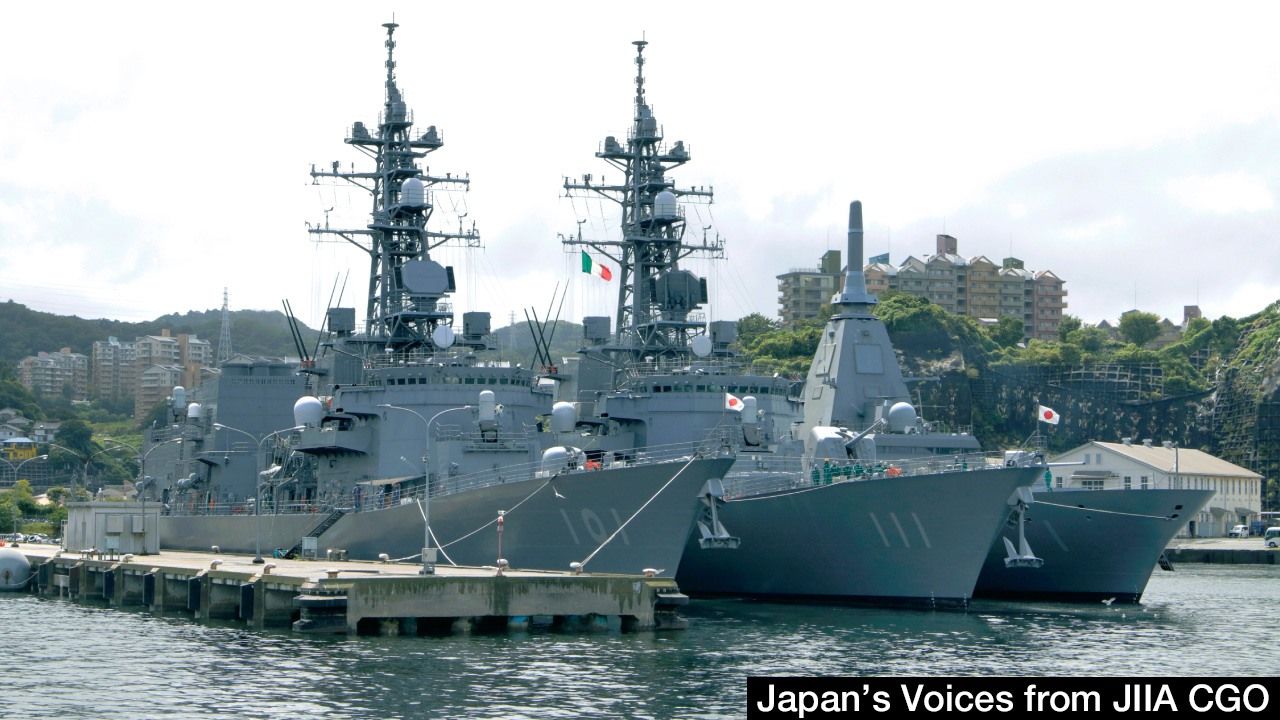
(This slightly edited article is republished through a partnership with JIIA CGO. See JIIA CGO to view the original post. Banner photo: Maritime Self-Defense Force vessels in port in Kanagawa Prefecture. © Kurihara Hideo/Aflo.)