Rethinking Japan’s National Defense: Takaichi Tackles the Three Security Documents
Politics- English
- 日本語
- 简体字
- 繁體字
- Français
- Español
- العربية
- Русский
Japan’s Conflicted Postwar Security Policy
In February 1945, as World War II was drawing to an end, the heads of government of the “Big Three” Allied Powers—US President Franklin D. Roosevelt, British Prime Minister Winston Churchill, and Soviet General Secretary Joseph Stalin—gathered near Yalta on the Crimean Peninsula to draw up a blueprint for the postwar international order. At the time, the three leaders envisioned a setup in which the United States and the Soviet Union would collaborate to neutralize any lingering forces of Nazism in Germany and militarism in Japan.
The following August, Japan surrendered unconditionally to the Allies, acceding to the terms of the Potsdam Declaration, and disbanded its armed forces. In November 1946, Japan promulgated a new Constitution, drafted under the direction of the US Occupation authorities, which renounced war as a sovereign right and prohibited the maintenance of “war potential” (Article 9). The victors of World War II viewed the permanent and total demilitarization of Japan as a key component of the “Yalta system,” intended to ensure lasting peace.
But the cooperative US-Soviet relationship envisioned at Yalta was not to be. Indeed, the postwar structure that emerged was precisely the opposite: a deeply entrenched geopolitical rivalry that became known as the Cold War. As this configuration took hold, Japan came under pressure to support the “Western” bloc by rearming and signing the Japan-US Security Treaty, even while upholding Article 9 of the Constitution, which prohibited maintenance of war potential. In this way, Japan’s postwar defense policy was torn between the imperatives of the Yalta system on the one hand and the Cold War on the other.
The Perilous Post-Cold-War Environment
The Cold War officially ended with the dissolution of the Soviet Union in 1991. In the years since then, Japan’s security situation has become increasingly fraught. The United States, exhausted by its “war on terror,” has moved to limit its engagement in East Asia, notwithstanding North Korea’s nuclear brinkmanship and China’s military expansion. These circumstances have eroded the formerly widespread view that Japan can best contribute to peace by letting others lead the way in matters of security. That passive, pacifist viewpoint has given way to a growing understanding that Japan should engage actively in security matters in order to maintain and develop an international order beneficial to this nation and the rest of the world.
On December 17, 2013, the first administration of Prime Minister Abe Shinzō adopted Japan’s first formal National Security Strategy as the basis for the country’s revised National Defense Program Guidelines (since renamed the National Defense Strategy) and Medium-Term Defense Program (now the Defense Buildup Program). The National Security Strategy, National Defense Strategy, and Defense Buildup Program are now known as Japan’s three key security documents.
The cabinet of Prime Minister Kishida Fumio adopted major revisions to the three security documents on December 16, 2022, partly in response to Russia’s invasion of Ukraine earlier that year. In what was billed as a historic shift in Japan’s postwar security policy, the documents called for the acquisition of counterstrike capabilities (previously deemed incompatible with the Constitution’s prohibition on maintaining a war potential) and an increase in defense spending from roughly 1% to 2% of gross domestic product. With these policy changes, the concept of “proactive pacifism,” introduced by the Abe administration in 2013, was finally put into effect.
Responding to Recent Threats
The magnitude of the 2022 upgrade notwithstanding, Japan’s security situation has grown even more perilous in the three years since it was adopted.
The biggest factor is the growing Chinese threat. China’s official 2026 defense budget amounts to more than ¥40 trillion, a more than two-fold increase from a decade earlier. Since 2022, China has boosted defense spending by ¥15.4 trillion, dwarfing Japan’s vaunted ¥3.6 trillion increase.(*1) Furthermore, China has stepped up its military activity in Japan’s environs. On May 3, 2025, a helicopter launched from a Chinese Coast Guard vessel entered Japanese airspace over the waters around the Senkaku Islands. China has conducted frequent military exercises in the vicinity of Taiwan. Moreover, on June 8, 2025, it was confirmed that a Chinese aircraft carrier had sailed east of the Japanese island of Iwo Jima for the first time, signaling China’s eastward advance into the Pacific.
Other factors are North Korea’s steadily advancing nuclear and missile capabilities and the military cooperation that has sprung up between Russia, China, and North Korea since Russia plunged into war with Ukraine.
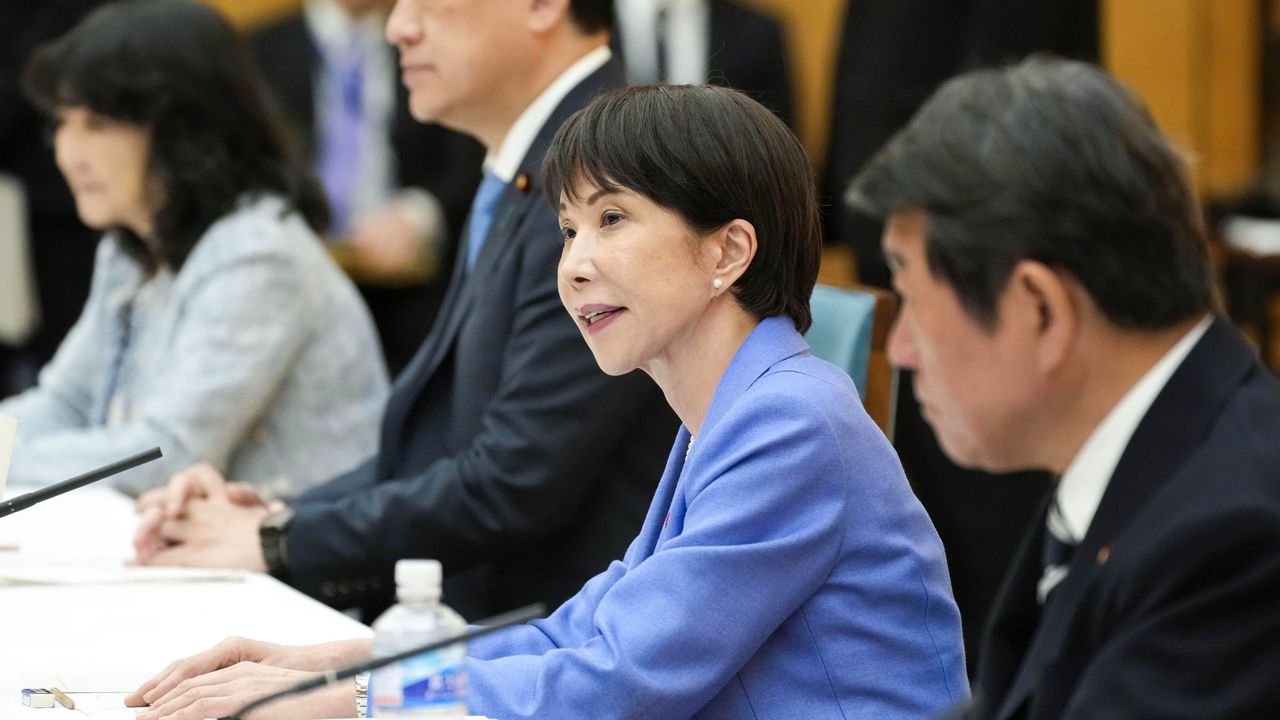
With these circumstances in mind, the Takaichi administration decided to move up the revision of the three security documents, originally scheduled for 2027. On April 27 this year, she convened a 15-member expert panel (including Sasae Kenichirō, former ambassador to the United State; Kuroe Tetsurō, former administrative vice-minister of defense; and Yamazaki Kōji, former chief of staff, Joint Staff), to draw up recommendations for the documents’ revision.
Agenda items include Japan’s standoff capability, integrated air and missile defense, defense of the Pacific and vital sea lanes, and use of unmanned assets, as well as development of defense capabilities in the space, cyber, and electromagnetic domains, use of artificial intelligence for command and communication, and enhanced cooperation with like-minded nations. Lessons from the war in Ukraine pertaining to new forms of warfare, such as the integrated use of missiles and unmanned assets, will figure prominently as background in the deliberations. Of equal importance are measures to strengthen Japan’s human-resource base, its technological base, and its defense production capacity.
Meanwhile, a new set of principles governing the transfer of defense equipment, adopted by cabinet decision on April 21, opens the door to the export of lethal weapons. This signals a historic departure from the long-standing de facto ban on all arms exports adopted in 1976. The objective is both to build Japan’s defense manufacturing and technological base and to strengthen cooperation with like-minded countries through the sharing of defense equipment and production and maintenance infrastructure.
An Evolving Philosophy
Under the “basic defense force concept” (formally adopted in 1976), Japan focused on developing a minimum defense force, with little thought to potential threats or actual operations. After 2010, however, the guiding concept behind Japan’s defense program shifted from a “beyond the threat” philosophy to a counter-threat approach, with a new focus on defense operations. What this means is that operational requirements have become the driving force behind Japan’s defense buildup. The Takaichi administration’s revision of the three security documents can be expected to continue this trend toward an operationally oriented defense geared to countering specific threats.
In this context, two key objectives are (1) overcoming areas of inferiority and (2) preparing for long-term warfare. There is a rapidly growing need to counteract Japan’s inferiority in land, sea, and air defense through multi-domain operations that make integrated use of new domains, such as cyberspace and the electromagnetic spectrum. Preparing for prolonged combat is also vital. One suspects that Russian President Vladimir Putin might have thought twice about launching his invasion of Ukraine if he had known in advance that Ukraine could sustain an effective resistance for more than four years. It follows that Japan can significantly enhance its deterrent capability by further upgrading its operationally oriented, counter-threat defense with a view to overcoming areas of military inferiority and preparing for prolonged warfare.
Whither the Nonnuclear Principles?
Amidst this ongoing shift toward an active, counter-threat defense, some observers have suggested that the Takaichi administration means to discard or weaken Japan’s “three nonnuclear principles” prohibiting the possession, production, or introduction of nuclear weapons in Japan. There is no denying that Takaichi herself has been calling for a review of these rules, originally adopted in 1967. In a 2024 collection of essays on national defense that Takaichi edited, she wrote that the explicit reaffirmation of the three nonnuclear principles in the 2022 National Security Strategy would become an “impediment.”(*2) This position speaks to the difficulty of reconciling the “non-introduction” principle with Japan’s dependence on America’s extended nuclear deterrence.
Be that as it may, when questioned in the Diet on November 26, 2025, after she took office as prime minister, Takaichi stated that she stood by the three nonnuclear principles and denied that she had instructed the panel charged with revising the key security documents to review those principles.
In other Diet testimony, meanwhile, Takaichi has made it clear that she regards the “non-introduction” principle as a policy guideline. In this regard she has referred to remarks made by Foreign Minister Okada Katsuya back in 2010, when the Democratic Party of Japan was in power. In Diet questioning on March 17 that year, Okada acknowledged that, in the event of a situation in which Japan’s safety could only be ensured by allowing a nuclear-armed American vessel into one of its ports, the government of the day would have to make the appropriate judgment call, “staking its own survival on that decision.”
As a practical matter, the question of allowing nuclear weapons into Japanese territory is closely intertwined with America’s own operational policies. Currently, the United States military does not deploy nonstrategic nuclear weapons on its ships or aircraft, nor is it operating attack submarines equipped with sea-launched cruise missiles. To some degree, this obviates the need for a clear-cut policy change in Japan.
According to insiders, the Liberal Democratic Party’s recommendations for revision of the three security documents do not call for a review of the nonnuclear principles. Under the circumstances, it seems likely that the government’s focus for now will be on deepening domestic discourse on the issue from the strategic perspective of strengthening extended deterrence.
Growing Doubts About Our Ally
The offensive against Iran launched by Israel and the United States on February 28, 2026, is bound to have some influence on deliberations regarding revision of the three key security documents. In the 2022 versions, the Japanese government reaffirmed its commitment to uphold and defend an international order based on international law. Unfortunately, there is a strong case for declaring Trump’s use of force against Iran a violation of international law.
Are these actions by the United States a temporary aberration or a long-term trend? Depending on the answer, a re-examination of the Japan-US alliance may be necessary somewhere down the road.
A more pressing concern is the danger that resources and attention that the United States would otherwise devote to East Asia will be siphoned into the war in Iran. Under the circumstances, the need to enhance Japan’s security independence and autonomy will doubtless figure prominently among the concerns driving the “Takaichi edition” of Japan’s three security documents.
(Originally published in Japanese on May 8, 2026. Banner photo: Prime Minister Takaichi Sanae addresses the first meeting of an expert panel convened to draft revisions to Japan’s three key security documents, including the National Security Strategy, at the Prime Minister’s Official Residence on April 27, 2026. © Kyōdō.)
(*1) ^ Ministry of Defense, Security Environment Surround Japan
(*2) ^ Takaichi Sanae, ed., Kokuryoku kenkyū—Nihon rettō o tsukoku, yutaka ni (National Power Studies—Making the Japanese Archipelago Strong and Prosperous) (Tokyo: Sankei Shimbun Publications, 2024), p. 19.