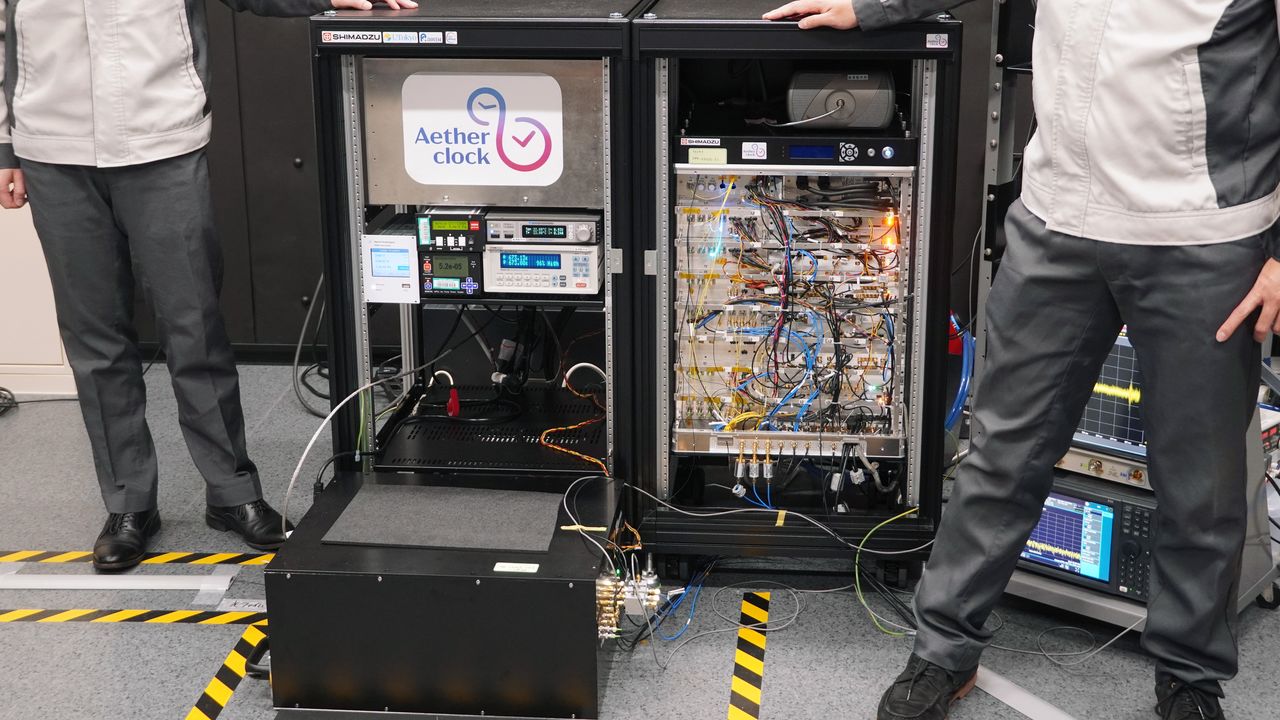
Redefining the Second: Japan’s Staggeringly Precise Optical Lattice Clock Promises Wealth of Real-World Applications
Science Technology- English
- 日本語
- 简体字
- 繁體字
- Français
- Español
- العربية
- Русский
Japan’s strontium optical lattice clock has been called the “ultimate timepiece.” Developed by Katori Hidetoshi, professor of physics at the University of Tokyo and director of the Riken (Institute of Physical and Chemical Research) Spacetime Engineering Research Team, the clock boasts unprecedented precision—measured in billions of years. This amazing accuracy, capable of gauging slight differences in elevation using Einstein’s theory of general relativity, holds immense promise as a new standard in timekeeping and a valuable tool in such fields as space exploration, earthquake research, and global positioning.
A Brief History of Time
In ancient times, human beings relied on the apparent movement of celestial objects to gauge the passage of time. The division of the day (one complete revolution of the earth) into ever smaller increments yielded the concept of the second as a tiny fraction of a day. But precision timekeeping did not develop until much later.
In the sixteenth century, the Italian astronomer Galileo Galilei (1564–1642) discovered that any pendulum of a given length would swing at a constant frequency, paving the way for the invention of the pendulum clock by the Dutch mathematician and physicist Christiaan Huygens (1629–95). (Portable spring-driven timepieces were developing around the same time.) A new era in precision timekeeping began with the development of quartz clocks, which rely on the constant frequency at which quartz crystals oscillate when exposed to an electrical charge. Some of today’s high-accuracy quartz timepieces are accurate to within a second over 100 years.
The next major advance came in the second half of the twentieth century with the development of atomic clocks. An atomic clock keeps time using the frequency of the electromagnetic radiation absorbed or emitted when a particular atom transitions between energy states. In 1967, the cesium-133 atomic clock was adopted as the world’s primary standard for timekeeping. As a result, one second is now defined not in relation to the earth’s movement but as 9,192,631,770 cycles of the microwave that causes the excitation of cesium-133. The most advanced cesium devices are said to have a relative accuracy of about 1 X 10–15, which equates to a drift of just one second over 60 million years.
Dawn of the Optical Lattice Clock
The optical lattice clock is a next-generation atomic clock that makes use of visible light to achieve a mind-boggling level of precision. Visible light has a frequency several orders of magnitude higher than that of microwaves. This means many more cycles per second and thus a much more finely ruled yardstick for measuring time. The technology also uses strontium, which has a resonance frequency many times higher than cesium.
Katori first proposed his optical lattice clock in 2001. A key objective was to find a way of using a large number of atoms while avoiding the disturbances and deviations caused by interaction among those atoms. It was a problem that had stumped researchers for years.
In Katori’s clock, the interference patterns of laser beams—tuned to a frequency dubbed the “magic wavelength”—create an optical lattice resembling an egg carton. Roughly a million strontium atoms, cooled to nearly absolute zero, are individually confined within this lattice. By averaging the extraordinarily high-frequency oscillations of these atoms as they absorb energy from a laser, the technology provides a dramatically more stable and precise basis for the definition of a second.
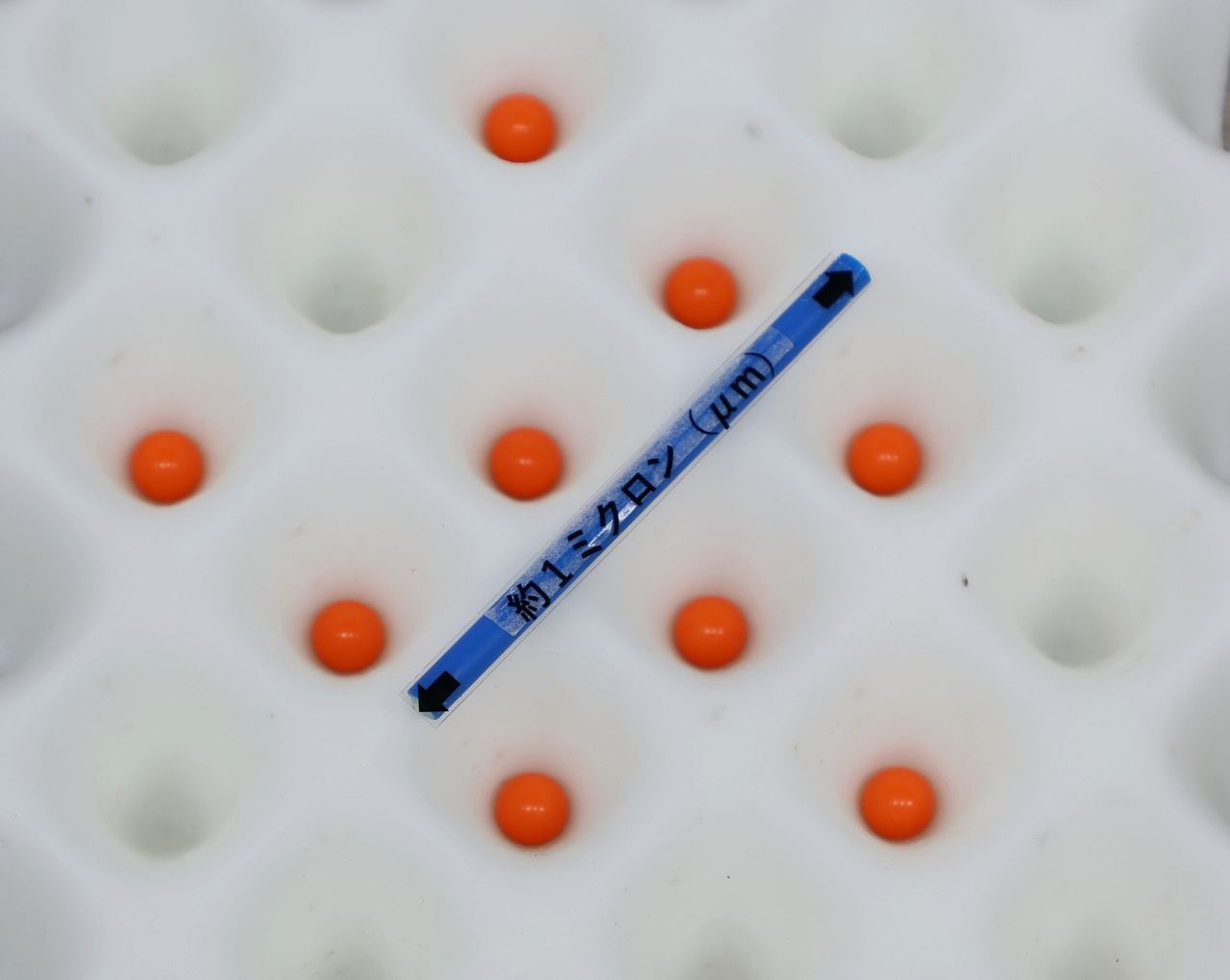
A three-dimensional model showing atoms trapped in the laser-beam “egg crate” of an optical lattice clock. (© Jiji)
After Katori and his research team had performed a series of successful ultra-high-precision frequency measurements, their work began to attract international attention as a technology capable of playing a key role in the redefinition of the second. As early as 2006, it was designated a candidate for the next generation of precision timekeepers. However, at this stage, the optical lattice clock existed only as a massive piece of equipment permanently installed in a physics laboratory. The research team’s next goal was to design a device that could be transported.
Katori’s team set to work, collaborating with private-sector partners like Shimadzu Corp. and JEOL (Japan Electron Optics Laboratory). In November 2024, the team unveiled a compact, 250-liter optical lattice clock, miniaturized from the original 920-liter version. It was a giant step toward practical application of this groundbreaking Japanese technology.
Staggering Precision, Surprising Applications
The test results published by Katori and his colleagues during this period caused considerable excitement in the global scientific community. In April 2020, the team successfully used two transportable optical lattice clocks (predecessors of the version unveiled in 2024) to test Albert Einstein’s theory of general relativity, which posits that time moves faster at higher elevations because gravity is slightly weaker.
The team placed the transportable models in two locations, one at the base of Tokyo Skytree and one on the tower’s 450-meter-high observation deck. The experiment found that time had passed 4.26 nanoseconds per day faster on the observation deck than on the ground, as predicted by Einstein’s theory. It also demonstrated that the precision of the transportable clocks—comparable to that of the laboratory model—was sufficient to gauge relatively small differences in elevation using Einstein’s theory. In fact, the accuracy of these measurements was found to be on a par with that of recent space experiments using satellites.

Professor Katori Hidetoshi of the University of Tokyo at a May 12, 2026, press conference in Kawasaki announcing an agreement with the International Bureau of Weights and Measures to evaluate the optical lattice clock as a candidate for redefining the second. (© Jiji)
Earlier, in February 2015, Katori’s team tested two optical lattice clocks and found that they deviated from one another at a rate of just 1 second in 16 billion years. What that means is that, theoretically, such a clock would drift by only 1 second over a period equal to the age of the universe (roughly 13.8 billion years). The most recent model achieves a fractional uncertainty in the realm of 10–18, which would yield an error of 1 second in about 30 billion years. This is without doubt the ultimate timepiece.
In March 2025, Shimadzu Corp. announced that it was launching sales of the world’s first commercial optical lattice clock. Measuring 108.3 centimeters high by 114 cm wide by 65 cm deep, the Aetherclock OC020 has a drift rate of approximately 1 second every 10 billion years. At the time of the announcement, Shimadzu set a suggested retail price of ¥500 million (about US$3.3 million at that time) with the goal of selling 10 clocks over the next three years.
Having demonstrated the technology’s practical potential, Shimadzu Corp. and Riken were able to conclude a memorandum of understanding with the International Bureau of Weights and Measures (BIPM), which plans to adopt a new definition of the second in 2030. In the MoU, announced on May 12, the parties agreed to collaborate on research and demonstration testing of optical lattice clocks. Katori’s device will be competing for the title of next-generation standard with other inventions, including the single-ion clock developed by researchers in Europe and the United States. But the optical lattice clock is regarded as a leading contender owing to its superior stability.
The MoU generated considerable excitement as a major step toward the adoption of the strontium optical lattice clock as an international standard. At a press conference following the signing ceremony, Katori said, “I’m glad if the tool we’ve provided for time comparison has done anything to accelerate the [second’s] redefinition.”
Potential for Volcanic, Seismic Monitoring
Katori received his doctorate in applied physics from the University of Tokyo’s Graduate School of Engineering in 1994. He held positions as a visiting scientist at the Max Planck Institute for Quantum Optics in Germany, an associate professor at the University of Tokyo’s Faculty of Engineering, and a principal investigator in the Japan Science and Technology Agency’s CREST strategic basic research program before accepting the post of professor at his alma mater in 2010. He is a winner of the 2013 Nishina Memorial Prize, the 2015 Japan Academy Prize, and the 2022 Honda Prize, awarded by the Honda Foundation. He is currently regarded as a strong candidate for the Nobel Prize.
On November 17, 2022, at the awards ceremony for the Honda Prize in Tokyo, Katori delivered a lecture titled “Curiosity-Driven Science as a Pathway to the Future.” In the introductory remarks to his lecture, he said, “As I have grown older, I have become more intent on using this [optical lattice] technology to leave behind something that will benefit society and humankind.”
In fact, beyond leading to a redefinition of the second, Katori’s groundbreaking clock is expected to spawn a host of technological offshoots with useful applications.
As previously noted, the optical lattice clock provides a tool for measuring even small differences in elevation. Indeed, the latest ultra-high-precision optical lattice clocks can detect height disparities of just a few centimeters. This makes it a highly promising tool in the emerging field of relativistic geodesy.
Among the applications being eyed in Japan is the use of optical lattice clocks as ultra-high-precision sensors to monitor volcanic and seismic activity. It is known that volcanoes exhibit topographical changes before an eruption owing to the movement of magma and other pressures. By deploying and networking multiple optical lattice clocks, it should be possible to detect subtle changes that are difficult to spot using conventional monitoring methods. Such networks could be used both for continuous monitoring of volcanic activity and for improved detection of other crustal deformations relevant to earthquake research and prediction.
A New Tool for Observation and Monitoring
In addition to disaster prevention, optical lattice clocks have great promise as a tool for space observation and exploration. In more earthbound terms, engineers are looking at their implications for the evolution of the global positioning system, the next generation of telecommunications, autonomous driving, and other technologies closely bound up with the technological underpinnings of our daily lives. Katori’s ultimate timepiece promises to take its place not simply as the standard for timekeeping but as a vital instrument for the high-precision observation and monitoring of the world we live in.
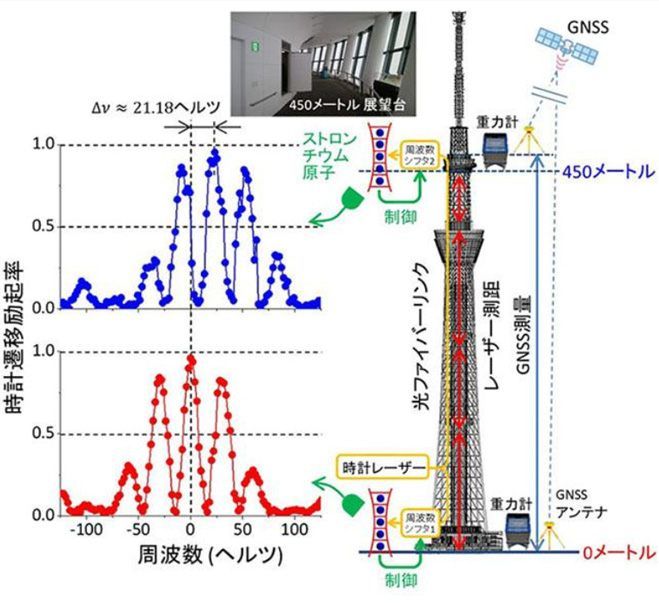
Summary of the Tokyo Skytree experiment. (Courtesy of Professor Katori Hidetoshi, University of Tokyo)
In a colloquy with University of Tokyo Professor Emeritus Murakami Yōichirō, sponsored by the Honda Foundation, Katori spoke as follows:
“My first thought when selecting a research topic was that I wanted to conduct research free from competition. But I also wanted to choose an interesting topic that the team would enjoy doing. That was my starting point. At the same time, I realized it was no good if the research didn’t benefit society. I was thinking that our basic research could yield results that conferred real benefits within about twenty years. And I’m really pleased that, after twenty years, our research has progressed to the point where it’s giving back to society.”
The development of more precise clocks is directly linked to the evolution of our social infrastructure. The future we envision for humanity could very well hinge on accurate timekeeping technology. Such are the expectations surrounding the ultra-high-precision strontium optical lattice clock pioneered by Katori Hidetoshi.
(Originally published in Japanese. Banner photo: Shimadzu Corp.’s Aetherclock OC020, the world’s first commercial optical lattice clock. Photographed on March 5, 2025. © Jiji.)