Can Takaichi Push Through Japan’s Long‑Delayed Refundable Tax Credits?
Politics- English
- 日本語
- 简体字
- 繁體字
- Français
- Español
- العربية
- Русский
Moving Ahead with Benefits First
After leading the Liberal Democratic Party to a sweeping victory in the February 2026 general election, Prime Minister Takaichi Sanae announced that she would temporarily reduce the consumption tax on food to zero for two years as a bridge measure before introducing refundable tax credits as the centerpiece of her reform program. To design the new system, she launched a cross‑party National Council on Social Security.
Following months of deliberation, the council’s working-level committee on July 16 reached an agreement to introduce an annual, continuous program of income‑linked, finely calibrated benefits beginning in fiscal 2029. The measure would reduce tax and social‑insurance burdens on low‑ and middle‑income workers based on individual, not household, income. By mitigating the “thresholds” that trigger sharp increases in taxes or social‑insurance premiums—resulting in sudden drops in take‑home pay—the system was touted as strengthening incentives to work.
To simplify administrative procedures, the agreement postponed the tax‑credit component and began with benefits only. In the face of strong calls for benefits to be paired with tax credits, however, the council stated it would continue to examine the full model, rather than committing fully to a benefits‑only scheme.
A separate proposal was advanced in late June for the consumption tax on food and non-alcoholic beverages to be lowered to 1% for two years from fiscal 2027. Meanwhile, income-linked benefits would be introduced to provide payments to lower-income consumers equivalent to the ¥600 billion in revenues expected from the 1% levy. Opposition parties voiced strong objections, however, thwarting a cross-party consensus. The final decision is expected to be made by the prime minister. (On August 5 a cabinet decision finalized the two-year reduction of the tax rate to 1% and the income-linked benefits to bring the effective taxation rate to 0% for low- and middle-income earners.—Ed.)
Strengthening Work Incentives for Low-Income Earners
Refundable tax credits combine two mechanisms: a tax credit that reduces income‑tax liability and a cash payment when the credit exceeds the tax owed. Although the design varies by country, the concept is often traced to the earned income tax credit, introduced by US President Gerald Ford in 1975. The EITC provides tax relief only to households with employment income, thereby encouraging workforce participation.
Unlike traditional social‑security benefits, refundable credits increase as income rises—up to a certain point—boosting take‑home pay and strengthening work incentives for low-income earners. After reaching a plateau, the credit gradually phases out for those with higher incomes.
In 1998, President Bill Clinton introduced the United States’s child tax credit, which varies by number of children. In Britain, Prime Minister Tony Blair launched that nation’s working tax credit in 1999 and consolidated child‑related support into the child tax credit in 2003.
Canada introduced the goods and services tax credit in 1991 to offset the regressive impact of its new value-added GST. It later added the Canada child tax benefit in 1993 and the working income tax benefit in 2007, both considered forms of refundable credits. Many European countries and South Korea adopted similar earned‑income and child tax credits in the 2000s.
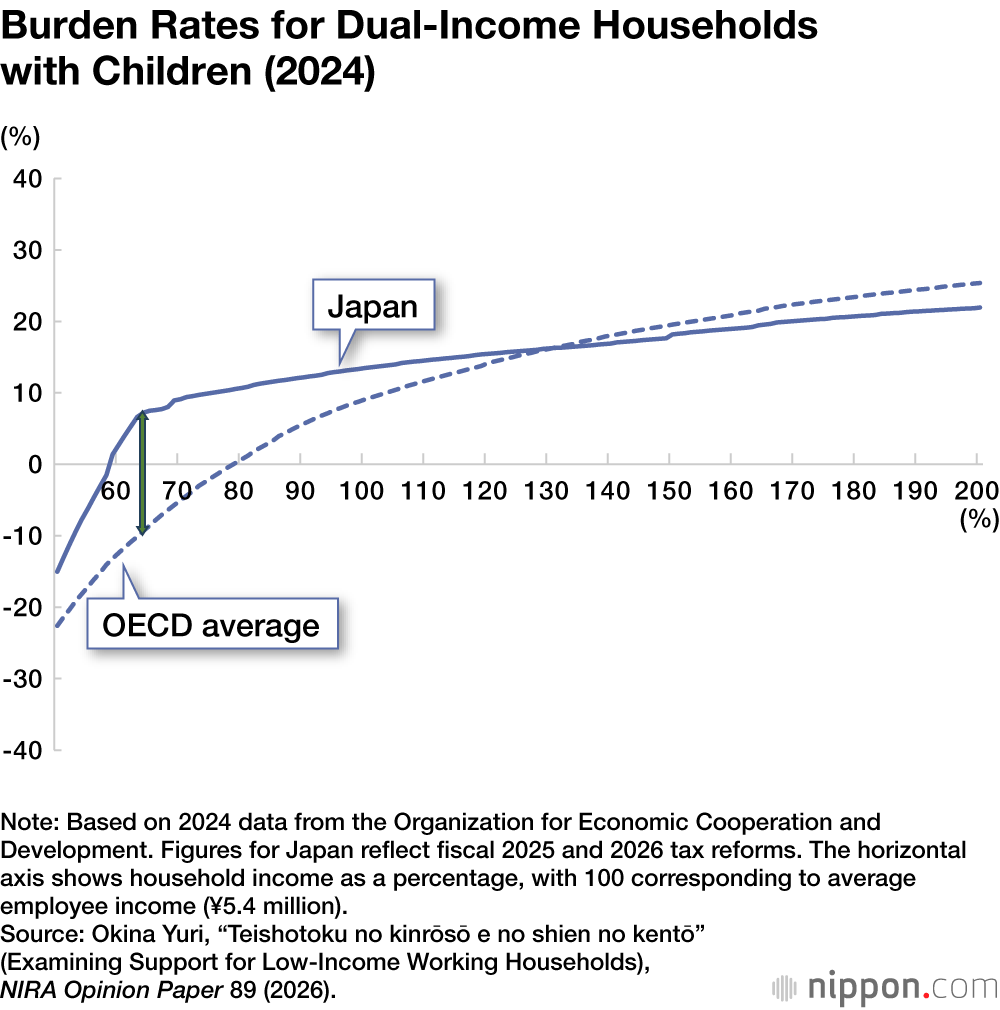
Japan’s social‑insurance burdens for low‑income households are deemed quite heavy compared to other advanced economies—especially for those whose income just exceeds the threshold for public assistance and are thus subject to insurance premiums (see figure). This has strengthened calls for Japan to adopt refundable tax credits.
Earlier Moves Under DPJ Rule
Japan’s interest in refundable tax credits is not new. The government’s Tax Commission called for study into the measure in its November 2007 report. Around the same time, the Democratic Party of Japan—then in the opposition—advocated introducing tax credits and cash benefits in lieu of tax deductions to strengthen income redistribution. The Asō Tarō cabinet’s December 2008 medium‑term program also included refundable credits as a way to ease burdens on low‑ and middle‑income households alongside a proposed consumption‑tax increase, and both the LDP and coalition partner Kōmeitō pledged to introduce refundable credits in their 2009 election platforms.
After sweeping to victory in the 2009 general election, the DPJ began preparing the My Number taxpayer identification system to ensure accurate income data—a prerequisite for refundable credits. Although the DPJ initially pledged not to raise the consumption tax for four years, Prime Minister Kan Naoto pivoted toward a tax hike in June 2010, only to lose the upper house majority in the following month. Internal divisions deepened, with a group led by Ozawa Ichirō openly opposing the hike. To overcome such resistance, Kan’s DPJ successor, Noda Yoshihiko, reached out across the aisle and sought the cooperation of the LDP and Kōmeitō to enact an increase.
The DPJ favored refundable credits as a remedy for the regressive nature of the consumption tax, while the LDP and Kōmeitō advocated lower rates for foods and other essential items. Kōmeitō’s stance was shaped by its close affiliation with Sōka Gakkai, the lay Buddhist organization that forms its core support base. Because Sōka Gakkai opposed a consumption tax hike, Kōmeitō pressed for reduced rates as a concession to secure the group’s backing. The June 2012 three‑party agreement committed the government to consider reduced rates, refundable credits, and a comprehensive cap on out‑of‑pocket costs for medical, nursing‑care, and childcare services.
Elections Focus on the Consumption Tax
The LDP-Kōmeitō coalition, led by Abe Shinzō, returned to power following the December 2012 general election. In the 2013 upper house race, Kōmeitō campaigned on introducing reduced rates for essential goods when the consumption tax is raised to 10%, creating tensions with the Ministry of Finance and the LDP, which sought to maintain a single rate for all items. Ultimately, in December 2015, the government approved reduced rates for food (excluding alcohol and dining out) and newspapers published at least twice weekly.
Although the Abe cabinet enacted the My Number bill that was initially introduced by the DPJ, the legislation focused on administrative efficiency and preventing improper payments, rather than on building a foundation for refundable credits. The comprehensive cap system was also shelved.
The DPJ (and subsequent manifestations such as the Democratic Party and the Constitutional Democratic Party), Nippon Ishin no Kai (Japan Innovation Party), and Kōmeitō maintained refundable credits in their platforms after the 2014 general election, but no concrete design emerged. Until the 2019 consumption‑tax hike to 10%, the political debate centered on freezing the hike, and since then it has focused on rolling back the rate.
Refundable credits have repeatedly fallen by the wayside because the LDP showed little enthusiasm for addressing the consumption tax’s regressivity—while strongly supporting corporate tax cuts—and Kōmeitō prioritized lower rates. But the policy also faced structural challenges.
The first was the difficulty of accurately ascertaining individuals’ income. The My Number system improved income reporting, but obtaining information on the earnings of the self‑employed and asset‑based income remained a challenge. A second obstacle was the high administrative cost. Introducing refundable tax credits would require a fundamental overhaul of systems spanning several ministries, including those for taxes and social‑security.
Overcoming these technical and administrative hurdles requires strong political leadership. A third challenge was the complexity of the system itself, making it difficult to explain and hard for the public to understand; designing it also takes time, even as the policy offers little immediate impact. Although some experts have long argued that refundable tax credits are more rational than reducing consumption‑tax rates on some or all products—which tend to deliver larger benefits to higher‑income households—politicians focused on winning elections have consistently opted for simpler, more popular measures, such as reduced rates and tax cuts.
A Policy Once Again at Center Stage
After the 2025 upper house election, refundable tax credits began to draw renewed attention.
The LDP-Kōmeitō coalition lost its lower house majority in the October 2024 election. One standout winner was the Democratic Party for the People, which campaigned on raising the threshold at which income is taxed—the so‑called ¥1.03 million barrier—and reducing social‑insurance burdens for working households. DPP leader Tamaki Yūichirō argued for increasing take‑home pay for the working‑age population and criticized the government’s decision to offer inflation‑relief payments to households exempt from the resident tax, noting that most recipients were elderly pensioners rather than workers. Also gaining seats in the election was Reiwa Shinsengumi, which called for abolishing the consumption tax.
The ruling coalition fared poorly again in the July 2025 upper house election, while Sanseitō—campaigning on the phased abolition of the consumption tax—made significant inroads. This prompted an LDP leadership contest in October, won by Takaichi, who had pledged to consider introducing refundable tax credits.
Takaichi has endorsed such credits since her 2021 leadership bid. Earlier, in 2012, she drew criticism for remarks about the rising number of welfare recipients—saying that Japan would collapse as a state if citizens put on a needy face just to get what they can. But her support for refundable tax credits reflects a consistent view: that even when seeking to correct inequality, the tax system should be designed to strengthen incentives to work. This position aligns with the logic behind Gerald Ford’s EITC, Tony Blair’s shift from welfare to “workfare,” and longstanding proposals from the Ishin party and economist Takenaka Heizō.
Unresolved Questions: Funding and Benefit Levels
Now that Japan has a highly popular prime minister who is strong proponent of refundable tax credits, the policy may finally become reality. Strong showings by the DPP and Sanseitō in recent elections have also pushed the rest of the LDP, the Ministry of Finance, and the Ministry of Health, Labor, and Welfare to confront the hardship and frustration of low‑income workers—concerns that had long been overlooked. Support for consumption‑tax cuts and lower social‑insurance premiums thus should not be dismissed as mere populism but as a reflection of genuine economic strain.
Even so, the central question—how to finance finely calibrated benefits linked to income—remains unanswered. Takaichi insists that she will not rely on deficit-financing bonds, but concrete plans for securing permanent funding have been deferred. Achieving meaningful reductions in burdens and offering stronger work incentives will require substantial benefits, but the size of such benefits cannot be determined without clarity on the program’s fiscal scale. With long‑term interest rates rising and the yen weakening amid concerns over fiscal deterioration, attention now turns to whether the government can make a responsible, credible decision.
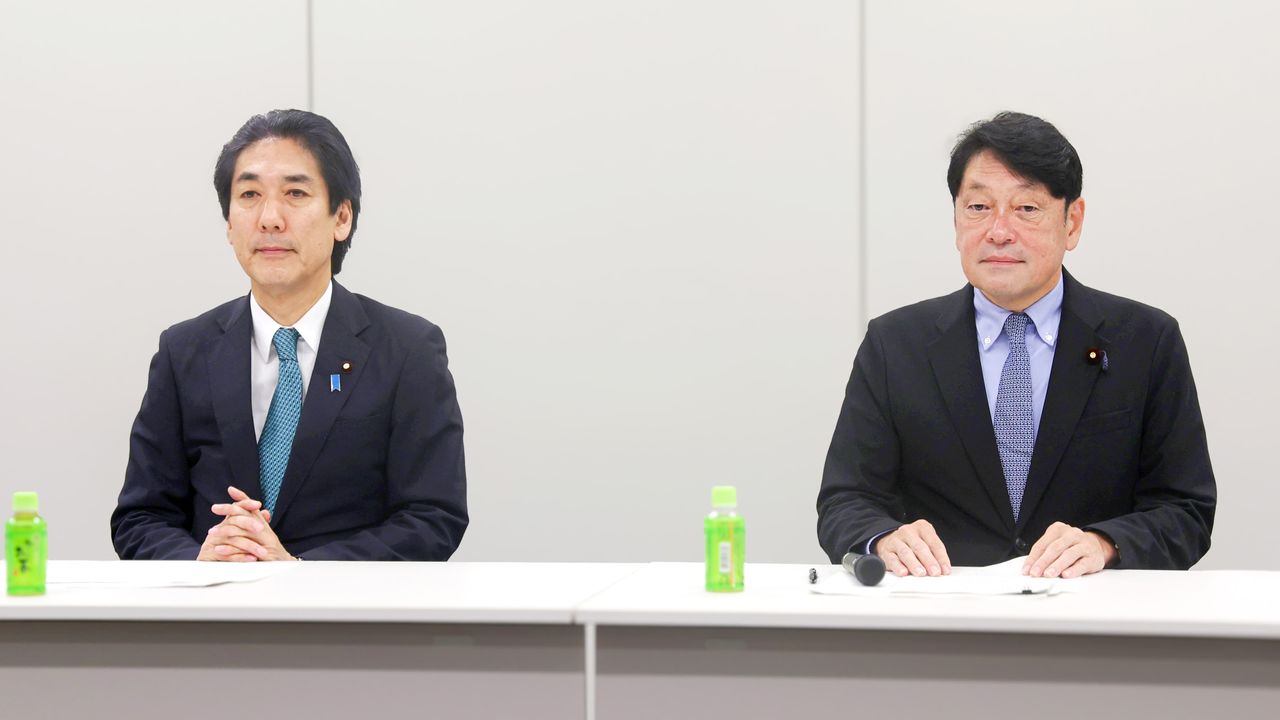
(Originally published in Japanese on July 23, 2026. Banner photo: LDP Tax Commission Chair Onodera Itsunori, right, attends a July 16 working group meeting of the National Council on Social Security. © Jiji.)