Japan’s Fresh Look at FOIP: Pragmatic Risk-Hedging in an Age of Strategic Uncertainty
Politics- English
- 日本語
- 简体字
- 繁體字
- Français
- Español
- العربية
- Русский
(An audio version of this article is also available.)
Japan Renews Its Focus on the Indo-Pacific
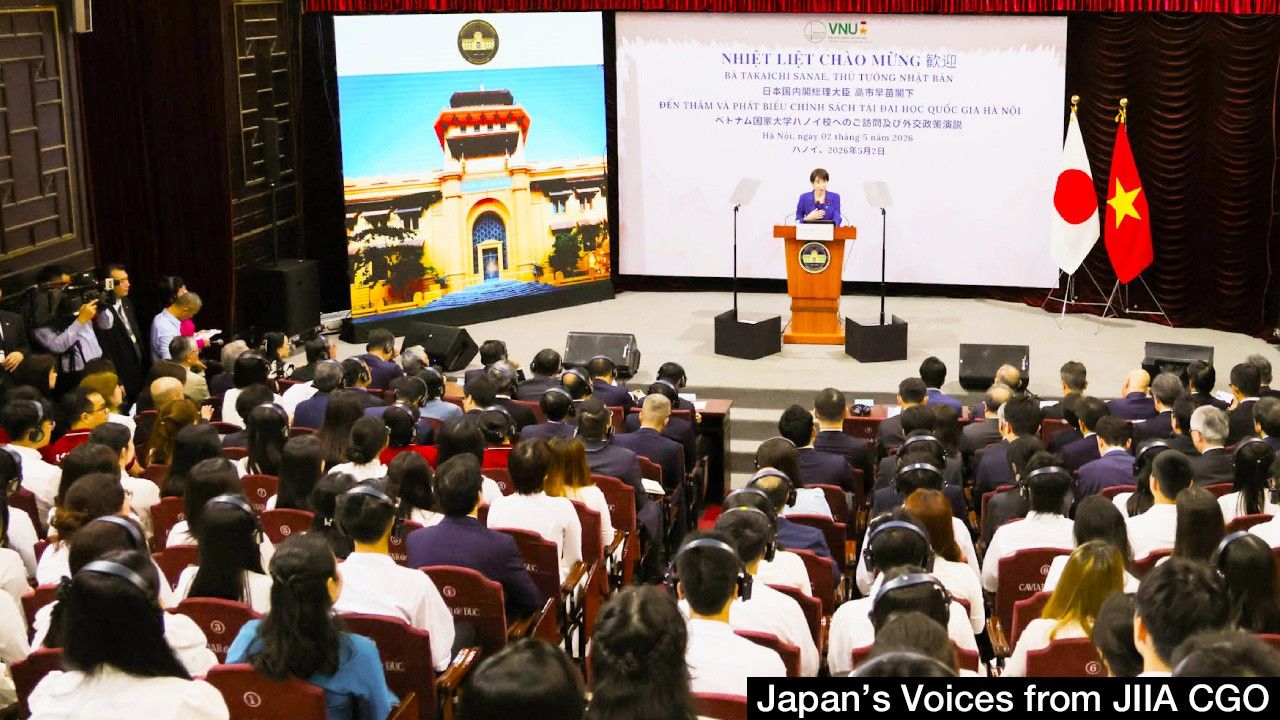
In early May 2026, Prime Minister Takaichi Sanae delivered a speech at Vietnam National University in Hanoi unveiling a new policy direction for the Free and Open Indo-Pacific, an initiative long advocated by Japan. She identified three priority areas for FOIP: building an economic infrastructure for the age of AI and data, cocreating economic growth opportunities through public-private collaboration and rule sharing, and enhancing cooperation in the field of security to ensure regional peace and stability. Specific initiatives in these areas were elaborated in a Japanese government document titled “The Updated Free and Open Indo-Pacific.”
Takaichi’s speech did not explicitly emphasize the essence of the crises currently confronting Japan and the rest of the world. Instead, she only briefly referred to intensifying geopolitical competition, the rise of the Global South, the spread of protectionism, and the economic and social changes caused by emerging technologies such as AI as background factors behind the new FOIP proposal. All of these had been mentioned already by former Prime Minister Kishida Fumio in his 2023 speech on the FOIP concept. However, the challenges Japan faces today are far more serious, with major powers like Russia, China, and the United States increasingly pursuing their national interests through the exercise of power. This makes the divide between them and middle or small powers—including Japan—ever more apparent.
The United States remains Japan’s most important ally, so fundamentally departing from the Japan-US alliance is not a realistic option. Moreover, bilateral relations have remained stable thus far. Given US President Donald Trump’s unpredictable approach toward European allies, though, as well as recent American military actions in Latin America and the Middle East, it is unclear whether the United States will continue to be a leading guarantor of a rules-based international order. Japan has trusted the United States not only because of its commitment to Japan’s defense, but also because of the assumption that it would continue to take responsibility for maintaining the international order. That assumption is now being reassessed.
Japan is consequently seeking to expand its network of strategic partnerships beyond the United States to enhance both economic and security cooperation. To accomplish this, Japan must demonstrate the concrete benefits of cooperation to its counterparts. In this regard, the initiatives listed as priority areas in the “Updated Free and Open Indo-Pacific” contain many elements that will likely attract the interest of numerous countries.
Energy, Tech, and More
One initiative garnering particular attention as a response to urgent concerns is the Partnership on Wide Energy and Resources Resilience Asia, commonly known as POWERR Asia. Announced by Takaichi in mid-April at the AZEC Plus Summit Meeting including members of the Asia Zero Emission Community, this initiative aims to assist Asian countries heavily dependent on the Middle East for energy supplies.
POWERR Asia has two pillars. The first is an “emergency response” framework designed to attend to immediate needs arising from the current Strait of Hormuz crisis. The second is a “structural response” framework aimed at strengthening the region’s long-term energy security.
Japan has committed a total of ¥1.5 trillion to these efforts, utilizing public financial institutions such as the Japan Bank for International Cooperation, Nippon Export and Investment Insurance, and Japan International Cooperation Agency while also mobilizing private-sector actors. This initiative offers a pragmatic and feasible framework for regional cooperation that Japan is capable of implementing.
It is also noteworthy that AZEC, which Japan has promoted for some time, is expected to evolve into AZEC 2.0 through POWERR Asia initiatives by incorporating the perspectives of economic and energy resilience.
Additionally, the updated FOIP presents a number of practical and highly relevant initiatives for countries across the Indo-Pacific region. Among these initiatives are cooperating on rare earths, developing AI in local languages, leveraging the CPTPP to promote free trade, and supporting security capacity-building through official development and security assistance, including defense equipment transfers.
Japan is cautious about vocally advocating middle-power alignment. Nevertheless, the nation has quietly and pragmatically begun to institutionalize security and economic cooperation with a wide range of middle and small powers. These forms of cooperation encompass credible risk-hedging responses to immediate crises, as well as efforts to address medium- and long-term challenges.
In the face of growing strategic uncertainty, the true significance of these initiatives will ultimately lie in their ability to reinforce global governance centered on the United Nations and its specialized agencies, along with institutions such as the World Trade Organization, while sustaining a predictable rules-based international order.
The views expressed in this article are the author’s and do not reflect those of JIIA CGO.
(This slightly edited article is republished through a partnership with JIIA CGO. See JIIA CGO to view the original post. You can also enjoy an audio version of the article. Banner image: Prime Minister Takaichi Sanae delivers a foreign policy speech at Vietnam National University. Courtesy Prime Minister’s Office of Japan.)