Japan’s Complex Stake in Freedom of Transit: Tough Calculus Behind Tokyo’s Stance on the Strait of Hormuz
Politics- English
- 日本語
- 简体字
- 繁體字
- Français
- Español
- العربية
- Русский
Strategic Chokepoint for Energy Transport
The Strait of Hormuz is a key hub of international logistics, providing access between the oil-rich Persian Gulf and the open ocean. In the wake of the strikes on Iran launched by the United States and Israel in late February this year, the passage of tankers and other commercial vessels has been severely restricted or suspended altogether. With few other shipping routes available, closure of the strait has had a major impact on Japan and other countries that depend on imports of Middle Eastern crude oil and liquefied natural gas for their energy needs.(*1) The Strait of Hormuz is rimmed to the north by Iran and on the south by the tip of the Musandam Peninsula, an exclave of Oman. Under international law, a country’s coastal territorial seas extend up to 12 nautical miles from the coast, but since the strait is only 21 nautical miles across at its narrowest point, everything to the north of the strait’s median line is regarded as Iran’s territorial sea, while the waters to the south are regarded as Oman’s. Due to the shallowness of the waters north of the median line, the shipping lanes established under the International Maritime Organization’s traffic separation scheme (to reduce the risk of collision) pass through Oman’s territorial sea.
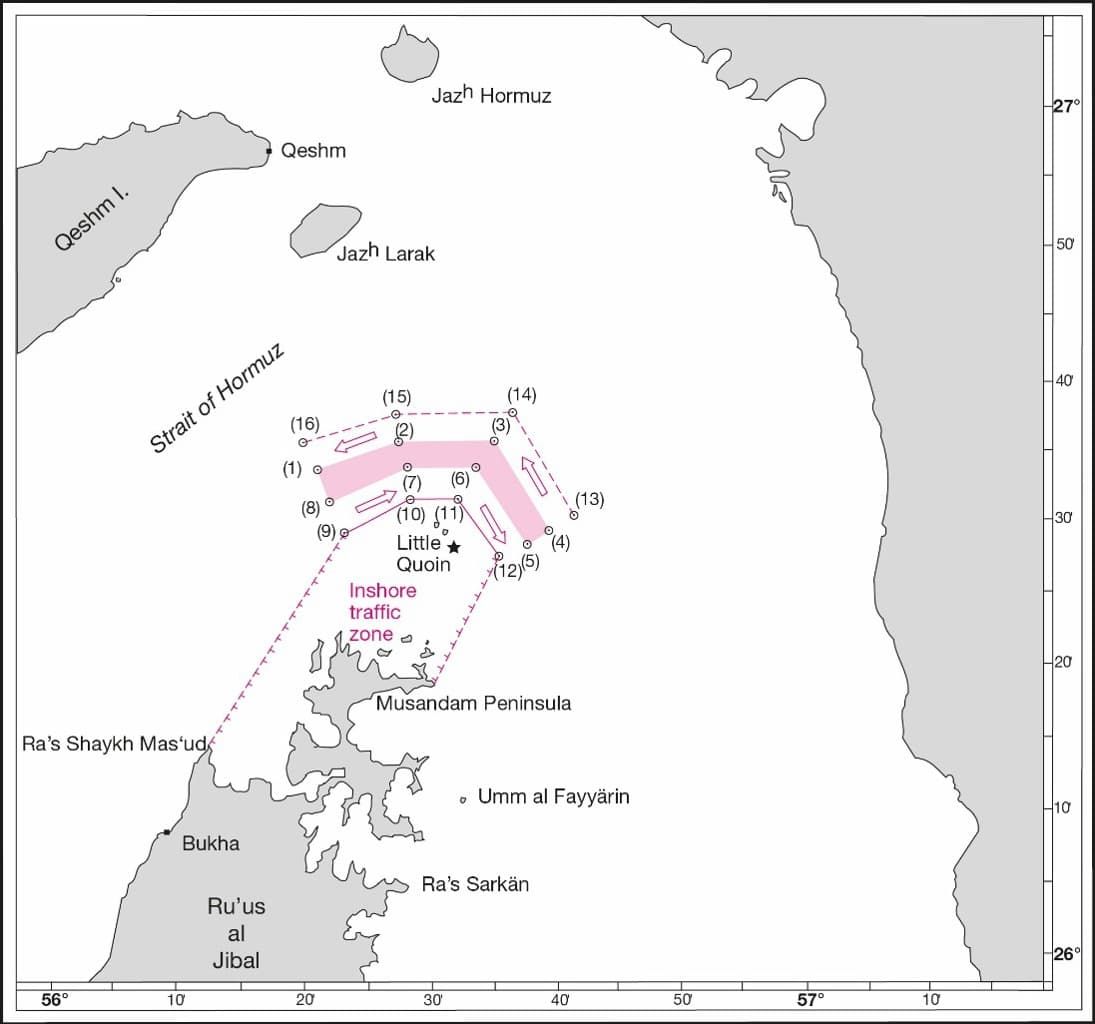
Traffic separation scheme established by the International Maritime Organization in the Strait of Hormuz (from the IMO website).
While Oman and Iran both view the Strait of Hormuz as part of their territorial seas, the strait is also an international strait under international law. Under the UN Convention on the Law of the Sea (UNCLOS), “straits used for international navigation“ (hereafter, “international straits“) are treated similarly to the high seas in that all vessels (including warships and official government vessels) are accorded “freedom of navigation and overflight [when] solely for the purpose of continuous and expeditious transit . . . between one part of the high seas or an exclusive economic zone and another part of the high seas or an exclusive economic zone“ (article 38).
Ships navigating international straits are subject to certain rules, but the right of transit passage through international straits is guaranteed as a fundamental right under the treaty. UNCLOS clearly stipulates that states situated on the coast of international straits shall neither obstruct nor suspend transit passage (article 44). Furthermore, vessels transiting through an international strait are not required to obtain authorization from any coastal state or to pay a transit fee.
Japan’s Policy Shift
Until recently, the Japanese government had avoided expressing a clear view on the legal status of the Strait of Hormuz as an international strait. Testifying before the House of Councillors Committee on Foreign Affairs and Defense on May 29, 2014, the director-general of the Ministry of Foreign Affairs International Legal Affairs Bureau stated that it was “difficult for Japan to make a definitive statement“ regarding the application of the transit passage regime because of “an insufficient accumulation of state practice.“
However, testifying before a meeting of the House of Representatives Committee on Foreign Affairs on May 13 this year, Minister for Foreign Affairs Motegi Toshimitsu clearly articulated the government’s view that the Strait of Hormuz “constitutes an international strait to which the transit passage regime applies under international law.” In support of this position, he noted that the Strait of Hormuz “is, in fact, a strait used for international navigation,” and he further cited UN Security Council Resolution 2817 (adopted on March 11, 2026), which reaffirms that the exercise of navigational rights and freedoms . . . must be respected in the Strait of Hormuz.
Later that month, at the same committee’s May 22 meeting, Nakamura Kazuhiko, director-general of the International Legal Affairs Bureau, with due regard to the fact that Iran had never ratified UNCLOS (since signing it in 1982), argued that it was appropriate to regard the core content of the transit passage regime as customary international law “in light of the accumulation of state practice and the emerging consensus of scholars in recent years.” This constitutes as an official acknowledgment that the transit passage regime for international straits had become customary international law and a confirmation that Iran, though not a party to UNCLOS, was nevertheless obliged to grant ships the right of transit passage.
A Precarious Position
That same day, Nakamura testified that international law prohibited coastal states from imposing fees on foreign vessels merely for passage through international straits. Particularly in the context of current efforts to develop an international system for managing maritime traffic through the Strait of Hormuz, this statement may be taken to imply that such fees would not necessarily violate international law if they were levied for other purposes, such as defraying the costs of navigation safety, traffic control, or maritime rescue operations.
Taken together, the statements quoted above constitute an official acknowledgment by the Japanese government that the Strait of Hormuz is an international strait to which the right of transit passage applies under international law. This establishes a legal basis on which the Japanese government can argue to the Iranian government that freedom of navigation through the Strait of Hormuz is guaranteed and that neither suspension of transit passage nor the imposition of transit fees is permitted. In view of the importance of the Strait of Hormuz to Japan’s energy supply, being able to make such a claim, supported by international law, aligns with Japan’s economic interest.
That said, if we shift our focus from the Middle East to Japan, the transit passage regime becomes a double-edged sword with considerable implications for Japan’s maritime and security policies. In formulating a position on traffic through the Strait of Hormuz, the Japanese government was obliged to weigh its immediate energy needs against issues of national security and maritime policy. Its recent clarification regarding the Strait of Hormuz indicates that it seems to have prioritized stable energy supplies.
In the remainder of this article, I would like to focus on the criteria for recognizing international straits and their implications for Japan’s security policies.
Geography and Use
In explaining the government’s position on the Strait of Hormuz, Foreign Minister Motegi identified two basic criteria for designating international straits: geography and use. Regarding geography, he noted that “the Strait of Hormuz is located between the high seas or exclusive economic zone of the Gulf of Oman and the high seas or exclusive economic zone of the Persian Gulf.” As for use, he argued that the strait is in fact used as a hub of global logistics, thereby constituting public goods.
These two criteria derive from the judgment of the International Court of Justice in the Corfu Channel case, delivered on April 9, 1949. The ICJ, noting that the right of transit passage is more strongly guaranteed for straits used for international navigation than for other territorial seas, stated that the basic criteria for designating a water as an international strait were (1) whether it connected two parts of the high seas and (2) whether, in fact, it was used for international navigation, as determined by the volume of traffic rather than the frequency of use.
These criteria were incorporated into the provisions of the Convention on the Territorial Sea and Contiguous Zone adopted in 1958, and subsequently into UNCLOS adopted in 1982. These are also the criteria that the Japanese government applied in recognizing the Strait of Hormuz as an international strait.
A Country of Straits
The criteria of geography and use that Japanese officials have cited for designating the Strait of Hormuz as an international strait are widely accepted standards established under international law and thus should apply equally to straits within Japan’s territorial seas. Until now, however, the Japanese government has deliberately maintained a position of ambiguity regarding both the application of the transit passage regime and the existence of international straits within its own territorial seas.
Japan has numerous straits that are no more than 24 nautical miles across at their narrowest points. Among these are the Tsugaru Strait (minimum width 10.5 nautical miles), which connects the Sea of Japan to the Pacific Ocean north of Honshū; the southern Ōsumi Strait (22 nautical miles), which lies south of Kyūshū’s southern tip and connects the East China Sea with the Pacific; and the Tokara Strait (22 nautical miles), farther to the south, between Yakushima and Amami Ōshima.
Although several straits, including the Tsugaru and Ōsumi straits, clearly qualify as international straits, the Japanese government has thus far avoided the application of the transit passage regime to them. It has done so by designating these straits as “specified sea areas” in which Japan’s territorial sea extend only 3 nautical miles from either coast, thereby leaving the central channel outside Japan’s territorial sea. The Japanese government has justified this practice by arguing that there has been “an insufficient accumulation of state practice” among the relevant state actors. The system of specified sea areas may be increasingly difficult to justify now that Japan has recognized the transit passage regime as customary international law.
Various security concerns center on the strategically important Tokara Strait, a major maritime passage south of Kyūshū where the fast-flowing Kuroshio Current enters the Pacific Ocean.
The Kuroshio flows northward between Taiwan and Yonaguni Island (Japan’s westernmost point) into the East China Sea and continues northeast along the continental slope. It then flows eastward through the Tokara Strait before continuing along Japan’s southern Pacific coast. The swift, deep Kuroshio makes the Tokara Strait better suited for submarine navigation than other straits connecting the open Pacific and the East China Sea.
Chinese naval ships (including surveillance and surveying vessels) have entered the Tokara Strait on several occasions since June 2016. The Chinese government has justified these passages by claiming that the Tokara Strait qualifies as an international strait to which the transit passage regime is applicable. This poses a serious security challenge for Japan.
While UNCLOS generally obliges submarines navigating territorial seas to surface (article 20), it does not explicitly impose such an obligation on submarines navigating international straits. Furthermore, while international law generally gives individual countries control of the airspace above their own territory and territorial seas, overflight of international straits is not regarded as a violation of a country’s airspace. If China’s claims about the Tokara Strait were accepted, it could enable the passage of submerged Chinese submarines through Japanese territorial seas and the flight of Chinese military aircraft over Japanese territory and territorial seas.
The foregoing circumstances make it easier to understand Japan’s earlier reluctance to take a position on the designation of international straits. They also raise serious questions about how the Japanese government’s revised position on that issue could affect the security situation around Japan and in East Asia as a whole.
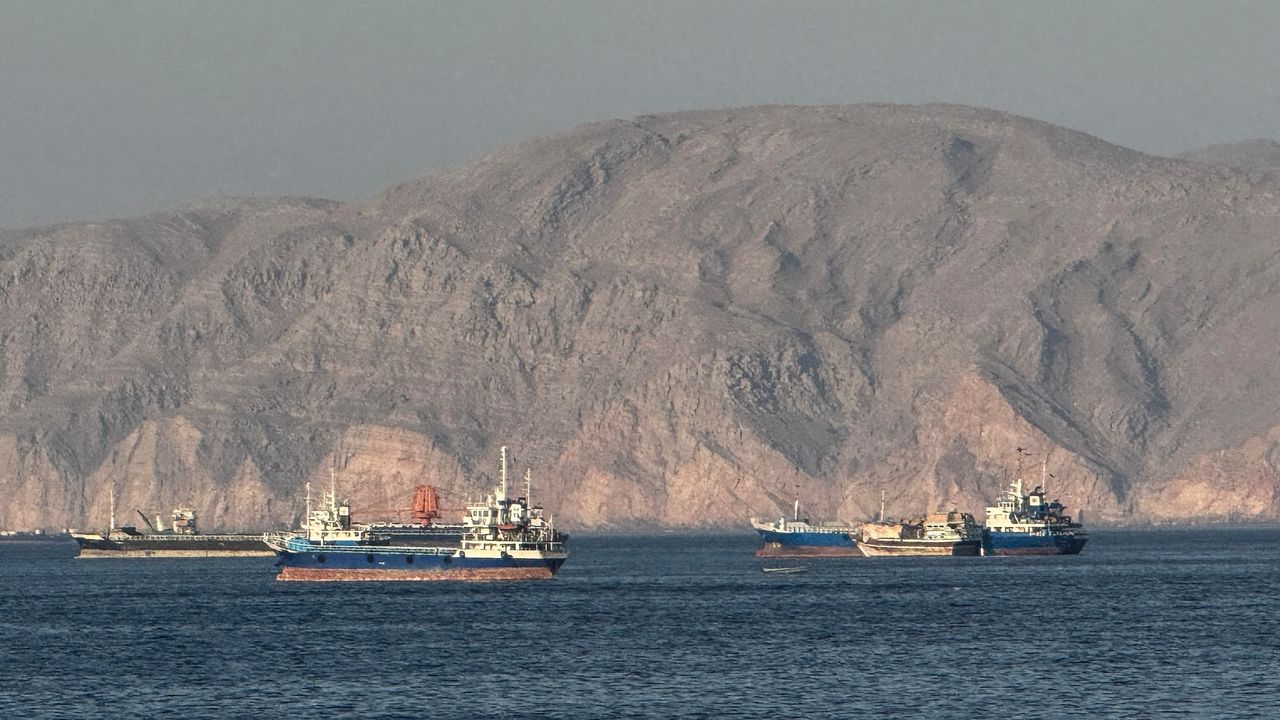
(Originally published in Japanese. Banner photo: A ship anchored in the Strait of Hormuz near the Omani port city of Khasab, May 17, 2026. © AFP/ Jiji.)
(*1) ^ According to data from the Petroleum Association of Japan, the United Arab Emirates accounted for almost 44% of Japan’s crude oil imports in 2024. Most of that oil passes through the Strait of Hormuz.