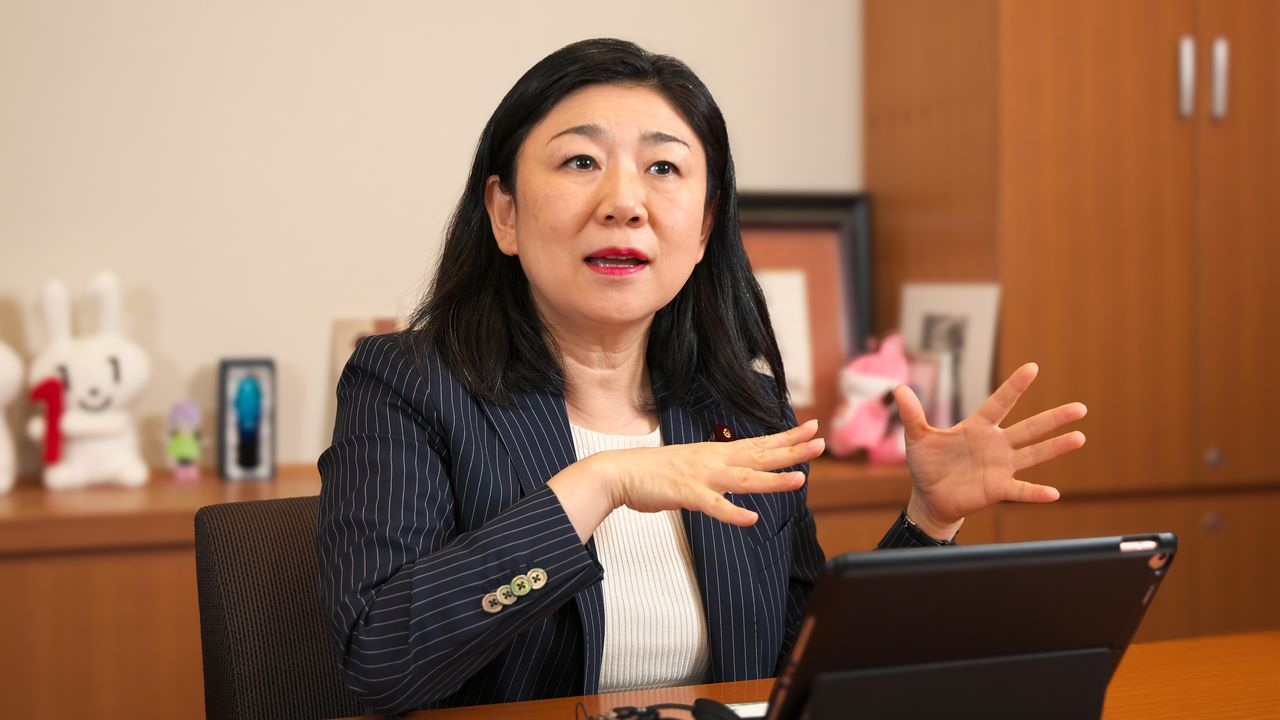
“Japan Must Support ICC President Akane”: LDP Lawmaker Makishima Karen
Politics World- English
- 日本語
- 简体字
- 繁體字
- Français
- Español
- العربية
- Русский
An Unacceptable Move
The International Criminal Court exists to promote the rule of law worldwide and to thwart the rule of force. Japan has consistently emphasized the court’s importance. I and several Diet colleagues have regularly met with ICC President Akane Tomoko to exchange views whenever she returns to Japan. She has long voiced concerns about becoming a target of sanctions, which finally came to pass with the August 18 announcement by the administration of US President Donald Trump. This is unacceptable.
On the morning of August 19, Japan time, I posted on X that we cannot turn a blind eye to this move. I also said that undermining the court’s independence poses a grave problem for the international community. Many of the comments I received echoed the view that the ICC must not be dismantled—as the Trump administration has threatened—and that we should do more to back President Akane. I believe that a large share of Japanese society supports my sentiments.
Some people ask if we are defending her simply because she is Japanese. But the ICC president should be defended regardless of nationality. That said, the government has a policy goal of increasing the number of Japanese nationals serving in senior positions at international organizations. If, after supporting their candidacies, we fail to stand by them when an ally imposes sanctions, who will aspire to leadership roles in the future? This is a key matter of diplomatic strategy.

ICC President Akane Tomoko, designated for sanctions by the Trump administration, speaks at an online press conference organized by the Japan National Press Club on August 26, 2026. (© Kyōdō)
Security Must Not Come at the Expense of the Rule of Law
Prime Minister Takaichi Sanae initially responded to the situation on August 19 by saying zannen ni omou—a phrasing that, especially once rendered in English as “unfortunate,” was criticized as overly restrained. But her subsequent statement on August 25, declaring that the measures taken by the United States are not compatible with Japan’s position, has softened such criticism. Needless to say, the alliance with the United States forms the cornerstone of Japan’s national security, but security must not come at the expense of the rule of law. You cannot trade one off for the other. Even between allies, there are times when one must speak plainly.
Some of the arguments being advanced to justify the US sanctions—such as concerns that the court could arrest US service personnel—are misleading and untenable. The United States has its own court-martial system and a functioning judiciary. The ICC does not threaten US sovereignty but plays only a complementary role. If misconceptions are spreading due to a lack of understanding, Japan needs to work with other member countries to provide clearer explanations.
Foreign and security policy matters often turn into political flashpoints in the United States, especially when elections are looming. Japan needs to factor that dynamic into its analysis, gathering information with this firmly in mind. Europe, for its part, is making a concerted effort to sustain the ICC as an institution.
The ICC is headquartered in The Hague, and the Dutch government has already taken steps to ensure that President Akane can live and work safely there. On August 26, I visited the Dutch embassy in Tokyo with Diet member Ide Yōsei to express our appreciation to Ambassador Gilles Beschoor Plug and to confirm our continued close coordination.
A Common Topic on Entrance Exams
On a visit to the Netherlands prior to the latest sanctions, I learned that ICC judges can face difficulty traveling, since they risk being detained when transiting through nonmember states critical of the court. The sanctions mean that President Akane can no longer enter the United States or attend the UN General Assembly. Even when returning to Japan, she may need to board direct flights from the Netherlands without a stopover.
Quite coincidentally, the rule of law was the theme of this year’s international politics and diplomacy essay contest organized annually by the LDP’s International Bureau. Held before the sanctions, the contest attracted submissions from a broad spectrum of the public—students from junior high school up through graduate school, as well as working adults. An essay by one high school student noted that the presidents of both the ICC and the International Court of Justice are currently Japanese. During a meeting with award recipients on July 15, I asked why the theme interested him. I was surprised to learn that the topic commonly appears on entrance exams for many competitive private high schools.
The sanctions against President Akane have been widely reported in Japan. One silver lining of the uproar may be that it has deepened public understanding of the rule of law’s critical importance to Japan’s national interest.
(Originally published on August 28, 2026, in Japanese based on an interview by Koga Kō of Nippon.com. Banner photo: Makishima Karen. © Nomura Kazuyuki.)