AI and the Productivity Trap: A Finance Perspective
Economy- English
- 日本語
- 简体字
- 繁體字
- Français
- Español
- العربية
- Русский
Sharing the Benefits
Generative AI is now used by all manner of industries, which see the technology as a silver bullet that can deliver giant leaps in efficiency to everything from document creation to data analysis and customer service. This is particularly true in the finance industry, which is one of the biggest adopters of artificial intelligence internationally. According to an international survey released in April 2026 by the Cambridge Centre for Alternative Finance, conducted in conjunction with the Bank for International Settlements, the International Monetary Fund, and others,(*1) around 80% of the world’s financial service providers already use AI in some form.
However, the study also made a surprising finding: while artificial intelligence does boost workplace productivity, relatively few companies have so far been able to translate that into a quantifiable improvement in profitability. So why do these gains fail to spread across the organization as a whole? I believe one cause is human factors that I refer to here as the “productivity trap.” In this article, I discuss what the productivity trap is and what we can do to remedy it.
Does AI Really Boost Productivity?
For a start, there is no longer any doubt that AI does indeed improve productivity. In 2025, the Quarterly Journal of Economics published a paper titled “Generative AI at Work,” authored by Erik Brynjolfsson, Danielle Li, and Lindsey R. Raymond. The paper was based on a study performed by a research team from Stanford University and the Massachusetts Institute of Technology that analyzed operational data from 5,172 customer support employees at a US Fortune 500 company, obtained before and after their employer phased in AI assistants.
The results were clear. First, the introduction of AI assistants immediately increased the number of cases employees could resolve per hour, a benefit that was sustained for the duration of the study. Second, the merits of AI were not evenly distributed. While the technology enabled less-skilled workers to process more than 0.5 additional cases per hour, the most skilled employees saw only limited benefits. Third, AI enabled new recruits to upskill much faster, with new recruits who had access to the technology from the time of joining the company taking around 2 months to achieve the same level of productivity their non-AI-using colleagues only reached after 10 months.
In other words, rather than merely functioning as a productivity tool, AI allows less-experienced staff to improve their skills faster, thereby helping to close the skill gap with more experienced colleagues. This could be a lifeline for Japanese companies facing increasingly severe labor shortages.
The Productivity Trap
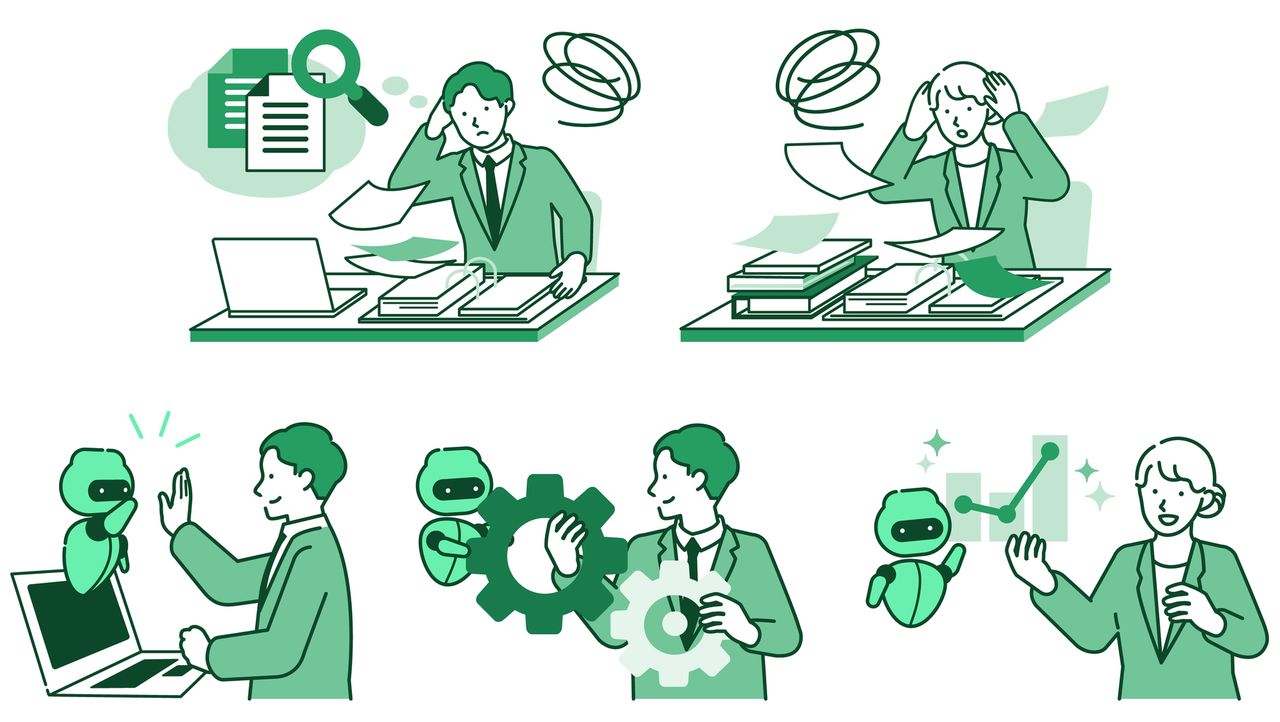
From the point of view of the employee, however, the scene is quite different. Let’s say that by using AI, a worker can perform in six hours a task that used to take eight. The problem is that the worker cannot necessarily use those spare two hours for leisure or creative activities.
That fear is supported by Japanese workplace data. According to a study of 3,000 permanent employees in Japan conducted in October 2025 by Persol Research and Consulting,(*2) tasks performed using generative AI took 16.7% less time on average. However, only 25.4% of AI users actually saw their working hours fall. In fact, even those who did experience a reduction in working hours reinvested an average of 61.2% of the time they had freed up back into their work, 75.4% of which consisted of day-to-day tasks. In other words, that time freed up by AI is being reabsorbed by other, repetitive tasks before it can be used for leisure activities.
Increased productivity therefore means that employees work the same hours while taking on more work at a greater intensity. What’s more, their salaries and HR assessments remain unchanged. Learning that productivity improvements only leave them worse off, workers begin to actively avoid AI, or attempt to hide what efficiencies they have made. This might be called a form of “smart slacking.” When smart slacking at an organization becomes more pervasive, the enormous investment that it made in AI will have been in vain, and growth across the organization will grind to a halt.
Three Practices to Boost Motivation
To avoid falling into this trap, it is imperative to implement human-centered practices when introducing new technologies. Businesses should focus on the following three practices.
First, the benefits of productivity improvements must be distributed fairly among the workforce. Businesses need to quantify the efficiencies generated by AI and reflect a set percentage of those benefits in the form of bonuses and pay rises. This could also take the form of trialing a four-day workweek or allowing employees to work from home more often. Companies need to start by giving workers faith that improved productivity will be rewarded with clear benefits.
Second, companies need to establish new roles and evaluation criteria for those employees who have been freed from routine tasks by AI, in particular skilled employees who have supported the organization in the past. Rather than assessing employees based on the volume of work they process, companies need to start evaluating them based on the quality of their problem solving, the outcomes of their coaching of more junior employees, and their contributions to improvements in artificial intelligence.
Third, management needs to emphasize the fact that AI makes work easier. This means regularly monitoring overtime hours, job satisfaction, and other metrics before and after the adoption of AI, and reporting the results to all employees in a transparent manner. Key to the uptake of artificial intelligence is the ability to make employees see AI not as something that is here to steal their jobs, but rather as a trusted partner that makes work more human.
Of course, not every workplace is able to numerically assess the benefits of improved efficiency. However, managers can still make their employees realize that the easier AI makes their jobs, the more they will benefit. Managers can give something back to their employees by reducing the need to work overtime, making it easier to take leave, providing opportunities to learn new skills, and taking other actions appropriate to their workplaces.
An Investor Focus on Coexistence
AI investment has become a central theme in corporate valuations in global equity markets. However, companies that share the benefits of AI investment with their employees, thereby helping them develop, can expect to enjoy significantly higher mid- to long-term profitability than those that, despite investing the same amount into AI, have practices that encourage smart slacking. In the future, the metric that investors use to measure investment targets will not be how much the company has invested in AI, but whether a company has systems in place that enable AI and people to coexist without friction.
Ultimately, the most important consideration when adopting artificial intelligence is not the technology itself but its effect on people. I believe that only those organizations that share the time savings and benefits generated by AI with their employees will be able to reap its full rewards.
(Originally published in Japanese. Banner photo © Pixta.)
(*1) ^ Named the 2026 Global AI in Financial Services Report: Adoption, Impact and Risks, the study was jointly conducted by the CCAF (part of the university’s Judge Business School), the BIS, the IMF, and the World Economic Forum, and surveyed 628 financial institutions, AI vendors, and regulators in 151 countries and regions.
(*2) ^ Seisei ēai to hatarakikata ni kansuru jittai chōsa (Study on Generative AI and Ways of Working), Persol Research and Consulting (2026). The study was based on interviews conducted in October 2025 with a cohort of 3,000 full-time workers recruited from an initial population of 19,855.