
Five-Year Cancer Survival Rates Improving in Japan
Health- English
- 日本語
- 简体字
- 繁體字
- Français
- Español
- العربية
- Русский
Survival Rates Improved
The National Cancer Center Japan has released data on the five-year survival rate among 2.5 million people diagnosed with cancer between 2012 and 2015. The study was based on data from 44 prefectures that met international standards, and it adopted the net survival rate which only counts deaths when cancer is the sole cause.
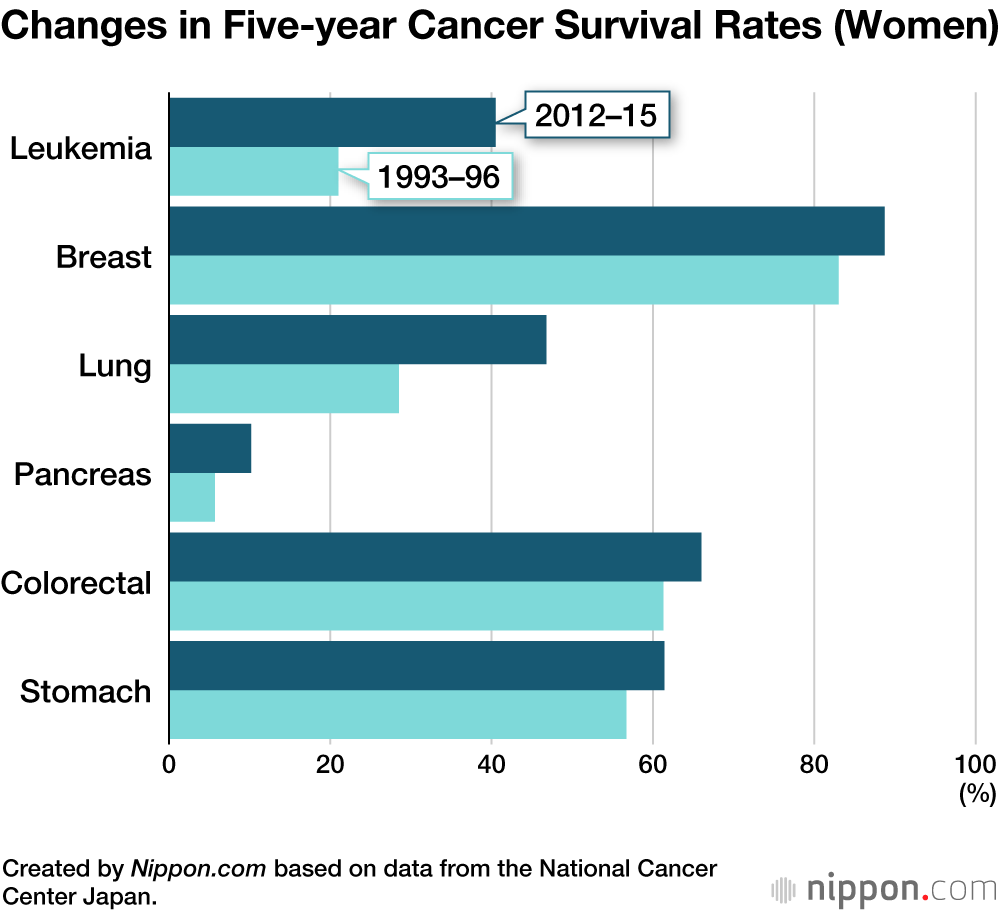
The highest survival rates for cancer among women were thyroid (92.7%), skin (92.4%), and breast cancer (88.7%), and for men were prostate (94.3%), skin (90.9%), and thyroid cancer (88.6%).
An analysis of survival trends since 1993 shows that survival rates have improved for many cancer types. There are notable improvements in leukemia, malignant lymphoma, and lung cancer for both men and women. Meanwhile, cancers affecting the pancreas and gallbladder or bile ducts have shown little improvement, with survival rates remaining low.
There were large gaps in survival rates between early-stage cancers that were confined to a single organ and advanced cancers that had metastasized to affect distant organs, such as the following: stomach cancer (early-stage 92.4%/distant metastasis 6.3%), colorectal cancer (92.3%/16.8%), lung cancer (77.8%/8.2%), and female breast cancer (98.4%/38.5%). The findings reaffirm the importance of early detection and early treatment.

Data Sources
- Data on five-year survival rate of people diagnosed with cancer between 2012 and 2015 (Japanese) from the National Cancer Center Japan.
(Translated from Japanese. Banner photo © Pixta.)