Assets of Japan’s Cabinet Ministers Average ¥66.4 Million
Politics Economy- English
- 日本語
- 简体字
- 繁體字
- Français
- Español
- العربية
- Русский
Prime Minister Takaichi’s Assets Total ¥32 Million
The government has disclosed the assets of Prime Minister Takaichi Sanae and her 18 cabinet ministers at the time the new administration was formed. The assets (including those of family members) averaged ¥66.4 million.
Prime Minister Takaichi’s assets totaled ¥32.1 million, which placed her tenth out of the 19 officials. She holds real estate in her hometown Nara under her own name, valued at ¥11.4 million, and also owns two cars (the value of the cars is not included in the calculation). Her husband, former House of Representatives member Yamamoto Taku, owns real estate in Sabae, Fukui, that is worth ¥10.6 million, as well as fixed-term bank deposits totaling ¥10 million.
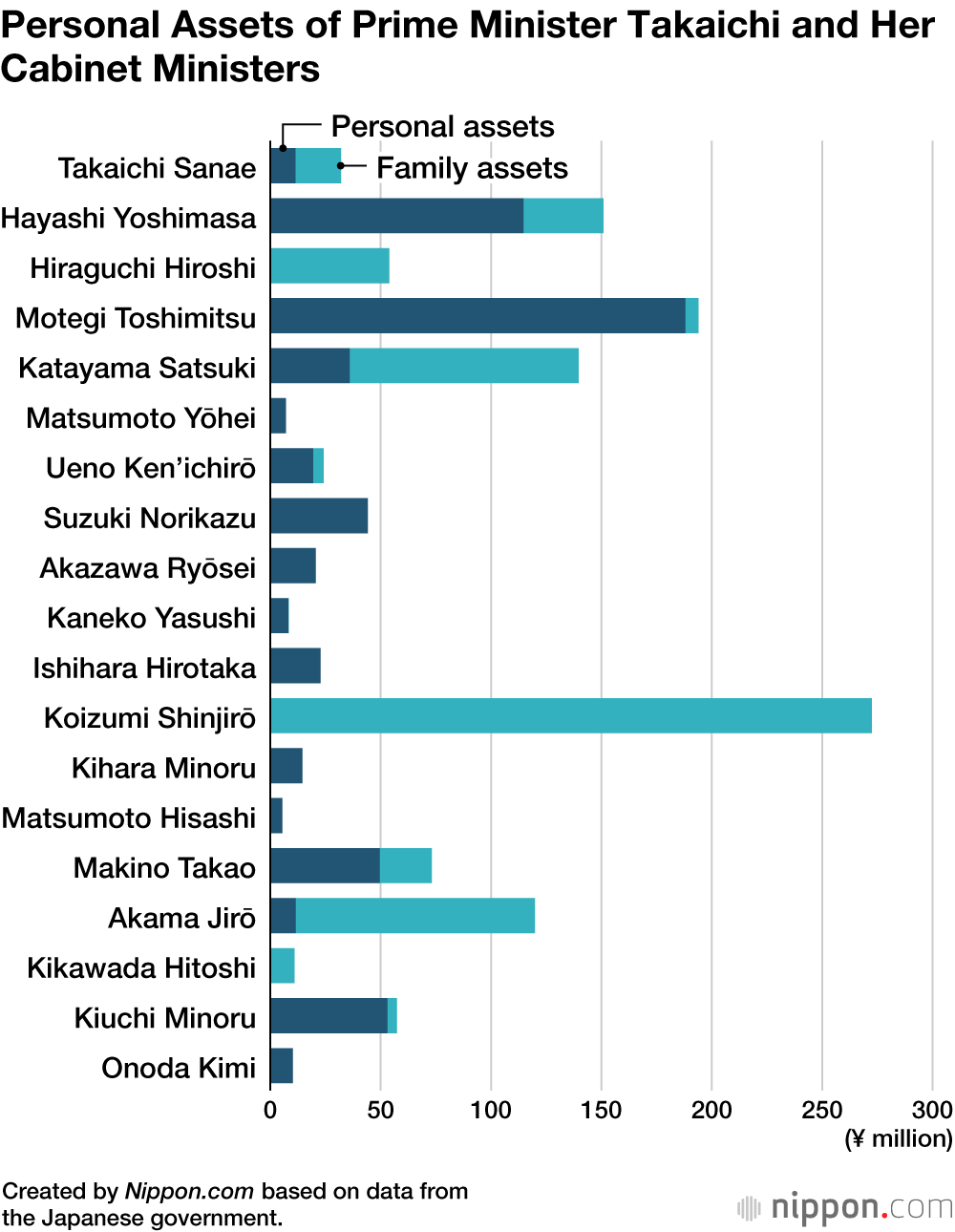
The cabinet minister with the largest assets was Defense Minister Koizumi Shinjirō, at ¥272.5 million. Koizumi himself held no assets, as everything was in the name of his wife, Takigawa Christel, consisting of securities and similar holdings. Koizumi was the only member whose assets exceeded ¥200 million.
The following four ministers reported assets exceeding ¥100 million: Foreign Minister Toshimitsu Motegi (¥194.0 million), Internal Affairs Minister Hayashi Yoshimasa (¥150.9 million), Finance Minister Katayama Satsuki (¥139.7 million), and National Public Safety Commission Chair Akama Jirō (¥119.9 million). In the case of Motegi, most of the assets were securities, including investment trusts. The bulk of Hayashi’s assets consisted of estate in his hometown of Shimonoseki, Yamaguchi. Finally, for Katayama, most of the assets were securities held under her husband’s name.
The person with the smallest amount of assets was Digital Minister Matsumoto Hisashi, at ¥5.5 million.
The aim of disclosing cabinet minister’s assets is to monitor and prevent the illicit accumulation of wealth through abuse of office. Under this system, the prime minister, cabinet ministers, deputy chief cabinet secretaries, vice-ministers, and parliamentary secretaries must report their assets when they take office and when they leave office. The system was introduced after former Prime Minister Tanaka Kakuei received a prison sentence in 1983 for his involvement in the Lockheed bribery scandal. In the late 1980s, following the Recruit scandal, spouses and dependent children were added to the disclosure requirements. Ordinary bank deposits and checking accounts, because of their high liquidity, are not subject to disclosure. For stocks, only the names of the securities and the number of shares must be listed. Some have indicated that the disclosures do not accurately reflect the actual wealth of politicians because they are not required to list monetary figures for golf club memberships, automobiles, and works of art.
Items Subject to Asset Disclosure for Cabinet Ministers
Included in asset calculations
- Fixed-term deposits
- Securities (excluding stocks)
- Land and buildings
Not included in asset calculations
- Stocks (only name of stock and number of shares reported)
- Automobiles
- Works of art
- Golf club memberships
Not subject to disclosure
- Ordinary saving accounts and checking accounts
Data Sources
- Asset Disclosure System for Diet Members (Japanese) from Legislation and Research published by the House of Councillors.
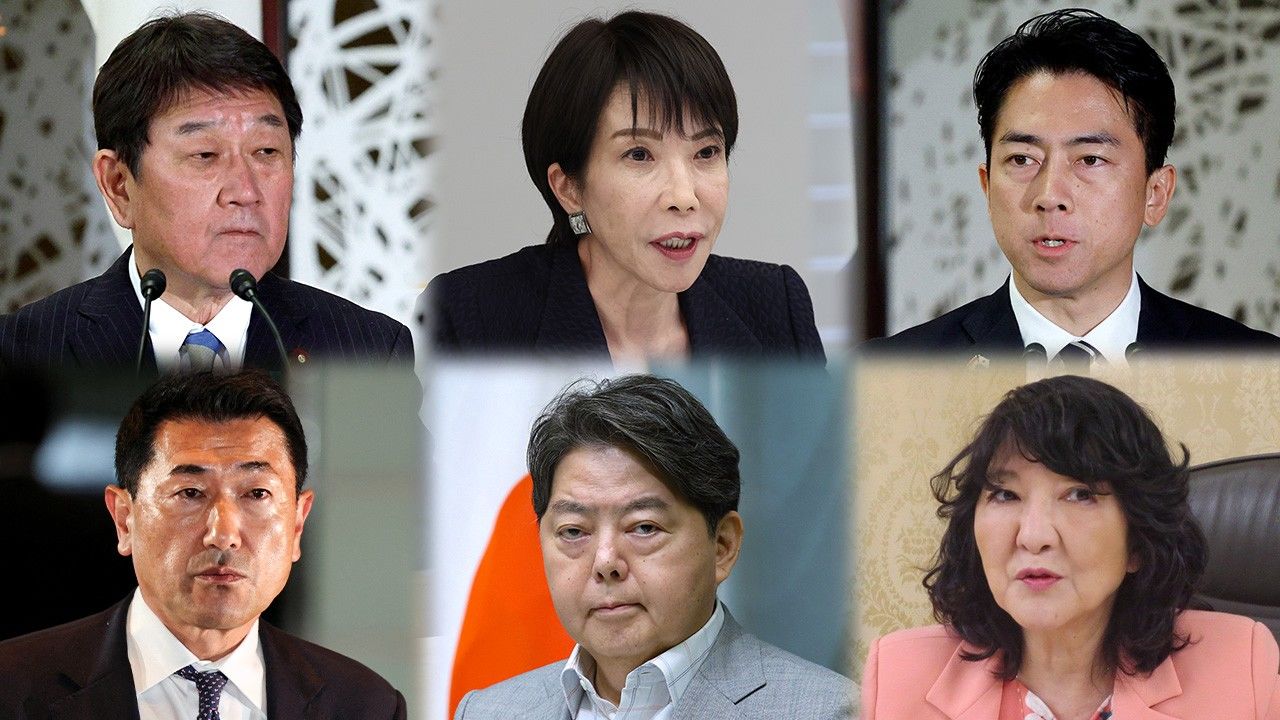
(Translated from Japanese. Banner photos, clockwise from left: Minister for Foreign Affairs Motegi Toshimitsu [© Franck Robichon/Pool via Reuters], Prime Minister Takaichi Sanae [© Jiji], Minister of Defense Koizumi Shinjirō [© Franck Robichon/Pool via Reuters], Minister of Finance Katayama Satsuki [© Jiji], Minister of Internal Affairs and Communications Hayashi Yoshimasa [© Jiji], Chair of the National Public Safety Commission Akama Jirō [© Reuters].)