A Quick Election for Takaichi; Dark Clouds on Japan’s Budgetary Horizon?
Politics Economy- English
- 日本語
- 简体字
- 繁體字
- Français
- Español
- العربية
- Русский
An Unusually Early Election at an Unusual Time
Prime Minister Takaichi Sanae has informed the leaders of her Liberal Democratic Party that she intends to dissolve the House of Representatives and call a snap election soon after the ordinary session of the Diet begins on January 23. Dissolution of the lower house brings the terms of all its members to an end before their full four-year terms are complete, triggering an election to choose the members of the chamber anew; it is generally viewed as a means of gauging the will of the people.
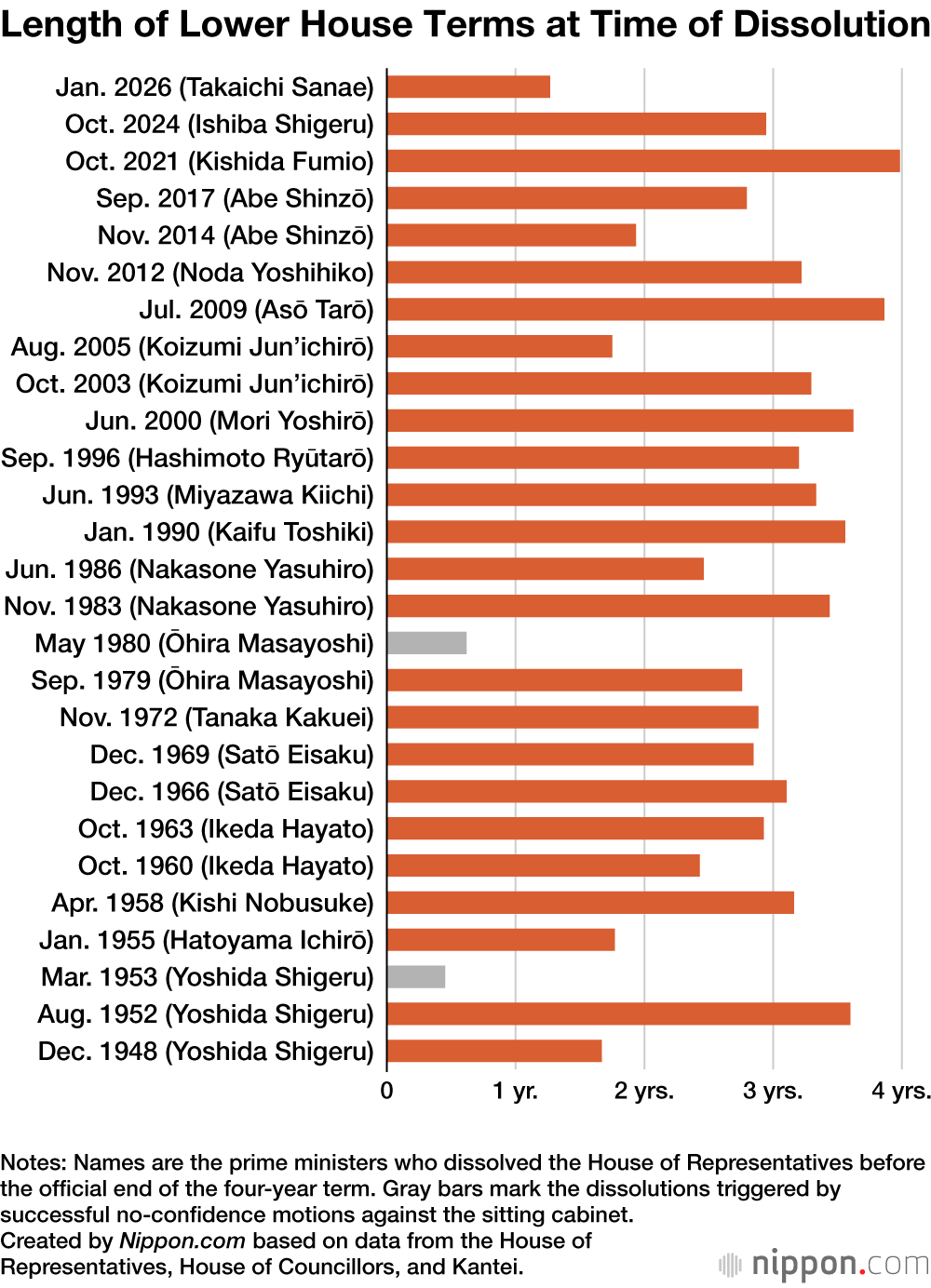
Under the postwar Constitution of Japan, the House of Representatives has been dissolved 26 times before the end of members’ terms. Only four of these instances have come at the outset of an ordinary or extraordinary Diet session, though, before any policy deliberations take place. Takaichi’s dissolution will be the first to take place at the start of an ordinary Diet session in 60 years, the last one being that by Prime Minister Satō Eisaku in 1966.
Takaichi’s move will be even more unusual for taking place in January, a month that has seen only two previous lower house dissolutions—in 1955, under Prime Minister Hatoyama Ichirō, and 1990, under Prime Minister Kaifu Toshiki. The first month of the year is an unpopular choice due to its importance in the legislative calendar, where it marks a phase of serious discussions on the budget for the fiscal year beginning in April. When Kaifu dissolved the chamber on January 24, 1990, his cabinet was unable to file its budget proposal until February 28, after the election. The budgetary deliberations in the Diet took months after that, and the budget for fiscal 1990 was not passed until June, well after the beginning of the fiscal year.
At her January 5, 2026, New Year press conference, Takaichi emphasized the importance of rolling out policies addressing rising prices and economic unease “whose impact is truly felt by the people of Japan.” Her decision to call an election, though, will probably prevent the passage of a fiscal 2026 budget to cover such policies during the current fiscal year ending in March.
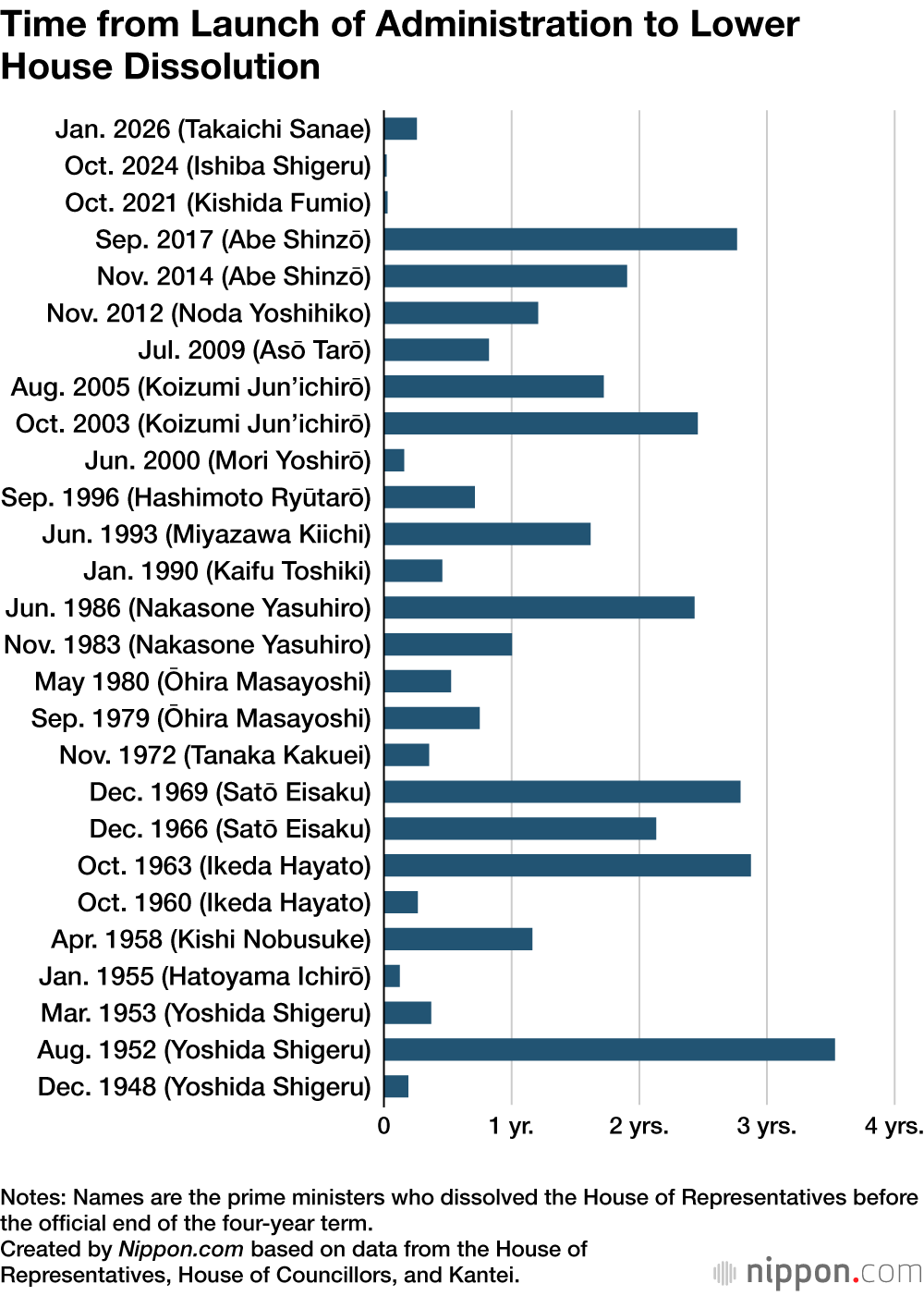
As of January 23, when Takaichi is expected to dissolve the lower house, its members will have been in office for 454 days, less than a third of their four-year terms. This is the shortest period in the postwar era, with the exception of two dissolutions brought about by successful no-confidence motions against the cabinets of Yoshida Shigeru in 1953 and Ōhira Masayoshi in 1980. If the election date is set as February 8, as expected, it will come just 16 days after the chamber is dissolved, yet another postwar record for the all-time shortest interval from dissolution to voting (the Constitution prescribes a 40-day maximum for this period).
Data Sources
- List of general elections for the lower house (Japanese) by the House of Representatives.
- List of lower and upper house elections, Diet sessions, and prime ministers (Japanese) by the House of Councillors.
- List of successive prime ministers by the Kantei.
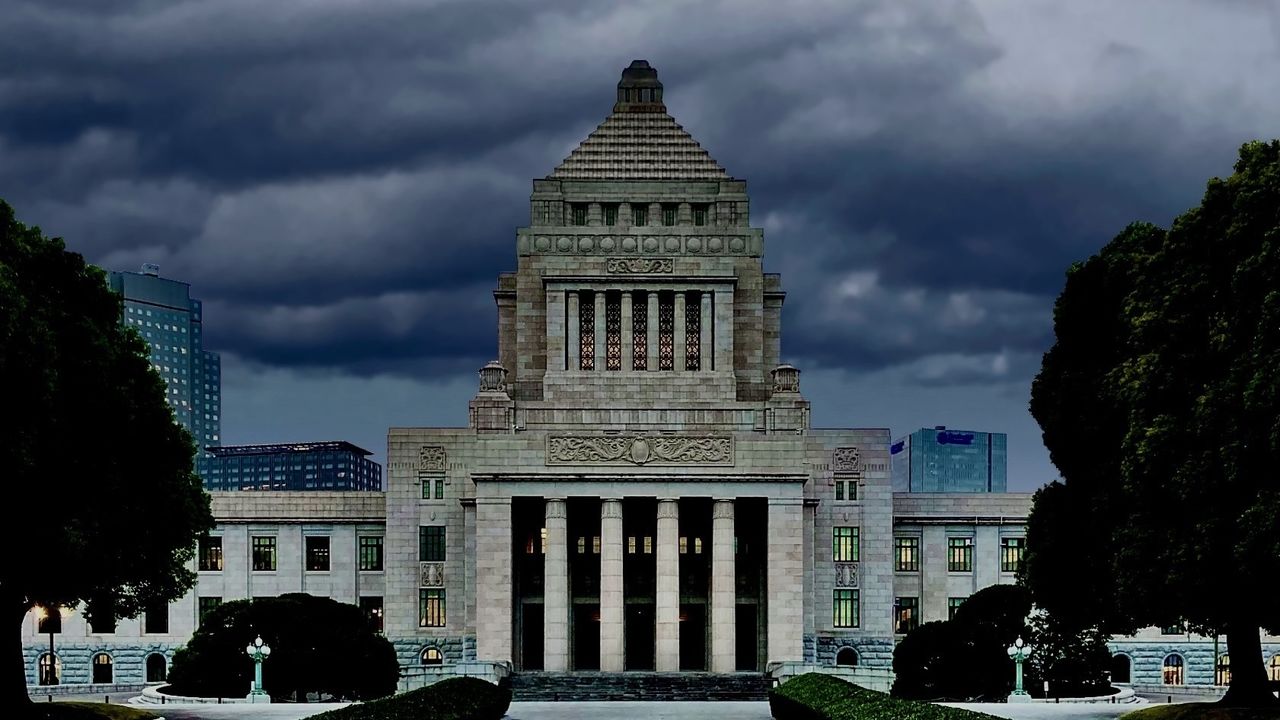
(Originally published in Japanese. Banner photo: The National Diet Building in Chiyoda, Tokyo. © PhotoAC.)