Japan’s 2026 General Election: Takaichi Stakes Premiership on Regaining Majority
Politics- English
- 日本語
- 简体字
- 繁體字
- Français
- Español
- العربية
- Русский
First Test for New Coalition
On January 27, campaigning began for Japan’s House of Representatives election, set to take place on February 8. A total of 465 seats are at stake (289 in single-seat districts and 176 via proportional representation), with key issues including policies on foreign nationals and the economy, such as measures to tackle high prices. More than 1,200 candidates will compete to secure a place in the house, either through a single-seat district or PR.
The previous lower house election took place under Prime Minister Ishiba Shigeru in October 2024. This time, lawmakers still have two years and nine months of their four-year terms remaining. It will be the first electoral test for Takaichi Sanae as prime minister, as well as for the new coalition she established in October between her Liberal Democratic Party and Nippon Ishin no Kai.
The table below shows the number of registered candidates running for the main parties. The Centrist Reform Alliance, created through a merger between the former Constitutional Democratic Party of Japan and Kōmeitō, has set its sights on becoming the leading party. Meanwhile, the Democratic Party for the People and Sanseitō will aim to maintain their momentum from last year’s House of Councillors election and build up strength in the lower house.
Candidates Fielded in the 2026 House of Representatives Election
| Single-Seat/PR | |
|---|---|
| Ruling Coalition | |
| Liberal Democratic Party | 285/52 |
| Nippon Ishin no Kai | 87/2 |
| Opposition | |
| Centrist Reform Alliance | 202/34 |
| Democratic Party for the People | 102/2 |
| Japanese Communist Party | 158/18 |
| Reiwa Shinsengumi | 18/13 |
| Sanseitō | 182/8 |
| Conservative Party of Japan | 6/14 |
| Social Democratic Party | 8/7 |
| Team Mirai | 6/9 |
Created by Nippon.com based on candidate lists from political parties.
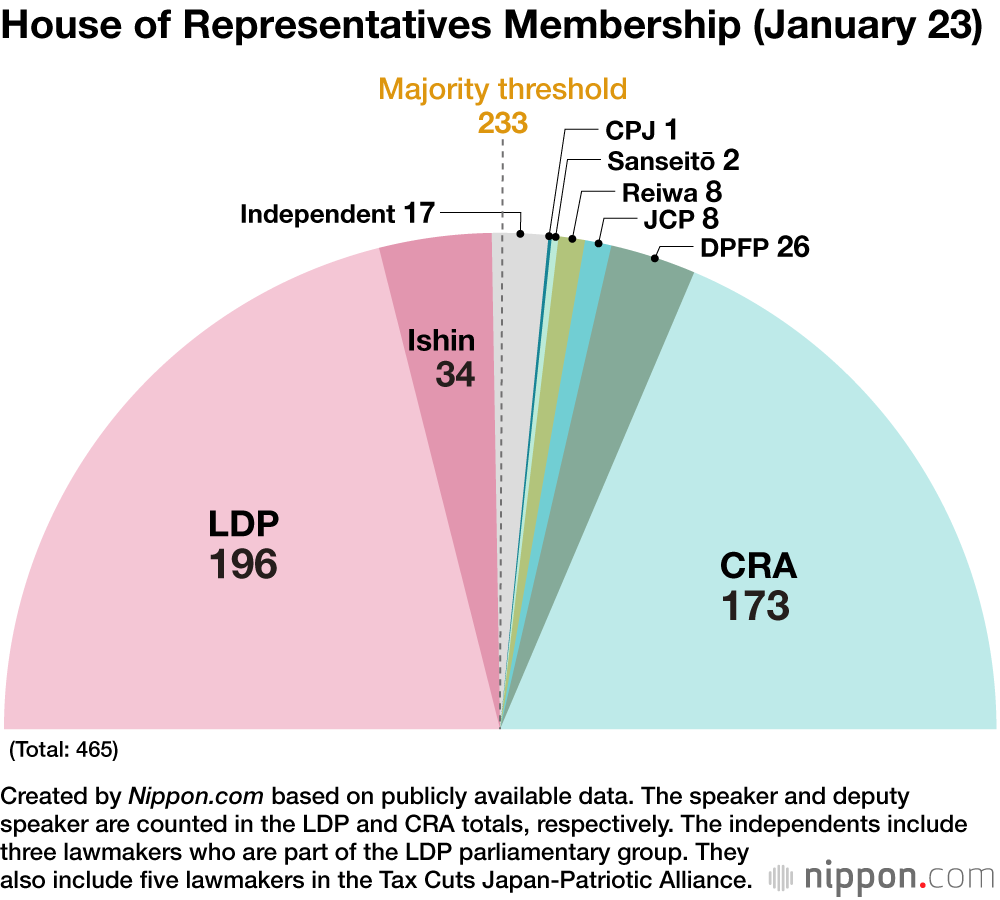
At the time the lower house was dissolved on January 23, the LDP had 196 seats and Ishin no Kai 34, for a coalition total of 230. This is just 3 below the majority threshold of 233 in the 465-seat chamber. Prime Minister Takaichi has set a goal of winning a majority with the coalition, stating that she plans to resign immediately if this is not achieved.
Apart from a simple majority, other possible targets would include the “stable majority” level of 243 seats, which would allow the coalition to chair all permanent lower house committees and ensure at least parity with the opposition in committee membership numbers; the “absolute stable majority” of 261 seats, which would allow it to chair and maintain a majority of seats in the committees; and the 310-seat two-thirds majority needed to pass revisions to Japan’s Constitution (also required in the House of Councillors).
How the Election Works
As well as the winning candidates from the 289 single-seat districts, an additional 176 lawmakers are selected in voting for 11 multiseat PR blocks. On their ballots, voters select one candidate for the local seat, along with a political party for the PR block, resulting in a situation where a candidate can lose in the single-seat vote but still make it into the House of Representatives as the PR pick.
Japanese citizens aged 18 and older are eligible to vote in the municipality where they are registered as residents. Voting in principle takes place in person at polling stations from 7:00 am to 8:00 pm on election day, and votes are tabulated immediately after the polls close.
Among the lawmakers who have decided not to run for reelection in 2026 are former Prime Minister Suga Yoshihide of the LDP and former JCP leader Shii Kazuo.
Data Sources
- Information on Diet members (Japanese) from the Liberal Democratic Party.
- Information on Diet members and their parties as of January 22 (Japanese) from the House of Representatives.
(Translated from Japanese. Banner photo © PhotoAC.)