Japan’s Real Wages Still Lagging Behind Inflation
Work Economy- English
- 日本語
- 简体字
- 繁體字
- Français
- Español
- العربية
- Русский
Can Wages Catch Up to Inflation?
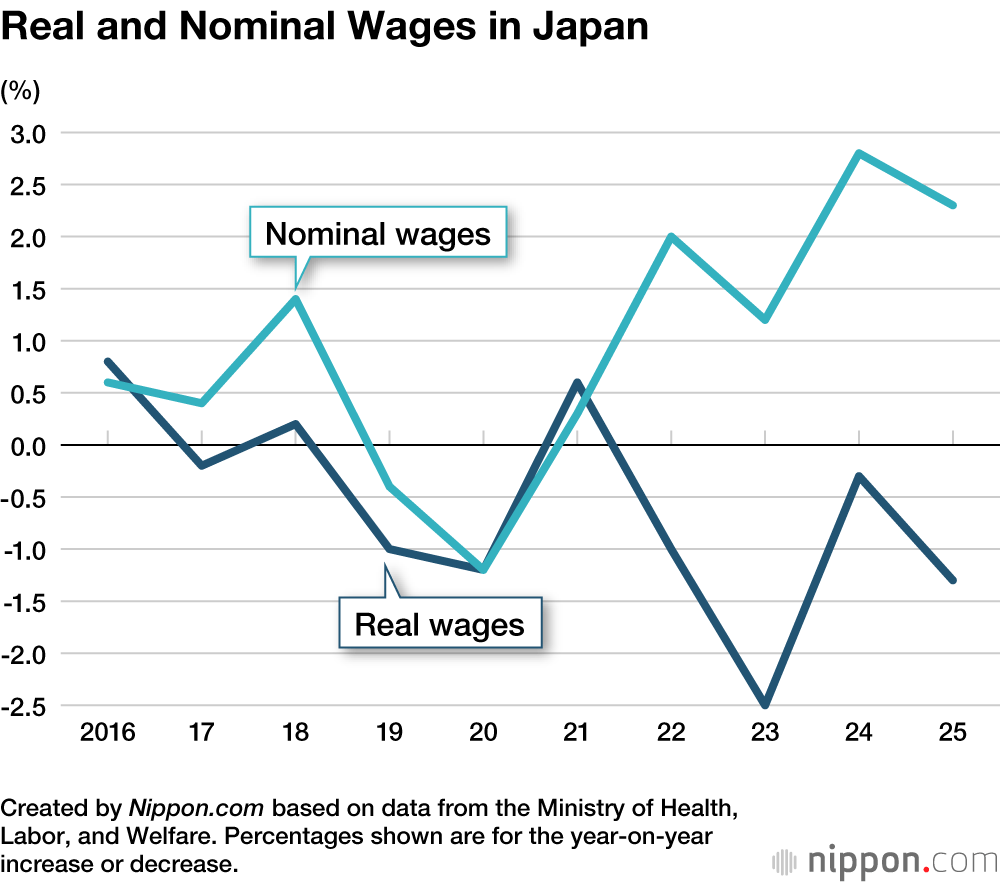
Real wages adjusted for inflation decreased by 1.3% in 2025, compared to the previous year, according to statistics from the Ministry of Health, Labor, and Welfare. Although total cash earnings rose by 2.3%, for a monthly average of ¥355,919, that increase was offset by a 3.7% rise in consumer prices. Real wages were down year on year for every month in 2025, never once entering positive territory.
Amid the economic sanctions against Russia, introduced after its invasion of Ukraine in 2022, resource prices surged. This has brought rising prices to Japan, with annual inflation hovering around 3% ever since. Wages have also begun to rise in response, but have lagged behind the pace of inflation for the past four years.
Saitō Tarō, chief of the of the NLI Research Institute’s Economic Research Department, offered the following analysis of the situation: “Around 2022 and 2023, price rises were driven by ‘import inflation’ related to the rising cost of imported goods. However, in 2024 and 2025, inflation became broader based across many sectors due to increases in wages and logistics costs, the rising price of rice, and other factors.”
Saitō adds that “there is a possibility wages could turn positive for the first time in five years.” The inflation rate is projected to be around 2% this year, given the expected decrease in electricity and gas charges, as well as the abolition of the provisional gasoline tax. Meanwhile, the Japanese Trade Union Confederation (Rengō) is calling for a 3% wage increase (excluding regular seniority-based raises) in its annual spring wage offensive. Wage growth is expected to remain between 2% and 3%, including companies without labor unions.
One inflationary risk is rising prices due to the weak yen. Following the landslide victory of the ruling Liberal Democratic Party in the February 8 general election, Prime Minister Takaichi Sanae reiterated her intention to pursue a “responsible proactive fiscal policy.” However, financial markets remain concerned about Japan’s deteriorating fiscal situation, and it seems likely that downward pressure on the yen will continue.
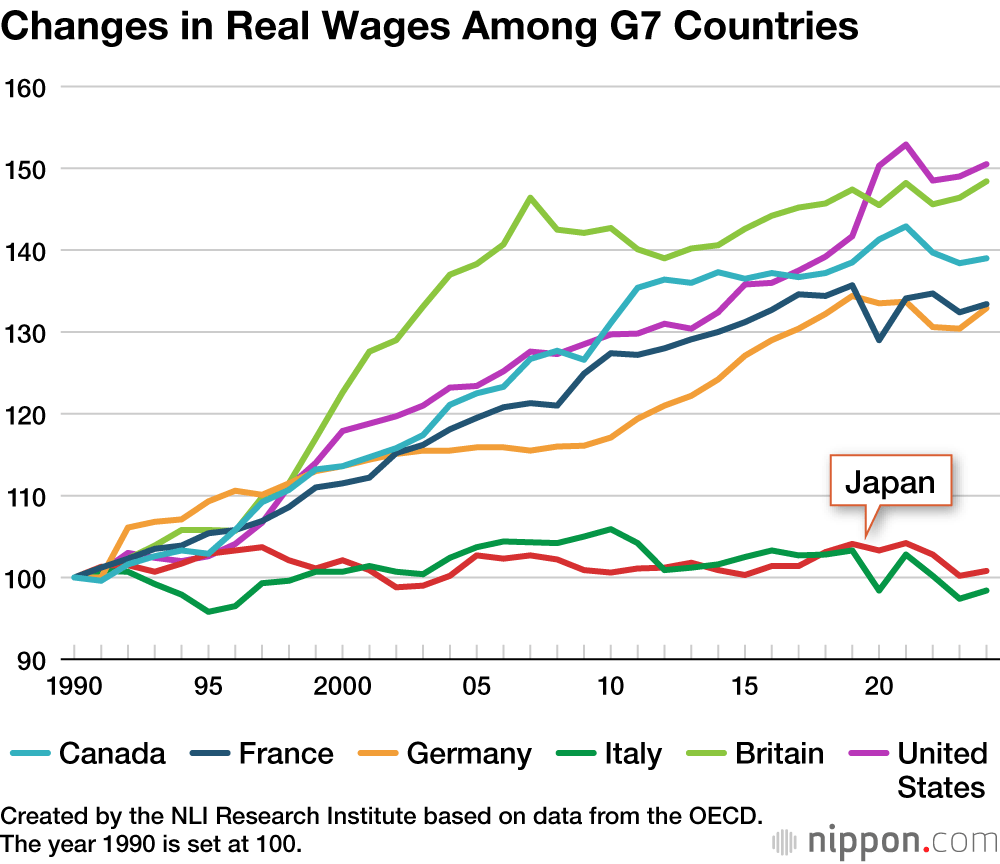
Japan’s prolonged stagnation in real wages stands out even by international standards. Among the G7 countries, only Japan and Italy have seen real wages remain almost flat since 1990. This contrasts sharply with the United States, where real wages are now about 1.5 times higher than they were in 1990.
Data Sources
- Monthly labor survey (Japanese) from the Ministry of Health, Labor, and Welfare.
(Translated from Japanese. Banner photo © Pixta.)