Historic Summits Between Japanese and US Leaders
Politics- English
- 日本語
- 简体字
- 繁體字
- Français
- Español
- العربية
- Русский
With Prime Minister Takaichi Sanae set for a summit with US President Donald Trump on March 19, we look at momentous past meetings between Japanese and US leaders.
Negotiating a Revised Japan-US Security Treaty
June 1957, Prime Minister Kishi Nobusuke and President Dwight D. Eisenhower (Washington)
Amid mounting dissatisfaction with the security treaty signed between the two countries in 1951, Kishi visited Washington to talk with Eisenhower. After the summit, the two leaders signed a joint statement establishing a committee to revise the treaty and greatly reduce the number of US troops based in Japan. The revised treaty was signed on January 19, 1960.
A Secret Nuclear Agreement for Okinawa’s Return
November 1969, Prime Minister Satō Eisaku and President Richard Nixon (Washington)
Satō, who took office in November 1964, lobbied hard for the return of Okinawa, raising the issue with President Lyndon B. Johnson in January 1965 and becoming the first postwar Japanese prime minister to visit the region in August of that year. During his November 1969 meeting with Nixon, the two leaders signed a secret agreement allowing for the reintroduction of nuclear weapons into Japan under emergency circumstances. On November 21, Satō and Nixon made a joint statement announcing that Okinawa would return to Japanese sovereignty by 1972, without nuclear weapons, the same as mainland Japan.
Ron and Yasu’s Common Destiny
1983, Prime Minister Nakasone Yasuhiro and President Ronald Reagan (Washington in January; Tokyo in November)
After coming to power in November 1982, Nakasone focused on rebuilding the relationship between Japan and the United States after disputes over defense and trade. Japan had built a large trade surplus based on its exports to the United States, which wanted its ally to boost domestic demand and open up its markets. During Nakasone’s January visit to Washington, he stated that the two countries shared a “common destiny.” When Reagan came to Japan in November, Nakasone invited the president and his wife to his mountain villa in western Tokyo, and the two leaders established a close relationship, calling each other “Ron” and “Yasu.” Nakasone subsequently embarked on a number of privatizations, including of the national rail service.
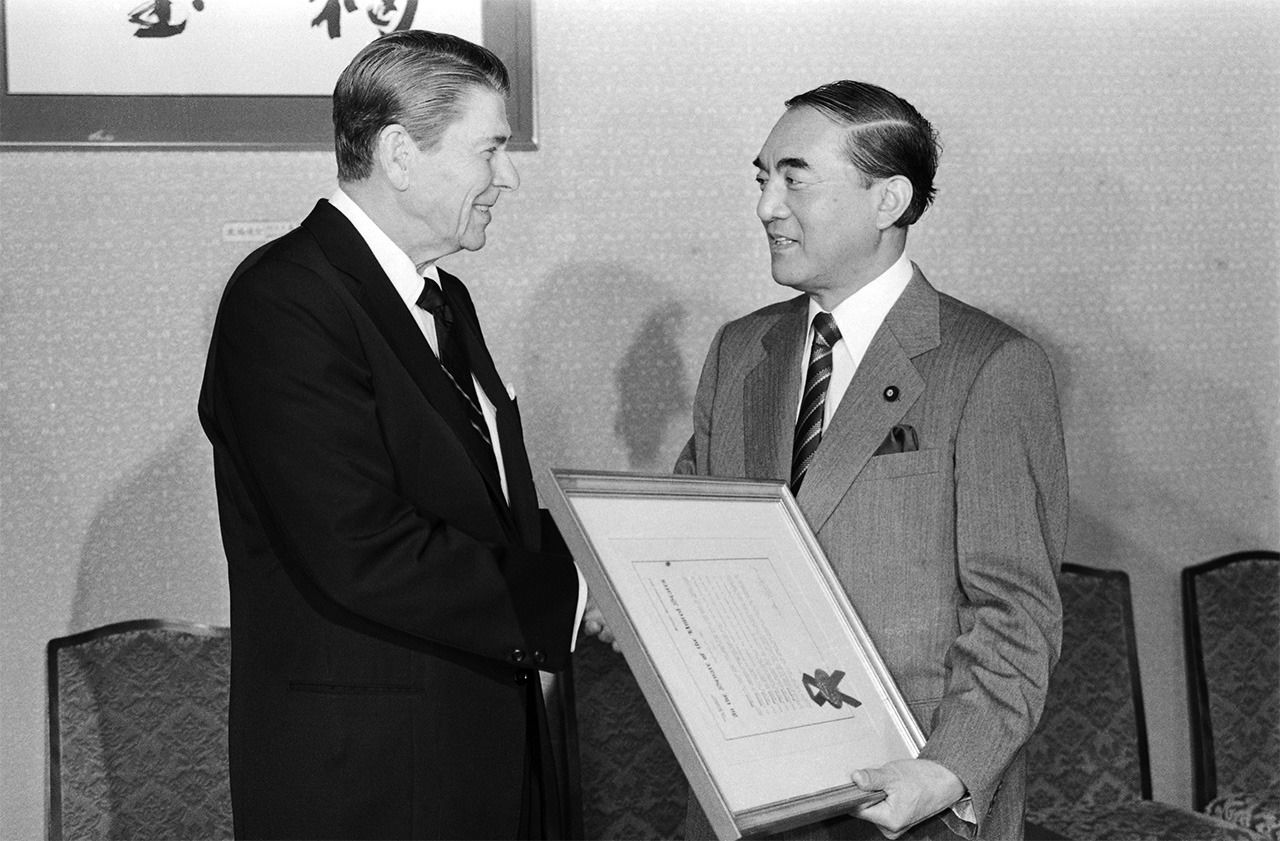
President Reagan (left) talking with Prime Minister Nakasone in Tokyo on November 10, 1983. (© Jiji)
SDF Involvement in the War on Terror
June 2001, Prime Minister Koizumi Jun’ichirō and President George W. Bush (Washington)
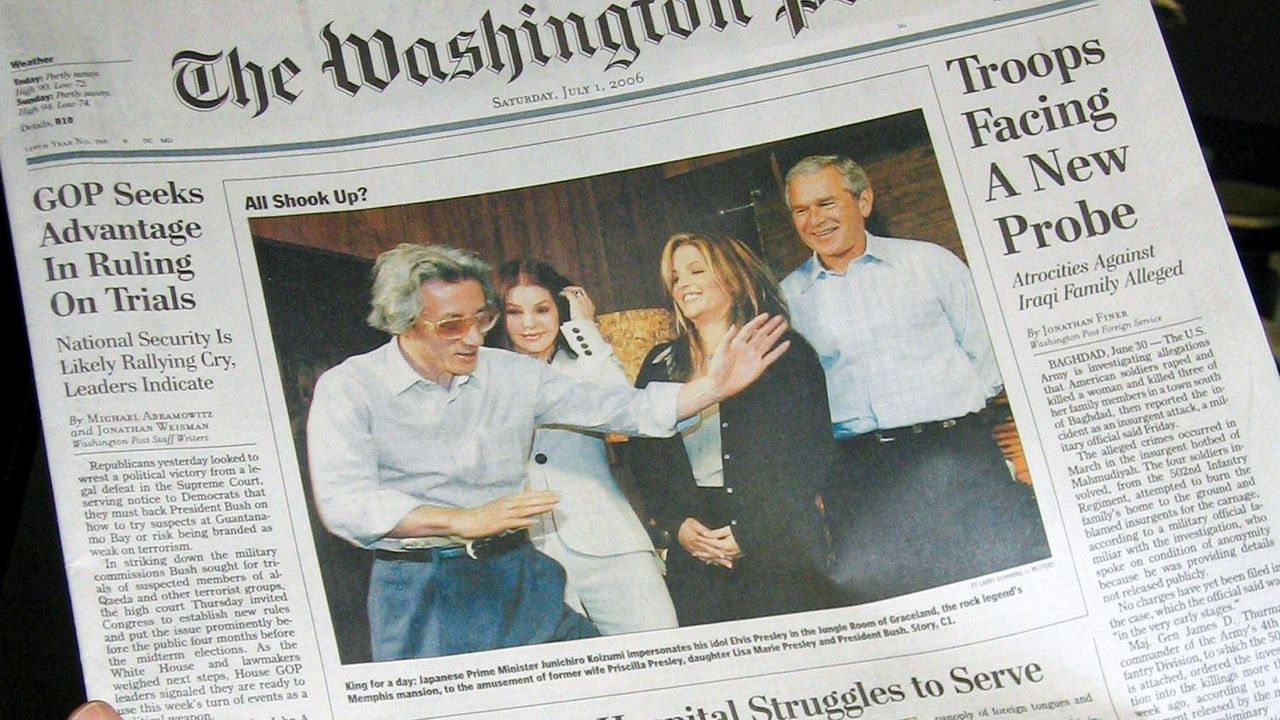
Koizumi and Bush met for the first time at Camp David near Washington in June 2001, after both coming to power earlier in the year. The two were both baseball fans, and developed a personal friendship. After the September 11 attacks later in the year, Koizumi dispatched Maritime Self-Defense Forces ships to the Indian Ocean to assist in the War on Terror. SDF troops also had a limited role in the Iraq War from 2004. During Koizumi’s 2006 visit, the two leaders flew together in Air Force One for a famous visit to Elvis Presley’s Graceland home in Memphis, Tennessee.
A Symbolic Reconciliation
May 2016, Prime Minister Abe Shinzō and President Barack Obama (Hiroshima)
Obama, who won the 2009 Nobel Peace Prize in part for his vision of a world free of nuclear weapons, visited Hiroshima Peace Memorial Park with Abe on May 27, 2016. They made offerings of flowers and briefly visited the Peace Memorial Museum. In December, while in Hawaii, Abe went to the Pearl Harbor Visitor Center and the USS Arizona Memorial, around 75 years after the Japanese Pearl Harbor attack.
Golfing Diplomacy
February 2017, Prime Minister Abe Shinzō and President Donald Trump (Washington)
Abe met with Trump soon after his installation in the White House for talks on February 10. Trump had expressed dissatisfaction with the alliance between the two countries, but the joint statement made clear US backing for Japan’s defense, including the application of the Joint Security Treaty to the Senkaku Islands. After the summit, the two leaders played golf in Palm Beach, Florida. This became a tradition, with a total of five rounds of “golf diplomacy” eventually taking place.
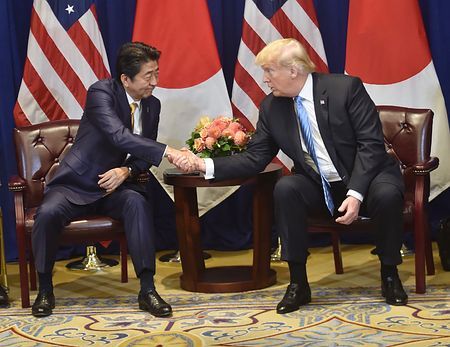
Prime Minister Abe (left) shakes hands with President Trump at a New York summit on September 26, 2018. (© AFP/Jiji)
Solidarity Against China
April 2021, Prime Minister Suga Yoshihide and President Joe Biden (Washington)
Suga became the first foreign leader to visit the United States after the start of the Biden administration in January. Their summit demonstrated how competition with China had become a central theme in US diplomacy. In their joint statement, they agreed to “oppose any unilateral attempts to change the status quo in the East China Sea” and objected to “China’s unlawful maritime claims and activities in the South China Sea.” The United States also “restated its unwavering support for Japan’s defense.” In August 2023, Prime Minister Kishida Fumio and South Korean President Yoon Suk-yeol took part in a trilateral summit with Biden at Camp David.
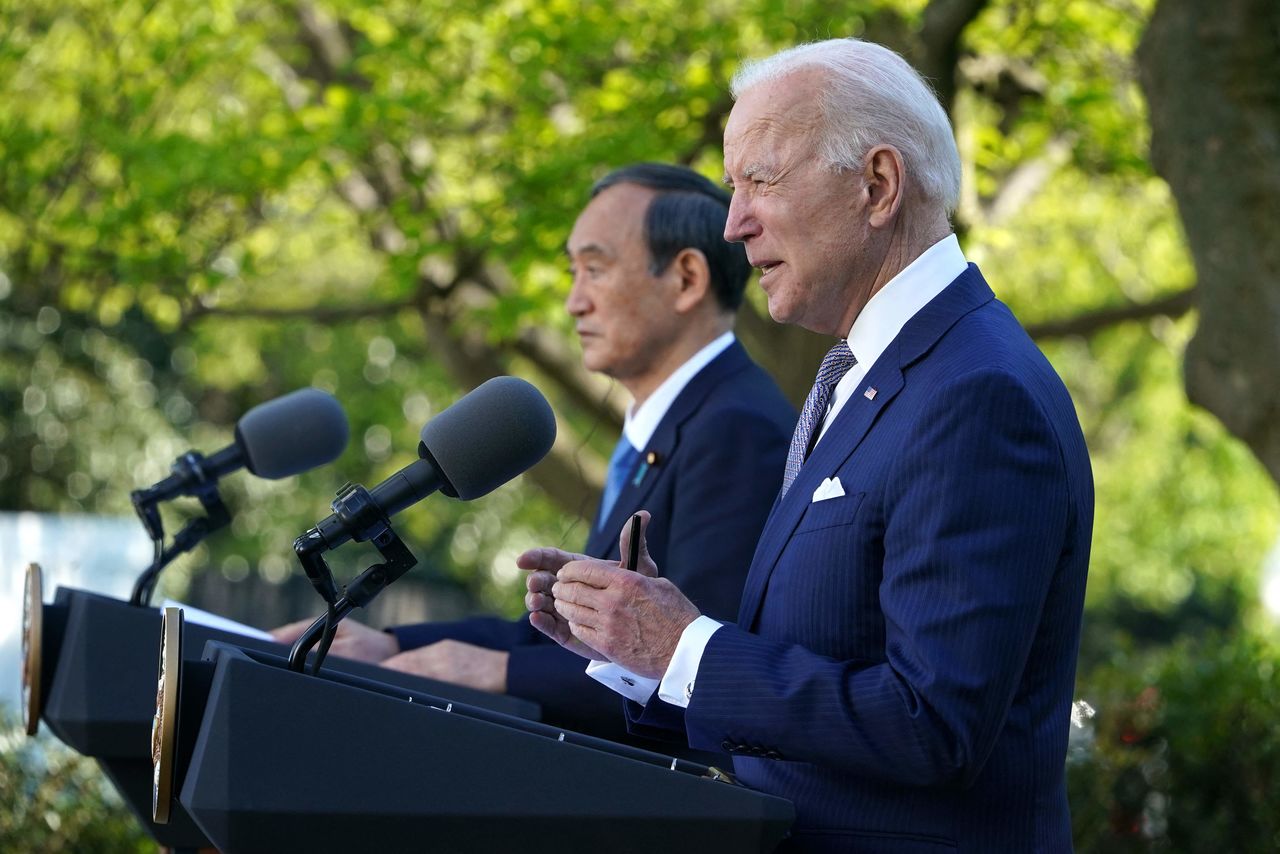
Prime Minister Suga, at left, and President Biden at a press conference after their summit on April 16, 2021. (© AFP/Jiji)
Data Sources
- Materials related to Japan-US summit meetings from the World and Japan database.
- Details of prime minister’s overseas trips (October 2006 to February 2025) (Japanese) from the Ministry of Foreign Affairs.
- Details of prime minister’s overseas trips (October 2020 to December 2025) (Japanese) from the Ministry of Foreign Affairs.
(Translated from Japanese. Banner photo: The front page of the July 1, 2006, edition of the Washington Post displays a photograph of Prime Minister Koizumi Jun’ichirō imitating Elvis Presley. © Jiji.)