Japan’s SDF Goes Abroad: Past Overseas Actions in Support of the United States
Politics World- English
- 日本語
- 简体字
- 繁體字
- Français
- Español
- العربية
- Русский
The Self-Defense Forces Overseas
During the postwar era, Japan’s Self-Defense Forces have primarily concerned themselves with the Japanese islands and maritime territory, as well as taking part in United Nations peacekeeping operations. At times, though, they have gone further afield alongside US forces in support of Japan’s sole military ally, the United States.
As Prime Minister Takaichi Sanae prepares for her March 19, 2026, summit with US President Donald Trump in Washington DC, many expect the American side to request Japanese participation in operations to maintain passage through the Strait of Hormuz. Will the Japanese leader pledge Maritime Self-Defense Force help in the ongoing conflict between the United States and Iran, adding to the list below?
MSDF Minesweepers in the Persian Gulf (1991)
Following Iraq’s August 1990 invasion of Kuwait, a multinational force came together under US leadership to strike back against Saddam Hussein. The Gulf War kicked off in January 1991, with air and ground operations that succeeded in liberating Kuwait in the following month. Japan provided $13 billion in funding for the operations, but did not provide any personnel, leading to criticism of the country’s “checkbook diplomacy” in the US Congress and media. In April 1991, after a ceasefire was reached, Japan approved the dispatch of six Maritime Self-Defense Force minesweepers to the Persian Gulf; from June to September that year they took part in demining operations. This marked the first overseas SDF deployment classified as a special measure, a specific, time-limited mission approved by legislation, under the Self-Defense Forces Act.
Rear-Area Support for the War on Terror (2001–2010)
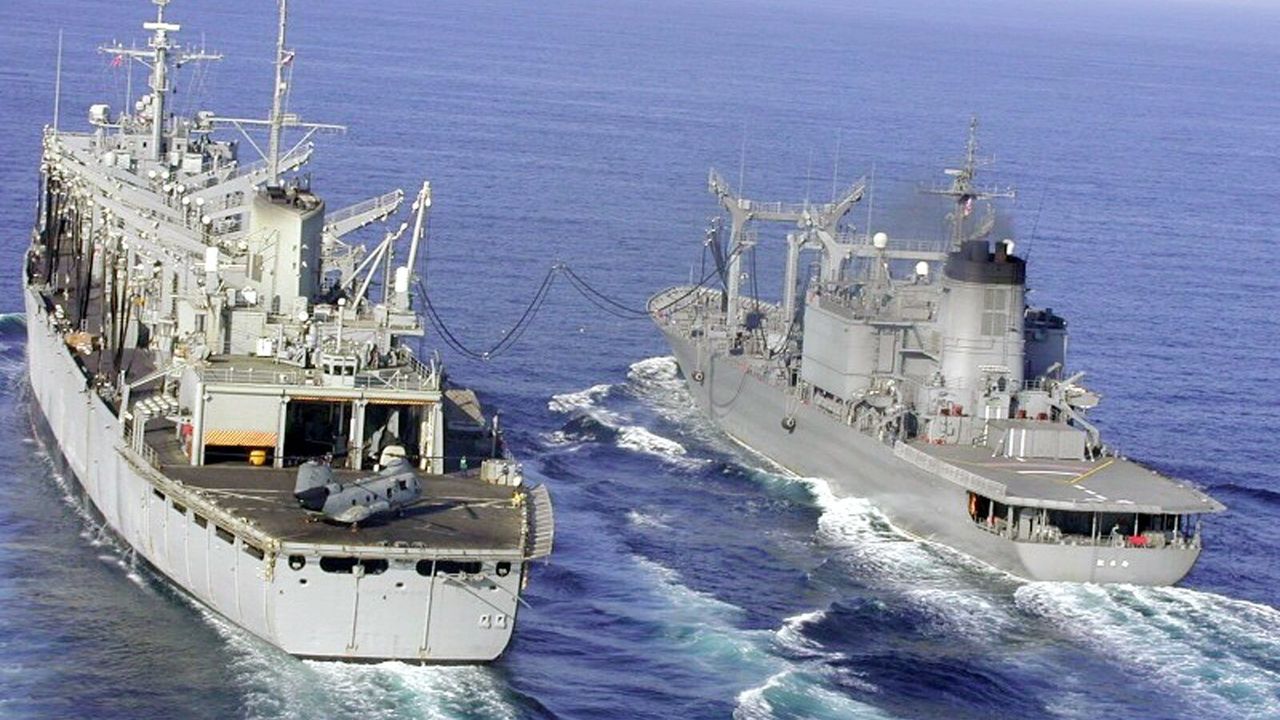
After the September 11, 2001, terrorist attacks on the United States, President George W. Bush declared the “War on Terror,” calling for international support. There were particularly high hopes that Japan would provide personnel. Deputy Secretary of State Richard Armitage, known as a Japan hand, urged Japan to “show the flag” by taking on a more meaningful role. The administration of Prime Minister Koizumi Jun’ichirō got the Anti-Terrorism Special Measures Law passed. Bound by constitutional restrictions on their activities, Japanese forces were not allowed to take part in combat, and Japan instead focused on refueling operations and other rear-area support, with MSDF supply ships providing diesel and aviation fuel at no cost to the multinational forces operating in the Arabian Sea and Indian Ocean.
Iraq Reconstruction Assistance (2004–9)
The US-led “coalition of the willing,” including forces from Britain, Australia, Poland, and other nations, invaded Iraq in 2003 on the grounds that the country had weapons of mass destruction, putting an end to the regime of Saddam Hussein. The Bush administration strongly requested Japanese “boots on the ground,” and the Koizumi administration responded with the 2003 Law Concerning the Special Measures on Humanitarian and Reconstruction Assistance in Iraq, enabling the dispatch of Japanese SDF troops to Iraq during the reconstruction phase after combat had ended. Up through 2006, Ground Self-Defense Force personnel took part in humanitarian actions around a base set up in Samawah, southern Iraq, a relatively stable part of the country. The Air Self-Defense Force, meanwhile, operated out of Kuwait, transporting supplies and personnel for the multinational force working to restore security in Iraq.
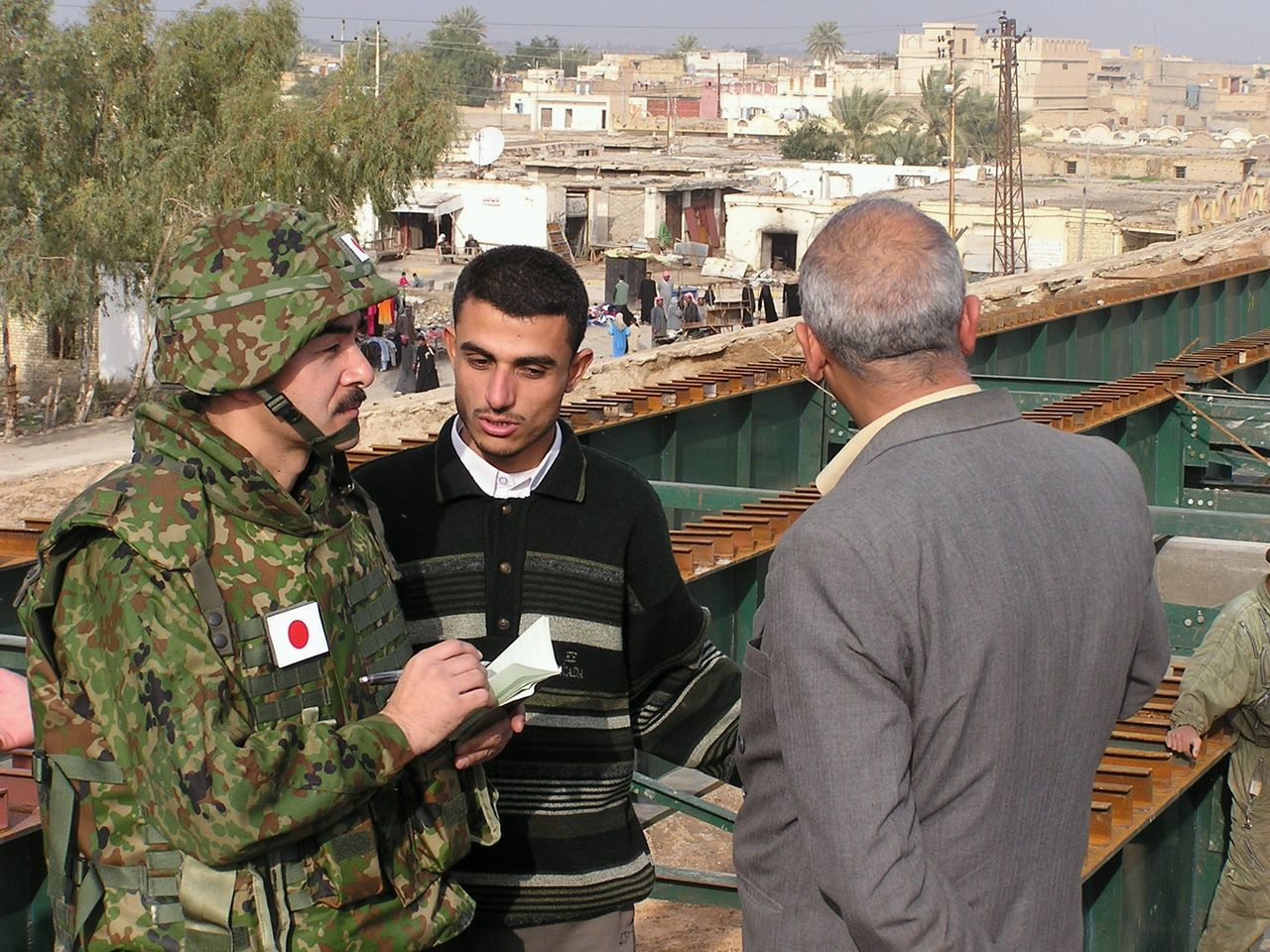
GSDF Colonel Satō Masahisa, commander of the Japanese reconstruction mission in Iraq, speaks to local officials about conditions at a bridge near Samawah on January 26, 2004. (© Jiji)
Middle East Deployment Near Hormuz (2020–)
Following a series of attacks on oil tankers in and around the Persian Gulf in 2019, US President Donald Trump’s administration called for cooperation in an operation to maintain security in the Strait of Hormuz. Japan, which sought to avoid harming its relationship with Iran, opted not to take direct part in this, stating that it would instead conduct its own intelligence-gathering operation. MSDF escort vessels and antisubmarine patrol aircraft were dispatched to the Gulf of Oman and the northern Arabian Sea, where they officially continue their mission of monitoring the status of Japan-related vessels and keeping watch for suspicious vessels and aircraft, under article 4 of the Ministry of Defense Establishment Act, covering survey and research activities by the Self-Defense Forces.
Data Sources
- Actions under the Law Concerning the Special Measures on Humanitarian and Reconstruction Assistance in Iraq (Japanese) from the Ministry of Defense
(Originally published in Japanese on March 19, 2026. Banner photo: A US Navy supply ship, at left, and the MSDF supply vessel Hamana transfer fuel in the Arabian Sea during antiterror operations in December 2001. Provided by Maritime Self-Defense Force; © Jiji. )