Severe Heat: Japan Adopts Official Name for No Longer Uncommon 40°C Days
Environment Lifestyle- English
- 日本語
- 简体字
- 繁體字
- Français
- Español
- العربية
- Русский
No Longer Extraordinary
On April 17, the Japan Meteorological Agency officially adopted the term kokushobi (roughly “severe heat day”) to describe days when the maximum temperature is 40° Celsius or higher. The Japan Weather Association, a private organization, has been using the term since 2022, which helped make it familiar enough to win a poll held by the JMA to determine the official name in Japanese.
Official JMA Names for Types of “Summer Days”
| 40°+ | Kokushobi (酷暑日; severe heat day) |
| 35°+ | Mōshobi (猛暑日; extreme heat day) |
| 30°+ | Manatsubi (真夏日; midsummer day) |
| 25°+ | Natsubi (夏日; summer day) |
High temperatures across the country this year led to cherry blossoms going into bloom around a week to 10 days early in many locations. On April 11, a temperature of 30.3° was recorded in the city of Shizuoka’s Suruga Ward, which was the year’s first “midsummer day” in Japan’s main island of Honshū.
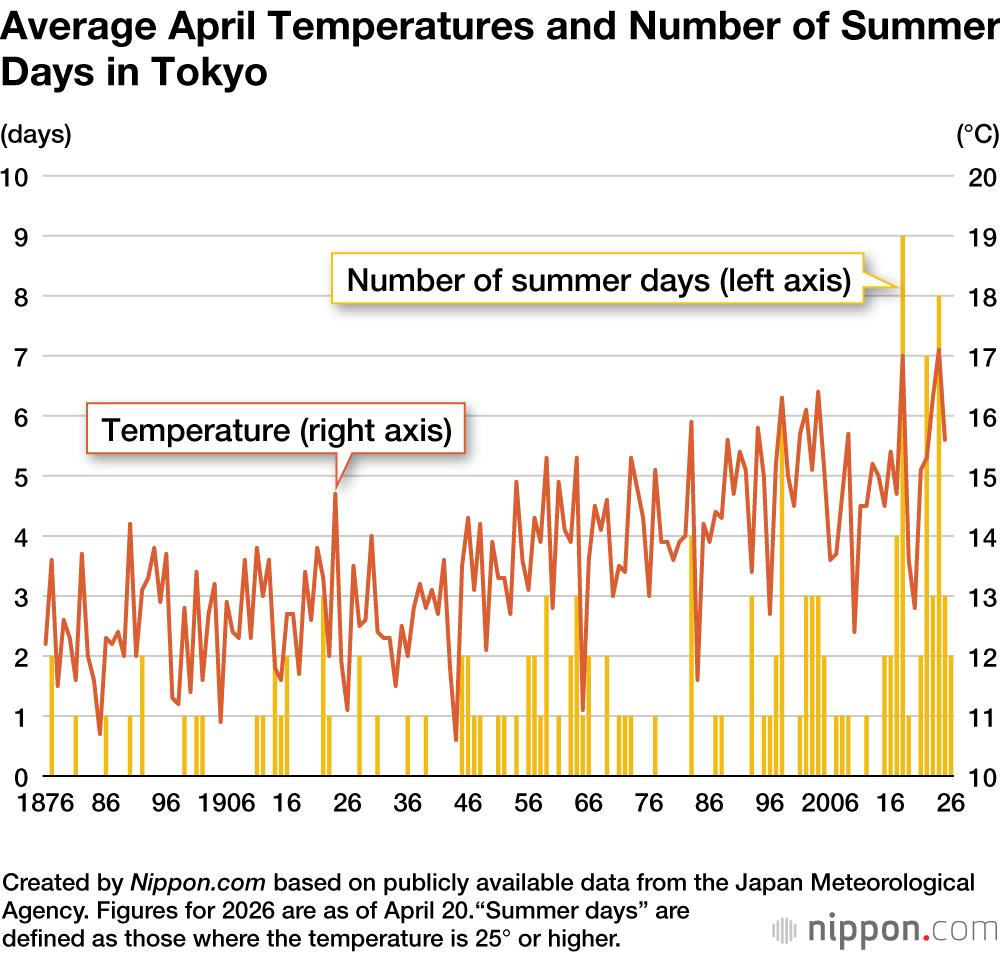
The graph below of average April temperatures in Tokyo since 1876 shows a steady rise. Until the 1980s, there were typically only one or two natsubi, when the temperature was 25° or higher, each April, but the number has seen a rapid increase in recent years.
In its forecast for April to June, published on March 24, the JMA predicted that due to factors including climate change, there will be high temperatures across the country. On August 5, 2025, Japan registered a new record temperature of 41.8° in Isesaki, Gunma. With average temperatures set to exceed typical levels in the summer of 2026 too, the agency is calling on residents to prepare for days of severe and extreme heat.
The JMA poll to name days with temperatures of 40° or higher was held with 13 options from February 27 to March 29. Kokushobi (酷暑日; severe heat day) received 202,954 votes, which was more than three times as many as Chōmōshobi (超猛暑日; very extreme heat day), with 65,896 votes, in second place. Among the responses to an open question in the survey were suggestions of names meaning “dangerous, extreme heat day” and “stay-at-home day.”
Data Sources
- Data on survey to name days with a maximum temperature of 40° or higher and three-month forecast for April to June (Japanese) from the Japan Meteorological Agency.
(Translated from Japanese. Banner photo © Pixta.)