
Japan Retail Bond Sales Surge in Shift Away from Low-Yield Bank Deposits
Economy- English
- 日本語
- 简体字
- 繁體字
- Français
- Español
- العربية
- Русский
Higher Interest Rates
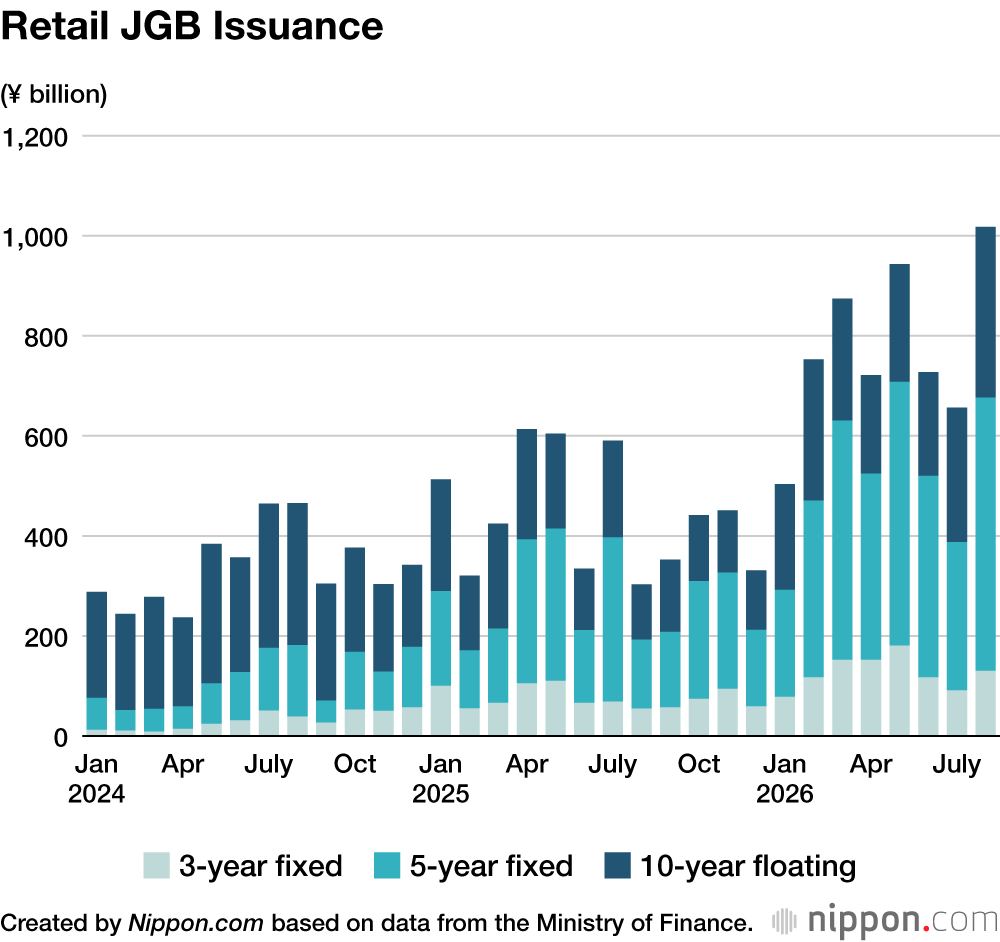
In 2026, issuance of retail Japanese government bonds (JGBs) to individual investors has surged, and as of August, it has already surpassed the total volume for 2025. More than two years since the Bank of Japan ended its ultra-loose monetary policy, meaning a return for positive interest rates, government bonds have become an attractive investment option for those seeking a safe place to manage their money
Retail JGBs can be purchased in increments of ¥10,000. There are three types: fixed-rate bonds with terms of 3 and 5 years, and 10-year floating-rate bonds whose rates reset every six months. They are issued monthly.
According to data from the Ministry of Finance, the amount of retail bonds issued from January to August 2026 totaled ¥6.2 trillion. This is 1.7 times the amount issued during the same period a year earlier, already surpassing the ¥5.3 trillion total for all of 2025. August issuance, for which applications were accepted the previous month, amounted to ¥1.0 trillion. This marked the first time a monthly issuance exceeded ¥1 trillion since January 2014, when all three types of bonds were first issued on a monthly basis. Because the bonds are issued based on investor demand, the surge in volume indicates their growing popularity among investors.
In March 2024, Bank of Japan Governor Ueda Kazuo put an end to the BOJ’s longstanding policy of ultra-loose monetary easing. The central bank discontinued its negative interest rate policy and also abolished the framework for maintaining an artificially low long-term interest rate on 10-year Japanese government bonds. At the time, interest rates on 3-year and 5-year retail government bonds stood at just 0.05% and 0.25%, respectively. Since then, Japan has returned to an environment with positive interest rates, and amid concerns over inflation, rates have risen to 1.71% and 2.06% for the 3- and 5-year bonds issued in September, which investors can apply for in August.
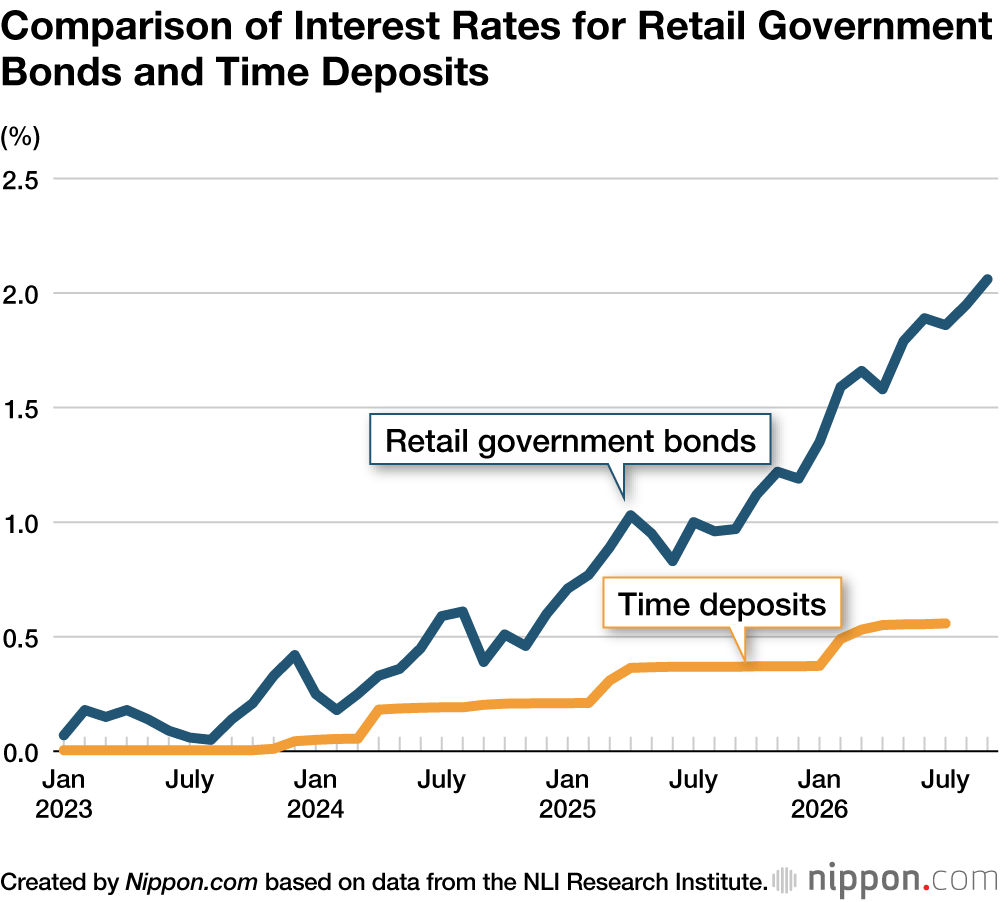
Compared with retail government bonds, which are directly influenced by financial markets, bank time-deposit interest rates have been much slower to rise. As of July, interest rates on retail JGBs were around 1.0 to 1.3 percentage points higher than those on time deposits. According to the Ministry of Internal Affairs and Communications’ Family Income and Expenditure Survey, people in their seventies hold an average of ¥7.8 million in time deposits. The NLI Research Institute estimates that if all of these funds were shifted into retail JGBs, the annual after-tax income from interest would increase by more than ¥70,000.
However, it is important to note that retail bonds cannot be redeemed within the first year of purchase, meaning they cannot be used to meet unexpected cash needs.
The government is also actively promoting the sales of retail bonds. The BOJ previously purchased large quantities of government bonds to suppress long-term interest rates, but under Governor Ueda it has gradually been scaling back its purchases. As a result, the Ministry of Finance needs to find alternate buyers to absorb the supply of JGBs. In addition to diversifying its product lineup, proposals have emerged to make retail bonds, whose interest income is currently subject to taxation, eligible for the Nippon Individual Savings Account (NISA) tax-exempt investment system.
Data Sources
- Data on retail government bonds (Japanese) from the Ministry of Finance
(Translated from Japanese. Banner photo © IllustAC.)