
A Rare Recovery for Ishiba? June Poll Numbers Halt Slide for His Administration
Politics- English
- 日本語
- 简体字
- 繁體字
- Français
- Español
- العربية
- Русский
Improvement, But Not Positive Territory Yet
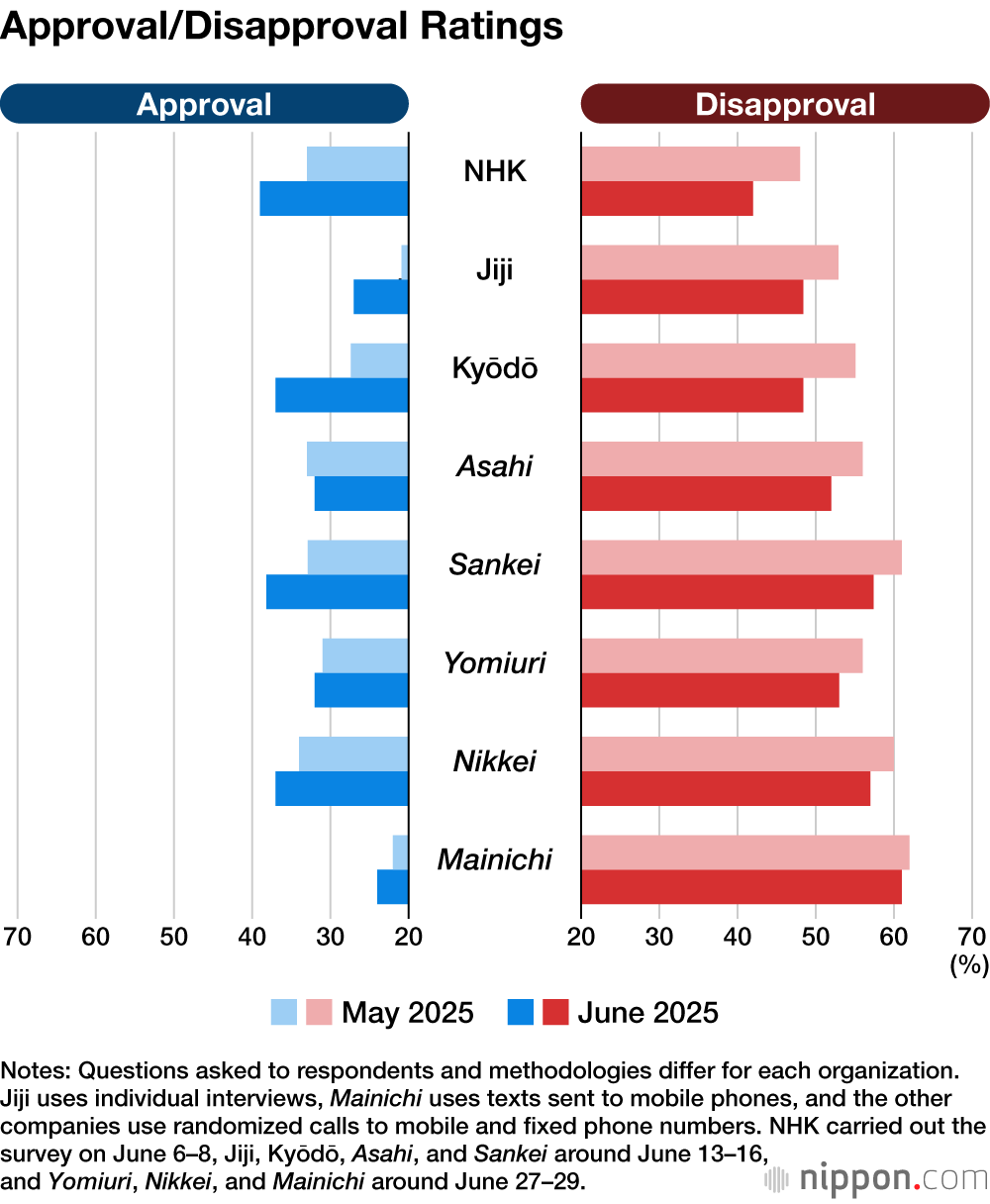
In the monthly public opinion surveys run by eight of Japan’s major media organizations, fully seven of them found growing support for the administration of Prime Minister Ishiba Shigeru in June, compared to the previous month. Ishiba gained his highest approval rating in the NHK poll, at 39% of respondents—up 6 points from May—and his lowest, just 24%, in the Mainichi Shimbun poll, where it rose 2 points. The most marked growth came in the Kyōdō News poll, where it rose 9.6 points to 37.0%.
This was a dramatic improvement for the prime minister, coming off of poll results in May that saw his support rating plunge in five of the eight polls, and five ratings hitting their lowest points ever since he launched his administration in October 2024. In June, only the Asahi Shimbun poll marked a drop in his approval rating, by 1 point to 32%.
This by no means indicates that Ishiba is out of the woods, though. On the disapproval side, his highest negative rating came in the Mainichi survey, where it fell 1 point to 61%. His lowest disapproval rating was down 6 points month on month to 42% in the NHK poll. Just as in May, all eight surveys showed disapproving responses outstripping approval.
Indeed, there can be dramatic shifts within the space of a few days, as shown by a special survey carried out by Kyōdō on June 21–22. Ishiba’s support numbers fell 4.5 points from the firm’s earlier June 14–15 survey, arriving at 32.5% at the end of the ordinary session of the Diet on June 22.
Jiji: First Turnaround in Four Months
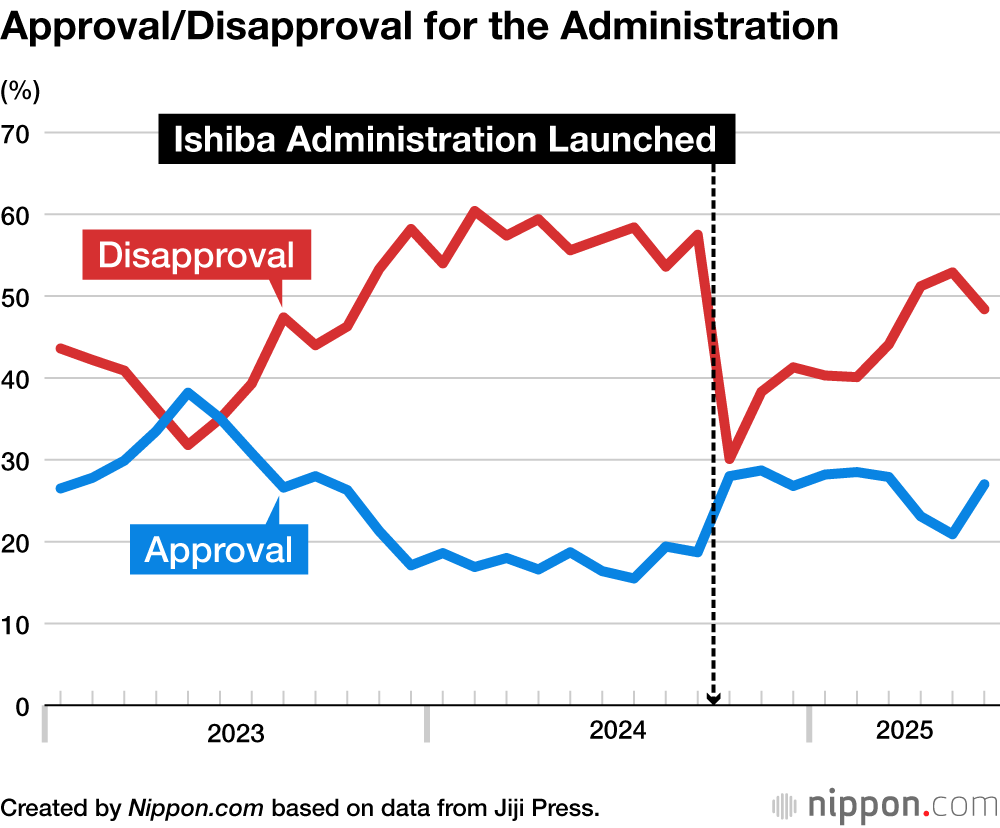
Ishiba’s support rating climbed for the first time in four months in the Jiji Press poll. The 6.1-point hike was the largest month-on-month climb since October last year, when the brand-new Ishiba administration saw a boost among survey respondents hoping for something new after his predecessor, Kishida Fumio, had suffered nearly a year of sub-20% approval ratings. Responses to survey questions in June 2025 point to consumer policy as one reason for this latest jump, with 63.8% of respondents noting that they favorably viewed Minister of Agriculture Koizumi Shinjirō’s moves to tackle ballooning rice prices by releasing grain from Japan’s emergency storehouses. Rice prices indeed fell for five straight weeks through late June, reaching Ishiba’s targeted retail level of under ¥4,000 on average for a 5-kilogram bag of the staple food.
Ishiba has seen less success on the international front. From June 15 to 18 he was in Canada for this year’s G7 summit. While there he met with US President Donald Trump, but their talks produced no agreement on the American imposition of tariffs on Japanese imports, a key focus for the Japanese side.
Domestically, too, Japan now looks to the July 20 House of Councillors election. The June 22 election for the Tokyo Metropolitan Assembly, viewed as a bellwether for the upcoming national contest, went poorly for candidates from Ishiba’s Liberal Democratic Party, the ruling coalition leader at the national level, while opposition groups like the Democratic Party for the People and Sanseitō gained their first seats ever in the chamber. Ishiba’s numbers in this month’s polls may depend on whether his party can avoid similar setbacks on the national stage.
(Translated from Japanese. Banner photo: Prime Minister Ishiba Shigeru, at center, in talks with other leaders at the G7 summit in Kananaskis, Canada, on June 17, 2025. Pool photo; © Jiji.)