A Dreary Year for Ishiba Shigeru: Support Rates Stay Low to the End
Politics- English
- 日本語
- 简体字
- 繁體字
- Français
- Español
- العربية
- Русский
No Relief for Ishiba in His Last Month
The monthly public opinion surveys administered by Japan’s major media organizations have covered Prime Minister Ishiba Shigeru for the last time. On September 7 he announced he would step down as prime minister and president of the Liberal Democratic Party, and on October 4 Takaichi Sanae was picked to succeed him as LDP head.
The September polls showed little change in approval and disapproval ratings for Ishiba from August. Respondents indicating support for the premier climbed slightly in polls from NHK and Jiji Press, dipped slightly in the Kyōdō News, Sankei Shimbun, and Mainichi Shimbun surveys, and fell by about 5 percentage points in the Yomiuri Shimbun and Nikkei polls.
The Yomiuri Shimbun and Asahi Shimbun surveys included questions asking whether respondents viewed Ishiba’s term in office positively. Just 44% of respondents to both polls said they had a positive take on his administration, while a majority in both—55% in the Yomiuri and 54% in the Asahi poll—did not.
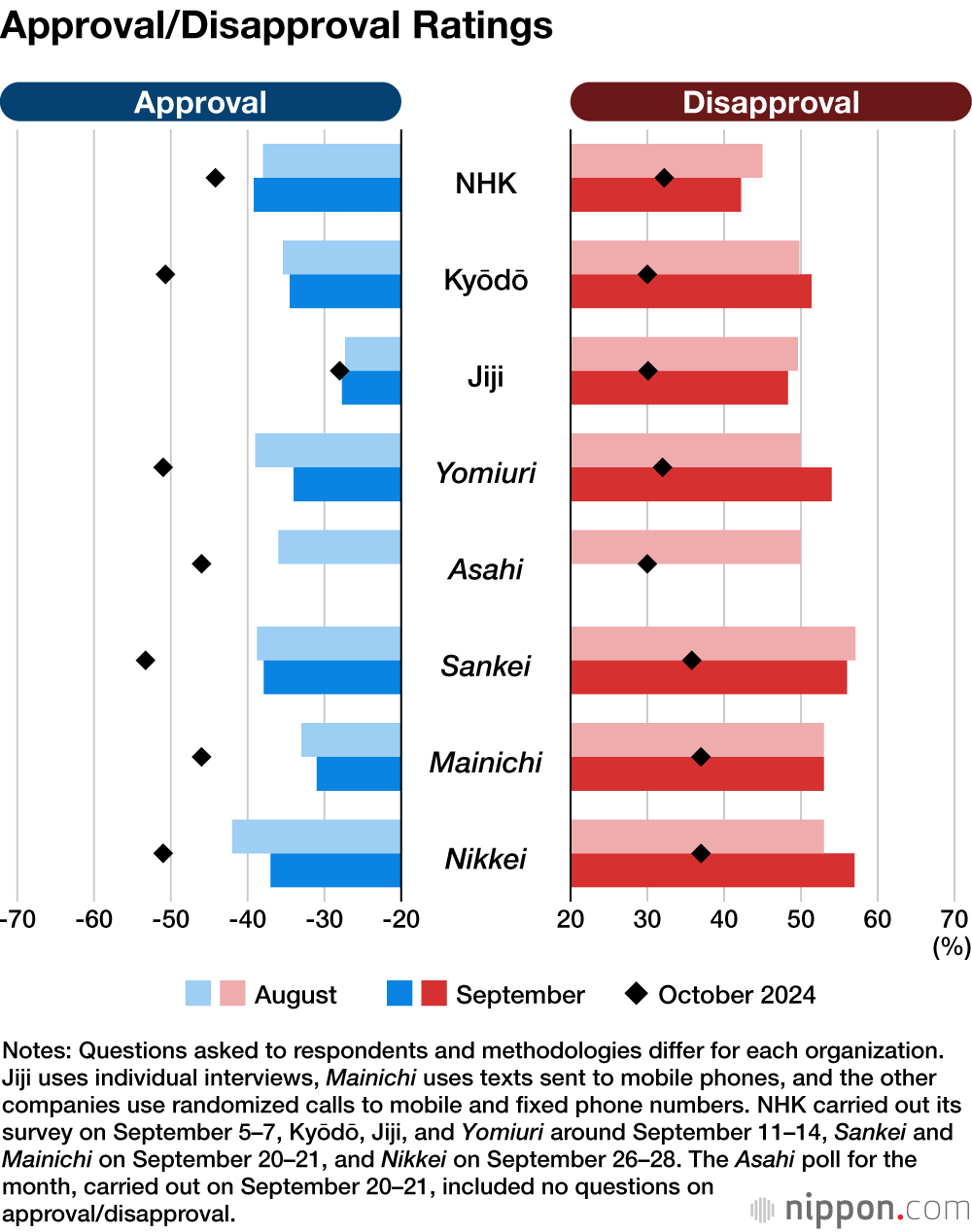
Notes: Questions asked to respondents and methodologies differ for each organization. Jiji uses individual interviews, Mainichi uses texts sent to mobile phones, and the other companies use randomized calls to mobile and fixed phone numbers. NHK carried out its survey on September 5–7, Kyōdō, Jiji, and Yomiuri around September 11–14, Sankei and Mainichi on September 20–21, and Nikkei on September 26–28. The Asahi poll for the month, carried out on September 20–21, included no questions on approval/disapproval.
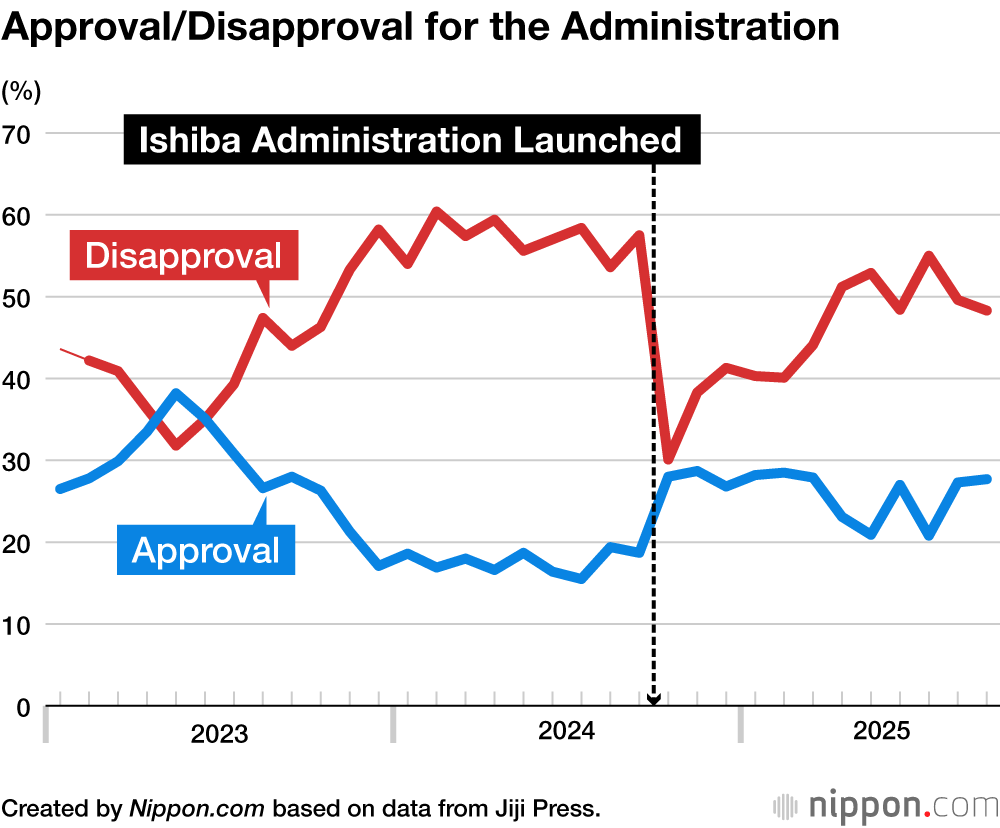
The approval ratings for Ishiba’s administration soon after it launched on October 1, 2024, were generally in the 40%–50% range. As noted by the Nikkei at that time, though, this was the lowest rating for a new administration since comparable statistics began being collected in 2002. The Asahi also wrote that it was the second-worst support rating for a new prime minister since 2001, behind only Ishiba’s predecessor, Kishida Fumio.
This was a dismal start for Ishiba, and his numbers failed to improve during his year in office. The House of Representatives election on October 27, 2024, saw the ruling coalition of the LDP and Kōmeitō lose their clear majority in the chamber. Now in charge of a minority government, Ishiba had to seek support from opposition forces to get his policies enacted. By the end of the year his approval ratings had fallen into the 30% range in a number of polls, and his approval numbers never cleared the disapproval percentages for the remainder of his administration.
In July this year the ruling coalition lost its majority in the House of Councillors after yet another election drubbing, and calls mounted within the LDP to remove Ishiba from office. Despite these mounting headwinds, opinion surveys carried out in August, just before he announced his resignation, found more respondents saying there was no need for him to step down than those thinking it was time for him to go. The slight bounce in his numbers at this time was not enough to pull him back from the brink, though.
Going Out on a Slightly Higher Note
The September 2025 poll by NHK found the highest support rating among all surveys, at 39.2%. In all, four polls gave him a closing grade above the 30% mark, including the Sankei poll’s 37.9% support. This performance may not be anything to be proud of, but it did at least place Ishiba above the final numbers for Prime Minister Kishida, whose support ratings were mainly in the 20% range—and in the teens in one survey—when he stepped down in October 2024.
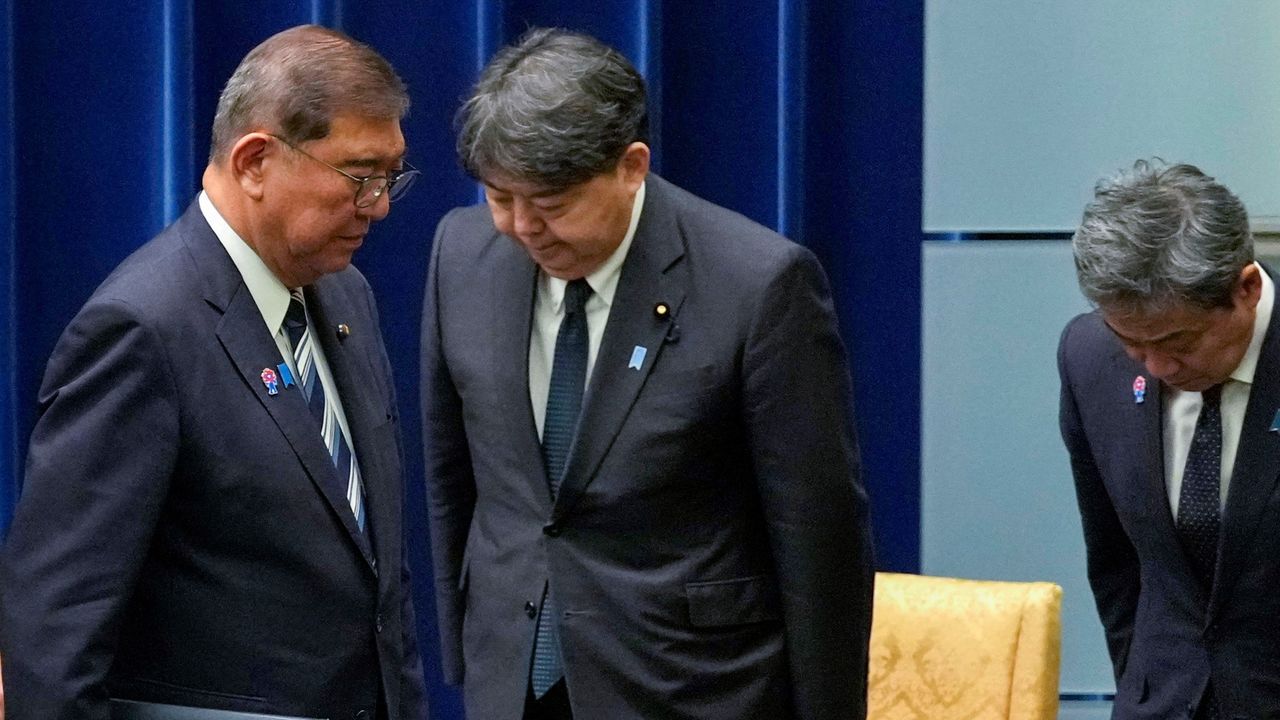
(Originally written in Japanese. Banner photo: Prime Minister Ishiba Shigeru, left, at the September 7, 2025, press conference at the Kantei in Tokyo to announce his resignation. © Reuters.)