Discovering “Nōgaku”: The Blossoming of Tradition
Nō Masks: The Subtle, Shifting Faces of Japan’s Centuries-Old Performing Art
Culture Art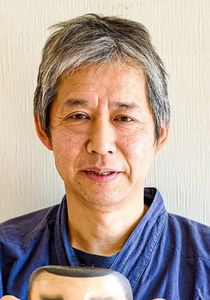
Kitazawa Hideta
Nō mask carver. Also produces and restores decorative carvings for temples and shrines. Born in Tokyo in 1968. Presents exhibitions, demonstrations, lectures, and research worldwide, including at Britain’s Pitt Rivers Museum and Victoria and Albert Museum and Australia’s Art Gallery of New South Wales. Author of Noh and Kyogen Masks.
- English
- 日本語
- 简体字
- 繁體字
- Français
- Español
- العربية
- Русский
The Faces of an Ancient Art
Born in the Muromachi period (1336–1573), nō is one of the world’s oldest extant theatrical arts. Kan’ami and his son Zeami drew on imported and native performing traditions to pioneer a refined theatrical genre integrating drama, music, and dance. Emphasizing restraint, elegance, and the aesthetic of yūgen—a subtle, profound beauty evoking a sense of unseen depth—the art form was embraced by both courtly and samurai elites. Masks are worn by principal actors (called shite), whose highly disciplined movements—as subtle as a slight tilt of the head or a shift in body angle—can convey deep emotion and animate the story.
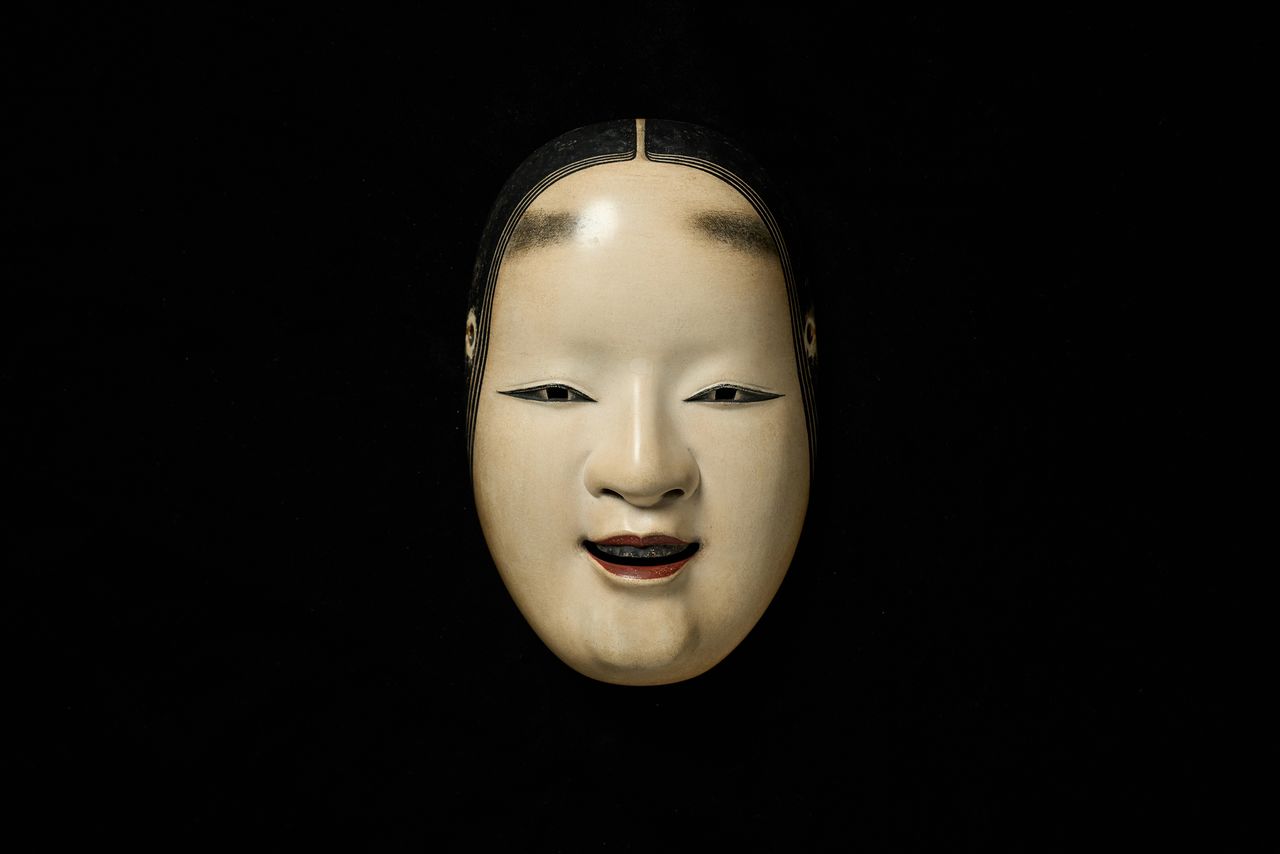
Ko-omote, a young woman’s mask. Kitazawa Hideta. (© Kuratani Kiyofumi)
Masks are used in many theatrical genres around the world, from ancient Greek tragedy to masked dramas across Asia. In many traditions, though, masks display specific emotions—like anger or joy—or the distinguishing personality of the character. Most nō masks, on the other hand, have “neutral” expressions that do not suggest any single emotion. This has given rise to the Japanese phrase “a face like a nō mask,” referring to people who rarely show their feelings.
But are nō masks truly expressionless? “It’s uncanny how the mask changes its appearance when worn by shite performers at the top of their art,” notes an actor specializing in waki (supporting) roles. “It can be so mesmerizing that I sometimes forget I’m on the same stage.” How can an inert object change its expression? Before delving into this question, let us take a step-by-step look at how nō masks are made.
Focused Attention to Detail
In his Tokyo workshop, mask carver Kitazawa Hideta keeps a large stock of Kiso cypress, the wood traditionally used for nō masks as well as for temple buildings and Buddhist sculpture. He selects blocks cut from 200–300‑year‑old trees, choosing pieces with fine, even growth rings.
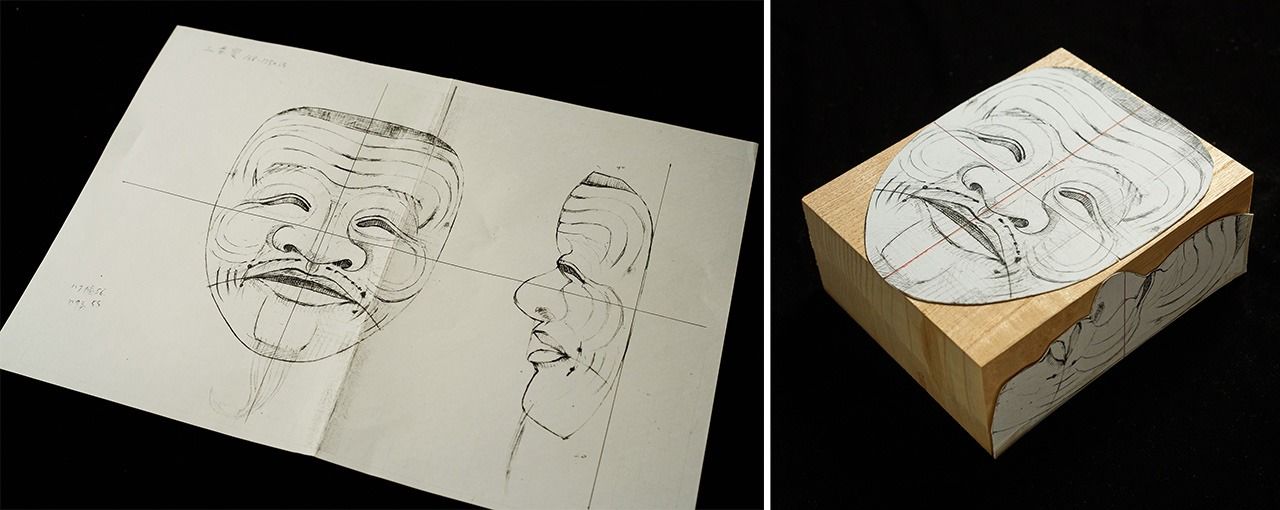
Transferring the pattern for an okina mask onto a block of cypress. (© Kuratani Kiyofumi)
The process begins with drawing patterns for the front and side, which are pasted onto a block roughly the size of the finished mask. Kitazawa says he cannot begin carving until he can clearly visualize the completed mask in three dimensions. Only when the image becomes vivid does he pick up his tools.
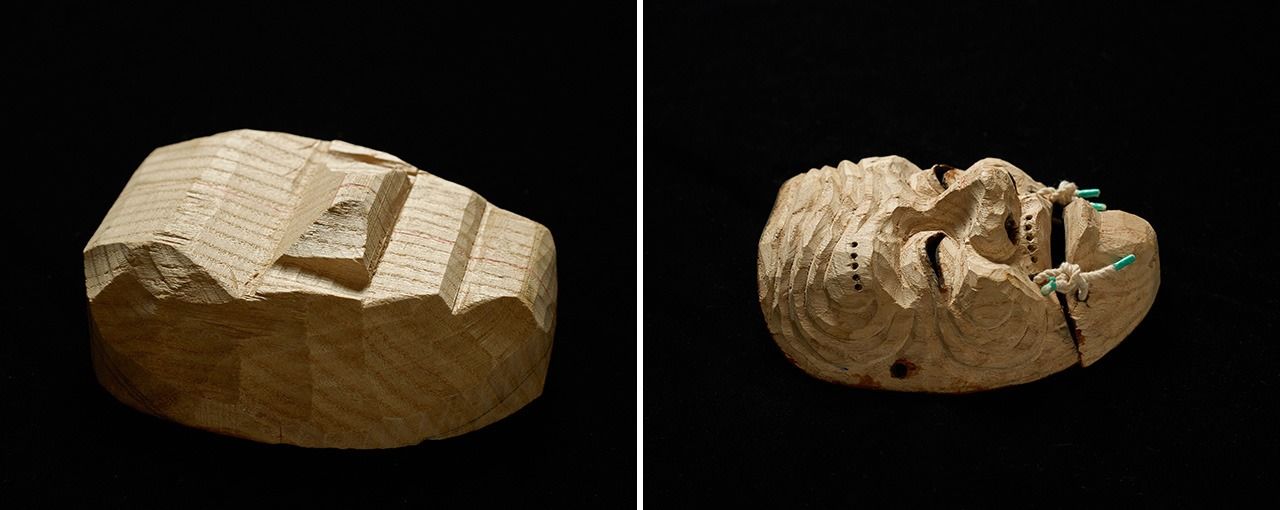
The various stages of carving an okina mask. (© Kuratani Kiyofumi)
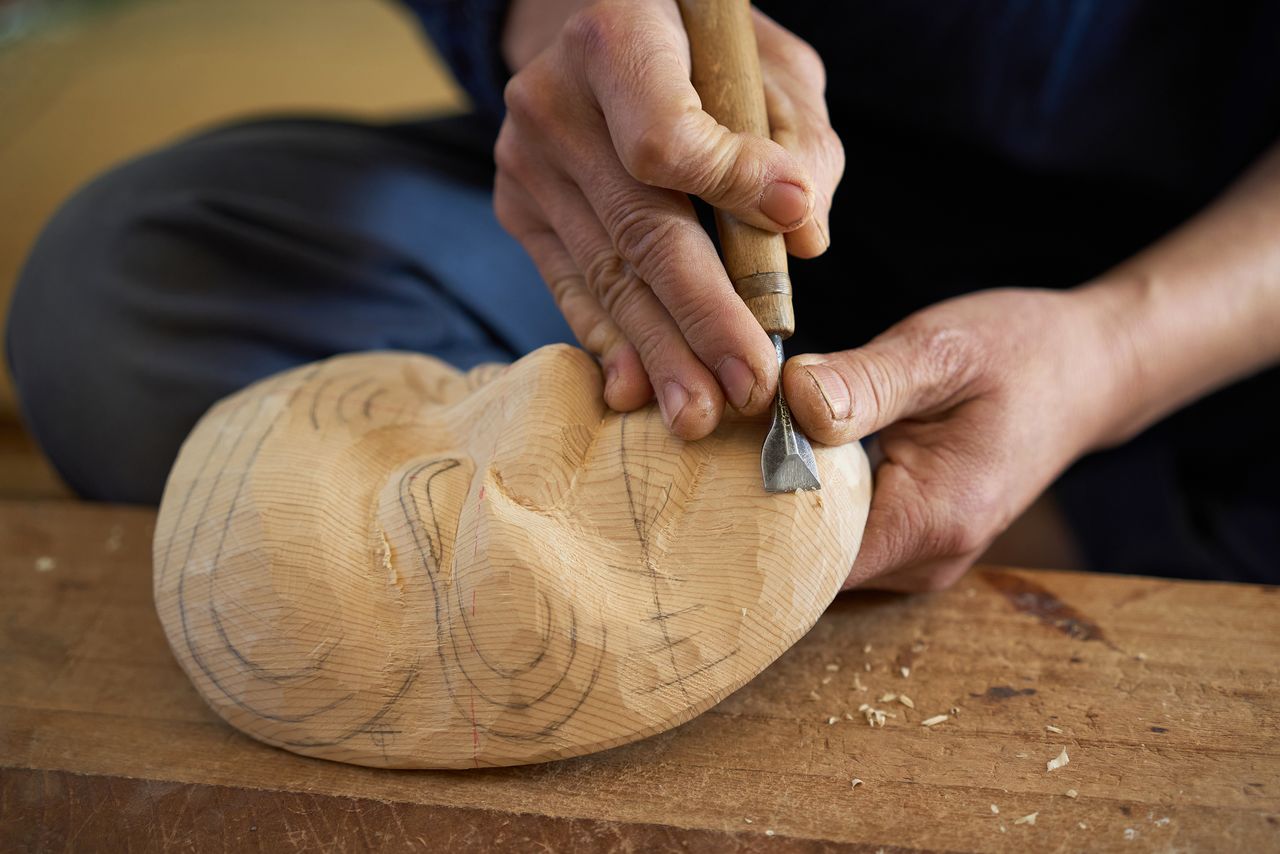
Adding detail with a chisel. (© Kuratani Kiyofumi)
Completing one mask takes about three weeks. On some days, he works for six hours or more without a break. After the rough form is shaped, he focuses on the eyes, nose, and mouth—details that determine the mask’s overall impression. Every movement of the chisel requires intense concentration.
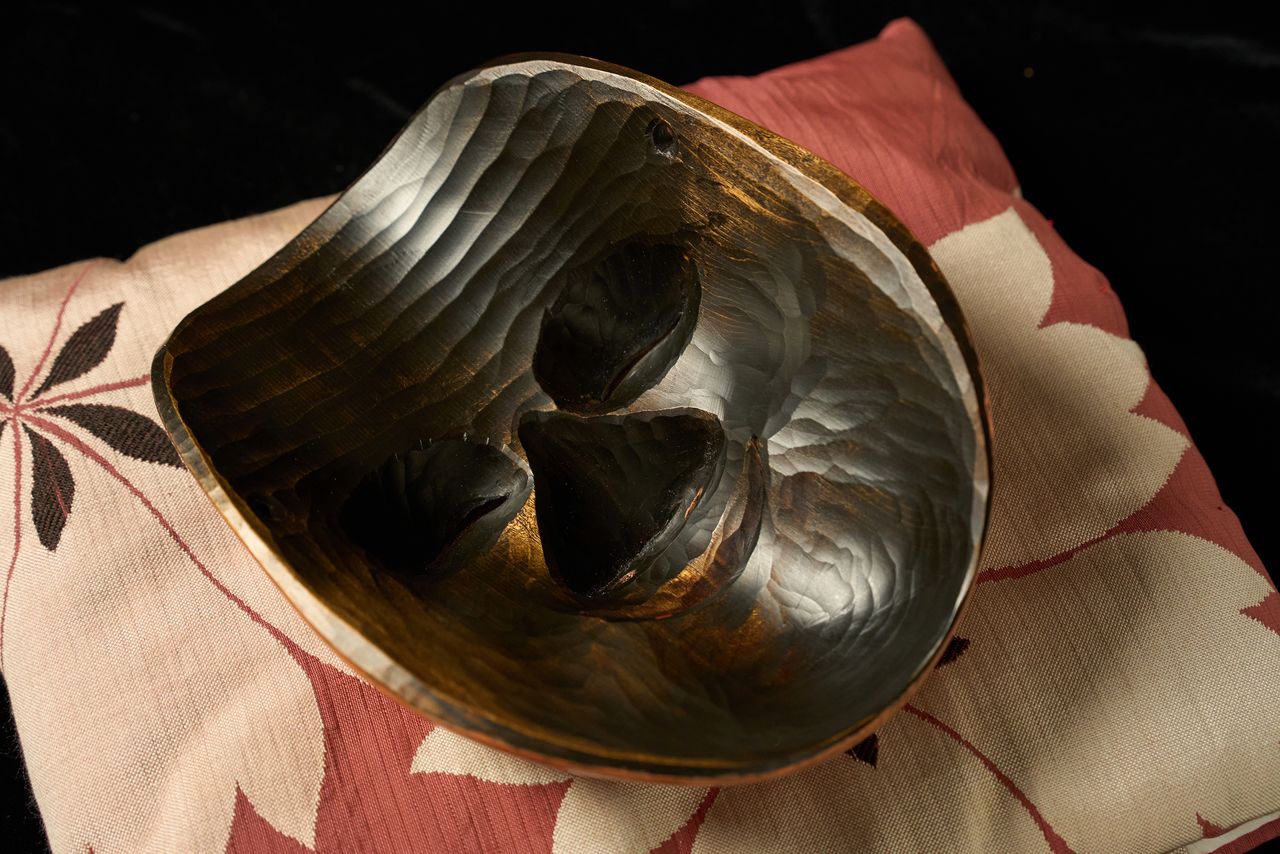
The lacquered interior of a nō mask. (© Kuratani Kiyofumi)
The inside of the mask is coated with layers of lacquer. This protects the wood from moisture, such as the actor’s breath and sweat, so the cord tying the mask to the head can be tightened without the mask cracking.
Bringing Out Light and Shadow
Once carving is complete, the surface is coated with gofun, a white pigment made from powdered seashells, and smoothed. Kitazawa then paints the hairline, lips, and other features. The most delicate work is the eyes and mouth. He applies black ink to the eyes, hangs the mask on the wall, and studies its expression from a distance.
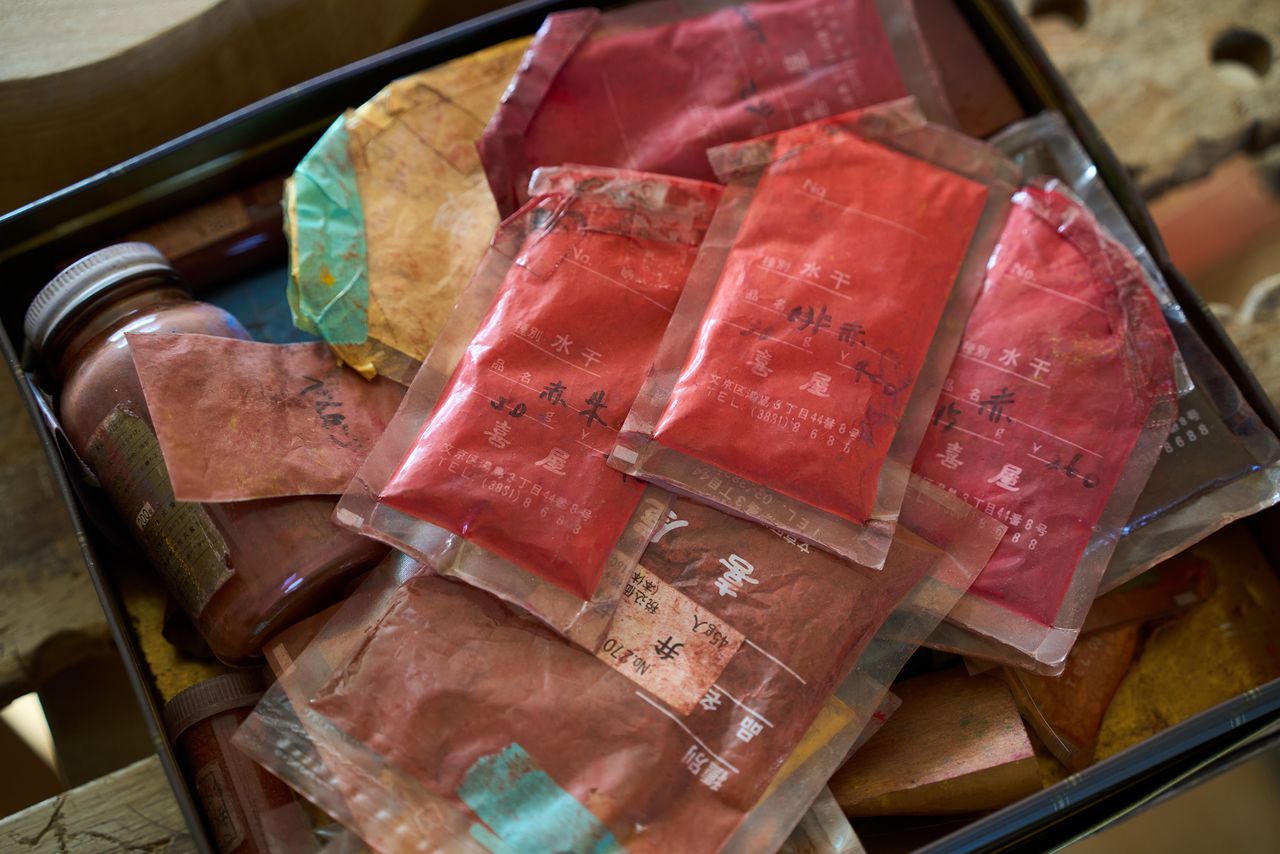
Water-based pigments used by Kitazawa, mixed with gofun for the final touches. (© Kuratani Kiyofumi)
The back side of the mask matters as much as the front. Because a nō mask drastically narrows the actor’s field of vision, Kitazawa pays great attention to the angle and depth of the eye openings. If he feels the opening is inadequate, he will rework the eye area with additional carving.
For the lips, he layers several shades of red and ocher to create depth. Finally, he applies a patina to evoke the soft glow of age, allowing light to diffuse gently across the facial features and enhancing the interplay of highlight and shadow.
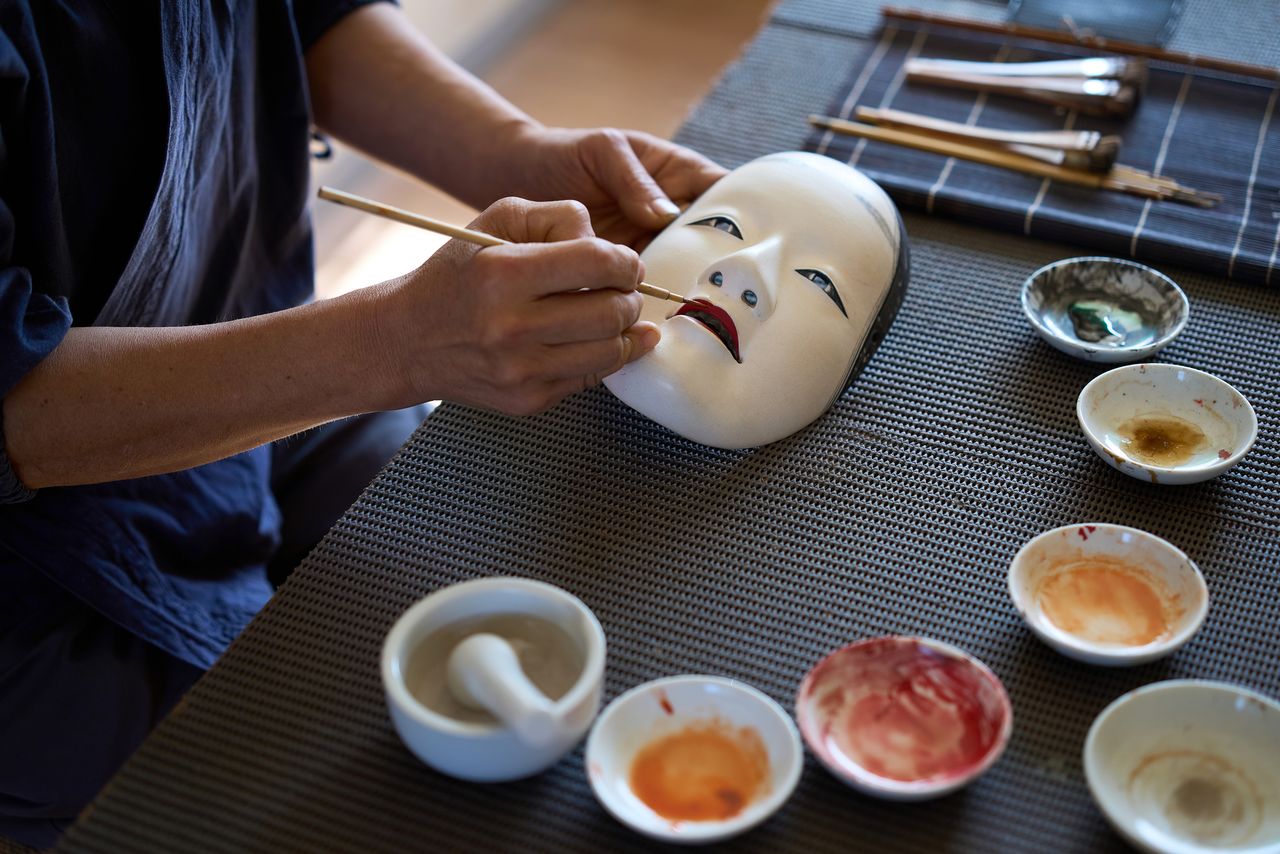
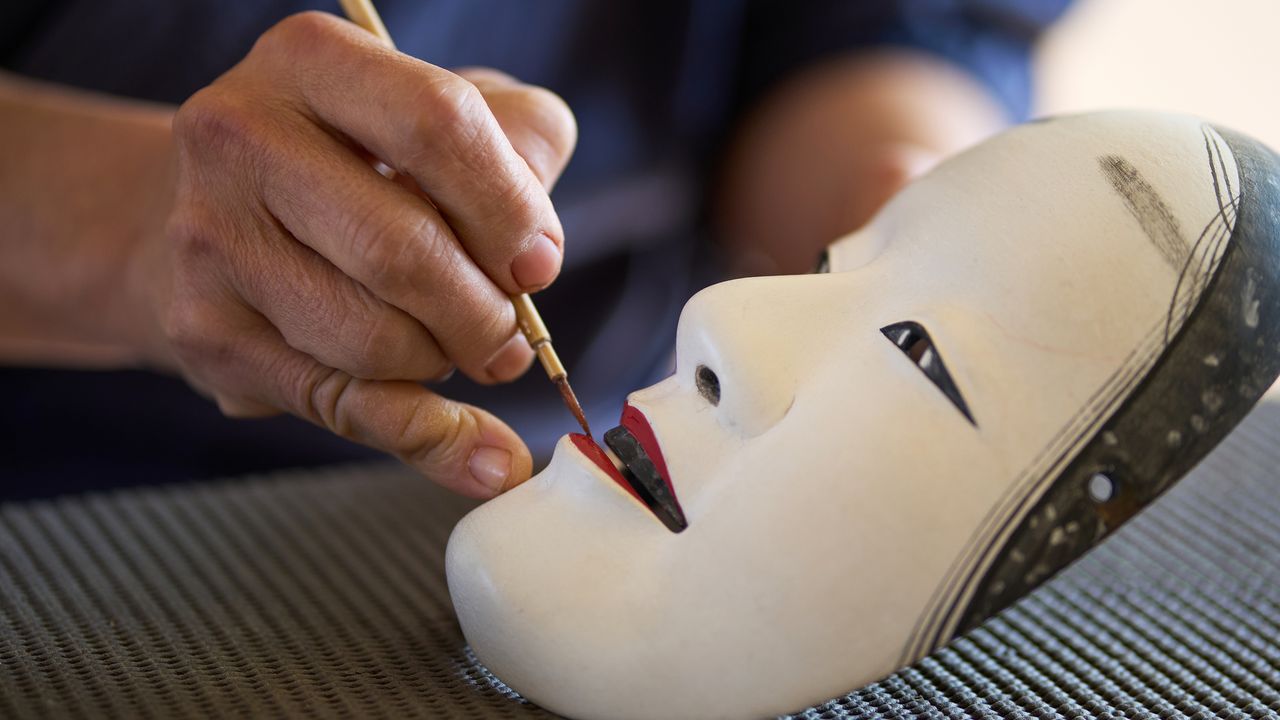
Painting the mouth of a waka-onna (young woman) mask—an especially delicate task. (© Kuratani Kiyofumi)
Knowing when to stop may be the hardest part of painting a mask. One more brushstroke might enrich the expression—or ruin it.
Seen Up Close—and from Afar
Viewed up close, a nō mask reveals exquisite detail, such as the fine gradations of color and the subtle surface texture. But in a nō theater, audiences sit many meters from the stage. At that distance, it is the contours of the carved surface that make the strongest impression.
For Buddhist or other religious statues, and even in other mask-making traditions, carving and painting are done by different specialists. And in the production of sculpture, painting, and reliefs, one task typically takes precedence over the other. Nō masks are unusual in that carving and painting are equally important and that both are done by a single artist.
The carving must appeal to the gaze of distant spectators, while the painting must hold the attention of fellow performers at close range. Meeting these dual requirements may be regarded as a defining feature of the nō mask.
A Neutral Face with Countless Expressions
So how does a mask “change expression,” as posited earlier? There are many different types of nō masks. Some are highly emotional, such as hannya, which represents a woman transformed by jealousy and rage. Others, like ko-omote, embody the innocent beauty of a young woman. The okina mask highlights sacred qualities in the figure of a venerable old man.
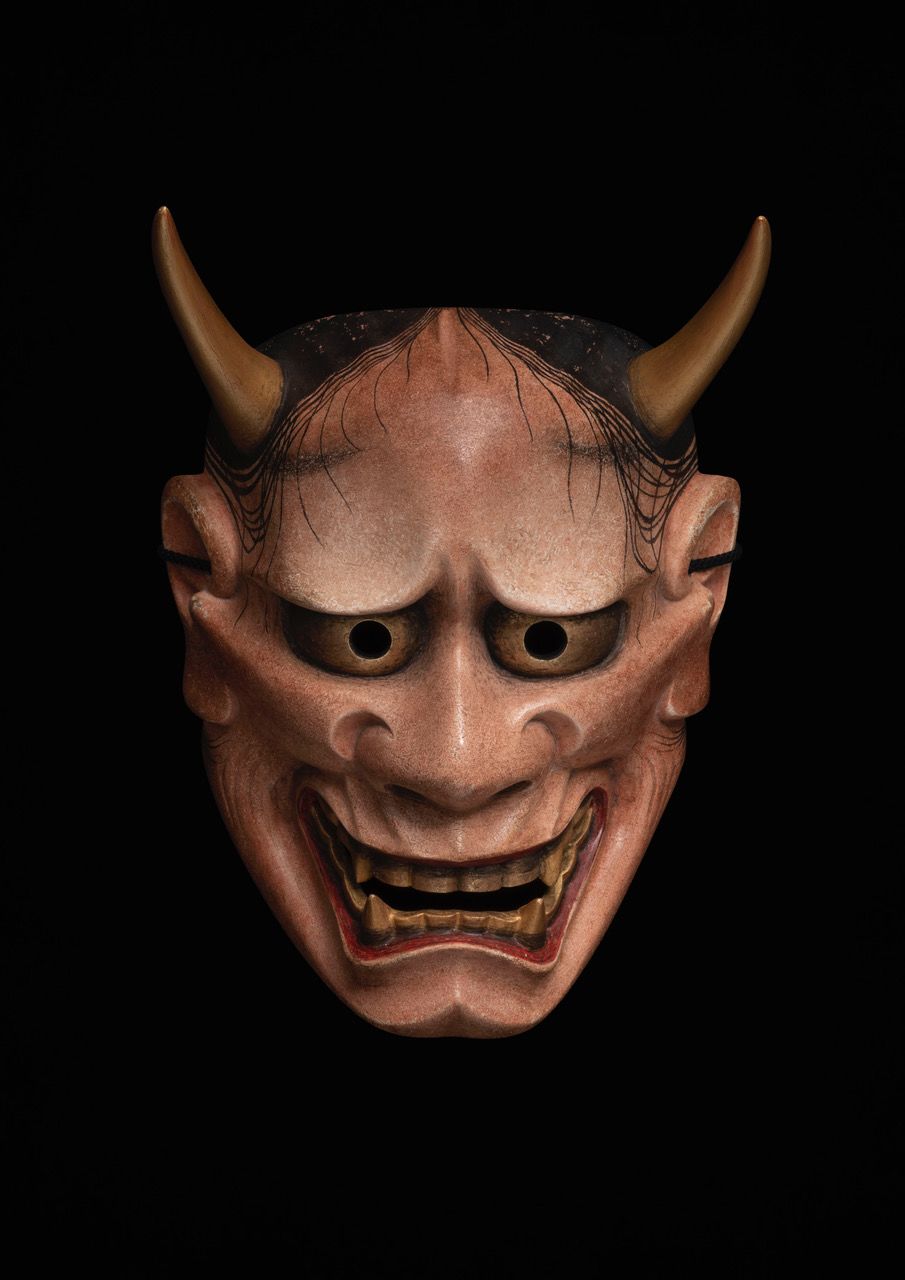
Hannya, an expression of a woman’s jealousy and rage. Kitazawa Hideta. (© Kitazawa Sōta)
Masks like hannya or those depicting demons are used to capture a moment of intense emotion in scenes that generally last only 10 to 15 minutes. By contrast, neutral masks such as ko-omote—with no fixed emotion—may be worn by the protagonist for an hour or more.
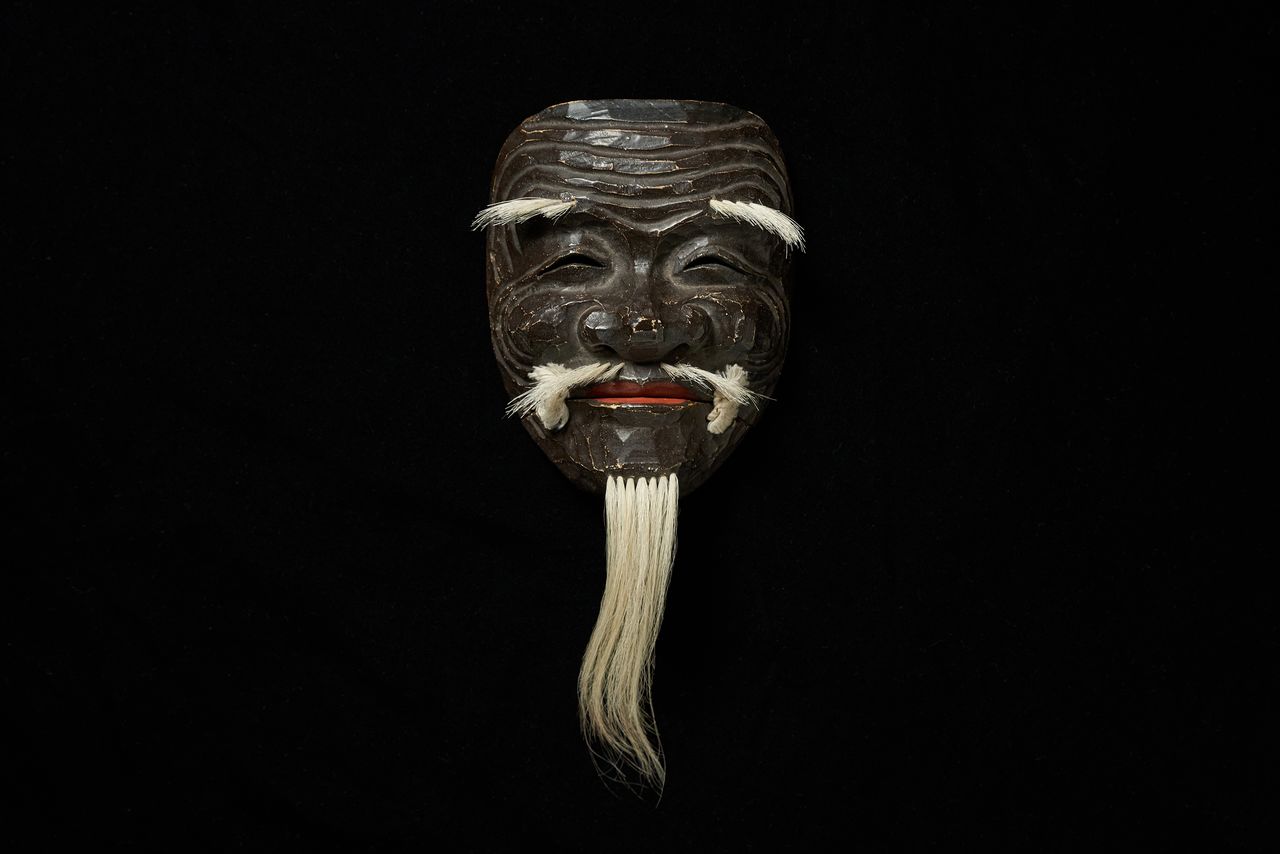
A mask of a sacred old man used during the latter half of the play Okina. Kitazawa Hideta. (© Kuratani Kiyofumi)
Two terms to describe the angle of a mask are kumoru (cloud) and teru (shine). When a mask tilts downward, shadows gather like clouds around the eyes and brow, creating a sorrowful expression. Conversely, when the actor tilts the face upward, the features brighten. These subtle shifts in light and shade create a spectrum of expressions, keeping audiences engaged.
One leading nō actor once told Kitazawa: “A mask that is a true masterpiece is one that allows the performer to convey hundreds of expressions.”
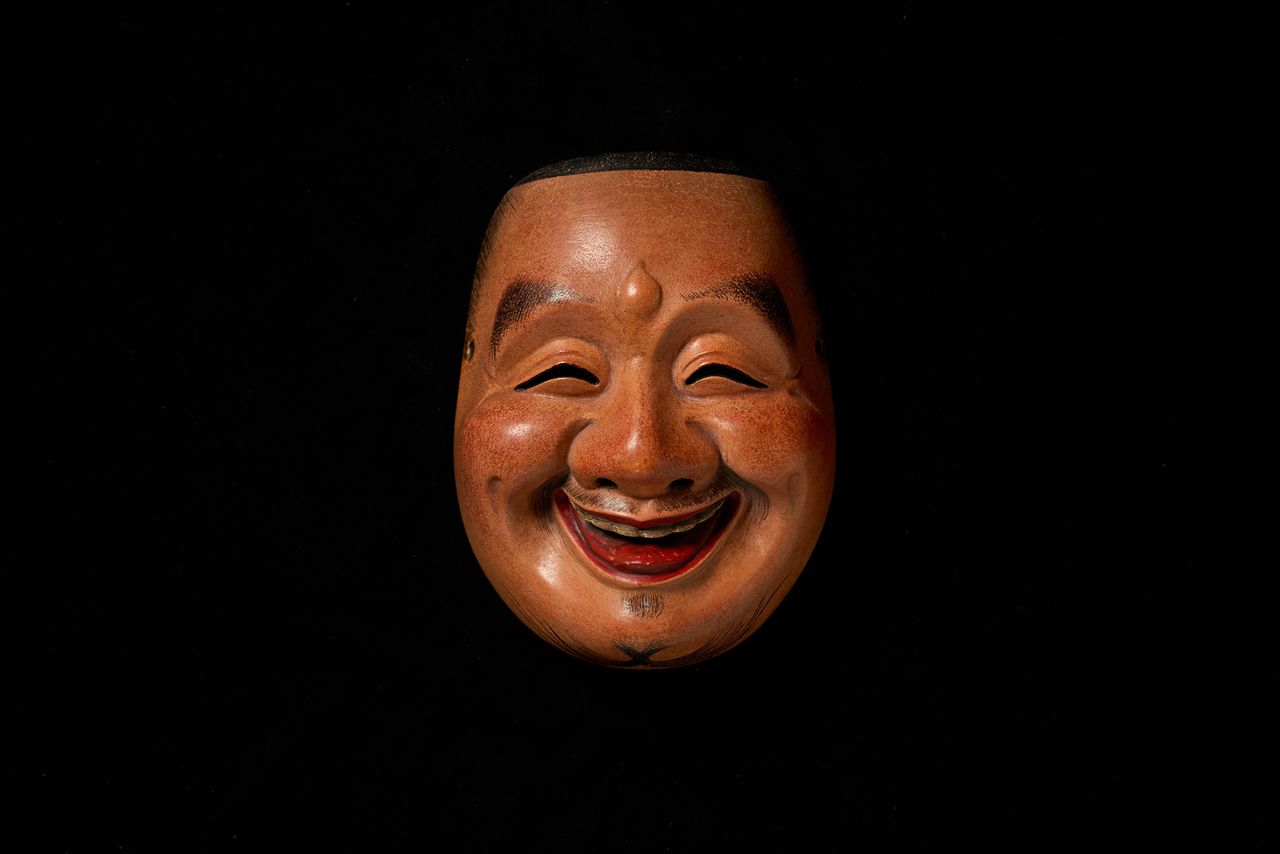
A mask used in the kyōgen play Fuku no kami (The God of Fortune). Kitazawa Hideta. (© Kuratani Kiyofumi)
Tools That Have Shared the Journey
Kitazawa owns about 300 chisels, including many inherited from his father, a woodcarver. Each stage of carving requires a different tool. Larger chisels are struck with a mallet for rough shaping, while smaller ones refine the details.
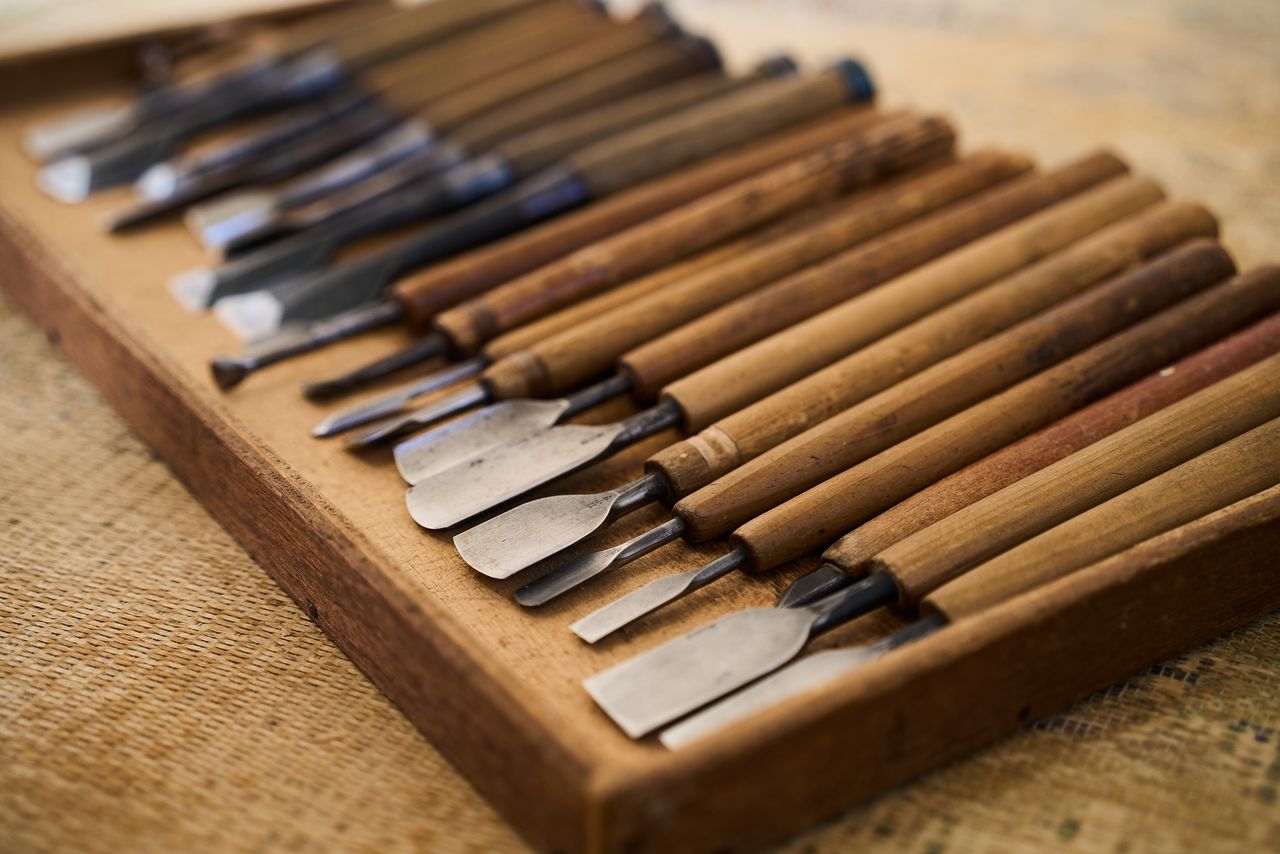
Chisels used in mask carving, selected according to the stage of work. (© Kuratani Kiyofumi)
Over many decades, these tools have become extensions of his hands. When absorbed in carving, his hand reaches naturally for the next chisel without the need to look.
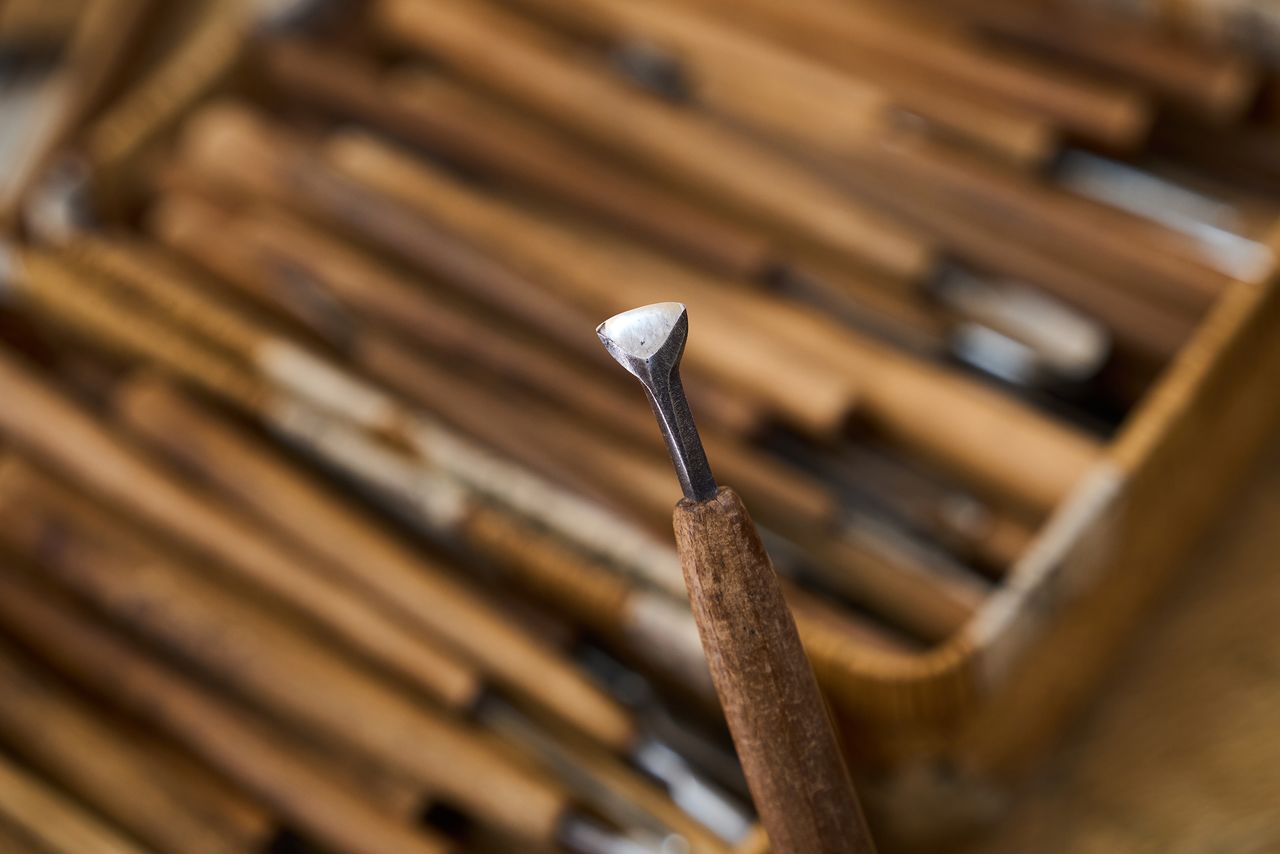
A chisel worn down after many years of use. (© Kuratani Kiyofumi)
Some of Kitazawa’s chisels date back to before World War II, their blades gradually shortened from years of sharpening. When a blade wears down near the shaft, Kitazawa bends the tip and repurposes it for fine scooping work.
Integrity as an Artisan
The creation of a nō mask is solitary, demanding, and intense. It involves a dialogue with the wood—a struggle to bring out its best. Kitazawa often wonders whether the finished mask will meet the performer’s expectations or wind up being rejected. He says he has never been fully satisfied with his work. Each time, he feels he can do better, and each new mask becomes a challenge to surpass the last.
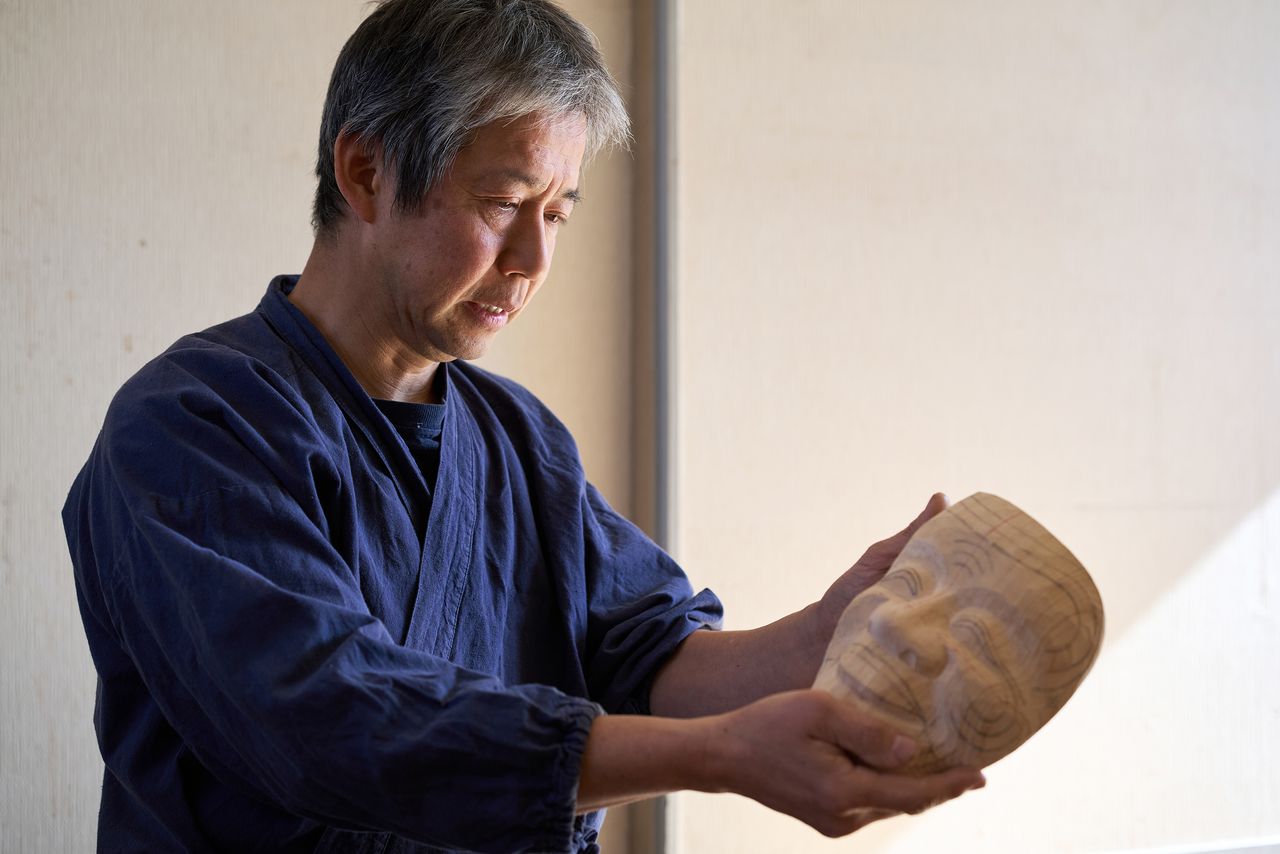
Kitazawa examining an okina mask in progress from different angles. (© Kuratani Kiyofumi)
The late Maya Angelou, the American writer and civil rights activist, once saw his masks and told him that his work reflected the person he is. To continue producing quality masks, he realized, he needed to uphold and deepen his personal integrity.
For Kitazawa, this requires being brutally honest about his art. “My ko-omote could never compare to the famed Yuki no Ko-omote once treasured by the medieval warlord Toyotomi Hideyoshi [and now held by the Kongō school],” he says. He also recalls being startled by the extraordinary onstage presence of a waka-otoko (young male) mask dating from the Edo period (1603–1868), even though it appeared unremarkable when held in his hands.
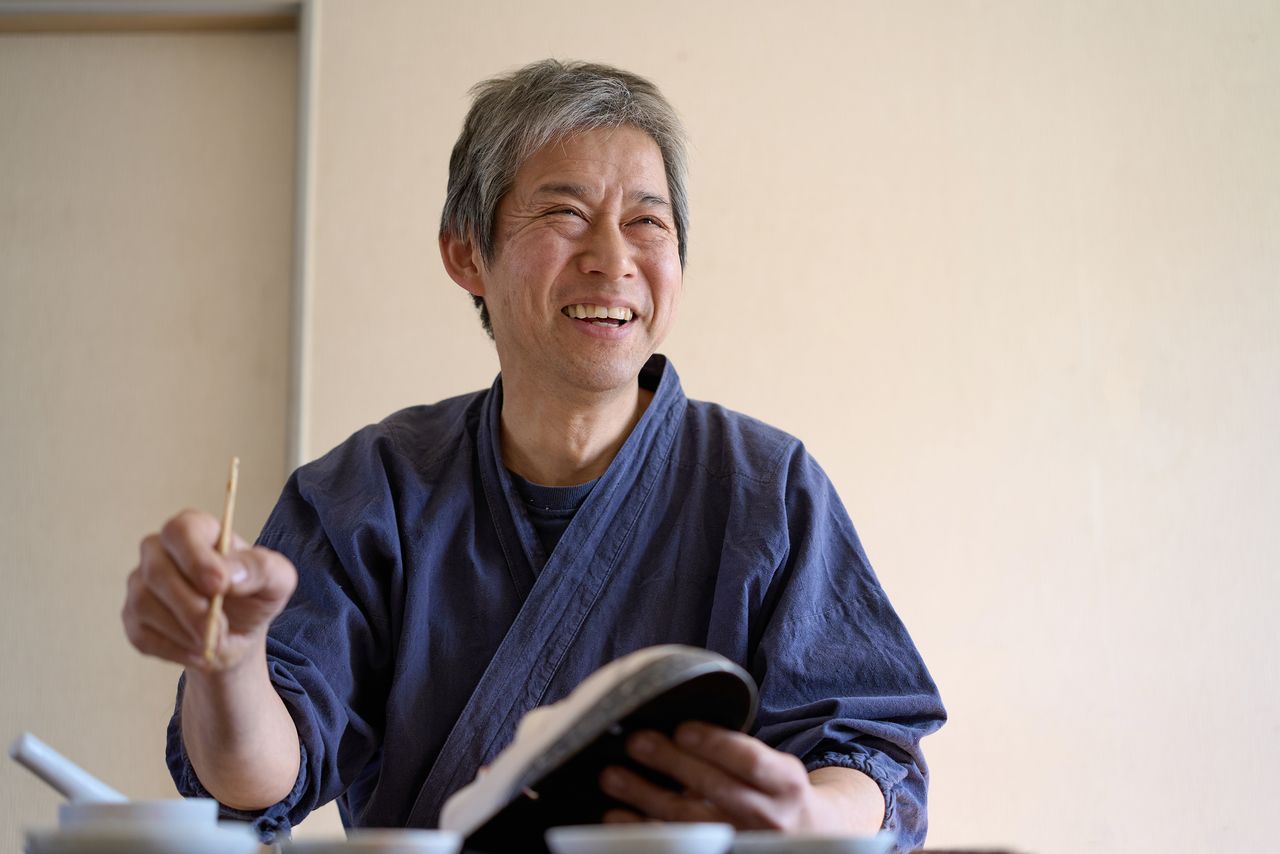
Kitazawa smiles while working on a waka-onna (young-woman) mask, vowing to continue honing his craft. (© Kuratani Kiyofumi)
“This is an art form that’s hundreds of years old, and I have to compete with masters who lived centuries ago,” he says, determined to keep refining his craft in pursuit of ever greater heights.
(Originally published in Japanese. Banner photo: A waka-onna [young woman] mask receives delicate paint work from mask carver Kitazawa Hideta. © Kuratani Kiyofumi.)