A Walk Around the Yamanote Line
From Tamachi to Shinbashi: Temples, Parks, and Oddly European Artifice
Travel- English
- 日本語
- 简体字
- 繁體字
- Français
- Español
- العربية
- Русский
Traces of Faith and History in the Southeast Yamanote Loop
Ryōzenji, Enjuji, Shōdenji, Kanshōji, Hōenji. Walking from Tamachi to Hamamatsuchō, on the southeast stretch of Tokyo’s Yamanote Line, I discover a hidden cluster of temples tucked into the west side of the tracks. There’s also a lone Shintō Inari shrine pressed up against a concrete wall: a slim red torii and two stone foxes guarding a tiny, doll’s-house-like wooden structure. I had first noticed them from the train. The elevated tracks offer the best vantage point for glimpsing this slightly surreal scene.
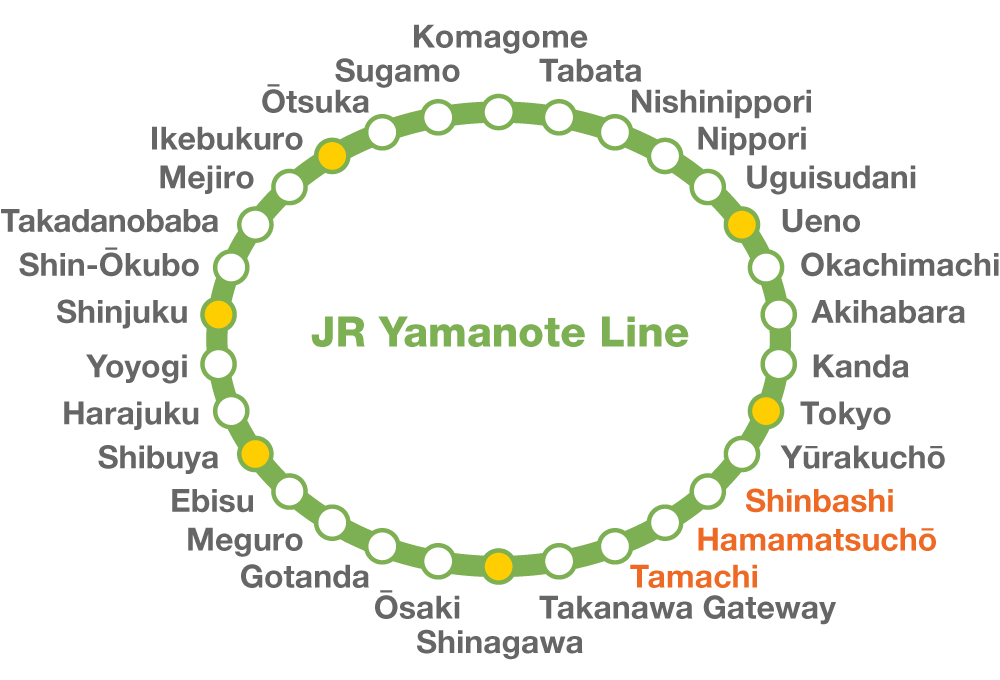
The stations on the Yamanote line stations loop. (© Pixta)
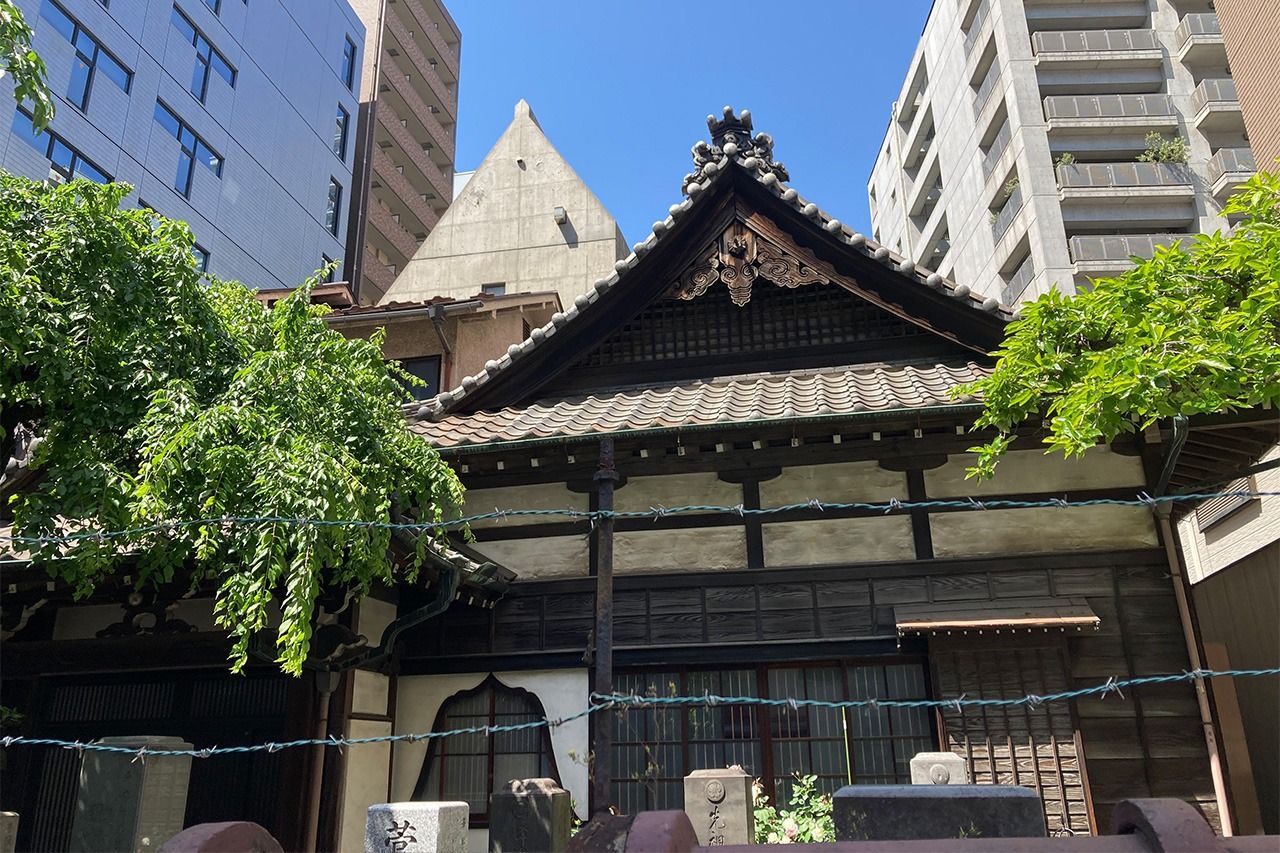
Hōenji is one of several temples wedged amid modern constructions between Tamachi and Hamamatsuchō stations. (© Gianni Simone)
During the early Edo period, Tokugawa Ieyasu’s shogunate reorganized the layout of the city. Many religious institutions were moved out of the castle’s immediate vicinity and resettled in designated zones, especially south and west of the center. These zones became some of the densest temple districts in the city, each religious site affiliated with a particular daimyō (feudal lord).
After multiple waves of destruction—fires, earthquakes, war—only the most adaptable or financially supported temples survived. Many were rebuilt in scaled-down form, squeezed into alleyways or tucked behind modern apartment buildings. What you see today are the remnants: reduced in scale, often surrounded on all sides, but still spiritually active. They persist as faint but resilient imprints of the city’s older religious topography.
Temples here were not just places of worship. They often managed cemeteries and were crucial for family funerals and memorial services. Even as neighborhood populations declined or gentrified, their services remained necessary. Some temples continue to survive on burial plot management and offer rental “eternal resting spots” for Tokyoites who no longer have family graves elsewhere.
The result is a strangely touching kind of presence: tiny, weathered, hidden temples with mossy stone lanterns, wedged between modern constructions. They seem out of place, and yet are more rooted than anything around them.
There are different ways to follow the Yamanote Line on foot. The easiest one is to walk along National Route 15 – the modern incarnation of the old Tōkaidō – but it’s also the least interesting and definitely the noisiest. As Charles Landry says in The Art of City-Making, “when a city is built with the car rather than the pedestrian—the person—in mind, the car underpins the sensory experience of that city.” The city’s soundtrack is too often scored by traffic. A constant wash of engine noise, interrupted by the occasional honk or electronic chime, fills the air. The smell of exhaust hangs low, mingling with the heat that radiates from sun-soaked asphalt.
Gardens and Greenery Amid the Concrete
Luckily, in Tokyo you can often avoid this torture by sidestepping car traffic and wandering into pockets of calm. Near Hamamatsuchō Station, I can visit Zōjōji, one of Tokyo’s main Buddhist temples. However, it’s always full of tourists. So I opt for the outer side of the Yamanote Line where, discreetly tucked next to the elevated rail tracks, is Kyū-Shiba-Rikyū, one of Tokyo’s most historically significant and yet overlooked gardens.
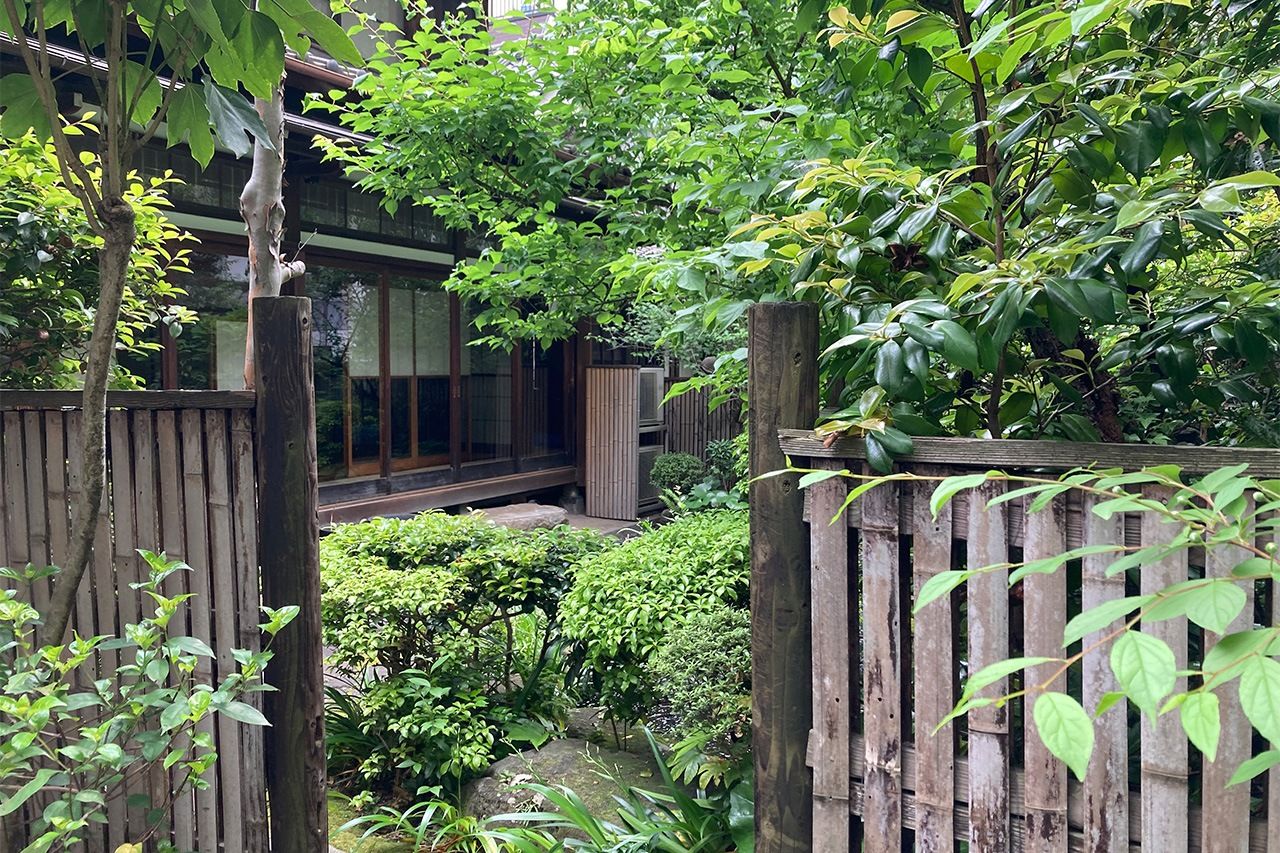
When visiting Zōjoji, don’t forget to explore the beautiful small temples surrounding the famous tourist spot. (© Gianni Simone)
Originally a feudal lord’s private playground, it later became a detached palace of the imperial household. It is regularly outshone by its bigger neighbor, Hamarikyū, just a few minutes up the street, but I prefer this one, probably because it’s more compact, inward-focused, and intimate in scale. Both are classic examples of kaiyū-shiki teien (strolling gardens with ponds), but Kyū-Shiba-Rikyū, being ten times smaller, features dense planting and stone arrangements that emphasize detail over breadth.
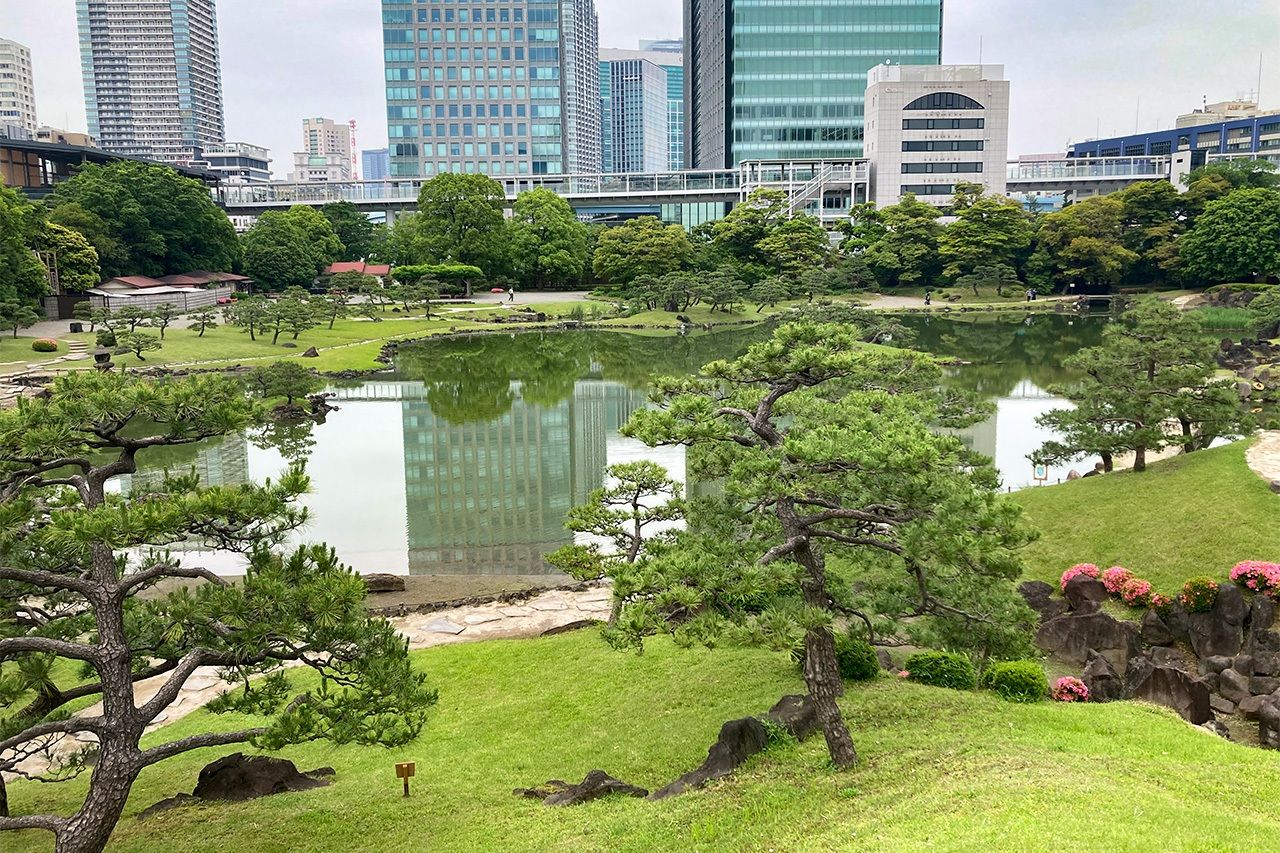
The delighful Kyū-Shiba-Rikyū stands as a defiant pocket against the spread of the city. (© Gianni Simone)
Here’s a chance to see what makes Japanese gardens so special. The Western-style garden, with its starkly straight paths and sparse design, seems to carry the austere desolation that often clings to rigid geometry. It’s a place where retirees might stroll their dogs under winter trees, wrapped in muted stillness. The Japanese garden, by contrast, speaks in hushed tones—a subtle, low resonance that’s easy to miss if one isn’t truly listening. Its voice is always there, but to hear it requires a gentler, more attentive ear. When we fail to catch its murmur, the silence says more about us—and our modern, noise-choked lifestyle—than the garden.
Kyū-Shiba-Rikyū is ideal for quiet walking and close observation of design details. Entering the garden feels like stepping into a painted scroll: dense, manicured, and full of visual texture including many rock garden arrangements, stone lanterns, and miniature hills. There used to be a tidal pond among its distinctive elements. However, the tidal inflow function was lost along with the distant view of the sea as development of the surrounding area, including land reclamation, progressed. Only a steel sluice gate remains as the lone trace of the ocean inlet.
Towering buildings now stand where empty, wind-blown beaches once stretched, and the distant hum of traffic has taken the place of the gulls’ solitary cries. Yet the garden still holds out—a small, defiant pocket against the spread of the city.
An Oddly Italian Enclave
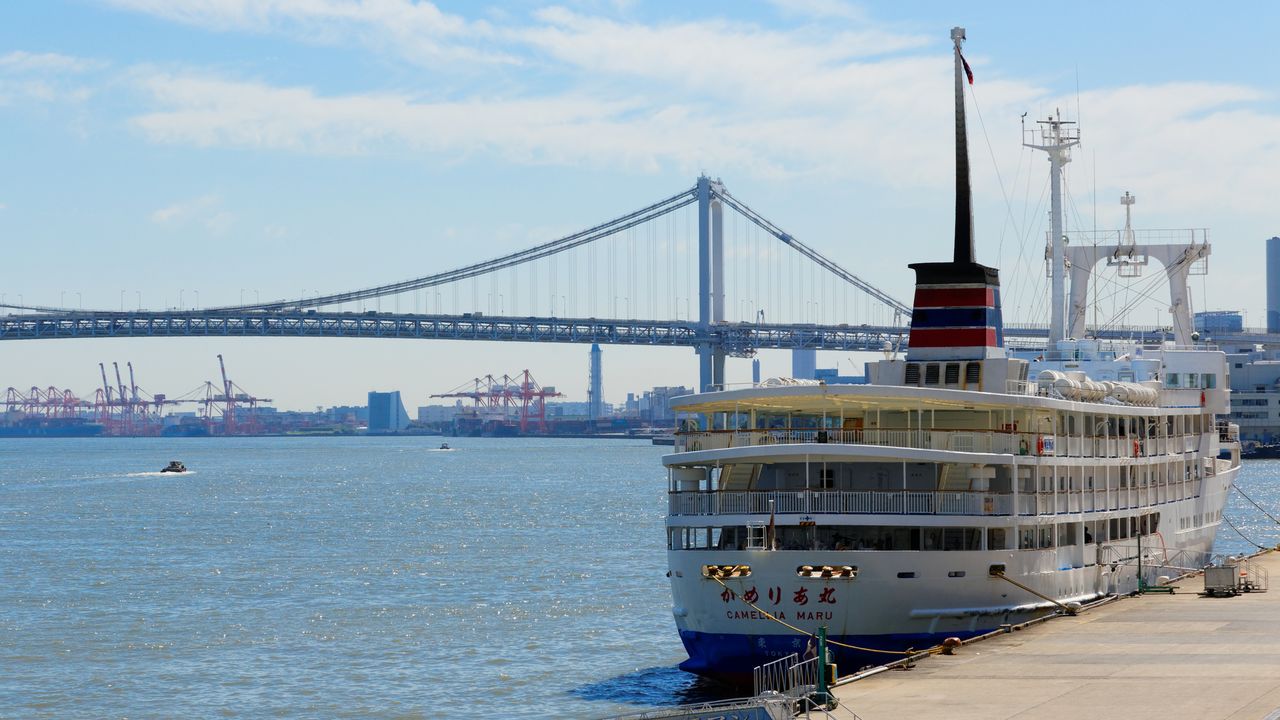
The ocean is not far away. In less than ten minutes I reach Takeshiba Pier, from where you can cruise around the bay or board a ferry to the Izu islands or even all the way to tropical Ogasawara, the outer reach of the Tokyo Metropolis—actually part of Tokyo more in name than in reality.
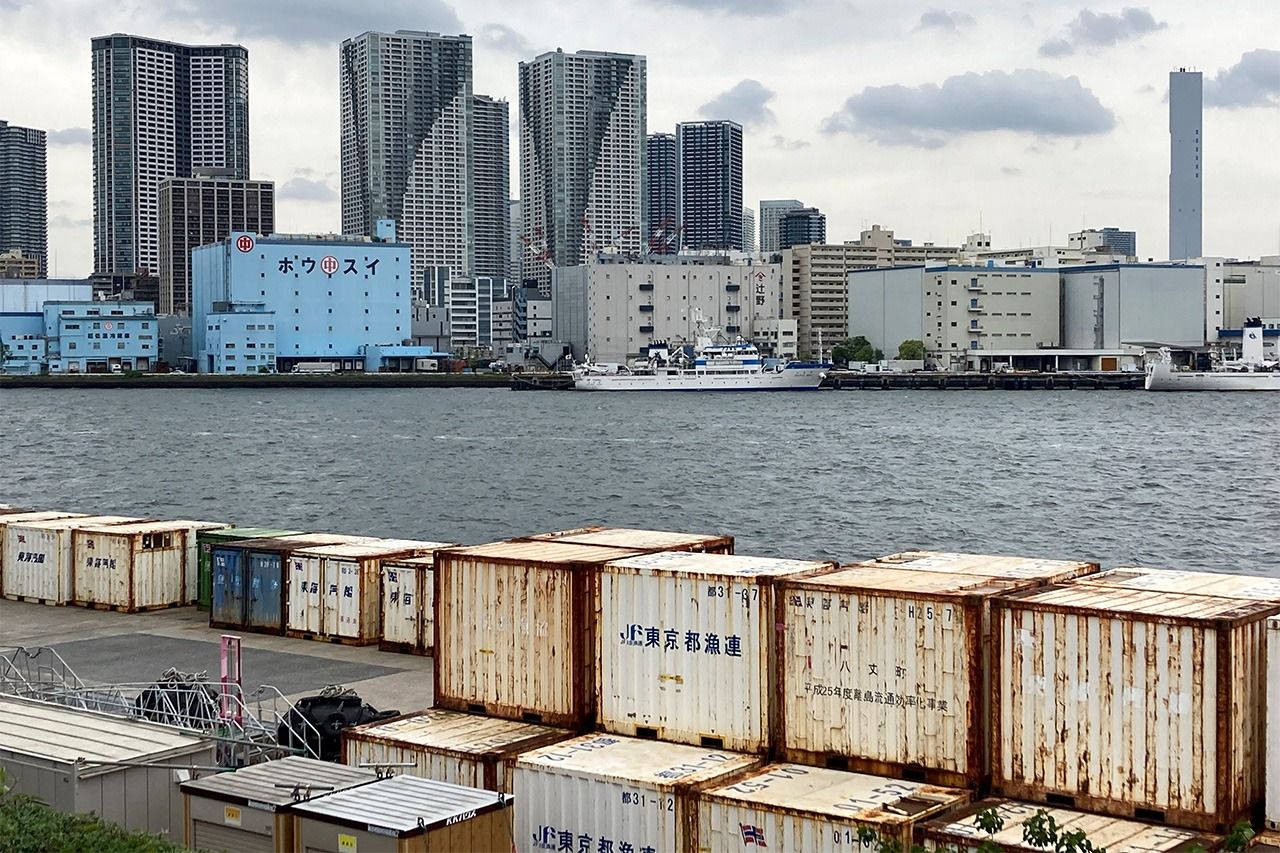
From Takeshiba Pier one can see the artificial islands slowly filling up Tokyo Bay. (© Gianni Simone)
The place is almost empty when I arrive. Only the agile forklifts dart about like ants. In the distance, I can see part of a new archipelago: the artificial islands that have slowly emerged from dredged silt and steel ambition, each one a blank slate that through the years has been filled up with condos, warehouses and malls. Their chiseled shapes speak of a city forever expanding, even into the sea.
As I never tire of saying, Tokyo’s best feature is that you never know what’s hiding around any corner. This neighborhood is so bland and anonymous that it doesn’t bode well for today’s walk. But then I find a dark, squat railway tunnel, cross to the outer side of the tracks and, as though I have passed through the mirror in Alice in Wonderland, I find myself in . . . Italy? Or an Italian surrogate, anyway.
Italia Park (“inspired by the Tuscan Renaissance style”), with its marble benches and clipped hedges, is one of Tokyo’s more whimsical urban quirks—a slice of vaguely Mediterranean landscaping squeezed between the Yurikamome driverless train line and the much bigger and more beautiful Hama-Rikyū.
Designed in collaboration with the Italian government and opened in 2003, the park was intended as a gesture of friendship. Hence the stone balustrades, geometric fountains, and imported sculptures, including copies of famous works like the Venus de Milo.
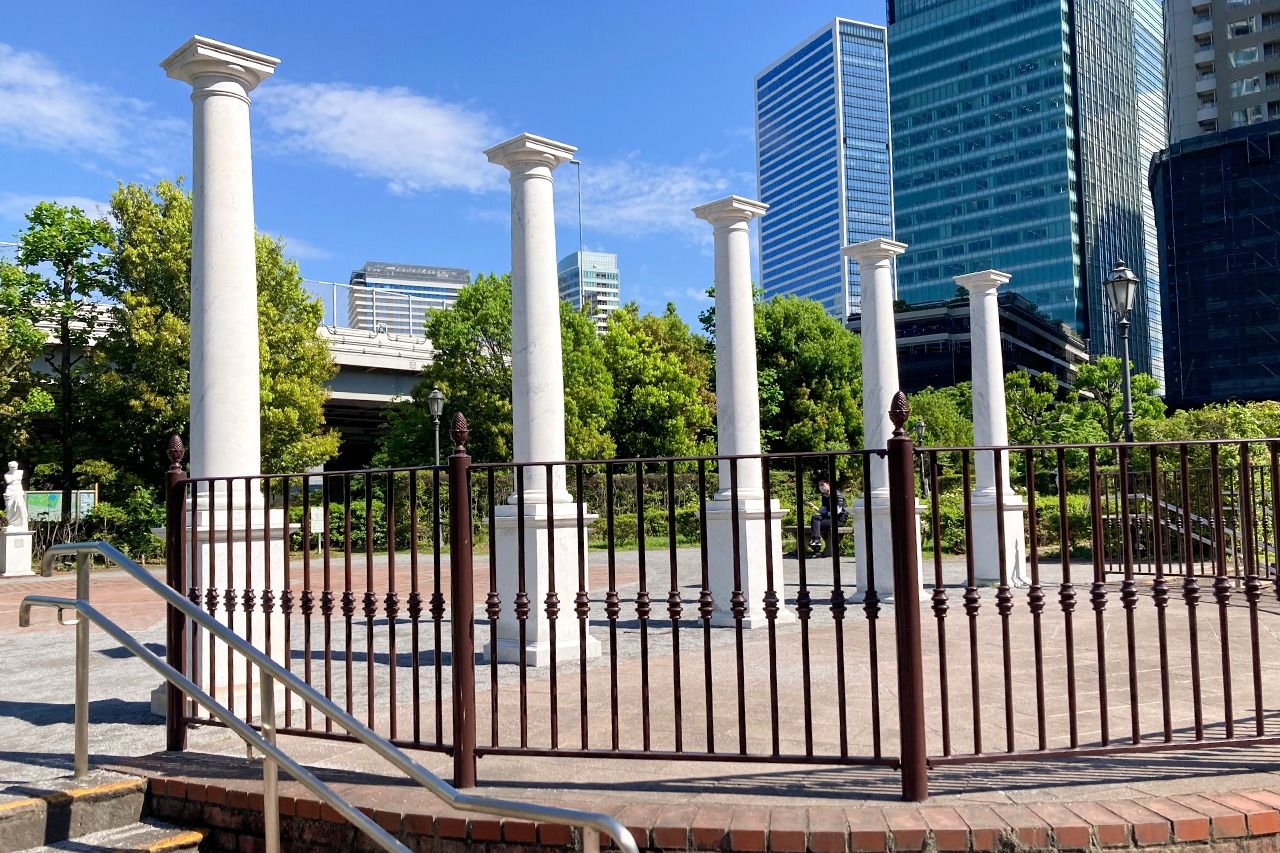
Italia Park is one of Tokyo’s more whimsical urban quirks. (© Gianni Simone)
Surrounded by office towers and bisected by pedestrian flyovers, the park feels oddly theatrical, like a stage set that forgot its actors. On a sunny afternoon, salarymen eat their bentō on marble benches beneath pine trees trimmed into polite obedience. Pigeons strut across the tiled fountain plaza as if they, too, are part of the design. Train otaku with sophisticated European tastes can sit on one of the stone benches and see the Shinkansen glide by.
There’s a sense of pleasant dislocation here—Italy by way of Minato. It’s clean, calm, and a little too symmetrical to feel entirely lived in, but perhaps that’s the point. I guess Italia Park should be seen as a decorative pause in the city’s flow. A momentary shift in register. A mirage, or better yet, a portent of more Mediterranean things to come.
Back on the inner side of the Yamanote Line through a different tunnel, I feel like a character in one of those stories where the protagonists think they’ve finally escaped into the reassuring safety of ordinary life, only to realize with horror that they’re still trapped in the same dream. Likewise, just out of the tunnel, I come face-to-face with an admittedly bad re-creation of an Italian building: pale stucco walls, faux-arched windows, and half-hearted terracotta roofing—an awkward pastiche of South European styling that seems lifted from a theme park concept sketch, like a replica built by someone who had only seen postcards. The proportions are off, the materials too clean, too synthetic. It’s not ruinous or crumbling, but somehow still feels abandoned by authenticity.
More fake Italian traces follow. Why, the whole neighborhood has been turned into a European neighborhood! Welcome to Italian Town, a pocket of vaguely Mediterranean façades and cobbled lanes tucked beneath office towers. It’s a remarkable experiment in urban cloning, until one starts noticing the small telling details. Something is clearly off, like the absence of the age-old grit that centuries-old buildings are meant to have. The pizza restaurant’s name is misspelled. The clock on the wall is running on time! And where’s the trash? It looks too perfect. Another fake, in a city that incites waking hallucinations at every step. You walk through it not quite sure whether to smile or to squint.
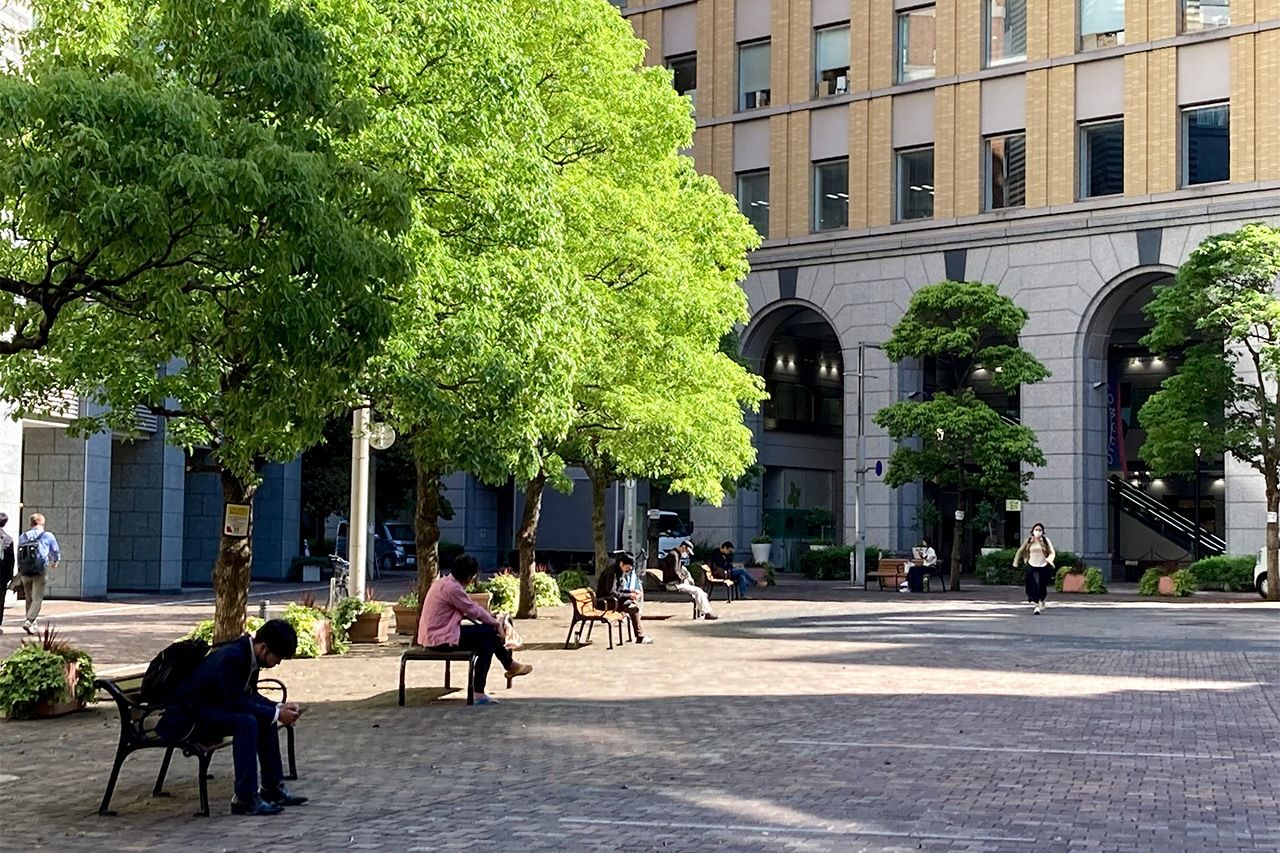
The charmingly bizarre Italian Town is another of those hallucinations one often encounters in Tokyo. (© Gianni Simone)
On the plus side, the atmosphere is pleasant, even charming in parts, though curiously incongruous. Here’s arguably the only proper square (in the European sense) you’ll ever find in Tokyo. Japanese cities lack public spaces where people can congregate, like squares or other communal areas for social interaction, parks being the exception.
I spend a few minutes sitting on a bench—another Tokyo rarity—looking at couples and young families enjoying the quiet and the trees. Then I leave the square, walk a couple of blocks, turn a corner, and I’m back in Japan. In the distance, another cluster of ferroconcrete high-rises announces the next station, Shinbashi.
I look back and see Italian Town for what it is: a movie set for a story that will never be shot.
(Originally written in English. Banner photo: From the east side of the Yamanote, views can be had of the Takeshiba Pier, Rainbow Bridge, and Tokyo Bay beyond. © Pixta.)