A Walk Around the Yamanote Line
From Tokyo to Akihabara: Glimpses of History and Tradition Beneath the Modern City
Travel- English
- 日本語
- 简体字
- 繁體字
- Français
- Español
- العربية
- Русский
The Bridge at the Heart of Japan
Today’s walk first takes me to Nihonbashi, about 600 meters east of the Yamanote Line just north of Tokyo Station. Though relatively close to the rail tracks, the trains’ rumble is smothered by the constant roar of traffic and the clanging noise of construction.
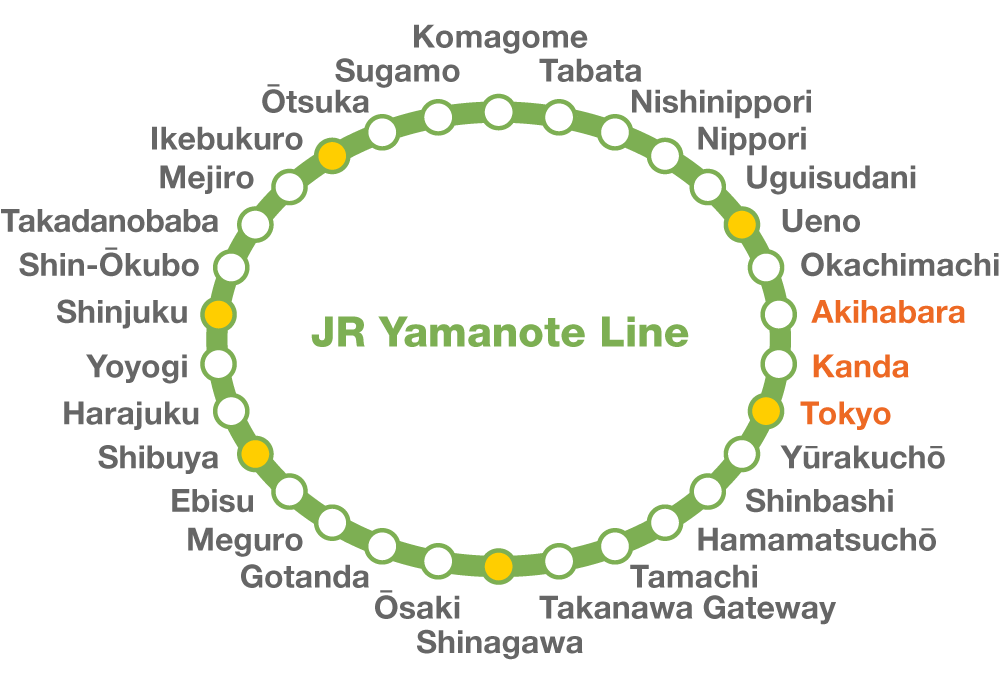
The stations on the Yamanote line stations loop. (© Pixta)
Tokyo is a city of flows, and they can all be witnessed in Nihonbashi. Flows of people and goods; the people streaming out of the subway station only to dive into Mitsukoshi department store, or Takashimaya, just down the road, kingdoms of posh shopping. Flows of trains, and cars on the overhead expressway. Last but not least, flows of water, or what little remains of the gorgeous canal network that once made Nihonbashi differently exciting—and a place redolent of seafood (before the fish market was moved to Tsukiji).
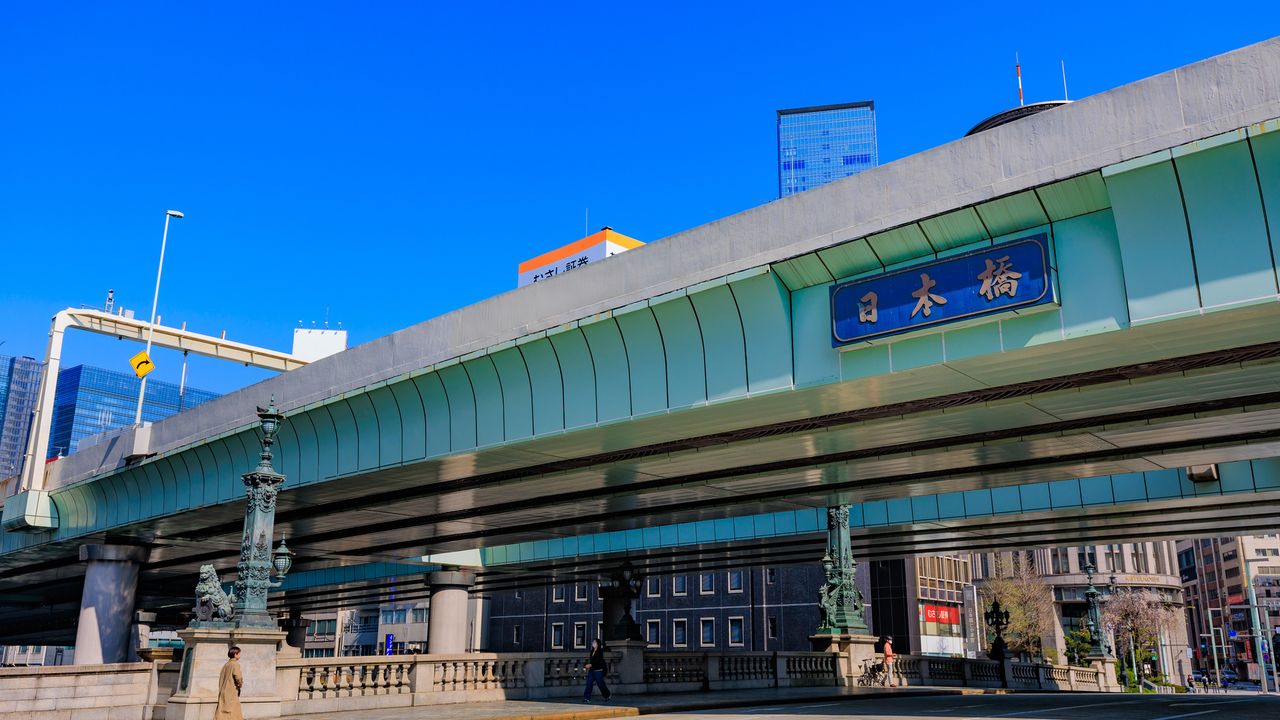
Standing in the middle of the bridge that gives the area its name (Nihonbashi literally meaning “Japan bridge”), and beneath the elevated expressway that looms over it, I can’t but feel a pang in my heart. The long-suffering Nihonbashi, the point from which all distances were calculated and the five main feudal highways started, was once considered the symbolic heart of Tokyo. Yet for decades, the Shuto Expressway has cast a literal and metaphorical shadow over this historic site, severing its connection to the sky, the river, and the city’s collective memory.
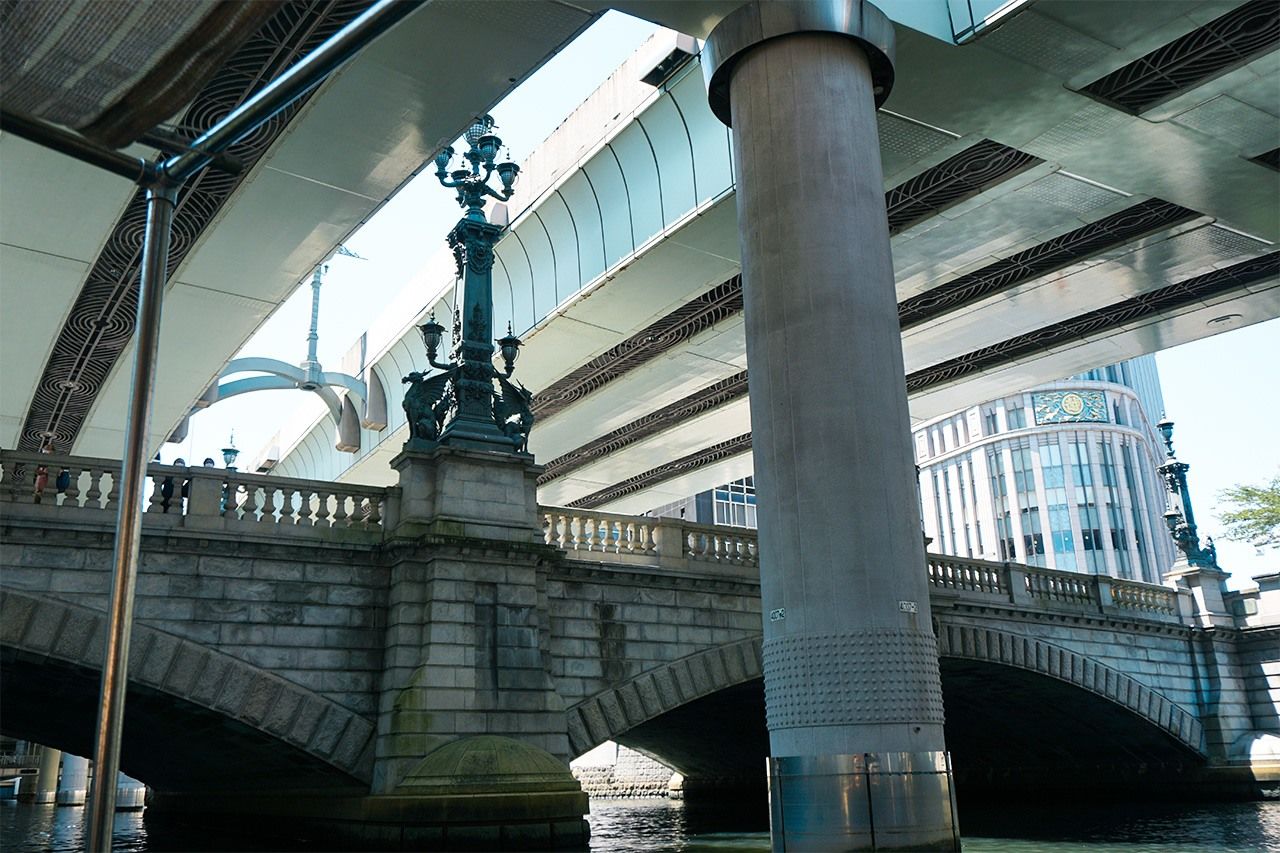
The Shuto Expressway has turned a cultural landmark into a forgotten underpass. (© Gianni Simone)
Tradition in the Shadow of Modernization
Most of Tokyo’s elevated expressways were thrown up during the frantic preparations for to the 1964 Olympics to alleviate the daily traffic jams. Those strips of concrete, stacked one atop another, instantly turned the capital into something out of a futuristic sketchbook. Significantly, they appeared in Andrei Tarkovsky’s 1972 sci-fi work Solaris, in which the Russian director devoted a full five-minute sequence to a dreamlike drive along the expressway. For many Tokyoites and city officials it embodied a source of pride. In the end, though, traffic crept back until congestion not only returned but grew worse than before, leaving cars stalled with nowhere else to spill.
Traffic aside, the expressway’s legacy is double-edged—a triumph of postwar engineering but also a blow to urban heritage. Laid over the existing urban fabric, it sliced through and wrapped around neighborhoods, prioritizing cars over human-scale design. This led to visual and acoustic disruption.
Worst of all, in order to save time and money, many sections were built above rail lines, existing streets, and the city’s waterway network in particular. Waterways were publicly owned, meaning the government didn’t need to negotiate with or pay compensation to private landholders. For many Tokyoites, these elevated roads evoke a sense of displacement and fragmentation. In places like Nihonbashi, the expressway literally covered the historic bridge where I’m now standing, turning a cultural landmark into a forgotten underpass.
The good news is that the authorities are now thinking of moving portions of the expressway underground and creating a so-called Tokyo Sky Corridor, which aims to reclaim these elevated spaces for pedestrians. Like New York’s High Line, this new project should introduce greenery and reconnect fragmented cityscapes with walkable, scenic routes.
Tucked away on a side street near the bridge, a modest stone monument marks the site of the house of William Adams, the English pilot who became a trusted adviser to Tokugawa Ieyasu in the early 1600s. Adams was Japan’s first Western samurai, a trailblazing immigrant whose story inspired novels and legends. Yet the marker itself is almost invisible, passed daily by foreign visitors intent on ramen or tempura, a reminder of how easily history slips beneath the noise of appetite and commerce.
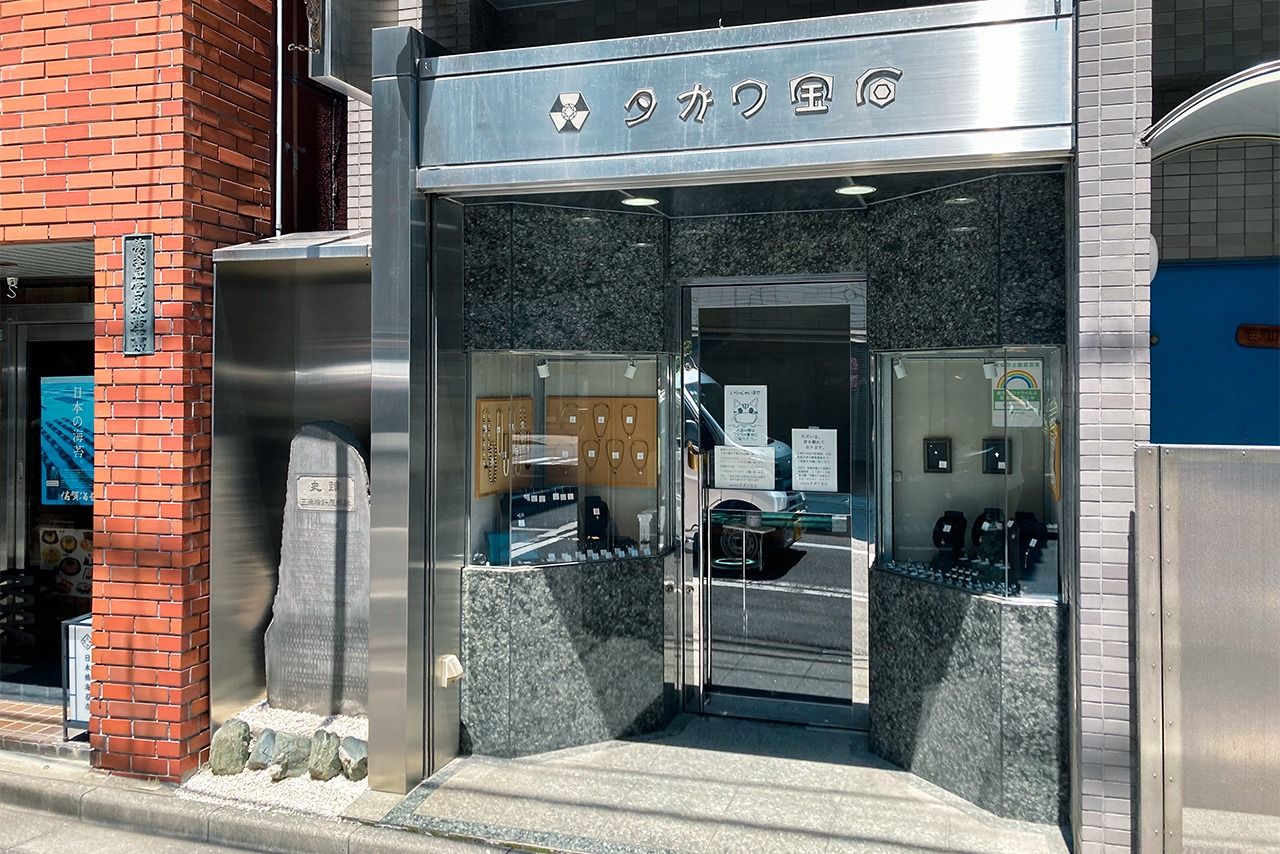
Few people realize that the unassuming stone monument to the left of this shopfront marks the spot where William Adams lived. (© Gianni Simone)
A Patchwork of Aromas
I walk back to the Yamanote Line, following the course of the Nihonbashi River. This stream, together with the larger Kanda River that we will cross later, is living proof that Tokyo’s landscape is less a gift of nature than the product of human design. Once the single flow of the Hirakawa River, its path was split, rerouted, and disciplined in the seventeenth century to supply water, prevent floods, and serve commerce, testament to a city literally carved into being. Today the Hirakawa, which once flowed directly into Tokyo Bay, has vanished, while the two streams reshaped by the Tokugawa now empty into the Sumida River.
The downtown stretch of land from Ginza to Kanda is a part of old Edo’s shitamachi, which literally means districts (machi) beneath (shita) the castle. During the Edo period, Kanda thrived as a bustling commercial district, home to merchants, craftsmen, and scholars. The neighborhood was particularly known for its vegetable markets, which supplied fresh produce to the city. The market was moved to Akihabara in 1928, but the district’s narrow streets are still teeming with activity.
Niku no Hanamasa, tucked beneath the railway tracks, might at first glance seem like an ordinary small supermarket, but it’s anything but. It stocks oversized items more commonly found in wholesale markets, catering to the needs of chefs and cooks from the nearby eateries.
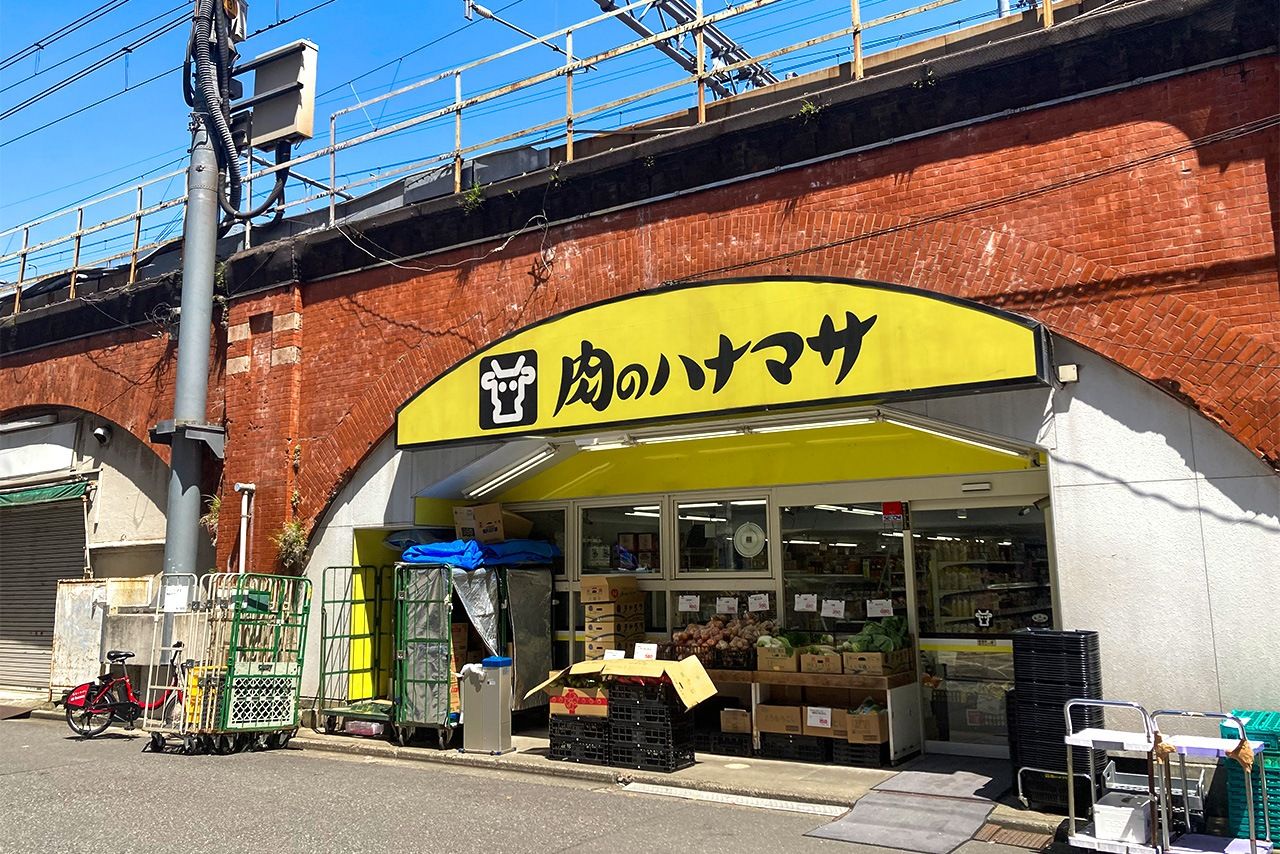
The Kanda outlet of the chain Niku no Hanamasa caters to the needs of chefs and cooks from the nearby eateries. (© Gianni Simone)
A little farther up the road, Kanda Station’s west exit opens right onto the entrance of a long shopping street. The narrow road hums with its usual mix of eateries, pubs, and risqué spots alongside newer additions, like an agency offering bike tours in English.
The air is a patchwork of aromas: sizzling dishes from tiny eateries and simmering broths mingling with the tang of soy and pickles. Cheap perfume competes with the faintly sweet, indistinct whiff leaking from air conditioners. It’s an unmistakably chaotic urban scent.
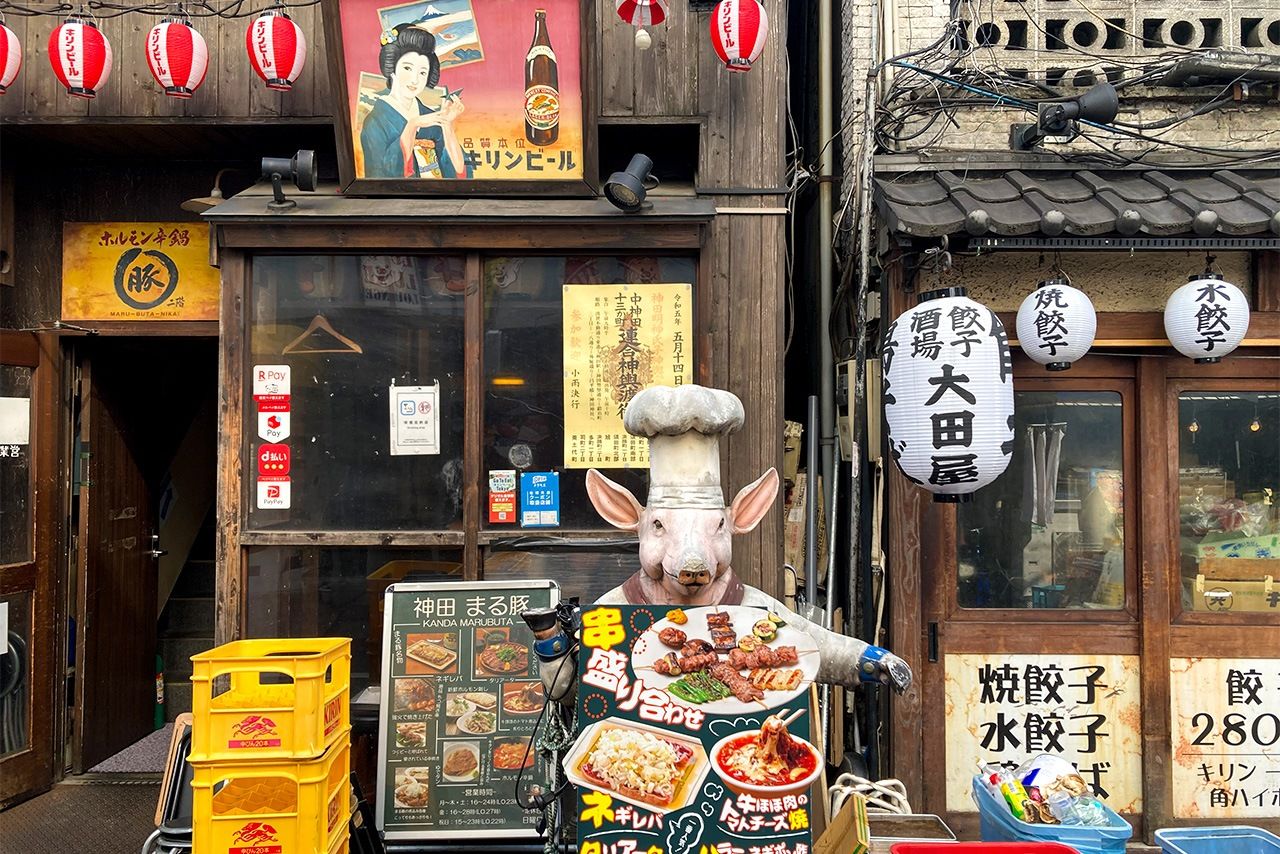
Kanda Station‘s west exit shopping street features the usual mix of eateries, pubs, and more. (© Gianni Simone)
Though the old Kanda market and many other hallmarks of shitamachi life have vanished, the area still preserves fragments of its past. Hidden among office towers and izakaya chains are a handful of storied eateries that have anchored the neighborhood for generations. Yabu Soba, founded in the nineteenth century, continues to serve elegant bowls of buckwheat noodles in a setting that evokes the atmosphere of old Tokyo. Botan, established in 1897, is renowned for its chicken hot pot, a dish once favored by writers and scholars who gathered here. The traditional confectionery shop Takemura, with its lattice windows and nostalgic sweets, offers a glimpse into the genteel tastes of Tokyo’s bygone days. And Isegen, the city’s oldest restaurant specializing in anglerfish hot pot, has been operating since the 1830.
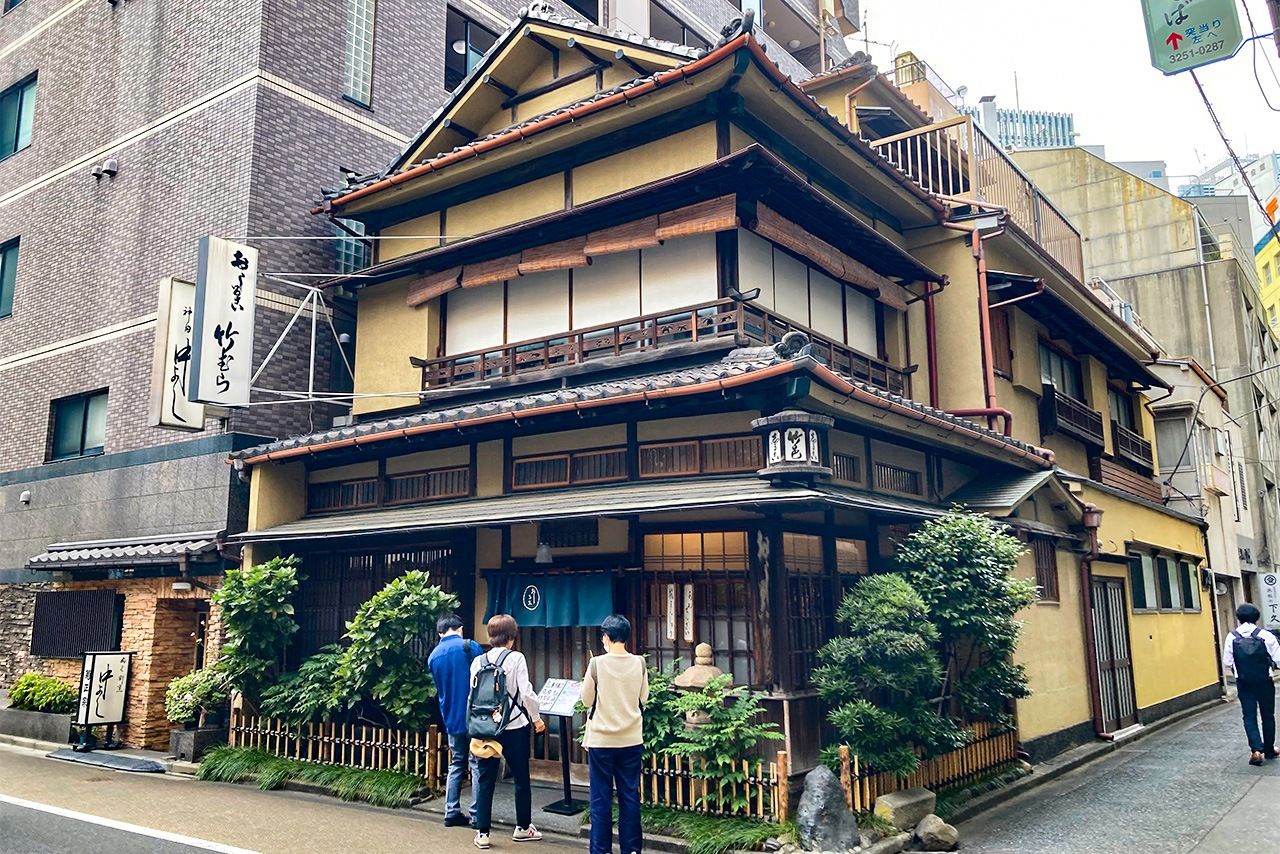
Confectionary shop Takemura’s building is designated a Tokyo Historic Landscape Property. (© Gianni Simone)
Together, these establishments form a living archive of Kanda’s history—reminders that even in a neighborhood reshaped by redevelopment, the flavors of the past still endure, inviting diners to taste echoes of the old shitamachi spirit.
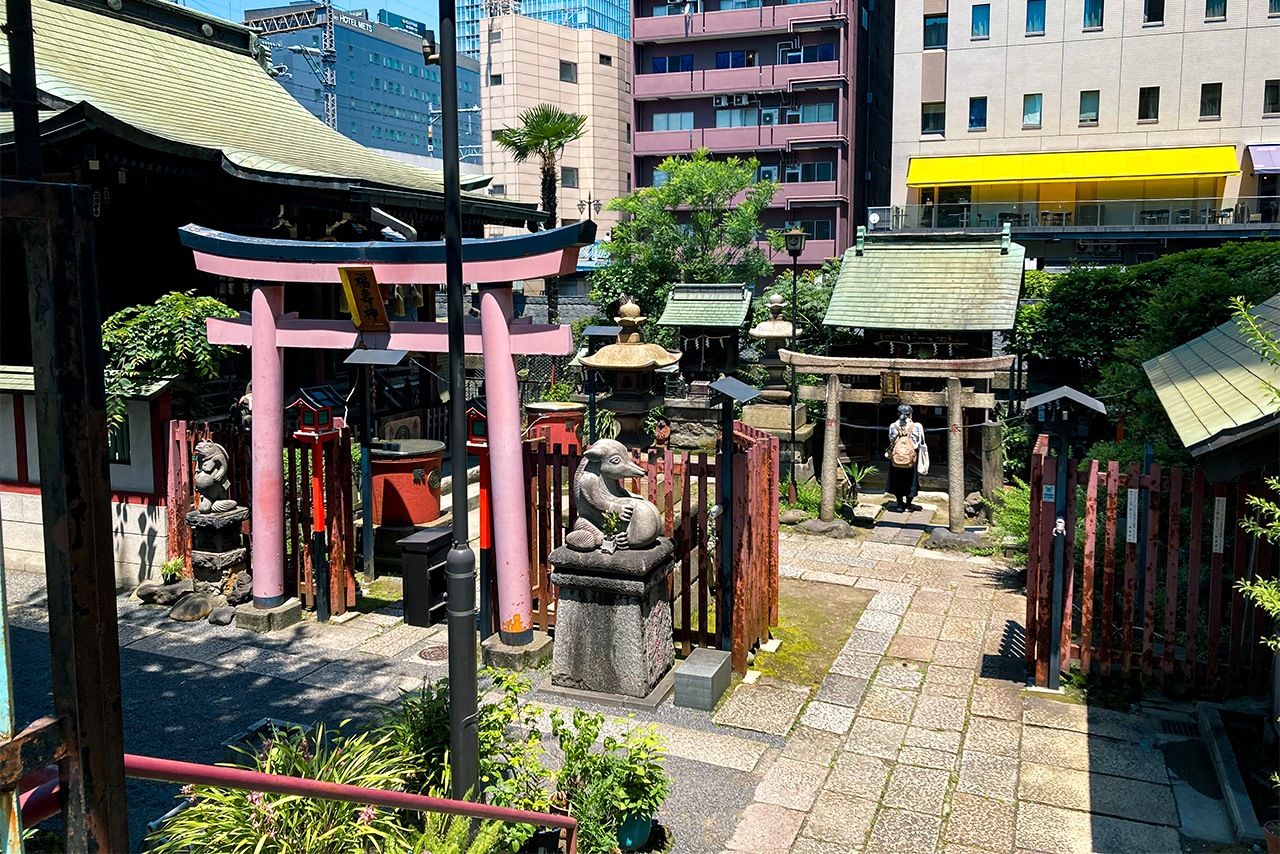
Near Akihabara, Yanagimori Shrine was originally established as one of Edo Castle’s spiritual defenses. (© Gianni Simone)
From Shitamachi Flavors to the Digital Age
I finally cross the Kanda River—the other stream born from Edo’s grand public works that diverted the Hirakawa River to reshape the city’s waterways—and enter Akihabara. Much has been written about the district’s evolution from a postwar black market to a hub for household appliances during the economic boom, and eventually into a mecca for computer hobbyists and otaku.
However, though this area’s connection to food culture is tenuous to say the least, the heart of Akihabara used to house Tokyo’s central fruit and vegetable market, and today, just north of the station, one can find the Chabara Aki-Oka Marche, a stylish food destination nestled—where else?—under the train tracks. The name “Chabara” blends yatchaba (the old term for produce market) and Akihabara, paying homage to the site’s history, while Aki-Oka refers to the stretch of the Yamanote from Akihabara to Okachimachi. It now features over 6,000 artisanal Japanese food products, regional specialties, and even a shojin ryōri restaurant inspired by vegan temple cuisine. So in a way, the spirit of the market lives on–not as a wholesale hub, but as a curated celebration of Japan’s culinary heritage.
(Originally written in English. Banner photo: The bridge at Nihonbashi, the start of all major roads leading out of the capital during the Edo years, is overshadowed by an expressway. © Pixta.)