Utagawa Hiroshige: The Ukiyo-e Master of Japanese Landscapes
Art Culture History- English
- 日本語
- 简体字
- 繁體字
- Français
- Español
- العربية
- Русский
A Step Down for a Samurai?
The ukiyo-e art of the Edo period (1603–1868) primarily depicted scenes from contemporary life, such as pictures of beautiful women (bijin) and kabuki actors. Townsmen artists from the artisan (shokunin) class produced woodblock prints and books mainly for the common people. However, Utagawa Hiroshige (1797–1858) was not a townsman. He was the son of a low-ranking gokenin samurai fire warden who served the shogunate, working at a fire station near Edo Castle’s Babasaki Gate.
Due to their low stipends, gokenin samurai were tacitly allowed to work side jobs, and Hiroshige, then known as Andō Jūemon, was strongly drawn to artistic pursuits. However, rather than the high-status art of the Kanō school, favored by official painters, he set his sights on ukiyo-e, with its beauties, actors, and even erotic works (shunga). It was an unconventional step for a samurai to compete in the commercial market using techniques associated with commoners. This could be seen as reflecting a shift in his mindset after his mother and father died in 1809, the year he turned 12. Hiroshige became the legal head of the family, living with his grandfather and sisters.
In Hiroshige’s youth, artists like Utagawa Toyokuni and Katsushika Hokusai were most popular with the general public. Hiroshige was unable to become Toyokuni’s disciple, as he had hoped, so instead he learned from Utagawa Toyohiro, a younger member of the Utagawa school. From his early teens, he completed his official fire duties while studying and painting in his free time, and this continued even for some time after he transferred the headship of the family to his nephew in his mid-twenties.
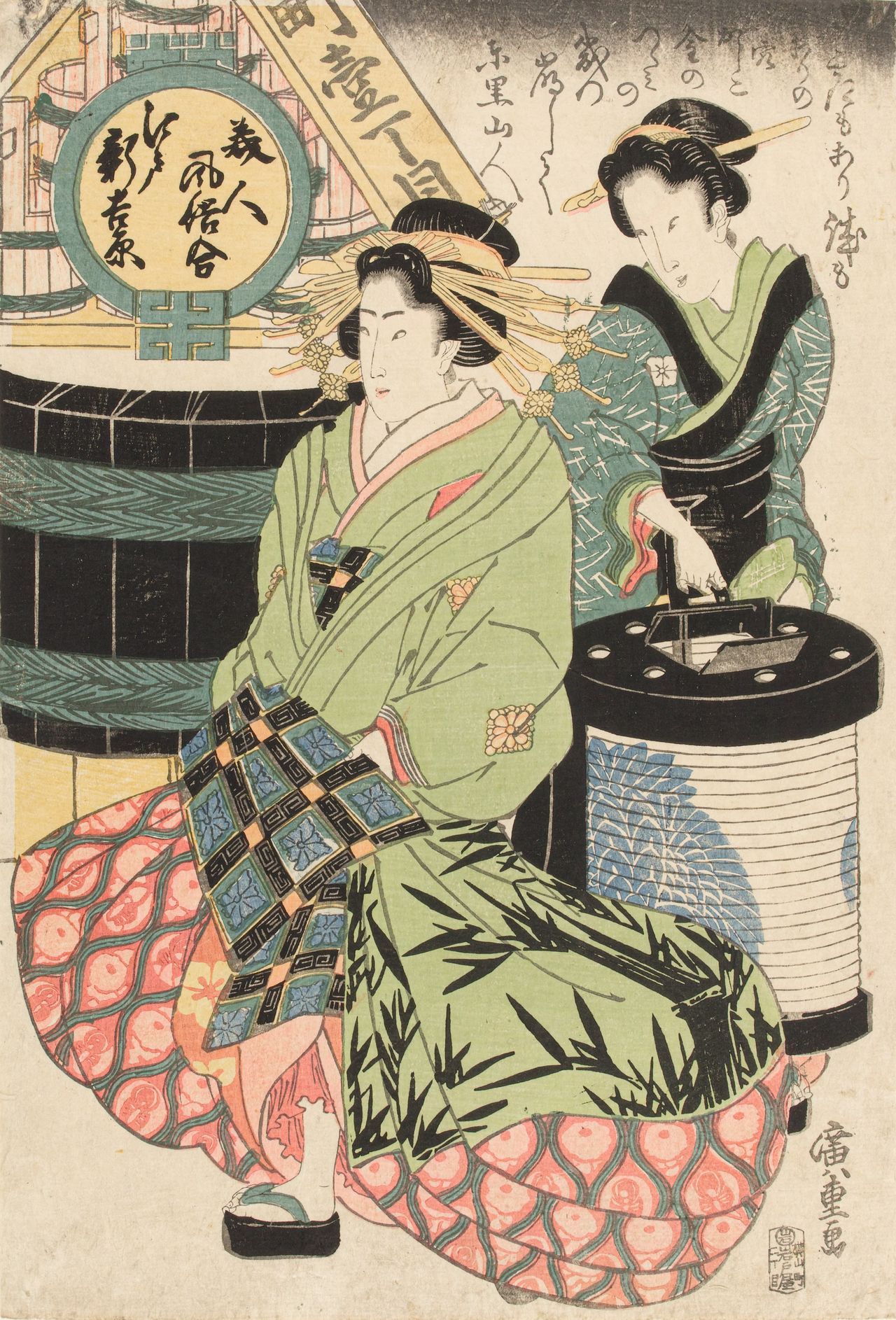
A print from the early series Bijin fūzoku awase: Edo Shin-Yoshiwara (A Comparison of Beauties and Fashions: Shin-Yoshiwara, Edo) (Courtesy Shizuoka City Tōkaidō Hiroshige Museum of Art)
Hiroshige is thought to have made his ukiyo-e debut in the late 1810s around the age of 20, taking on the standard themes of beauties, actors, and illustrations for popular fiction. When it came to commercial prints and illustrated books, however, sales were everything. In the precarious business of being an artist, there was fierce competition even within the Utagawa school, and derivative works had no chance of success. For the next decade or so, it seems likely that he kept feverishly drawing while exploring the possibilities for developing his own style.
A Formidable Rival
Hiroshige is thought to have started out in the landscape genre in the early 1830s with the collection Famous Places in the Eastern Capital. This presented well-known spots in Edo (now Tokyo), while weaving in human activity and customs.
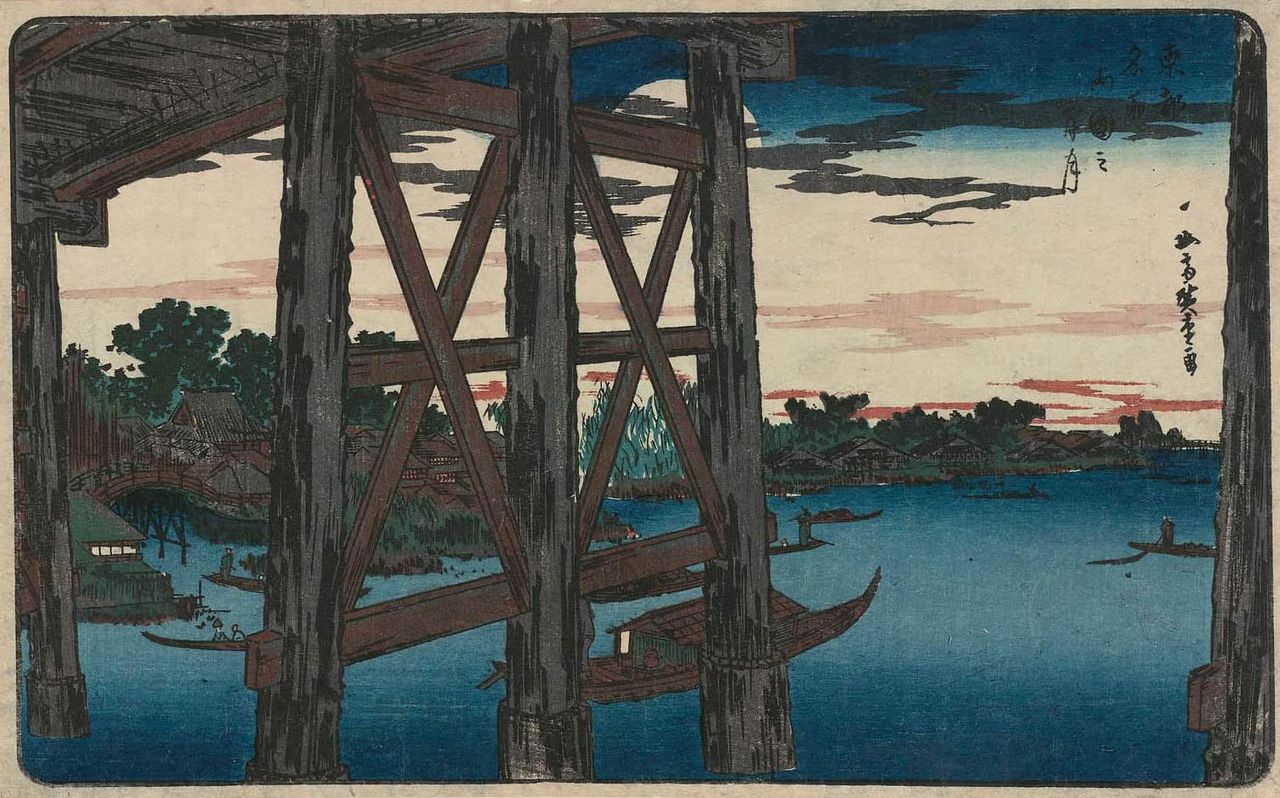
Ryōgoku no yoizuki (Evening Moon at Ryōgoku Bridge) from the series Tōto meisho (Famous Places in the Eastern Capital). (Courtesy Museum of Fine Arts Boston)
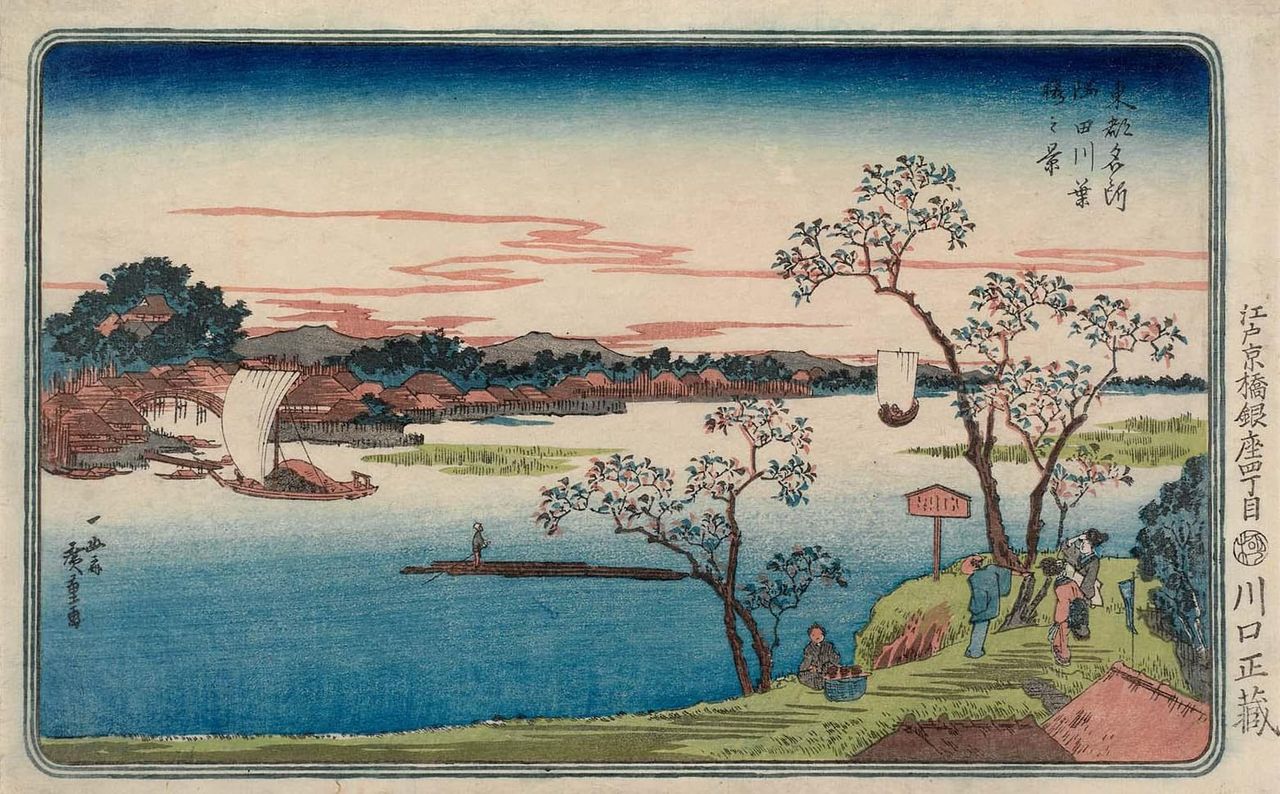
Sumidagawa, hazakura no kei (Leafy Cherry Trees on the Sumida River) from the series Tōto meisho (Famous Places in the Eastern Capital). (Courtesy Museum of Fine Arts Boston)
Previously ukiyo-e had introduced Western methods of perspective to emphasize distance, in prints known as ukie that enjoyed two waves of popularity. However, in his Eastern Capital collection Hiroshige went beyond simple usage of perspective, applying such innovative techniques as placing objects prominently in the foreground and creating an expansive sky by lowering the horizon line. This probably derived from his studies of Kyoto’s Maruyama Shijō school around the late 1820s. The focus on landscapes meant this series saw the first emergence of “Hiroshige Blue,” a shade he used abundantly in the sky, rivers, and sea. Despite Hiroshige’s efforts, however, the series came to an end after 10 prints, as he faced a formidable rival.
Hokusai was an ukiyo-e legend. In his seventies, he brought out his celebrated Thirty-Six Views of Mount Fuji around the same time as Hiroshige’s collection to a rapturous public reception. This depicted the sacred peak in stylized forms, winning many people’s hearts through unconventional, engaging pictures that conveyed the artist’s desire to entertain. Hiroshige’s collection just could not compete.
Developing New Genres
The works of the two artists at this time signaled the creation of a new ukiyo-e genre of pictures of famous places (meisho-e). Hokusai went on to produce landscape series based around such themes as waterfalls, bridges, and the sea. Hiroshige responded by setting his hopes on the success of The Fifty-Three Stations of the Tōkaidō, depicting coastal scenery along the Tōkaidō highway that stretched from Edo to Kyoto. According to a much later account by Hiroshige III, who was the artist’s student, Hiroshige himself had traveled the highway in 1832, although the truth of this is disputed. Hiroshige’s Fifty-Three Stations, published by Hōeidō from 1833, became a massive hit, and made his name while he was still in his mid-thirties.
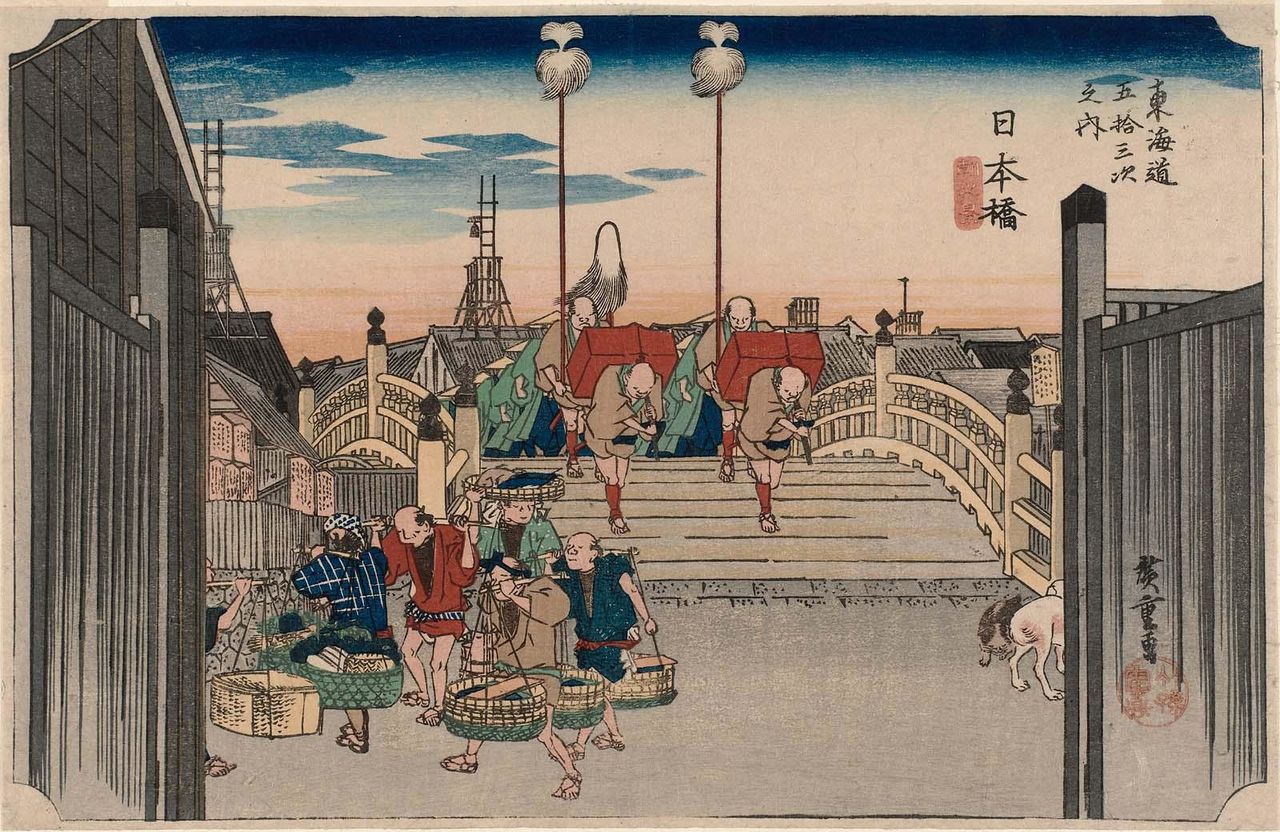
Nihonbashi, asa no kei (Nihonbashi: Morning Scene) from Tōkaidō gojūsantsugi no uchi (The Fifty-Three Stations of the Tōkaidō). (Courtesy Museum of Fine Arts Boston)
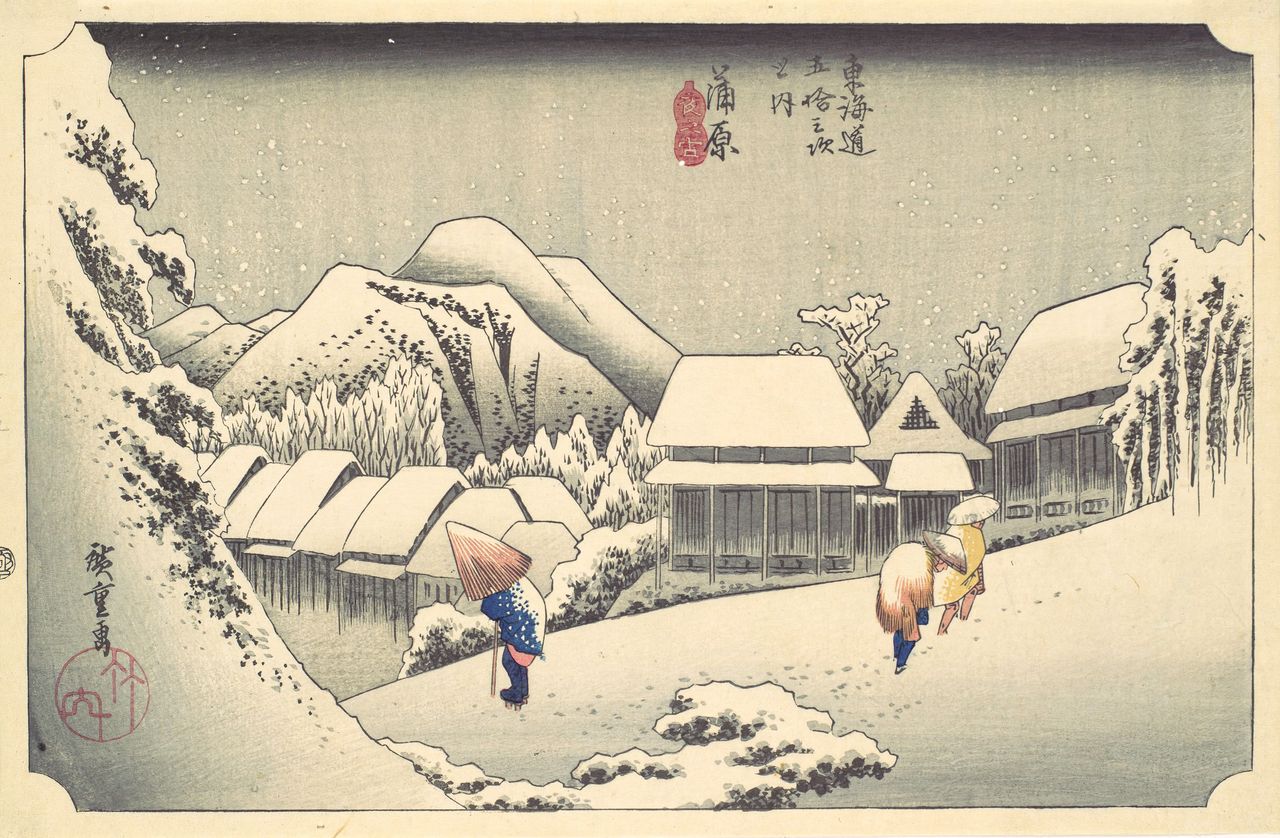
Kanbara, yoru no yuki (Kanbara: Evening Snow) from Tōkaidō gojūsantsugi no uchi (The Fifty-Three Stations of the Tōkaidō). (Courtesy Metropolitan Museum of Art)
Hiroshige’s landscapes were clear, accessible, and realistic, similar to today’s picture postcards, and he used weather features like rain and snow to create a rich atmosphere. The Edo public had been won over by Hokusai’s exaggerated and eccentric compositions, but the appearance of Hiroshige’s quiet Tōkaidō prints brought a shift in taste. The volatile social climate due to the onset of the Great Tenpō Famine may have contributed to the warm reception for the newcomer Hiroshige and his gentle, elegant artworks. In response to public demand, Hiroshige produced a huge succession of highway landscapes and famous scenes across Edo and the nation, practically cornering the market in landscape prints.
While Hokusai and Hiroshige are well known for their competing achievements in developing the genre of famous places, they also came head-to-head in bird-and-flower prints (kachōga), previously considered a minor category. The two artists released works reflecting their own inventive approaches.
Hiroshige emerged victorious in this field too, as the Edo public showed its preference for his richly expressive prints, often composed within the tall, narrow tanzaku-ban format, like the strips of paper used for writing poetry. This was not because the veteran Hokusai’s prints were inferior, but rather due to the tastes of the time. Ukiyo-e saw a fundamental shift to landscapes and bird-and-flower prints, away from the earlier beauties and actors that had formerly filled stores.
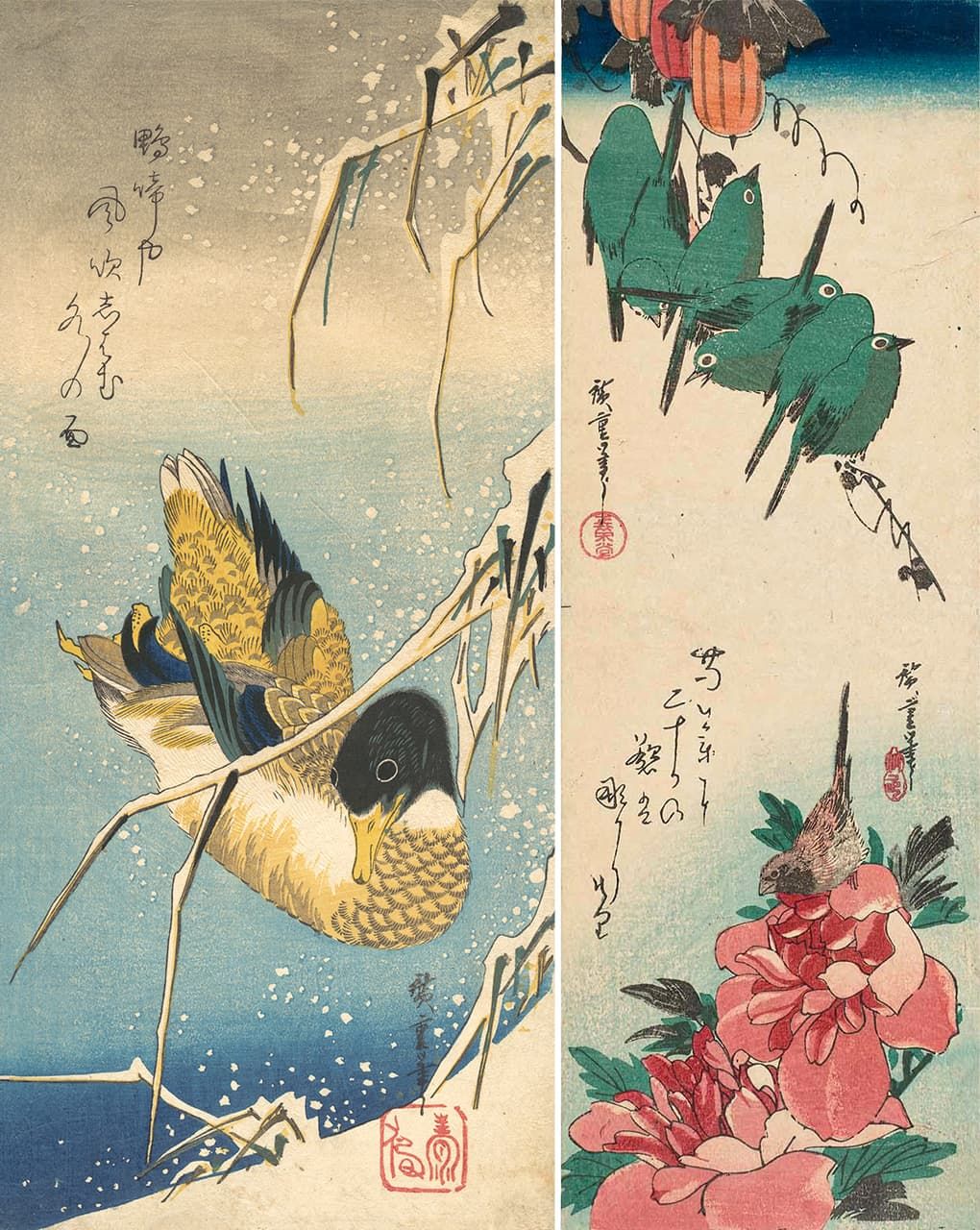
Setchū ashi ni kamo (A Wild Duck Near a Snow-Laden Shore), (Courtesy Metropolitan Museum of Art), at left; Karasu uri ni mejiro (Snake Gourd and Japanese White-Eye) with Shakuyaku ni kotori (Peonies and Small Bird), (Courtesy Museum of Fine Arts Boston)
In the guide to drawing Ehon tebikigusa, Hiroshige described his own style as “sketching from life while adding artistic touches.” Both Hiroshige and Hokusai produced series known in English as One Hundred Views of Mount Fuji; in Hiroshige’s Fujimi hyakuzu, he criticized Hokusai’s pictures of the famous peak as “mainly focused on clever composition,” comparing them with his own works that were “authentic life studies” based on “direct observation.” He defined his natural ability as lying in his realism and authenticity, which laid the foundation for the popularity of his landscape and bird-and-flower prints.
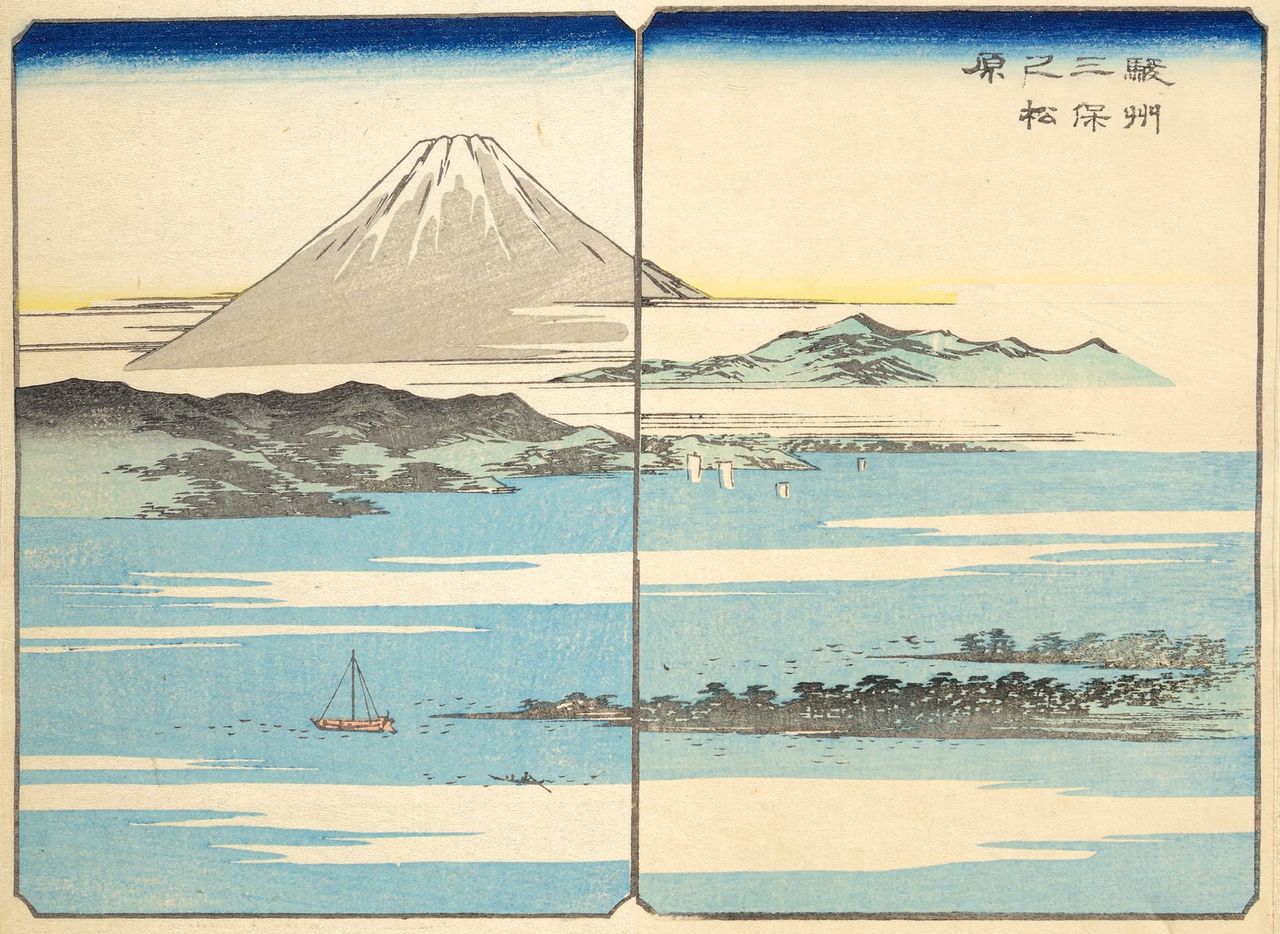
Sunshū Miho no matsubara (Pine Groves of Miho in Suruga Province) from Fujimi hyakuzu (One Hundred Views of Mount Fuji). (Courtesy Metropolitan Museum of Art)
Hiroshige continued to produce a stream of Tōkaidō and Edo sightseeing prints with a range of publishers, maintaining his position as one of Japan’s most popular artists. Especially after Hokusai’s death in 1849, the ukiyo-e world was dominated by the Utagawa school, including Kunisada (he later took on the name Toyokuni III), who specialized in the classic beauties and actors; Kuniyoshi, known for his warrior prints; and Hiroshige, the master of famous places. His acclaim led Hiroshige to receive private commissions. Of these, the most famous are the huge curtains he painted on-site for the Dōsojin festival in Kai province (now Yamanashi Prefecture) and many hanging scrolls commissioned by the Tendō domain in Dewa province (now Yamagata and Akita Prefectures) to give as gifts to wealthy farmers the domain had previously called on to provide emergency funds. These projects confirm Hiroshige’s high standing among the artists of the day.
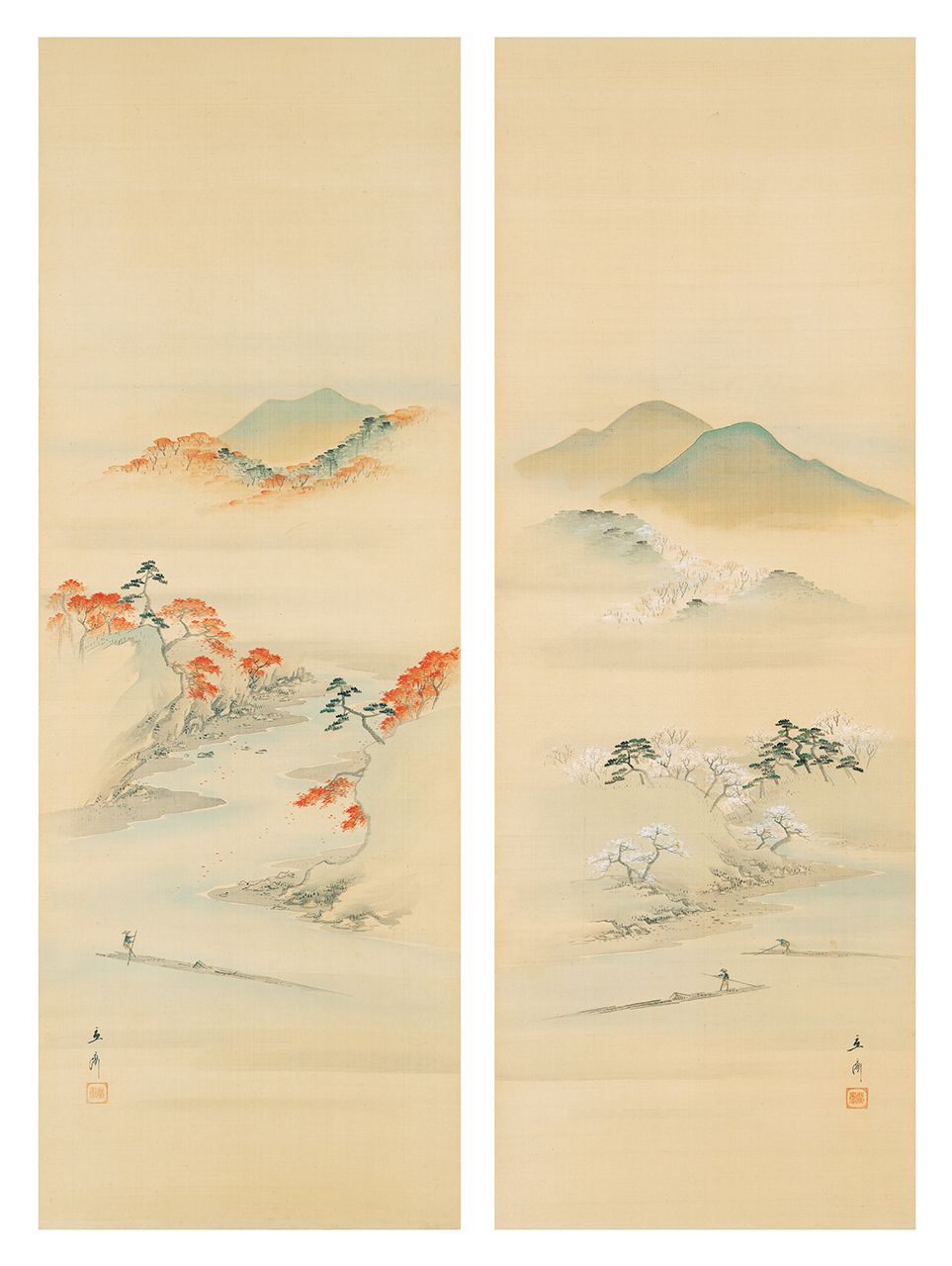
Hanging scrolls commissioned by the Tendō domain: Tatsutagawa no momiji (Autumn Leaves at the Tatsuta River), at left, and Yoshino no sakura (Cherry Blossoms at Yoshino). (Courtesy Hiroshige Museum of Art)
Comfort to Citizens After Edo Earthquake
Even in his later years, Hiroshige continued to experiment in his landscape artworks, such as switching from the horizontal format he had used extensively in favor of vertical compositions, and painting skillful reconstructions of places he had never visited by borrowing from other artists’ works. While Famous Places in the Sixty-Odd Provinces is a prime example, the grand series One Hundred Famous Views of Edo was the crowning achievement of his final years.
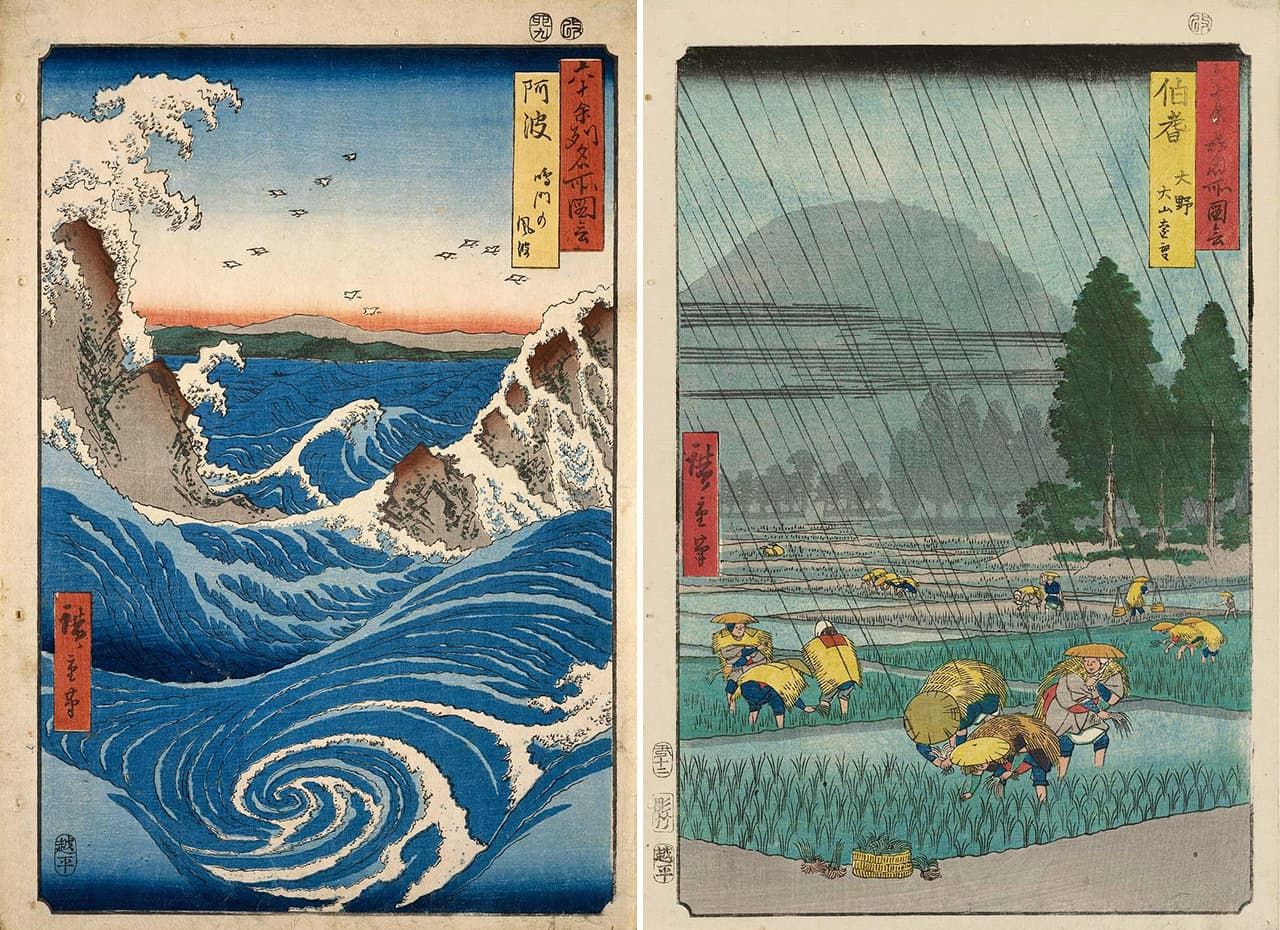
Awa Naruto no fūha (Awa Province: Naruto Whirlpools), at left, and Hōki Ōno Daisen enbō (Hōki Province: Ōno, Distant View of Mount Daisen), both from Rokujūyo shū meisho zue (Famous Places in the Sixty-Odd Provinces). (Courtesy Museum of Fine Arts Boston)
One can imagine that for the landscape master Hiroshige, depicting Edo in its ideal form after it was struck by a huge earthquake in 1855 was a form of personal mission to lend courage to the many ordinary residents of the city who suffered in the disaster. The scenes he captured in the vertical format he favored in his later years of the city center and suburbs that he knew so well surely provided such Edoites with comfort. The amazing feat of publishing more than 100 large prints in just three years was only possible because of the great support of buyers and patrons.
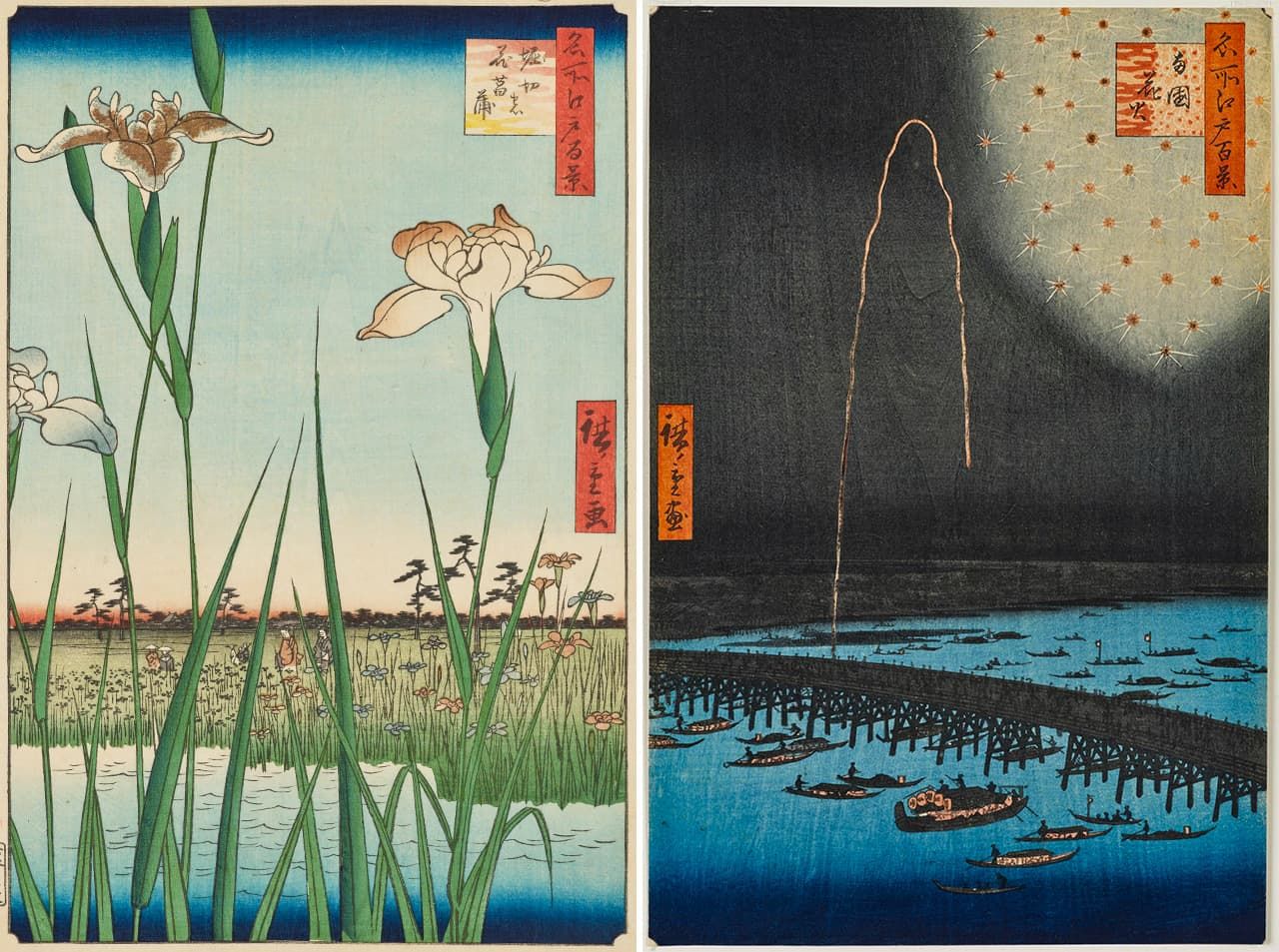
Horikiri no hanashōbu (Horikiri Iris Garden), at left, and Ryōgoku no hanabi (Fireworks at Ryōgoku), both from Meisho Edo hyakkei (One Hundred Famous Views of Edo). (Courtesy ColBase)
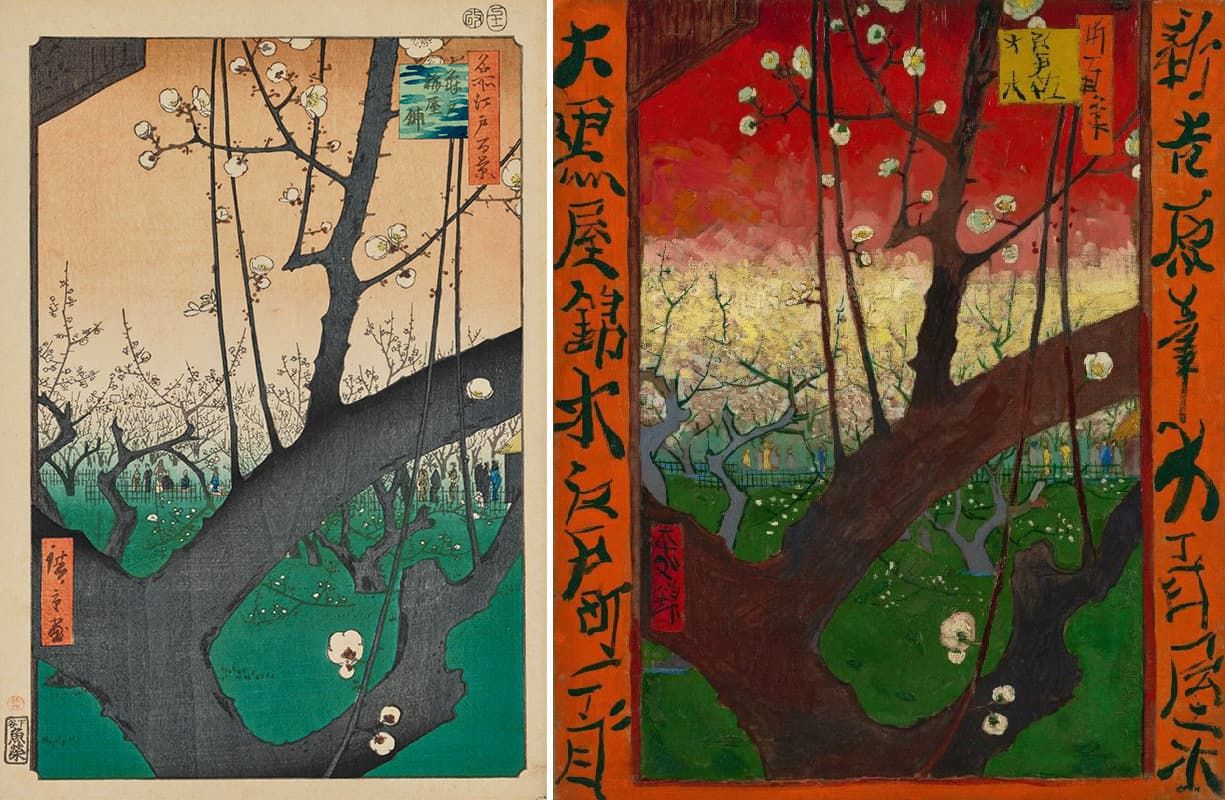
Hiroshige’s Kameido Umeyashiki (Plum Garden at Kameido) from One Hundred Famous Views of Edo, at left (Courtesy ColBase) was famously reproduced by Van Gogh in his Flowering Plum Orchard (After Hiroshige). (Courtesy Van Gogh Museum)
Just as the series had reached its planned 100 prints, and was drawing to a close, Hiroshige reportedly contracted cholera during an outbreak of the disease and passed away in 1858.
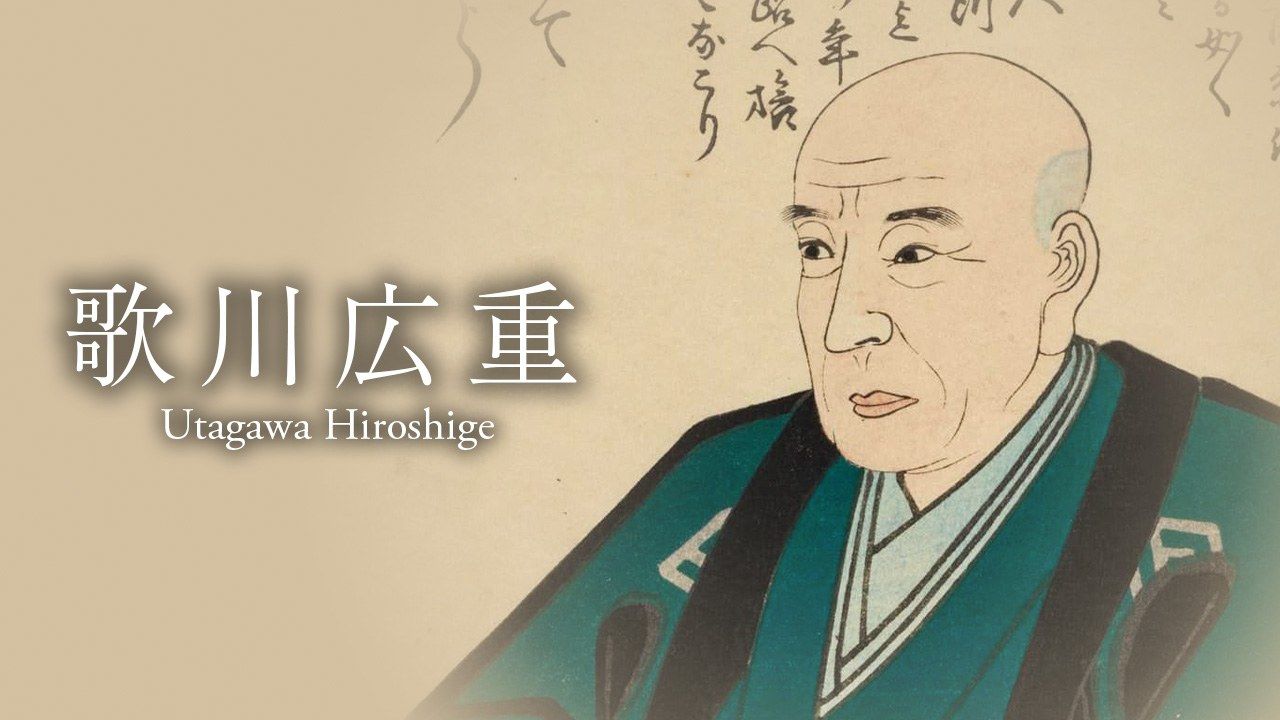
Sensing that he was soon to die, Hiroshige left detailed instructions to his family on how to repay his debts, indicating his tough financial situation despite his popularity as an artist, likely due to low commission fees and the large number of students he had taken on. His will, short sword, and other mementoes are still extant, while the memorial print by his friend Toyokuni III (the banner image for this article) conveys both good sense and amiability, offering a glimpse into his character during his lifetime.
(Originally published in Japanese on July 17, 2026. Banner image: A portrait of Utagawa Hiroshige by Utagawa Toyokuni III. Courtesy ColBase.)