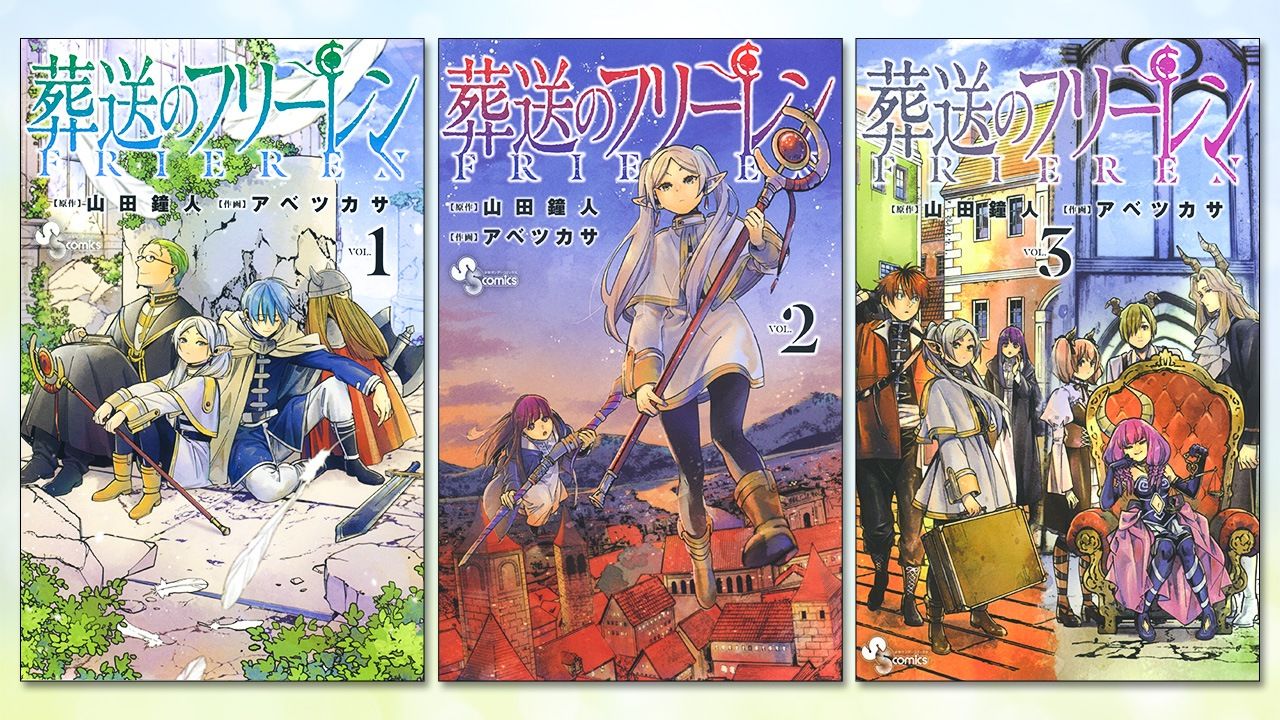
Manga Worth Having on Your Shelves
“Frieren: Beyond Journey’s End”: Going Beyond Adventure
Manga Anime- English
- 日本語
- 简体字
- 繁體字
- Français
- Español
- العربية
- Русский
Lamenting Lost Friends
Sōsō no Furīren (Frieren: Beyond Journey’s End) is a fantasy unlike most, in that it starts with the end of a great adventure. The manga begins at the point when the elven mage Frieren and her companions—the human hero Himmel, human priest Heiter, and dwarven warrior Eisen—find success in a 10-year quest to defeat the Demon King. Most fantasy stories would make that quest the main event.
Near this story’s start, Frieren reflects with her companions about their “short adventure.” Because elves have such long lifespans, a mere decade goes by in a flash.
The four reunite 50 years later. Frieren is unchanged, but the humans Himmel and Heiter have become elderly. Dwarves also have long lives, but Eisen still shows his age. Soon, Himmel dies of old age. His death weighs on Frieren, and she laments, “I knew humans had short lifespans . . . Why didn’t I try to get to know him better?”
After Himmel dies, Frieren sets out on a new journey. The goal is both to continue her hobby of gathering spells and to learn more about humans. Eventually, she decides to head once more for the cold, northern city of Ende, where the Demon Lord’s castle once stood. This was the goal of her previous adventure.
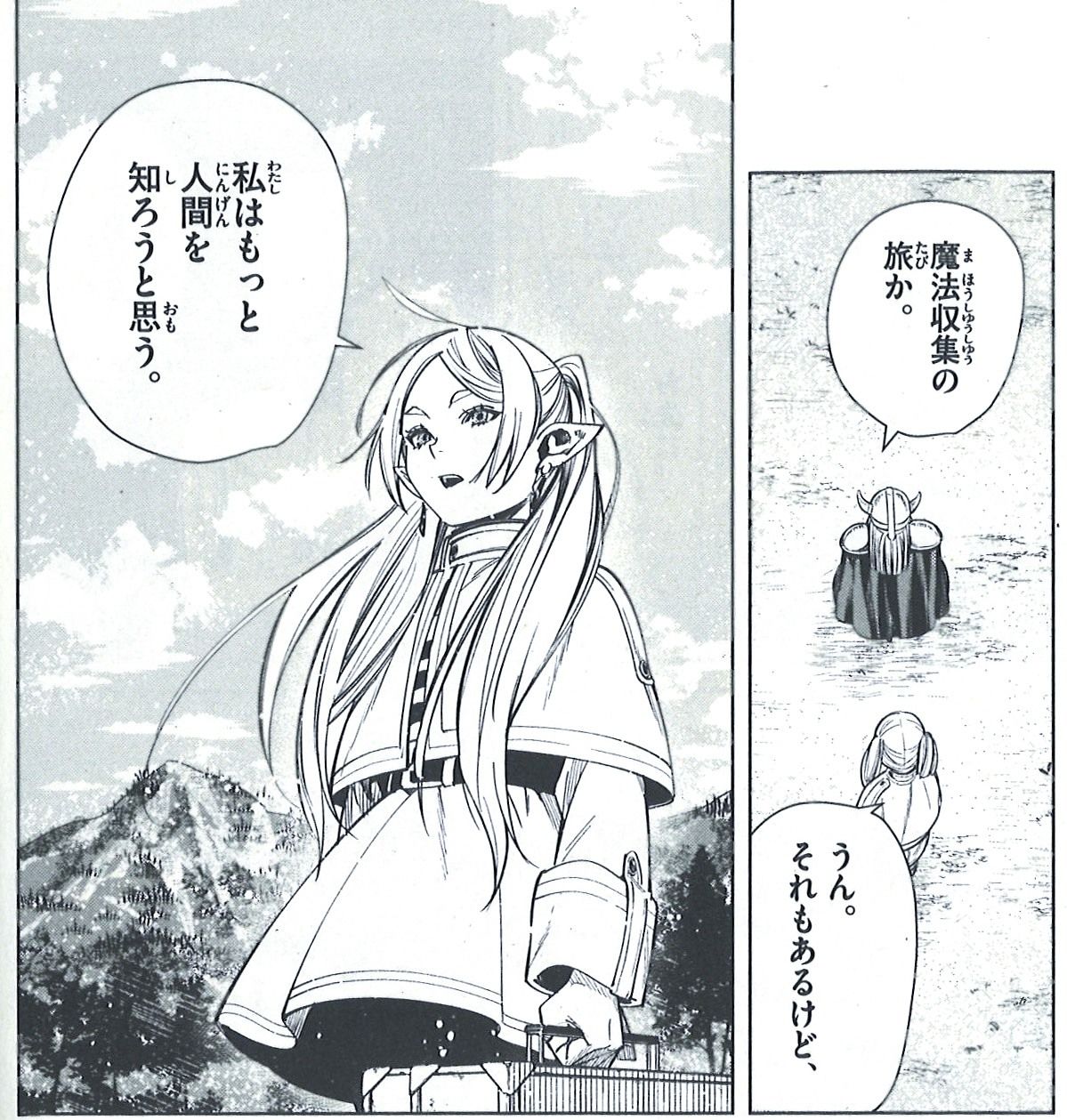
Frieren sets out on her journey to learn more about humans in Volume 1 of Frieren: Beyond Journey’s End. (© Yamada Kanehito and Abe Tsukata/Shōgakukan)

In Search of Meaning
Frieren: Beyond Journey’s End began serialization in April 2020, just as the COVID-19 pandemic went into full swing, and Japan’s government declared a nationwide state of emergency. Mortal peril became a familiar fact of life and losing loved ones was all too common. The shortness of human life became impossible to ignore. The way that readers around the world have been able to identify with the themes of this manga is surely rooted in how it distills the mood of those days.
There was already a similar feeling of isolation in the air before the pandemic, perhaps due to a sense that the world was at a turning point. From 2016, works like Demon Slayer brought gloom and an interest in the meaning of life to shōnen manga, perhaps out of awareness of that turning point. Frieren shares that gloomy mood, with a story full of shadows, sadness, and quiet.
Written by Yamada Kanehito and illustrated by Abe Tsukata, this work has won a slew of domestic awards, including the Manga Taishō Prize and Tezuka Osamu Cultural Prize for a New Artist in 2021, then the 2023 Shōgakukan Manga Award, and in 2024 it was selected the Best Shōnen Manga in the Kōdansha Manga Awards. The first season of the TV animation broadcast in 2024, with the second season scheduled from January 2026. The anime is a hit overseas, and more than 30 million volumes of the manga are now in print.

The anime broadcast drove Frieren: Beyond Journey’s End to global popularity. (© Yamada Kanehito and Abe Tsukasa/Shōgakukan/Sōsō no Furīren Production Committee; courtesy GU)
One other potential reason for its popularity is the worldview it shares with other fantasy works, particularly games in the Dragon Quest series, rooted in the story of a party of adventurers on a quest.
Elements of game-world fantasy like hero, priest, mage, or warrior character classes appear throughout Frieren with little to no explanation offered. That is because its readership both in Japan and abroad share a high level of literacy in the sword-and-sorcery fantasy subgenre. The fact that no one seems to think twice about how this story starts after the big quest finishes is probably also related to this shared worldview. In a similar vein, Frieren has running gags about being deceived by Mimics, monsters that are disguised as treasure chests that are a standard for Dragon Quest and similar fantasy media.
So-called isekai or “secondary world” stories featuring faux Medieval European settings, fantasy races, and magic also grew very popular from the 2010s and are already an established manga genre. For example, Kui Ryōko’s Delicious in Dungeon manga, which started its run in 2014, is another major work using fantasy tropes. It puts a unique spin by taking familiar monsters, like slimes or living armor, and turning them into meals.
A Truly Human Story
Some 20 years after Himmel’s death, Frieren has gathered new companions on her journey. One is Fern, a war-orphan adopted by Heiter; another is Eisen’s warrior apprentice Stark.
“It’s what Himmel the Hero would have done.” This becomes almost a catchphrase for the character Frieren for whenever she sticks her nose into some pesky business that she’d normally just ignored, because Himmel was always ready to aid people on their original quest some 80 years before. Fern and Stark thus learn to help others in trouble from her example. And so another generation learns to follow in the footsteps of the fallen hero.
Another theme of the work—summed up in the old adage, “You die twice: first, when life leaves your body, second, when you are forgotten”—was also taken up in Hagio Moto’s work The Heart of Thomas. It seems to be part of Himmel’s motivation as he travels around acting the hero and having statues put up in his honor. He tells Frieren when she asks about it, “Maybe it’s so you won’t be alone in the future.” And on Frieren’s new journey, she is indeed reminded of him every time she sees a statue of her old friend. As she does, she slowly starts to realize just how deeply he had cared about her. And as Fern and Stark grow on their journey, Frieren finds herself watching over them like a proud parent, thinking of their future.
In a sense, it seems to be saying that learning about humans is learning about love. Although this manga is a work of fantasy, it evokes the drama of the human condition in a way that resonates with us readers living in the real world.
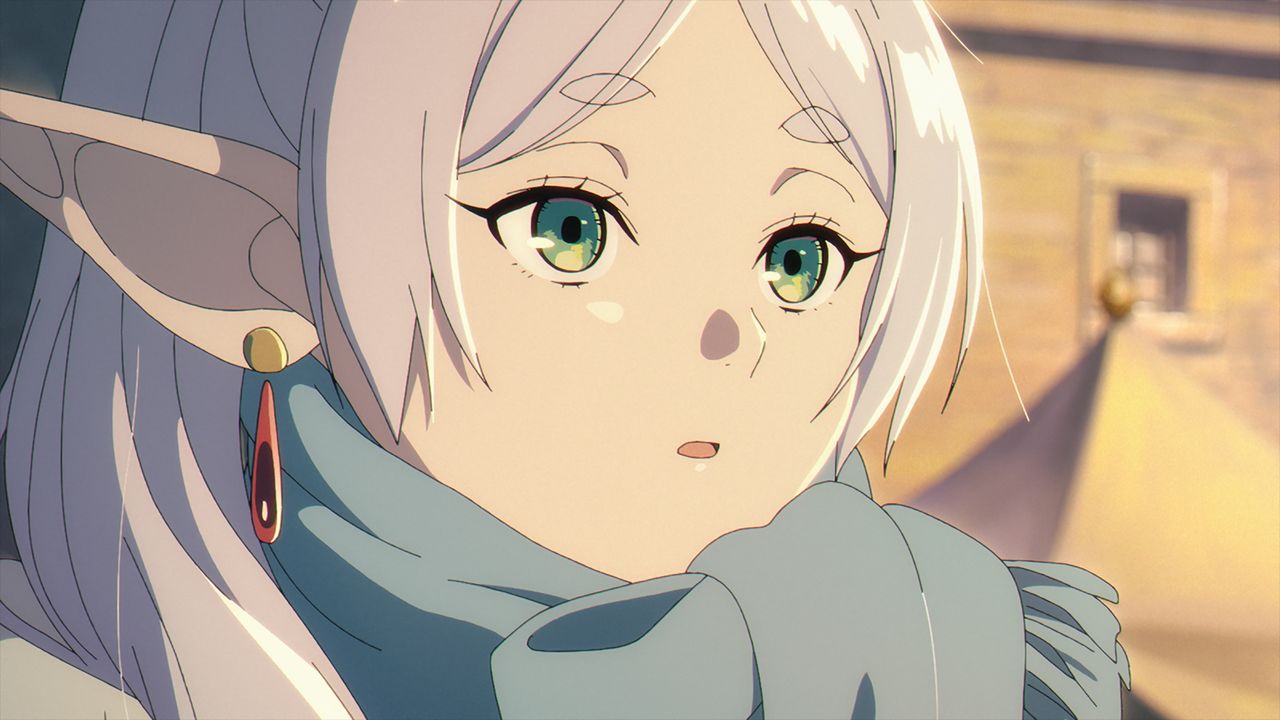
The Frieren: Beyond Journey’s End anime has been available on various streaming services since 2023. (© Yamada Kanehito and Abe Tsukasa/Shōgakukan/Sōsō no Furīren Production Committee; courtesy Abema)
A Sense of Reality
As mentioned, the manga layers elements of real human drama onto the story, but it never hesitates to use fantastical elements like dragons, demons, and epic fight scenes. A particular attraction is Frieren’s own overwhelming, exhilarating power.
But there is a delicate balance to how the magic and demons are used in the story. They are depicted in ways that make sense and fit our own understanding of the world.
For example, the demon Qual, wielder of the unstoppably fatal spell Zoltraak, was once a formidable foe. But after the last 80 years of building her magical power, Frieren defeats him easily on his return. Reading that scene put me in mind of the Spanish influenza epidemic that devastated the world a century ago. There are still many deadly viruses, but now we have effective treatments and vaccines for the flu.
Frieren describes the demons plaguing her world as raging beasts with no reason, but the manga itself takes care to show that they are not acting out of real malice. The reader is encouraged to compare them to harmful insects or animals from the real world.
In other words, the work uses carefully constructed logic so that the reader can understand its magic as a stand-in for real world medicine or science.
Lessons for All
The goal of Frieren’s new journey is to learn more about humans, but her desire to gather more magic is also a big part. Many of the spells she finds are quite gentle, like being able to speak quickly or send a paper airplane flying far. But the journey also teaches that such magic can lead to encounters that change lives.
On his adventure with Frieren, Himmel once explained that he hoped their journey would be one they could look back on with laughter at the ridiculous things they went through. Will Frieren, destined to live a thousand years, be able to look back and laugh at the life she led when her end comes?
The most insignificant moments of day-to-day life can in the end become the greatest treasures. That is one of the lessons readers can take for their own lives from reading Frieren: Beyond Journey’s End.
(Originally published in Japanese. Banner photo: Volumes 1 to 3 of Frieren: Beyond Journey’s End. © Yamada Kanehito and Abe Tsukasa/Shōgakukan. Photo © Nippon.com.)