Photography as a Bridge to a Vanishing Time
Aenokoto: Oku-Noto’s Harvest Rite
Culture History Lifestyle- English
- 日本語
- 简体字
- 繁體字
- Français
- Español
- العربية
- Русский
Physical Manifestation of Rice Deity Worship
The Oku-Noto aenokoto is a harvest rite passed down in cities and towns in the Oku-Noto district, the northernmost tip of the Noto Peninsula. On December 5, heads of farming households welcome tanokami (the deity of the rice paddies), preparing a bath and a meal for the spirit, to give thanks for the harvest. On February 9, this time to pray for a plentiful harvest in the fall, the deity is feted again before being seen off in the paddies. Aenokoto shares elements in common with niinamesai, a ceremony conducted yearly by the emperor, in which he offers newly harvested rice to the deities. Because of this, it has been called the folk version of niinamesai and a physical manifestation of inadama, the traditional Japanese belief in the spirit of the rice.
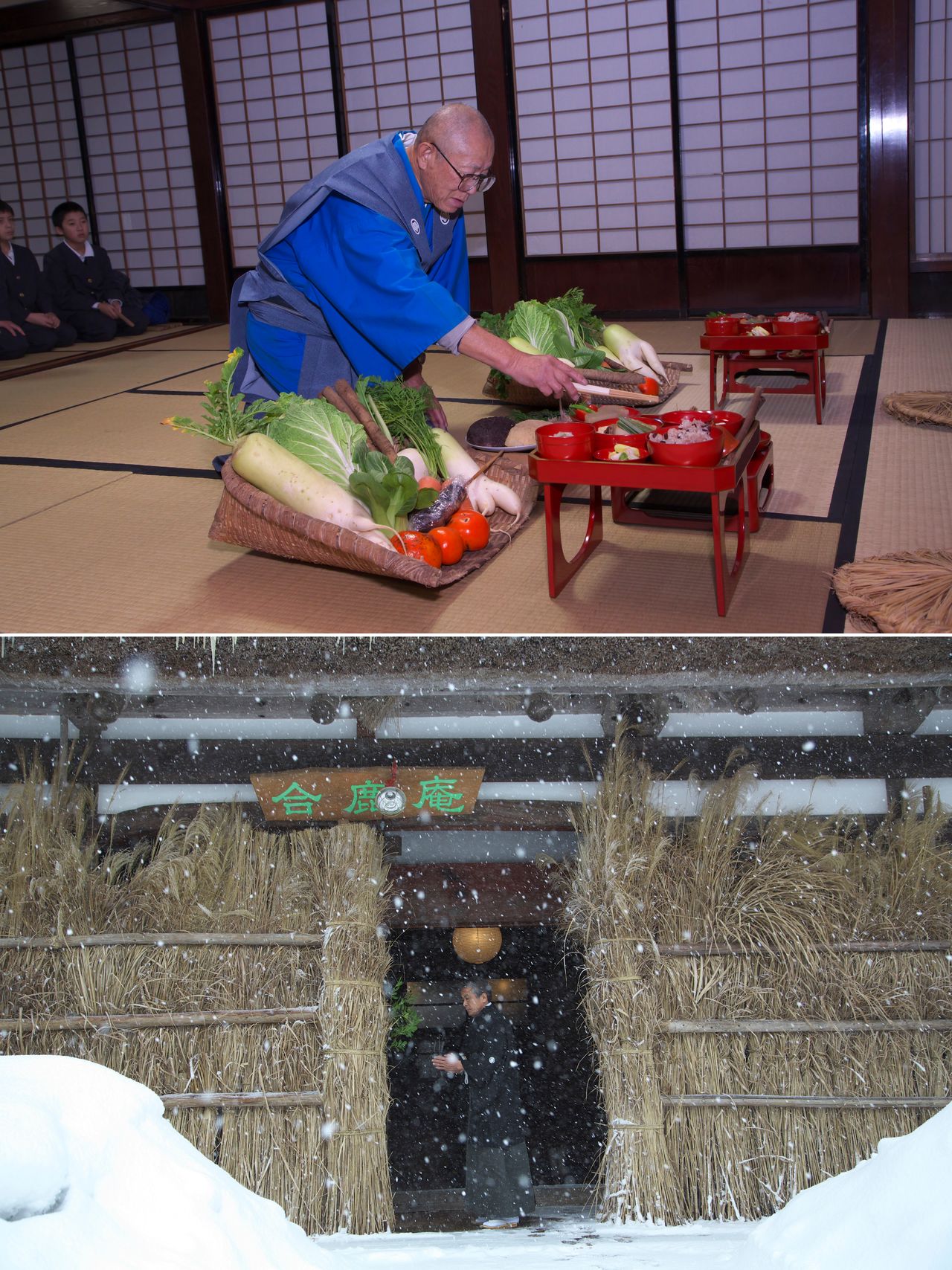
Aenokoto takes place on December 5 and February 9 at the Yanagida Botanical Park in the town of Noto. The old farmhouse on the site was damaged in the January 2024 Noto Earthquake. After a two-year hiatus, the ceremony is set to resume in 2026. (© Shimozato Kazurō/Haga Library)
Aenokoto was designated an intangible cultural asset by the national government in 1976 and selected as a UNESCO intangible cultural heritage in 2009. This stimulated scholarly and media interest in the rite, but for some local inhabitants, dealing with the attention generated proved to be overly time-consuming, or led them to place vague hopes in tourism to make up for poor harvests. Nonetheless, while aenokoto seems like an old-fashioned rite that has survived despite the travails of those who uphold it, it continues to evolve to meet changing times.
In my book, Yanagita Kunio to minzokugaku no kindai—Oku-Noto no aenokoto no nijusseiki (Yanagita Kunio and Modern Folklore Studies: The Oku-Noto Aenokoto in the Twentieth Century), first published in 2001, I traced the complex relationship between this so-called niinamesai of the people and the times in which it has been practiced. Preeminent folklore photographer Haga Hideo selected the center photo, which depicts aenokoto, for the book’s cover because of the unique position the rite occupies in the history of folklore research. Haga interpreted it differently, as the essence of a folk belief, in contrast to Yanagita Kunio, doyen of Japanese folklore, who believed that it represented a ritual akin to the imperial niinamesai rite.
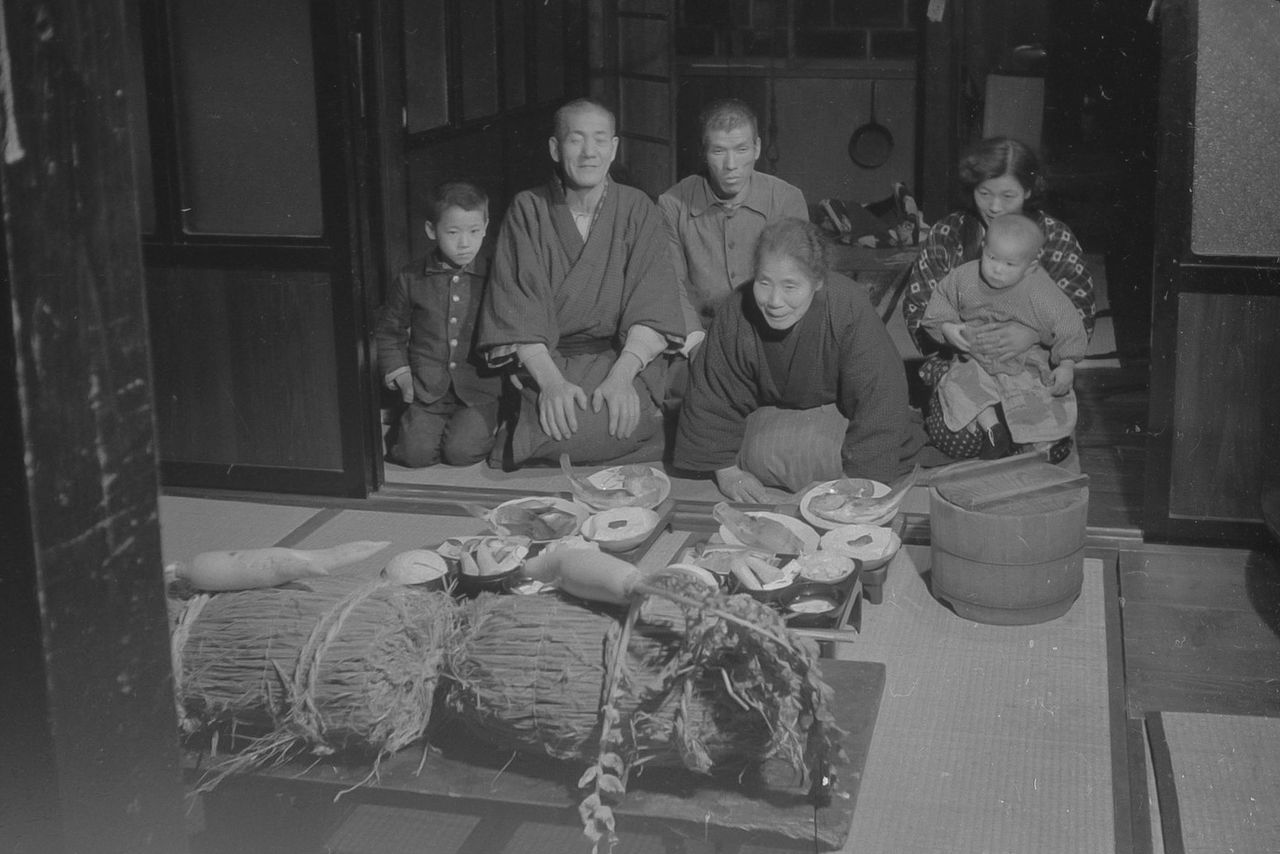
A family offers food and drink to the tanokami, represented here by bales of seed rice and a forked daikon radish. (© Haga Hideo)
Yanagita’s Interpretation of Aenokoto
Academic research into aenokoto began in earnest in 1934, led by Yanagita. Initially, Yanagita hoped to find material that would buttress his hypothesis on the rite’s significance. After completing research, he interpreted its name to mean “feast” and “ritual,” from ae and koto, but locally, it was simply called tanokami. At the time, there was just a single reference to aenokoto, but Yanagita selected that elaborate name to refer to the practice in general, because he needed something to support a certain supposition of his.
In 1951, the Allied Occupation authorities allowed research into imperial worship rites, which had been in abeyance since 1945, to resume. Sensing an opportunity, Prince Mikasa Takahito, a younger brother of Emperor Shōwa (Hirohito), founded the Niiname Research Society with Yanagita. The purpose of the society was to establish niiname as the raison d’être for the emperor system in cultural history terms, given that after the war Hirohito had proclaimed that he was not a deity in human form. That led Yanagita to develop the idea of ubuya (birth of the rice) as the source of Japanese identity, a belief in the rice deity that was identical among both the emperor and the people. Based on this, he drew parallels between aenokoto and niinamesai.
During the joint research in Noto carried out by the Federation of Nine Learned Societies, a cross-disciplinary grouping of scholars from various disiplines, from 1952 to 1953, researchers observed aenokoto as it was practiced in the field. Inspired by the Niiname Research Society, they noted that aenokoto had helped them picture how the niinamesai secret ceremony performed by the emperor was conducted. Furthermore, Yanagita’s son-in-law Hori Ichirō, a scholar of religion, reported that aenokoto had a religious dimension as a niiname ritual of the people. Hori’s paper was published in the Niiname Research Society’s academic journal, and Yanagita’s interpretation of aenokoto as a ritual thus took root.
It becomes clear that in later years, instead of proper research being conducted to clarify the nature of aenokoto, Yanagita’s imagined concept of the practice became mainstream orthodoxy. This strange development was also manifested in a visual image.
Around the time of the Niiname Research Society’s founding, a local folklorist had obtained a photo of aenokoto, which shows an older man in a kamishimo, a kind of formalwear sleeveless jacket worn over kimono, offering a ritual prayer. That was the first photo Yanagita had ever seen of aenokoto, and it was repeatedly used in publications issued by the folklore research society he headed.
But no one knew the circumstances under which the photo had been taken. I questioned the families of the photographer and of the man in the photo and learned that the photo had been taken in 1943, and that this aenokoto was a reenactment put on for military officers at a ceremony marking the opening of a local Imperial Army maneuvering ground. I also discovered that the man in the photo was Nomoto Kichitarō, who had been conscripted to transform aenokoto into a Shintō ritual, based on his experience acting as a proxy for the local Shintō priest, who. Thus, the photo had been taken in wartime, and whether Yanagita and his followers were aware of that or not, the photo had continued to be used to represent a folk version of niinamesai.
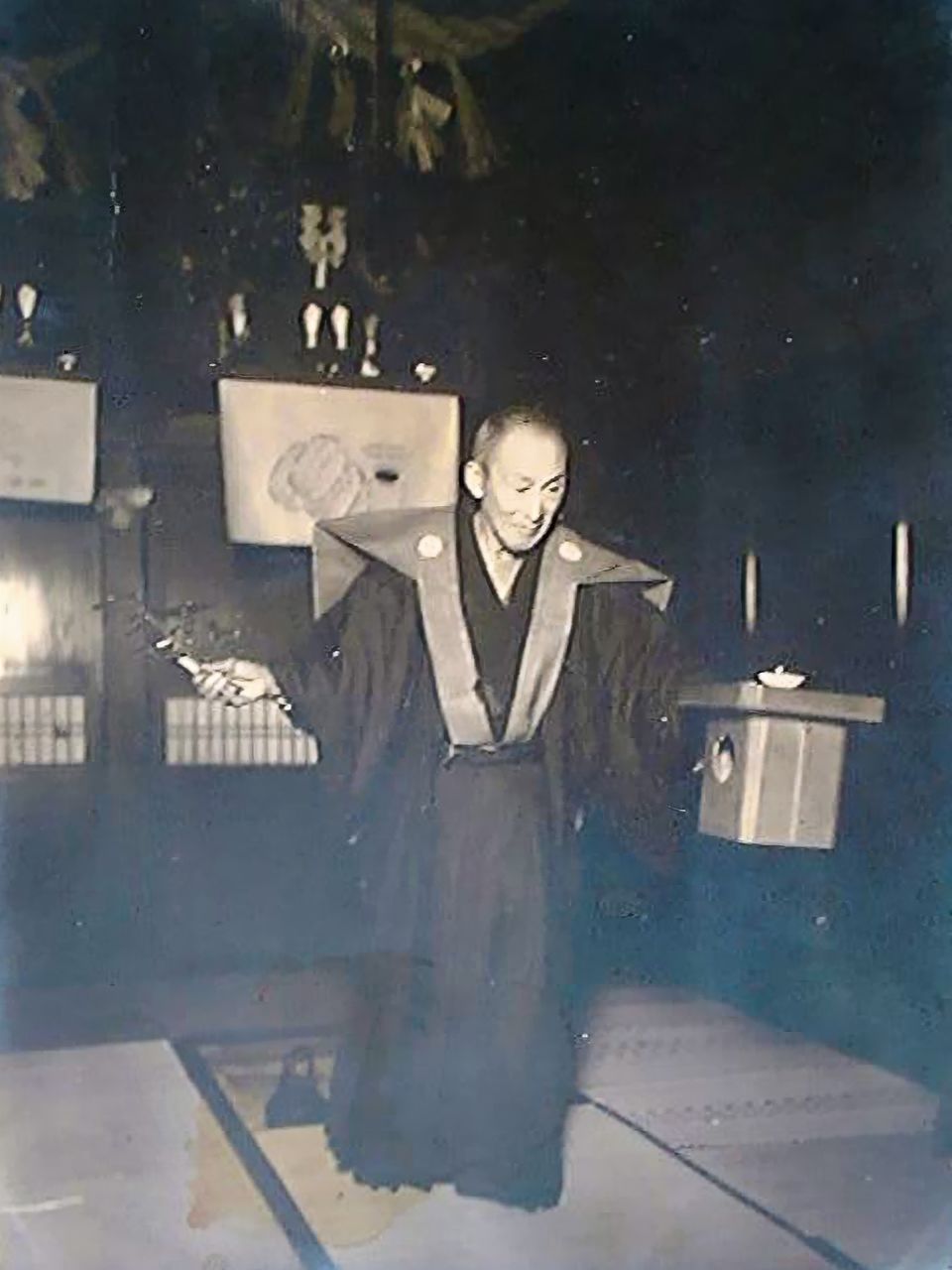
The photo of aenokoto seen by Yanagita for the first time. (Property of the Nomoto family/Courtesy Kikuchi Akira)
Highlighting the Simplicity of Folk Beliefs
Haga Hideo photographed the Nomoto family in 1954, around which time he began questioning whether that photo was an authentic representation of aenokoto. As he wrote in Tanokami: Nihon no inasaku girei (Deity of the Rice Paddies: The Rice Cultivation Rituals of Japan), “The manner in which the altar was set up, the offerings were displayed, and the ritual was performed in the home gave me the impression that the ceremony was very Shintō-like in character. It lacked the simplicity of folk rituals. When I asked the family about this, they expressed pride in having acted as the priest’s proxy during and after the war and said they believed that honoring the tanokami with a Shintō altar was a sacred calling.”
Haga had only just began his career as a photographer at the time, but he was nevertheless able to correctly interpret the special circumstances in which the photo had been taken, an issue that folklore scholars had missed.
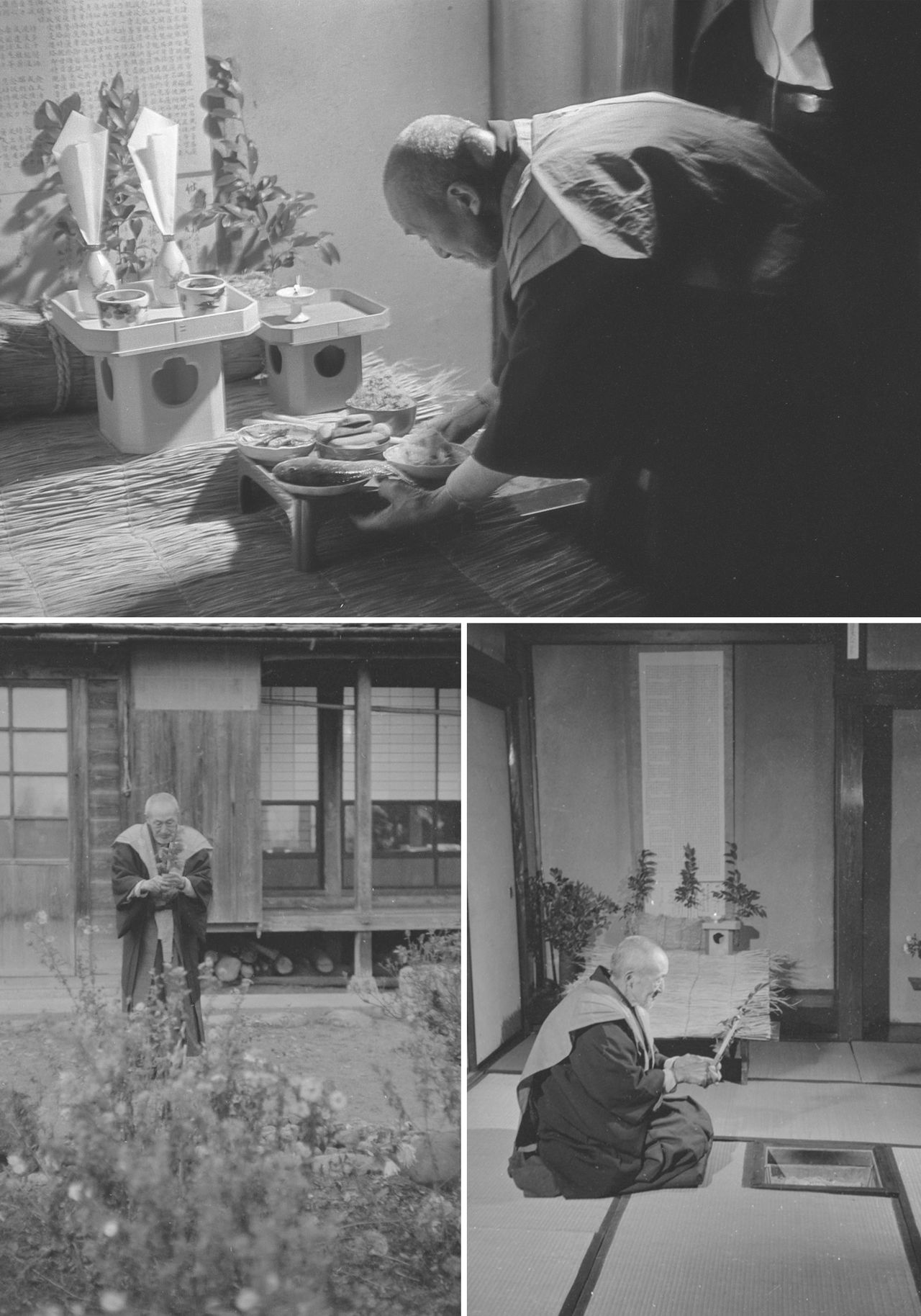
Aenokoto at the Nomoto home, photographed by Haga Hideo in 1954. (© Haga Hideo)
Haga began researching aenokoto more intensively in Hanami, a district of Noto. In Hanami, since the men were fishers, the women, who farmed the land, were the rite’s officiants. In contrast to the solemn atmosphere in the Nomoto home, in Hanami families carried out the ceremony wearing everyday clothing. Haga later told me that “Just as ‘folk’ implies, I felt that the rite conducted in Hanami was truer to the meaning of that word.”
Haga’s Tanokami book culminates with his photos of Hanami, which became some of his best-known works. Haga returned to Noto again and again, creating a priceless record of the region’s people and events: Wajima’s morning market, the Nafune festival’s gojinjo-daiko drumming and dancing, the ama female divers of Hegurajima, the Noto Nakajima Okuma Kabuto Matsuri in Nanao, and the rough-and-tumble Ushitsu Abare Matsuri.
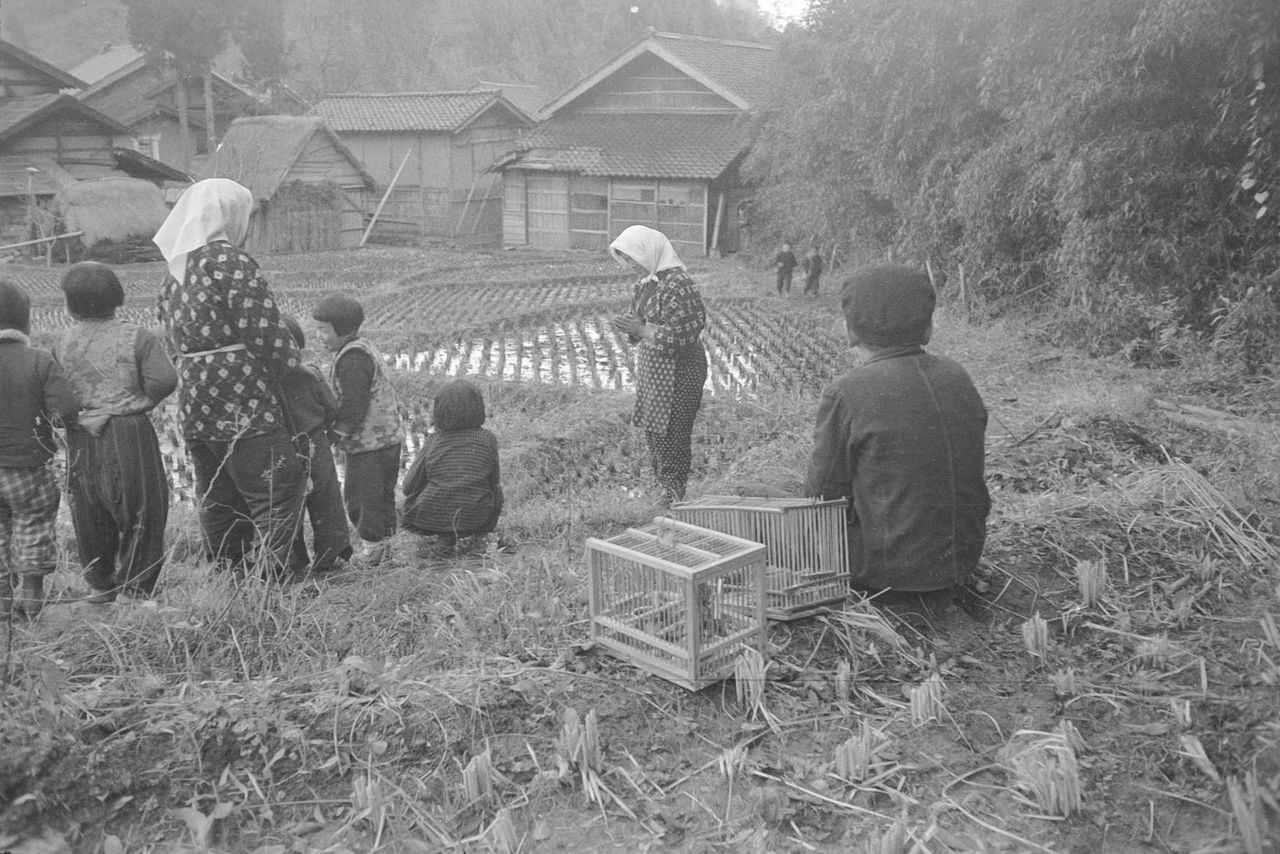
A Hanami district family welcoming the deity. (© Haga Hideo)
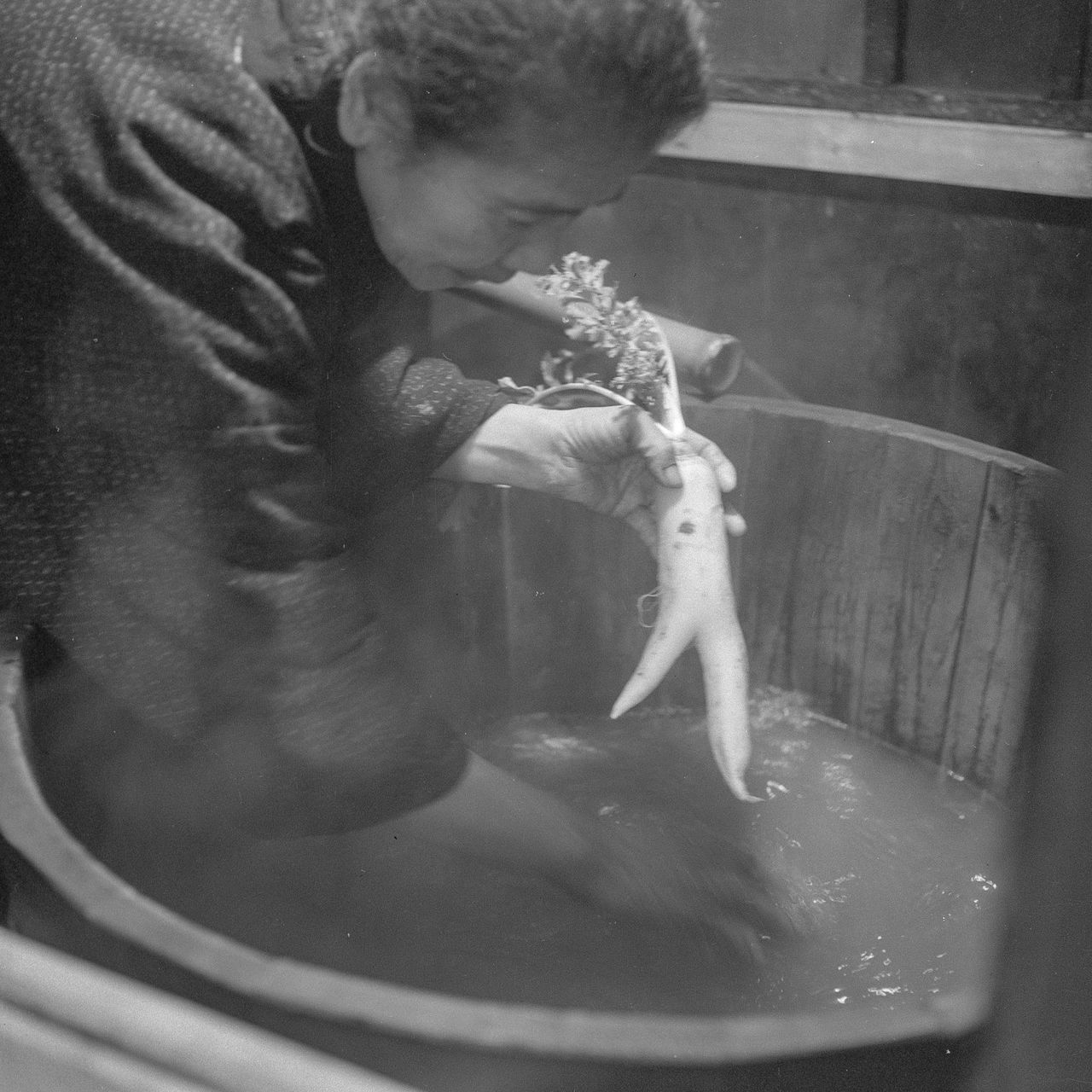
In this family, a forked daikon radish representing the divine spirit was bathed reverently. (© Haga Hideo)
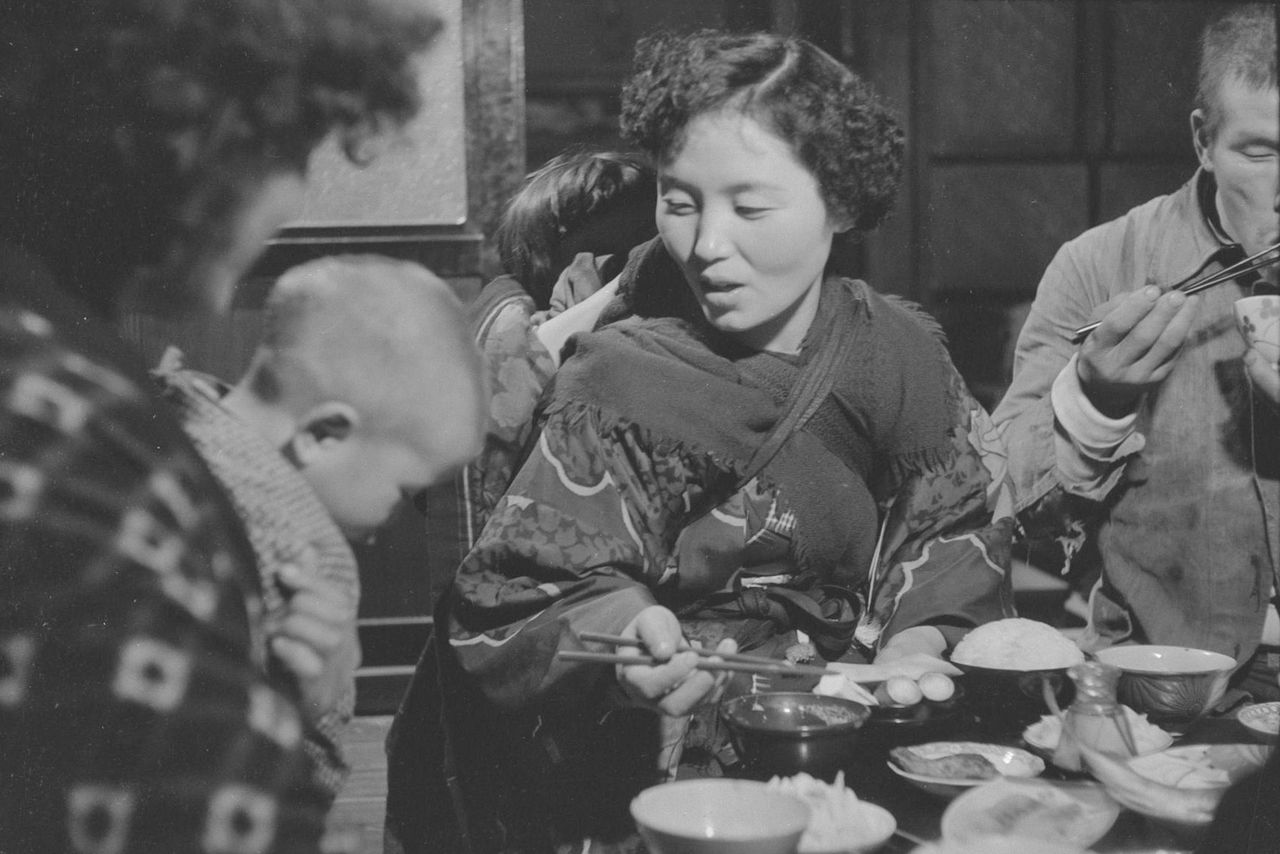
The family later partook of the food offerings to the deity. (© Haga Hideo)
Praying to Tanokami for Recovery
How has aenokoto fared since then? In the years after Japan’s rapid economic growth, Oku-Noto’s population steadily declined, farming was abandoned, and the keepers of traditional practices became fewer in number. But signs of revival have been apparent since such local folk practices were designated as intangible cultural assets by the government.
It is interesting to see that this ritual, which is practiced by individual families, has begun to be transmitted anew by communities or groups of interested parties. One of these, the environmental monitoring group Maruyama-gumi in Wajima, offers thanks by having the biodiversity of the satoyama rural woodland spaces stand in for the tanokami. One could call this movement a modern-day interpretation of aenokoto.
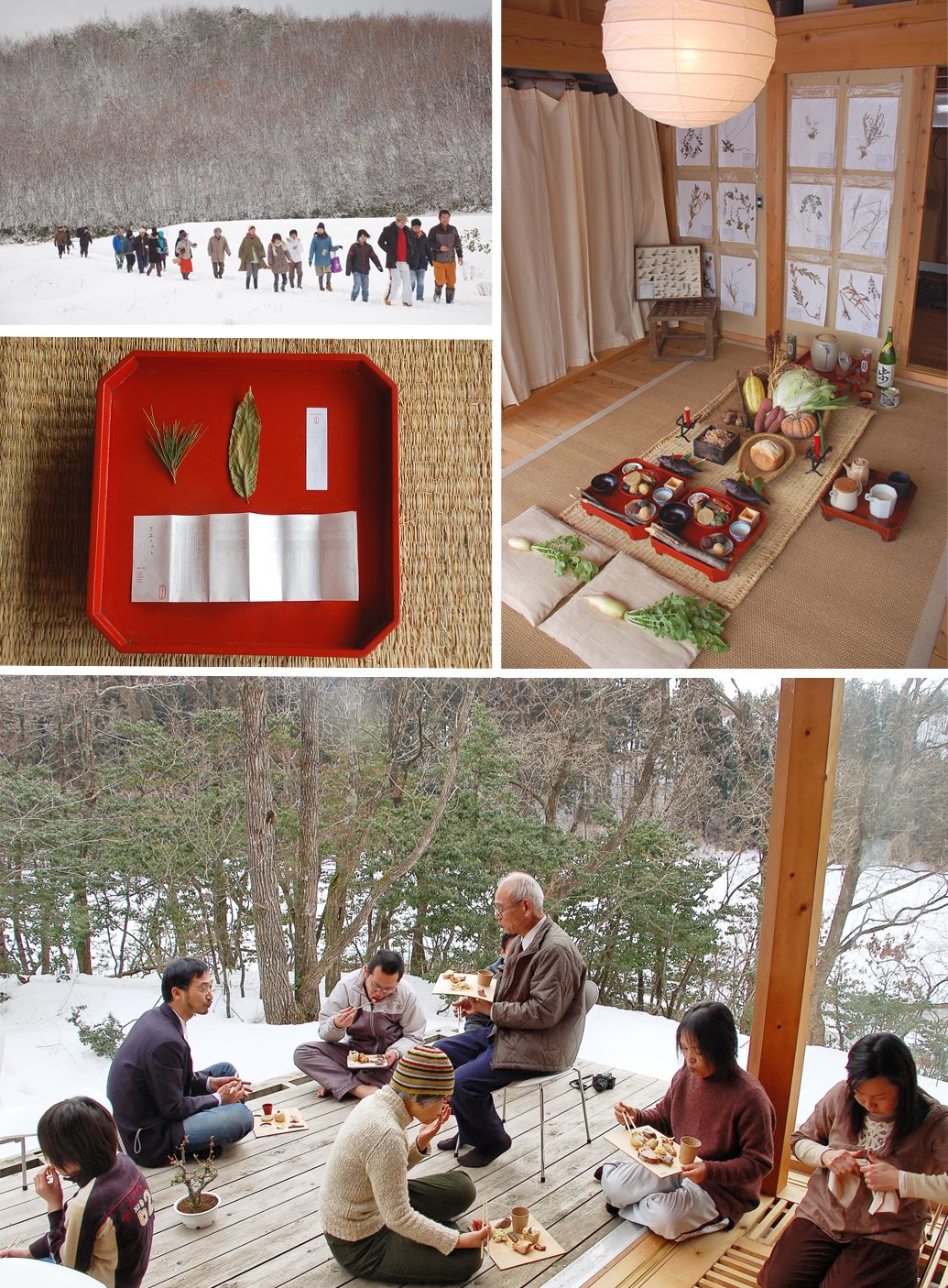
A group welcomes the deity in front of Maruyama hill, presenting a list of the living creatures monitored during the past year to represent the divine spirit. Offerings later enjoyed by the group included bread made from rice flour. (Courtesy Maruyama-gumi)
Misfortune struck the region when the January 2024 earthquake, followed by torrential rains later in the year, heavily damaged paddies, fields, and irrigation channels, crippling agriculture in many areas. This has delayed recovery, although perhaps because of the delay, some farming households seem to be placing a fresh focus on aenokoto. But the future of this practice also depends on how well agriculture and people’s lives can recover and whether inhabitants continue to live in the area.
Haga’s photos of aenokoto capture one family’s sincere devotions to the tanokami. Aenokoto has continued unbroken until now, and I hope the family’s prayers will be heard.
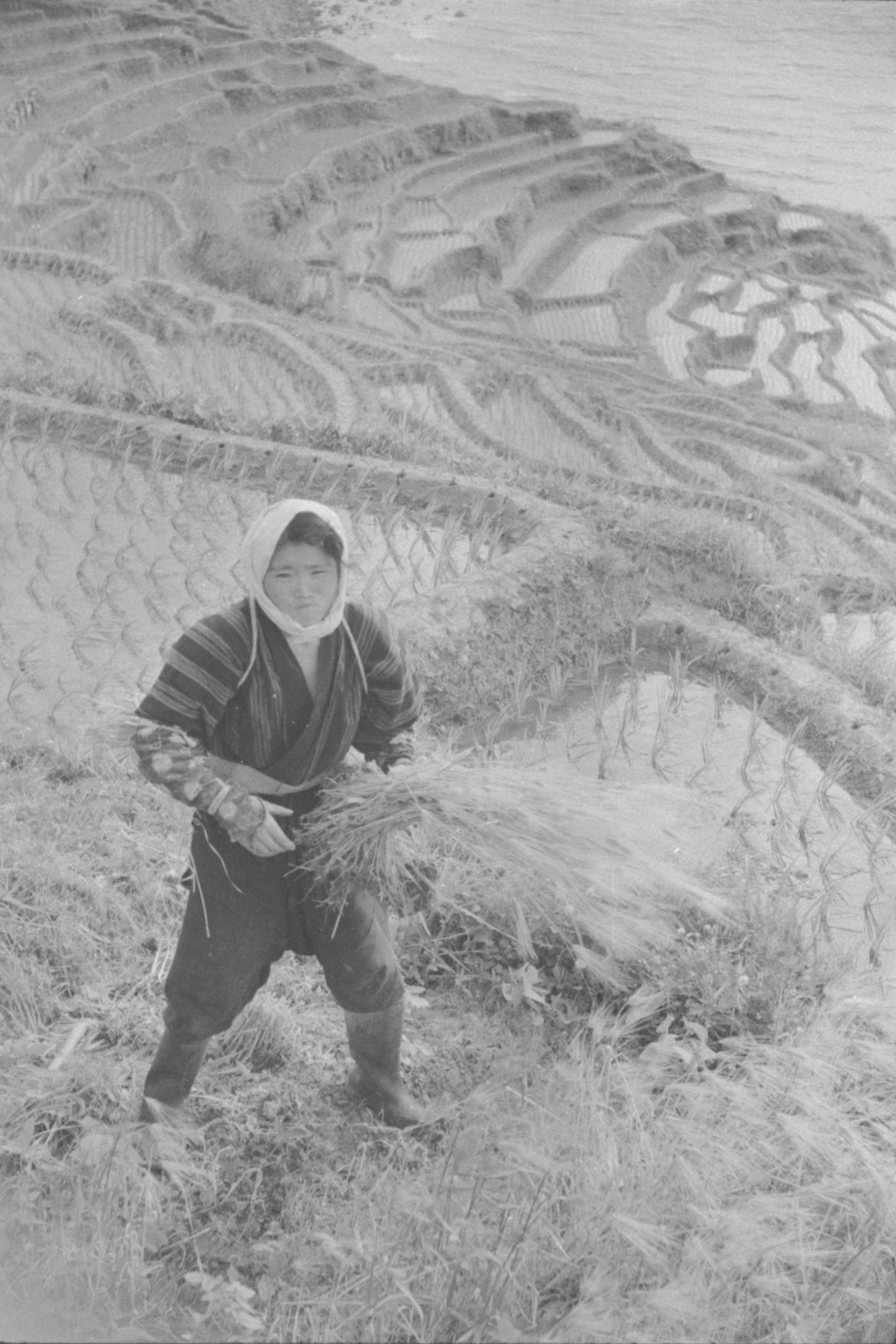
Harvesting rice at Shiroyone Senmaida, a steep hillside containing over 1,000 terraced rice paddies, in 1953. (© Haga Hideo)
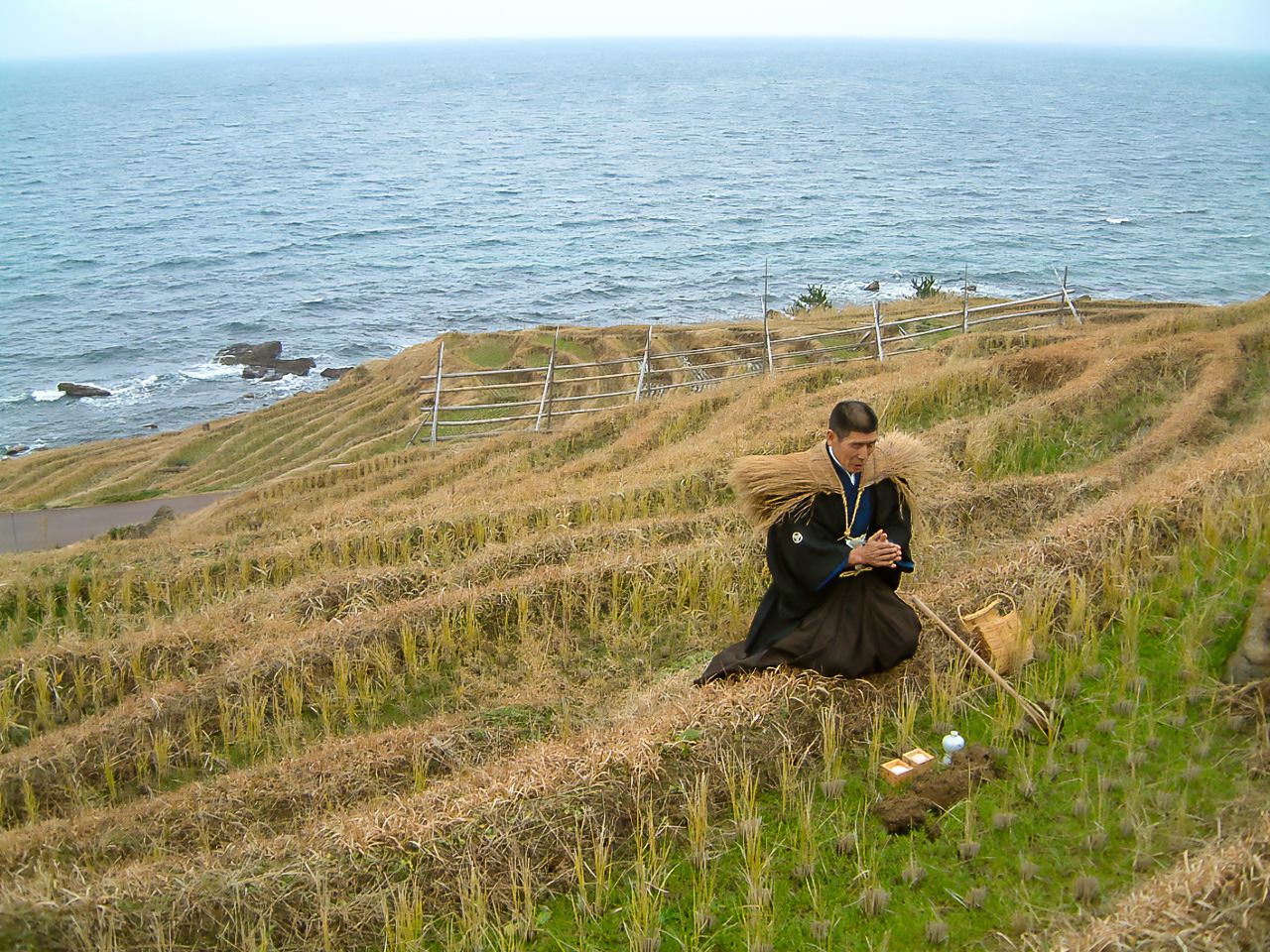
Welcoming the tanokami to Senmaida in 2002. The slope was heavily damaged in the 2024 earthquake, and restoration work is ongoing. (© Kikuchi Akira)
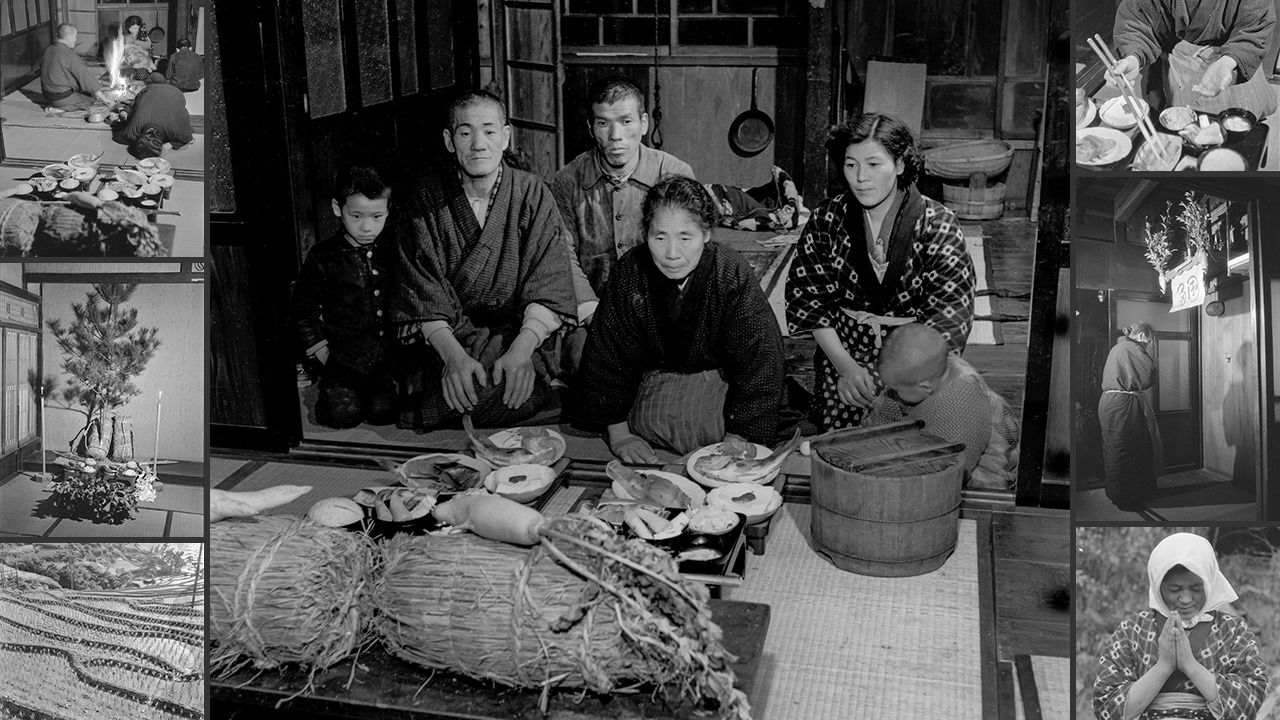
(Originally published in Japanese. Banner photo: The aenokoto rite in Oku-Noto in the 1950s. © Haga Hideo.)