The Songs of Japan’s Political Times: Lessons from Takaichi’s Historic Win
Politics- English
- 日本語
- 简体字
- 繁體字
- Français
- Español
- العربية
- Русский
A Record-High Seat Count—But Why?
“Songs change with the times,” goes an old Japanese proverb. The singer-songwriter Ōtaki Eiichi once explained the meaning behind these words as “it’s the people listening to music who create the hits.” It is, of course, the musicians creating the tunes and lyrics who actually put out the songs, but it takes the listeners to turn them into hits.
On February 8, when the Liberal Democratic Party under Prime Minister Takaichi Sanae took an astounding two-thirds of the seats in the House of Representatives election, my mind went to this old “songs change with the times” phrase. The listeners—the voting electorate, in this case—had produced an election result going far beyond anything imagined by the “songwriters” of the Nagatachō political heart of Tokyo.
There were, of course, other songwriters hoping to get a hit on the charts this time—politicians like Noda Yoshihiko and Azumi Jun, respectively the joint leader and joint secretary general of the opposition Centrist Reform Alliance going into the election. In the end, though, the listeners had little interest in their tunes, and the LDP won 316 of the 465 seats in the lower house, an all-time electoral record.
It should be noted, though, that the LDP numbers were not historically strong across the board. The party won 36.72% of the proportional representation vote, cast for parties instead of single-seat candidates. This was higher than the 34.66% taken by the party in 2021, when Prime Minister Kishida Fumio dissolved the House of Representatives and called a snap election soon after taking office, but it does not come close to the 38.18% won by the Liberal Democrats in 2005 when Prime Minister Koizumi Jun’ichirō triggered his “postal reform election” as a public referendum of sorts on his plan to privatize Japan’s postal services.
In short, when comparing the proportional representation votes, it appears that Prime Minister Takaichi’s popularity, as a means of buoying her party’s fortunes, is not at the same level as Koizumi’s just over two decades ago. Despite this, the Takaichi LDP took far more seats in 2026 than the Koizumi LDP did in 2005, due to the way that the single-seat contests skewed so heavily in favor of the ruling party.
An Opposition Merger Fails to Turn the Tide
One variable with an especially large impact this year was the shift seen in the support base of the Constitutional Democratic Party of Japan, which had been expected to flow to the CRA, formed by a merger of the party with Kōmeitō in January.
I began noticing this shift in the week beginning on January 19, when the results began appearing from a series of voter surveys covering electoral districts around the country. On January 16 the CDPJ and Kōmeitō had announced their merger, and most attention was focusing on how much of the latter’s traditional support base could be counted on to back the new party. As reports began trickling in from the districts nationwide, it became clear that in most of them, LDP candidates were in the lead in polling, and CRA candidates were having trouble finding their footing.
Looking deeper into trends among the supporters of each political party, I found that on the whole, unaligned voters were leaning heavily toward LDP candidates. This is not an especially surprising discovery, given the high approval ratings that Prime Minister Takaichi has enjoyed even among nonaffiliated voters, but it was odd indeed to see how even in districts where the CDPJ had traditionally been strong and the CRA candidates had firmed up support among the backers of that previous entity, the LDP appeared to be running away with the popularity race. Digging deeper into the data, I realized that voters who had selected CDPJ candidates in the 2025 House of Councillors election were not relocating to the new CRA camp.
This was nothing less than the beginning of a meltdown among the CDPJ’s supporters. And as Japan entered the campaigning leading up to the February 8 contest, the phenomenon only picked up momentum.
On February 2–4, just past the middle of the official campaign period, the election information website operator Senkyo Dot Com and JX Press, my firm, carried out a nationwide opinion survey. In it we found that of voters who had picked a CDPJ candidate in the 2025 upper house contest, just 55.7% of them planned to cast their PR ballots for the CRA in the upcoming lower house election. Just a few weeks earlier, on January 17–18, the same query had found a figure nearly 7 percentage points higher, at 62.2%. This presented a contrast with behavior among supporters of the former Kōmeitō, who showed a deepening dedication to the CRA over this same period; as time went on, more and more CDPJ supporters appeared to be defecting from the newly formed party. An outcome of all of this was media coverage showing that the LDP was picking up steam as it moved from the launch to the final stages of the election campaign, while the CRA was headed in the opposite direction.
Brutal Results for the Former Opposition Leader
After the dust settled on the House of Representatives election, losing candidates on the CRA side and political journalists spoke about the “split opposition”—in particular the counterproductive competition between candidates from the CRA and the Democratic Party for the People, or DPFP—as a reason for the defeat. A look at the numbers, though, shows this line of thinking to be somewhat misguided. The CRA ended the election down a full 123 seats from the total held by the CDPJ and Kōmeitō prior to voting, but there were only 46 single-seat districts where CRA candidates went head-to-head against DPFP opponents. This number clearly cannot account for the entirety of the losses suffered by the CRA.
This is underpinned still more by the fact that in districts where CRA and DPFP candidates had managed to avoid facing off against one another, there was a trend for prior DPFP supporters to opt for LDP candidates at an even higher rate than for CRA options. Conversely, a considerable number of CRA supporters cast their votes for the DPFP when their own party fielded no local candidate. The result was dramatic: As of 8:00 pm on February 8, when polls closed, exit polls pointed to zero single-seat districts nationwide where CRA candidates were on track to win, while the DPFP already had four seats lined up. A look at Saitama Prefecture tells a similar tale: While the LDP took all 16 of the single seats there, districts 13 and 14 were the only ones where an opposition candidate came close, gaining over 90% as many votes as the winning candidate—and both of these were from the DPFP.
In recent years the CDPJ has led the opposition in its cooperative efforts against the ruling coalition. The newly formed CRA evidently hoped there would be a “mutual nonaggression pact” of sorts between it and the DPFP, but it turns out that politicians on their own—“musicians,” to build on the metaphor from the beginning of this article—clearly cannot count on their composition skills, coordinating candidates among different opposition parties in single-seat districts, to win the hearts of voters. In a district with just one seat to award, a broad selection of non-LDP candidates will result in none of them victorious over the LDP choice. And just as unfortunately for those candidates, whether the CRA partners with Kōmeitō or the DPFP, the mere act of joining opposition forces together is also not enough to convince voters to choose them. Perhaps the lesson has at last been learned that the manner of joining forces is also an important factor to consider.
In the end, Noda, Azumi, and the other “songwriters” of the CRA were unable to produce a hit song by simply adding the opposition parties together, and the charts were topped by the megahit put out by Takaichi Sanae instead. Election success can no longer be crafted by the crowds of musicians in Nagatachō—the songs are changing with the times, just as the times change with the songs.
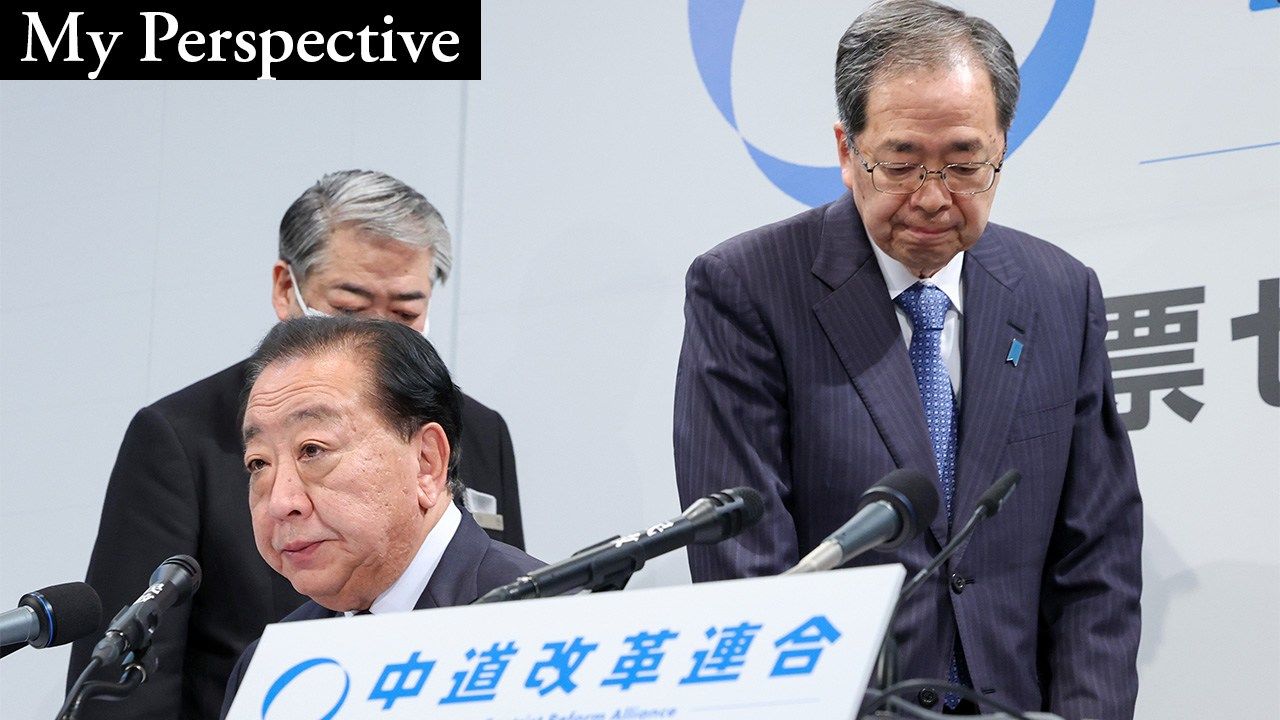
(Originally published in Japanese on February 17, 2026. Banner photo: The coleaders of the Centrist Reform Alliance, Noda Yoshihiko [seated at left] and Saitō Tetsuo [right], prepare for a television appearance on the night of February 8 as the dismal reports roll in for their party. © Jiji.)