Dismantling of USAID Impacts Refugees in Uganda
World- English
- 日本語
- 简体字
- 繁體字
- Français
- Español
- العربية
- Русский
Uganda’s Helping Hands
In January 2025, shortly after the commencement of his second administration, US President Donald Trump announced that the US Agency for International Development, the national foreign aid agency, would be dismantled. This forced the immediate cessation and exit of numerous aid projects worldwide, simultaneously leaving over 250,000 aid workers unemployed, according to one tracking website.
For the many people who rely on support from USAID, the move left their very lives in jeopardy. This has also been the case in the Republic of Uganda, where I operate a business. Uganda, which according to some publicly available figures was the fifth largest recipient of USAID support worldwide, is experiencing devastating impacts nationwide.
Uganda receives tremendous levels of aid due to the large number of refugees within its borders.
Before the current Ugandan president, Yoweri Museveni, was sworn into office in 1986, the country suffered years of upheaval, with many Ugandans seeking refuge abroad. The Museveni administration now accepts refugees from neighboring countries out of gratitude for their past kindness. Consequently, Uganda now hosts roughly 1.9 million refugees from countries including South Sudan, the Democratic Republic of the Congo, and Eritrea.
This is far in excess of Japan’s refugee intake. Furthermore, Uganda has an “open-door policy” that affords refugees the same rights as citizens. The government grants them with land to encourage residency, and guarantees the minimum rights required to live in the country. It allows refugees freedom of movement and the right to work, and provides education for their children.
Foreign Aid as a Lifeline
But the country cannot provide this support unaided. Consequently, the dismantling of USAID significantly impacts the government and refugees. Most notably, the Ugandan government immediately halted the provision of monetary coupons. Previously, refugees received coupons each month worth 28,000 Ugandan shillings (approximately ¥1,200). Many families who relied on this support are now forced to survive on one meal a day, and are unable to send their children to school or receive medical treatment. Some refugees from South Sudan have forsaken life in Uganda, returning to their homeland, despite political instability there.
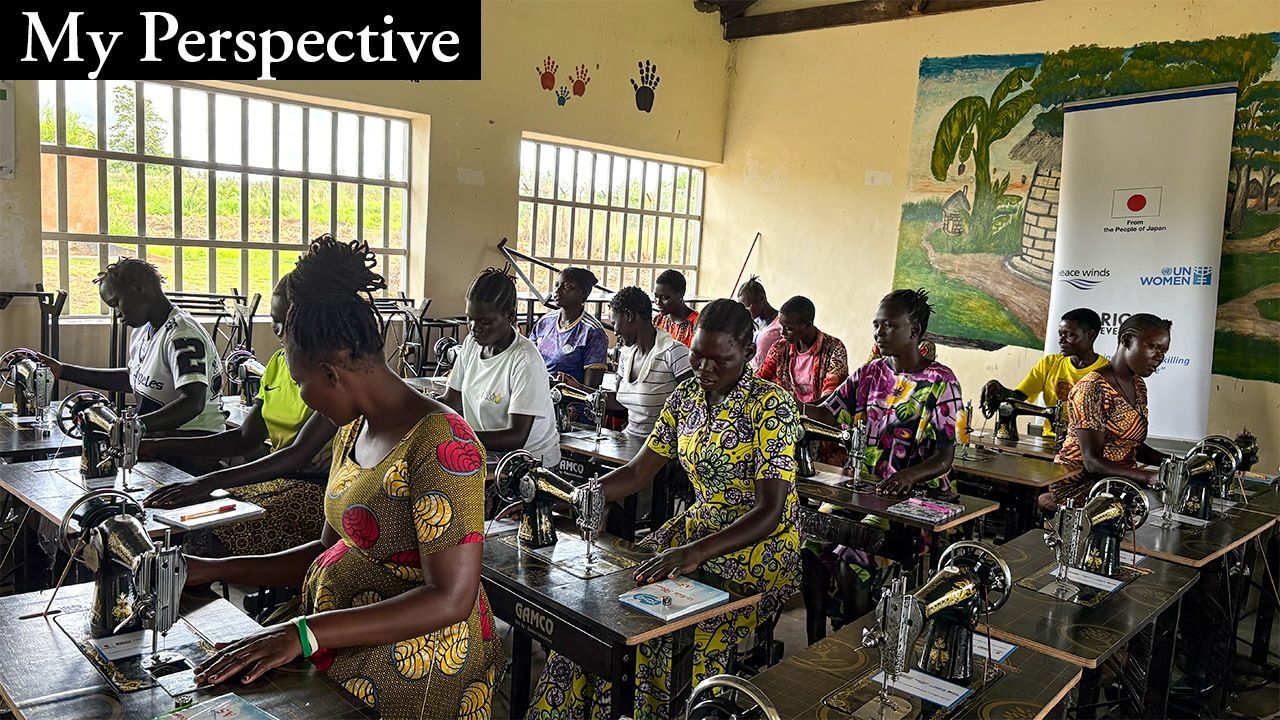
The company I manage, Ricci Everyday, currently operates a project through a consortium involving the United Nations Entity for Gender Equality and the Empowerment of Women (UN Women) and the international NGO Peace Winds Japan. It provides work experience for South Sudanese refugees living in northern Uganda and members of the local community. By giving them more advanced sewing skills and marketing knowledge, we aim to equip them to sell products not only at local markets, but also in the national capital and globally. The project applies our accumulated experience for assisting refugees.
Sewing and handicrafts fundamentally differ from other industries. Materials are easy to obtain, and require minimal initial investment. For refugees with little funding, this lowers the barrier for entry into business. The work is labor-intensive and the finished product is tangible, which gives a sense of satisfaction. Furthermore, sewing and handicraft skills can secure high returns, providing an effective means to secure a living.
The establishment of craftsmanship provides other benefits for refugees.
Acquisition of skills can offer a path to financial independence, and in addition, creating items by hand and gaining positive customer feedback can help renew self-confidence. When refugees gain an income and engage with the local community, it enhances social cohesion. Working with one’s hands also improves mental health.
Finally, leveraging traditional artistry connected to people’s roots helps individuals to preserve and strengthen their identity despite being separated from their homeland. Handicraft is more than simply “work.” I believe it is a simple yet powerful means to enable refugees to live with dignity.
(Originally published in Japanese on May 22, 2026. Banner photo: Women participating in a work experience project in northern Uganda. © Nakamoto Chizu.)